In The New York Times

Played with Nous Non Plus last night at the Paris Paris, a disco on the Avenue de l’opéra that features bands a few nights a week. Needless to say we performed our “(I Want to Spend a Night in) Paris,” a song about Paris Hilton, at the Paris Paris in Paris.

Paronomasia aside, I awoke this morning to read about Lini Lambrusco (wines that I love) and see myself quoted in Eric Asimov’s weekly wine column in The New York Times.

Catering at Francofolies

jar_driving.jpg

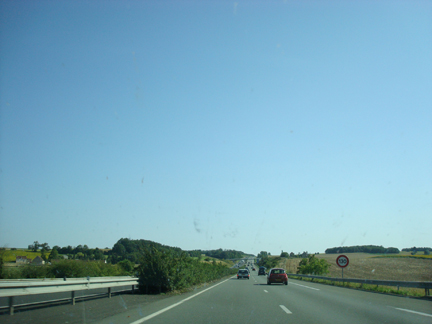
We drove this morning from Vosne-Romanée to La Rochelle, a journey that took us back up toward Paris on the A6, then over to Orléans, and then on the A10 to Tours and down to La Rochelle (not far from Bordeaux).

cross_country.jpg

The trip took us through the “heartland” of French agriculture and then through the Loire Valley, where we could see signs for (but could not stop at) Chinon, Saumur, etc.

Just outside of Tours we stopped for gas at a rest stop and by chance we happened upon the other members of Nous Non Plus.

We were met in La Rochelle by our handlers Pierre and Pascal from Scène et Public, our agent for France and Europe, who had booked us at the Francofolies festival. After a long day of traveling, everyone was hungry and Pascal was raving about the catering tent behind the mainstage. We checked into our hotel and made our way through La Rochelle, which was in full party mode, with musicians (buskers and festival performers) everywhere.

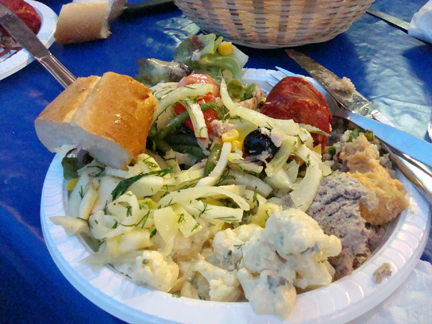
When we arrived at the tent, even the French among us (including Patrick Woodcock of Mellow, Céline Dijon’s boyfriend) agreed that the spread was the best “catering” they had ever seen at a music festival: summer salads, freshly shucked oysters, fish loaf (which I loved), couscous, saffron rice, a cheese board… amazing… (N.B.: the French use the American word “catering” which they pronounce KAH-tehr-eeng.)

catering.jpg

I was happy to eat a meal lighter than my typical Burgundian repast!

rose_rochelle.jpg

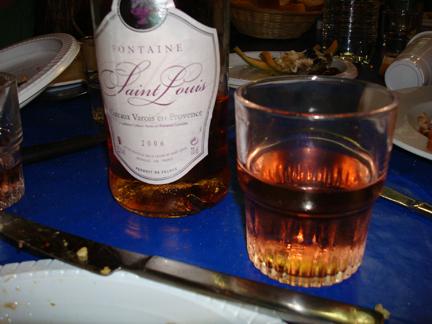
It was also nice to drink something a little less demanding on the palate, like the Provençal rosé they served.

I had a great time talking about wine with Pierre and Pascal. Nearly everyone I meet here knows and appreciates wine, although Pascal is not a fan of Italian wine. The French seem to know only Sicilian wine (and occasionally they’ll tell you that they like Lambrusco).

everyone_chewing2.jpg

Above, from left, Céline Dijon (Verena Wiesendanger), Bonnie Day (Emily Welsch), François (our sound guy), Pascal (our handler), François Hardonne (David Griffin), Prof. Harry Covert (Greg Wawro).

Halfway through dinner, a huge storm exploded over La Rochelle and everyone poured into the main tent to escape the rain. The tent was transformed into a fantastic party (you can imagine). At a certain point, an African group started up a contagious rhythm by banging empty wine bottles on the tables and the whole tent broke out in song led by the group’s lead singer… A smoke-filled tent of happy happy people, their bellies full of wine.

Despite the rain, the festival went on, and I caught the tail-end of the closing set by ex-tennis star Yannick Noah, who closed the penultimate night of the festival on the main stage. Man, that guy can work a crowd…

A Wine Older than Me: Spanna Colline Novaresi VdT 1958 Vallana

Opening fifty-year-old wine with fellow forty-year-old and friend Jeff Grocott at Morandi.

Spanna VdT 1958 Vallana

A few weeks ago, good friend and fellow child-of-the-Summer-of-Love Jeff Grocott proposed that we drink a bottle of old Spanna by Piedmontese (Novarese) producer Vallana to celebrate the near completion of our nearly four decades on the planet. Jeff, a page-one editor at the Wall Street Journal, wrote a number of wine features and tasting notes when he was an editor at the WSJ Weekend Section. You have to subsribe to the WSJ online edition in order to browse/search old articles but you can find some of Jeff’s articles on the web. His story on wine storage, which appeared in syndication, is one of the most popular and it offers some interesting and solid insights into the myths/truths of cellaring. Jeff and I met a few years ago when I was doing media relations for a NYC wine merchant and have since opened and enjoyed many bottles together, including a Barolo Riserva (Red Label) 1990 Giacosa that my friend and colleague Jim Hutchinson generously poured for us in his apartment last winter (served with a Coda alla Vaccinara that Jim had cooked all day in his crock pot).

Jeff, who lives in the village with his wife Barbara, had spied the Spanna 1958 Vallana at the relatively new Morandi on Waverly at Charles St.

We were both reluctant to open such an old bottle at a place like Morandi: similar to the ever-popular Da Silvano, Morandi is a glamorous, star-studded (see our celebrity encounter below), pseudo-trattoria New York City cafeteria — not exactly the place you think of when it comes to old wine. The bottle was reasonably priced but what was its provenance? how had it been stored? what kind of wine service would we find at a bustling downtown “feed-em-and-turn-the-table” eatery on a hot July evening?

While the food at Morandi was unremarkable (typical greasy but well-dressed downtown Italian), the wine list offered some interesting Nebbiolo options, including a Barbaresco 1988 Produttori del Barbaresco magnum at a good price. I was also impressed by the Ligurian whites on the list and a few labels from Basilicata, unusual for a restaurant where wine-savvy diners are unlikely to be found.

Jeff Grocott and Rosario "Roy" Marino

Above: sommelier Rosario “Roy” Marino (right) tasted with me and Jeff (left).

As it turns out, where were greeted by Rosario “Roy” Marino, a Salerno native, who gave us a great table in the back, had set the bottle upright (at Jeff’s request) the night before, and produced excellent Burgundy-style crystal glasses and a crystal decanter for our table (before opening the Vallana, we ordered a glass of Donnas Rouge from Val d’Aosta, which Roy poured in the restaurant’s standard glass stemware).

Novara is a lower-lying, wine-producing zone found to the east of the Langhe Hills (Piedmont) were the more famous Barolo and Barbaresco appellations are produced. The Spanna DOC was created in 1969. In order for the bottle to be labeled “Spanna” (Spanna is the Novarese name for Nebbiolo), it must contain at least 85% Spanna (Nebbiolo). This wine was made before the DOC existed and thus was labeled vino da tavola (table wine; see label detail below).

Judging from the newish cork and clean label, the Spanna Vino da Tavola 1958 Vallana had been recently rebottled (and probably topped off with a little bit of new wine, as is the custom among many Piedmontese producers who keep reserves of older wine in their cellars).

Spanna has often been cited by wine experts (including the great Shelly Wasserman) as one of Italy’s greatest aging wines. Many people think only of Barolo (and Barbaresco) as cellar-worthy Nebbiolo. In fact, Nebbiolo grown in the Langhe was not labeled as Barolo until Ratti’s legendary 1971 bottling, while Spanna, Gattinara, Grumello etc. had already achieved fame as long-lived wines in the 1960s (for those who read Italian, I found this informative and moving account of drinking a bottle of 1964 Spanna discovered in the mud by rescuers in the aftermath of the 1969 flood in Novara).

I believe that Spanna’s longevity can be attributed — at least in part — to the addition of smaller amounts of less tannic, more acidic grape varieties. Vespolina and Bonarda other grapes are allowed in the appellation. Many have pointed to Antonio Vallana’s blending skills as the secret behind his remarkable wines.

The wine was fantastic: after the initial stink dissipated (not uncommon in wines this old), the nose opened up beautifully and the wine had gorgeous fruit, nice acidity, and perfectly softened tannins. The 1958 harvest is considered one of the great twentieth-century vintages for Piedmont and this nearly-fifty-year-old wine was powerfully elegant but retained some of the rustic character that you find in the naturally and traditionally made wines from Novara. We enjoyed it thoroughly.

As we were paying and preparing to leave, a party of three was seated next to us. Jeff discretely told me, “turn around and look who is sitting next to you.” Little did I know but the Edge was rubbing elbows with me. Wow… He was dining with two young women (I imagine one was his daughter). I wonder what they drank. I’m sure that Roy took very good care of them.

Vallana Lable Closeup

Old Spanish at Il Buco

Centovini_Spuntino

Above: the Spuntino Reggiano at Centovini (photo by Winnie).

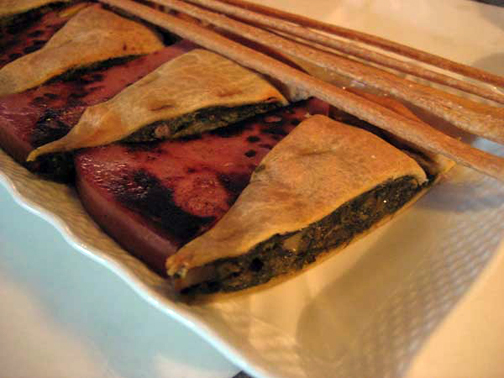
Last night began with a Spuntino Reggiano at Centovini with my colleague Winnie. The Spuntino Reggiano (a “snack in the Reggio Emilia style”) is a dish inspired by a visit I made with our colleague Jim Hutchinson to Correggio where we discovered the Lambrusco of Vini Lini. The snack consists of grilled mortadella wedges (which were awesome) and erbazzone (called “torta di verdura” here), a Swiss chard and Parmigiano-Reggiano pie which benefitted from chef Patti Jackson’s amazingly light and tasty pie crust. We paired — of course — with a glass of Lambrusco Labrusca Rosso 2006 from Lini. The fresh wine tasted great after a way-too-hot day in NYC.

From Centovini, I walked over to Il Buco where I met my good friends Mitzi and Flip.

Flip is one of the world’s greatest luthiers (not kidding… see below): he and I met through our mutual friends, the band Hello Stranger, with whom Nous Non Plus has done a lot of shows in NYC as well as touring.

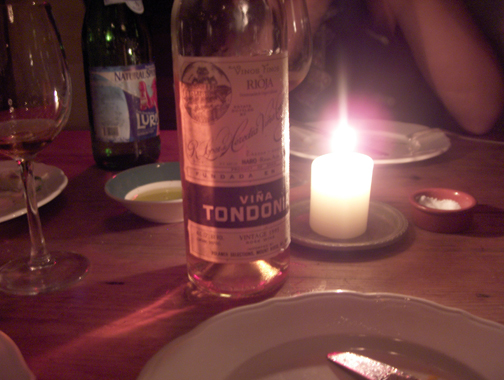
Despite her concern that the wine would be too oxidized for our palates, our waiter brought us a bottle of Rosado 1995 by Lopez de Heredia. I can understand her reluctance: old rosé from Spain is not everyone’s cup of tea and does not have the fruit forward mouth and nose that blush lovers expect. I do find it strange however — and this happens a lot — that waiters and sommeliers tell people the wine is “oxidized.” I know what “oxidized” means and I like oxidization in certain wines (when it is intended by the winemaker). But I can’t imagine that the term means much to unititiated wine drinkers. Couldn’t she have said something like “the wine won’t have the fruit that you might expect from a rosé”?

Rosado_at_il_Buco

I love Lopez de Heredia and drink and buy the wines when I can find them. The 12-year-old rosado was bright and full of life, had structure, and a rich nose. It went well with the octopus and potatoes — a favorite dish there.

The wine director at Il Buco, Roberto Paris, and I have been friends many years and he always surprises me with the bottles he opens for me. He had given us my favorite table, where we had a great view of Sandra Bernhard‘s table (I’m a fan and couldn’t help to do a little star-gazing). We were thinking about doing the 1987 Rioja from Lopez de Heredia but Roberto promised he had something special that he knew we would love.

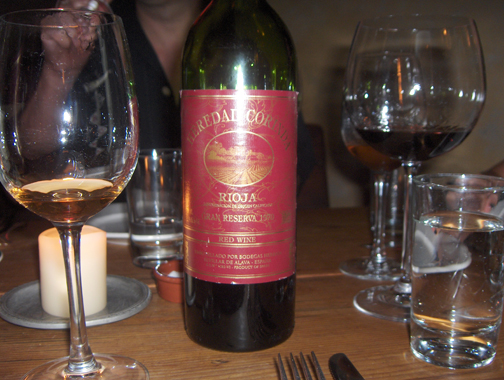
Heredad_Corinda_at_il_Buco

He disappeared and came back a few minutes later with a wine that “no one orders because they don’t know it”: Heredad Corinda Gran Reserva Rioja 1970 (embotellado por Bodegas Herbasa) — yes, 1970!!!. Flip and I particularly enjoyed the nose of this wine and in the mouth, it was rich but so light. Roberto’s wine knowledge is fantastic and we were all blown away by the wine, paired with some goat’s and cow’s milk cheese and prosciutto.

By the end of the night, the conversation had turned to Flip’s work and the many famous guitars he’s worked on over the years. I had been waiting to ask him about Paul McCartney’s 1963 Hofner bass, “the most famous guitar in the world,” as Flip put it. He worked on it some years ago.

“They flew it out to NY on the Concord,” he said. “It had it’s own seat on the plane and its own bodyguard,” who, evidently, remained in the guitar’s presence the whole time Flip worked on it. Flip also recommended seeing Will Lee’s Fab Faux Beatles cover band, which, he said, plays amazing versions of tracks from the White Album.

Tasting with Richard Parsons at Porter House

Dining with the rich and powerful in NYC.

Last night I attended a dinner for roughly 40 persons in a private room at Porter House in the Time Warner Center at Columbus circle. Time Warner CEO Richard Parsons sat at the head table and guests tasted 9 bottlings of his Brunello di Montalcino Il Palazzone. Richard’s wife Laura Parsons and Washington insider Vernon Jordan also attended, not to mention the sommeliers, wine directors, and general managers of a number of top NYC restaurants (Babbo, Esca, Felidia, San Domenico, Four Seasons among others). I had been invited by my friend Amanda de Leon, who is president of Il Palazzone. Richard Parsons and his wife dine regularly at I Trulli and he and Ron Lauder often lunch at Centovini (two of the businesses for which I do marketing).

One of the most fascinating elements — to my mind at least — about working in the New York City restaurant scene is how the allure of fine dining and the aphrodiasic of money and power bring together some of the most unlikely bedfellows. On the one hand, between Vernon Jordan and Richard Parsons, I broke bread with two of the country’s most powerful dealmakers and Washington insiders. I exchanged pleasantries with Mr. Jordan who sat with Amanda and chatted briefly with Mr. Parsons about I Trulli. I can’t imagine any other context where I would come into contact with such luminary figures. On the other hand, after working as a writer/copywriter in New York for the last ten years, I have seen some of the more unsavory sides of the city’s restaurateurs and wine merchants. Working in the wine and restaurant business in NYC is kind of like being in the mafia: the overblown egos and the intense competition create a sort of kill-or-be-killed working environment. Politicians and powerbrokers like to eat well and perhaps more than anything else, like to feel like they are restaurant insiders. Restaurateurs like to feel like they have access to power. Having seen some of those restaurateurs and wine merchants up close, I find them strange bedfellows.

But what really blew my mind about the dinner was how Il Palazzone’s enolgoist, Paolo Vagaggini, stood up and told the party — first in broken English and then in Italian — that the Palazzone winery “respects and reflects the tradition of Brunello and makes a very traditional wine.” In fact, the wines are very modern in style: very fruit driven and concentrated, oaky and high in alcohol. What tradition is he talking about? The one launched by Wine Spectator’s James Suckling and the inimitable Robert Parker in the early 1990s? Forget Mondovino, we need Michael Moore!

Although they’re not wines I would drink at home, they are very well made modern-style wines. The 2001 Riserva will drink well in a few years and both the 1998 Brunello and 1998 Brunello Riserva showed well.

The food at Porter House was mediocre and the 1995 Brunello Riserva, which I had tasted a number of times over the last few years, seemed shot (at least the bottle poured at my table). But the evening’s glamour — borne out of the odd marriage of monied power and restaurant power brokers — made for a memorable evening nonetheless.

Stepping out into the street after the dinner, I was happy to return to the warm June night air and the smells and sounds of the Upper West Side. Those dinners remind me of Fellini’s 1950s movies where the characters fill the emptiness of their lives with meaningless conversation. Last night the welcomed Broadway street scene was the little girl who Marcello meets at the end of La dolce vita. It reminded me that there is a “sweetness” to life in NYC… where dinners like that happen every night and no one even notices. Broadway and the Upper West Side just keep doing their thing — they don’t care about overly oaked Brunello, badly cooked steak, and unsavory restaurateurs who cuddle up to the rich and powerful.

Foodies vs. Winies?

My friend and colleague Winnie helps me to understand the “foodie vs. winie” dialectic.

I was recently inspired to create my Do Bianchi blog by my friend and colleague Winnie. She works with me in the marketing department for the company that runs Vino, I Trulli, and Centovini. She is also the editor of the Slowfood newsletter, The Snail. She’s one of the best food writers that I know.

Browsing her blog, I came across a link to an Epicurious/Gourmet Mag blogger that Winnie particularly admires, Francis Lam. I was intrigued by his take on “foodies vs. winies” and wanted to address some of the issues he raises. See quotes from his post and my reflections.

…food geeks are insufferable, but wine geeks are TOTALLY insufferable, and most people try to limit their insufferability. Once, at dinner with a real winie (if I’m forced to answer to “foodie”, it’s only fair to call them “winies”, right?) I took a bite of peas and exclaimed, “Oh my God. . . that tastes so much like pea!” Kind of annoying, sure. But then my winie friend took a bite and said, “Yeah. . . it tastes like pea skins.”

Wine geeks are insufferable (and I would argue that food geeks are equally insufferable, especially when they consider talking about food more important than eating well, but then again I guess that’s why all of us are in this business. “Foodie” and “winie” (a neologism? or is this what they call us all the time?) are reductive terms. We all need to approach food and wine within the context of who and where we are and whenever style supercedes substance, we all might as well just stop eating and drinking all together.

…have you read any wine tasting notes lately? Yeah, I don’t blame you. Last time I picked up a wine magazine, I realized that I can’t really blame my pea-skin loving friend. Hey, I understand how hard it is to talk about what something tastes like–we really don’t have much of a vocabulary for it.

I can’t say how much I agree: wine tasting notes are the “lice” of the wine world (as Montale once said of pronouns in poetry). Wine tasting notes are such a turnoff to so many people. Wine should taste like wine and the sad thing is that people overlook the fact that you need to start your knowledge by learning what different grapes and appellations taste like. You have to learn what Merlot tastes like before you can begin to describe the differences between Merlot grown in different places and vinified using different methods.

…I’ll say this at the risk of losing all my credibility in the gastronomic world: WINE IS NOT AS IMPORTANT AS FOOD. It’s just not.

As much as I agree with the central theme of his post, I have to say that a statement like this is just ridiculous and it’s irresponsible for someone like Francis to publish an “absolute” like this (in all caps?). This is a great example of what’s wrong with the blogosphere. Wine and food are equally important: uninformed bloggers like Francis are not aware of the fact that wine (like beer, also an important source of nutrients) were essential to human existence unti the post-second-world-war era when consumerism and the hegemony of American puritanism transformed wine into a purely “luxury” item.

Despite what oenophiles will tell you, wine is not central to food. To wit: all of the food cultures that have developed without wine: Hello, Muslim world! Hello, Asia! Hello, Mexico!

Again, why does he have to write in such extreme colors? And, again, he is misinformed: just think of the great fourteenth-century Persian poet Hafiz and the many verses he devoted to the mystical pleasures of wine. Muslim culture developed without any wine? Yeah, right.

…it’s a real problem that the idea of “knowing” wine means that you’ve memorized grapes and vintages, or that you know to look for the grapefruit, chalk, and sea salt in your glass of Pouilly-Fumé. These things might matter, but the bigger question, I think, is not how to get people to name the 13 varietals in Chateauneuf-du-Pape, but how to get people excited about trying something new, something good.

I felt compelled to write this post because what Francis is saying is fundamentally right (at least in my mind). Knowing wine, as he writes, is being excited about “something new, something good.” I tell people all the time: don’t listen to the would-be poets who taste “star anise” in their wine (when’s the last time they put star anise in their mouths?). All you need to know about wine is whether you like it or not. Drink what you like and don’t let anyone tell you different!

…that’s what I might say if I were going to be thoughtful about this.

Good thing Francis has decided not to be thoughtful.

Do Bianchi

Do Bianchi: The origin of the name.

My pseudonym Do Bianchi (Venetian for “two glasses of white wine”) came about when I was writing anonymously for The Magazine of La Cucina Italiana back when I first started working in NYC in the late 1990s. The editor and I wrote 90% of the content and so we each assumed a few noms de plume (my other pen name was Giovanni Malpaghini, borrowed from Petrarch’s calligrapher).

Do Bianchi was inspired by the pseudonym of one of my favorite authors, Samuel Clemens. In the early part of his life, when he lived and worked as a journalist in San Francisco, saloon-goers could often be overheard calling out “mark twain!” In other words: “mark me down for two glasses of whisky.” In the latter part of his life, evidently embarrassed by the origin, he invented a series of less savory explanations.

Trying to come up with my own pseudonym, I remembered the line you often here in Venetian osterie: “do bianchi!” (doh BEE’AHN-kee), “give me two ombre (or small glasses) of white wine!”

The Venetian term ombra means a small pour of wine to be consumed standing at the counter of a bar. The word’s origin is attributed to a wine carriage that appeared in the shadow (ombra in Italian and Venetian, umbra in Latin) of the campanile or bell tower of Piazza San Marco (St. Mark’s Square in Venice, see image above).

As the shadow moved, the wine seller would follow (in order to keep his wines and his patrons cool). One would say: ci vediamo all’ombra (xe vedemo al’ombra) or “I’ll meet you at the shadow.” By metonym, the term came to mean a glass of wine.

Manducatis: 1982 Produttori Rabajà

“The Last of the Produttori”: Dinner with family at Manducatis

Rabajà_1982

Brunello di Montalcino 1997 Mastroianni
Barbaresco Rabajà 1982 Produttori del Barbaresco

June 18 bis, 2007 – On Friday, June 8 (the night before my Fortieth Fête), my brothers Tad and Micah treated me and my mom Judyto dinner at one of my favorite New York City restaurants, Manducatis, in Long Island City, Queens.*

Owner and good friend, the erudite and musical Anthony Cerbone, has been collecting fine Italian wine since he became the restaurant’s sommelier many years ago. Legend has it that his father Vincenzo began filling the cellar with excellent vintages of Piedmontese (Langhe) wines in the 1970s when few wine connoisseurs were interested in Italian labels. Vincenzo’s famous friendship with Lou Iacucci is often cited by Italian wine experts as the early catalyst (and undoubtedly the precursor) of the current renaissance of Italian wine in the U.S.

Anthony’s wine knowledge is immense and I have always considered him one of my wine gurus. Although his collection of Piedmont vintages from the 70s and 80s is not as large as it was when I first began frequenting Manducatis in 2000, there are still many gems left in his cellar.

For my pre-birthday celebration, he produced a Brunello di Montalcino 1997 Mastroianni, which drank beautifully (Mastroianni is somewhat modern in style and Anthony opened this 10-year-old bottle arguably at its peak).

Next came a Produttori del Barbaresco cru (Rabajà) from the storied 1982 harvest. Winemaker Aldo Vacca of Produttori del Barbaresco has called Rabajà the “quintessential” cru of the appellation, “the most complete and balanced” single-vineyard expression of the appellation. The wine was powerfully gorgeous and could easily have spent another 5-10 years in bottle. Anthony told me that the bottle had been purchased in the mid-1980s and had rested in the restaurant’s cellar since that time (note the label damage in the image above, due most probably to mold, a good sign when you’re looking for wines that have been cellared in cool, humid conditions). The wine showed classically elegant tar and rose petal aromas and flavors — simply one of the best I’ve ever had. Anthony told me that it was one his last 1982 Produttori.

I owe a hearty “thank you” to my brothers Tad and Micah an my adoptive Neapolitan fratello Anthony who was kind enough to share this special bottle with us on the occasion of my fortieth birthday celebration.

*No one really remembers why the restaurant is called “Manducatis.” I believe that the name is an allusion to Psalm 126 (or 127 depending on the critical apparatus). In this “gradual canticle” (or “song of degrees” or “song of ascents”) attributed to King Solomon, the singer reminds the listener that all toil is useless unless “the Lord builds the house.” In other words, unless you believe in God, you will live your life in vain.

The line in the Latin Vulgate:

qui manducatis panem idolorum [alternatively doloris]

A literal translation:

you who eat (are eating) the bread of pain [toil, grief, sorrow]

Song of Ascents, of Solomon.
(from the New American Standard Bible, 1995)

Unless the Lord builds the house,
They labor in vain who build it;
Unless the Lord guards the city,
The watchman keeps awake in vain.
It is vain for you to rise up early,
To retire late,
To eat the bread of painful labors;
For He gives to His beloved even in his sleep.
Behold, children are a gift of the Lord,
The fruit of the womb is a reward.
Like arrows in the hand of a warrior,
So are the children of one’s youth.
How blessed is the man whose quiver is full of them;
They will not be ashamed
When they speak with their enemies in the gate.

Although it is possible the name of the restaurant was intended ironically, it is more likely that the name reflects the author’s faith. One possible interpretation: “you will eat our bread not in vain.”

Nous Non Plus Debuts in Paris

The night after our amazing debut in Paris, the band dined in the home of Céline’s gracious parents, Syliva and Uli Wiesendanger. We were all a little tired following our big night at the Flèche d’Or, still drunk in the afterglow of playing for a 500+ crowd and one of the city’s top rock clubs.

Celebration was in order and Uli started us off with a wonderful Pinot Gris rosé. Although Chardonnay and Pinot Noir rightfully dominate the hills of Burgundy, growers do plant a few other varieties there. Technically, Pinot Gris is neither a red nor white grape: its white skin is bespeckled with red and purple. Hence the name: "gray" Pinot (in romance languages, white grapes are called blancs while red grapes are often called "black" or noirs. Pinot Gris, called Pinot Grigio in Italian, falls somewhere in the middle of black and white). The lovely pink coloring of this wine was undoubtedly the result of skin contact during maceration. The hue wasn’t quite as dark as you might see with a Pinot Noir rosé: the lightly colored Pinot Gris skin gave the wine a bright rose glow. The wine was fresh and bright in the mouth and paired well with the smoked salmon tartines.

Next in the flight was a 1996 Corton Grancey Grand Cru by Latour that I found at the Wiesendangers’ neighborhood Nicolas, a chain of wine shops scattered throughout Paris (luckily this branch was open on Sunday evening). This wine was simply gorgeous: 11-year-old Grand Cru by one of Burgundy’s oldest "shippers." Maybe not as graceful and refined as the wines you find from smaller houses but this wine was undeniably powerful, with intense fruit, and lingering secondary and tertiary aromas and flavors. Paris is one of the world’s greatest "wine" cities: to think that I found this wine in a commercial chain at a price I couldn’t believe! Still aglow from the concert of the night before, I purchased two bottles for a song.

Above: the morning after (photo by Greg Wawro).

Last but not least in the flight were a few bottles of Château Bonnange, produced by Claude Bonnange, a gentleman winemaker and friend of Uli’s who owns a 38-hectare estate just outside of classified Bordeaux. While so many new winemakers in Bordeaux are trying to make overly concentrated and oaked wines for the American market, producers like Bonnange are inspired solely by their passion for wine. Wines like this are nearly impossible to find in the States. Bonnange makes very few bottles and from what I’ve gathered googling the house, most of its bottles are sold to fine restaurants in France. I believe that the wine was a classic blend of Merlot, Cabernet Sauvignon, and Cabernet Franc (perhaps with some Malbec?). It had a wonderful classic right-bank nose, judicious wood, and beautiful fruit in the mouth. These bottles, which had been given to Uli personally, were a wonderful coda to a flight of three wines that I would rarely if ever have the chance to drink in New York.

Not unexpectedly, the end of the night found us gathered around the Wiesendangers’ harpsichord, gleefully singing our favorite Beatles songs. A night to remember following a night that I’ll never forget.

Bistecca Fiorentina at La Buca dell’Orafo

ponte_vecchio.jpg

Above: the Ponte Vecchio at sunset (photo by Zachary Hitchcock).

My good friend Zachary Hitchcock, who resides in Hawaii, recently sent me the photo above. In May 2005 we met up in Italy, where I was meeting with a client and Zach was passing through on his way to a friend’s wedding in England.

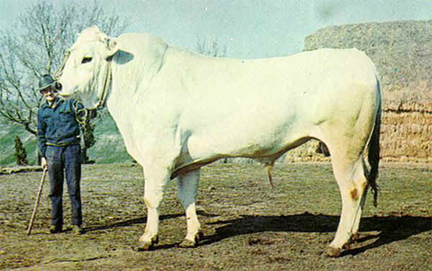
Whenever Zach comes to visit New York, we always dine in a steakhouse together and for years, we’d talked about connecting in Florence and eating bistecca fiorentina, the famous Florentine porterhouse. These enormous aged steaks are butchered from a Tuscan breed of cows known as chianina.

chianina.jpg

These bovines, bred mostly in the provinces of Arezzo and Siena (see image above), are extremely large. For the bistecca fiorentina, the heifers are slaughtered young, before they reach full-size. The steaks are aged and then grilled served al sangue, "bloody," charred on the outside and blood rare on the outside. Zach and I enjoyed our bistecca fiorentina at La Buca dell’Orafo, a classic Florentine semi-interred trattoria, steps away from the Ponte Vecchio.* We paired it with a Morellino di Scansano, which showed nicely. (Buca is a term commonly used in Tuscany for urban eateries, which are often found in the ground floors of the palazzi like this one. Buca means literally "cavity." The Buca dell’Orafo, or "goldsmith’s trattoria," is situated in the heart of the Florentine jewelry district, in the corner of the edifice that houses the Uffizi galleries.)

Above: Zach enjoys his bistecca fiorentina. As a faux-French singer
once said of poet Apollinaire, at life’s table Zach is a big eater.

* Ristorante Buca Dell’Orafo
50122 Firenze (FI) – Via Dei Girolami
tel. 055 213619