My martini lunch and news from Italy

Above: chilled beet soup and martinis for lunch yesterday at Lucques in West Hollywood.

My editor at Princeton University Press will kill me: I was supposed to be working on my final edits of my translation of a Guide to the History of Italian Cinema yesterday but I played hooky and met the producer of a Swiss (yes, Swiss) vodka, Xellent, for lunch at the fashionable Lucques in West Hollywood. Maybe she’ll forgive me: after all, the 3-martini lunch used to be a given in the world of east coast publishing!

In other news…

The Siena Farmers Union is meeting tomorrow to discuss potential changes in the Rosso and Brunello di Montalcino appellations. Click here for the story.

Good weather holds in Montalcino for harvest today.

And far-flung Do Bianchi correspondent Italian Wine Guy reports from San Benedetto del Tronto in the Marches:

Harvesting trebbiano today—the much maligned ugni blanc. This AM the fishing boats came in from the sea. Lovely stuff on the adriatic.

Word from the vineyard: Sangiovese harvest has begun in Montalcino

My friends in Montalcino just let me know that they have begun harvesting the 2008 Sangiovese Grosso. Alessandro’s been posting nearly every day over at Montalcino Report and he also posted his winery’s government-issued certification letters (translated into English but for the bureaucratically minded only). Ale, I’m really digging the Montalcino weather widget!

Word!

Anteprima da la Terza (a first look at third)

This just in from the “life could be worse” department…

Above: Executive chef Gino Angelini and chef de cuisine Gianpiero Ceppaglia at La Terza on Third in West Hollywood.

David Schachter and I met up last night at La Terza, Gino Angelini’s restaurant on Third (hence the name) where Gino and his chef de cuisine Gianpiero Ceppaglia were debuting their new fall menu. We were also joined by LA chef-about-town Walter Manzke and wine industry veteran Enrico Nicoletta: needless to say, some great bottles were opened as we sampled the new repertoire.

Don’t try this at home. We paired David’s 2001 Raveneau Montée de Tonnerre with the spaghetti with lobster. Gino’s seafood is always fantastic, the long noodles were perfectly al dente, and the Raveneau was simply singing…. a great pairing…

Architectonic food has always fascinated me and the theme has pervaded my research in Italian Renaissance cuisine (see my translation of Maestro Martino): I loved this take on baked macaroni, “Vesuvius.”

Gianpiero and Gino matched this beautiful scallop with porcini mushrooms, an unusual pairing that worked swimmingly well. The crostino took it over the top.

David and I got into a fist fight as to whether or not fregola can be called Israeli couscous. I guess it’s the self-loathing Jews in us. The seafood medley with fregola was delicious nonetheless and paired well with a “simple red,” Mick Hucknall’s Etna Nerello Mascalese Il Cantante 2001. I liked the wine despite the dumb name.

Quail over polenta was tender and moist. Definitely a standout… Does it show that I’m a fan? Life could be worse…

Gambero Rosso abruptly fires respected director Stefano Bonilli

I am sorry to report that one of Italy’s most respected and beloved food and wine writers, Stefano Bonilli, has been abruptly fired by the Gambero Rosso. Franco and I have reported the story at VinoWire (click here).

The circumstances of his being let go are dubious and the Italian food and wine blogosphere is up in arms. Even the usually smug Kelablu is quaking in his boots. But Nerina seems unfazed.

Montalcino on my mind

In the nineteenth century, Nietzsche wrote famously that “God is dead.”

In the year of my birth, 1967, Roland Barthes informed us that the author was dead.

Sometime in the 1970s, and I can’t seem to track down where or when exactly, Woody Allen told us that Marx is dead and “I’m not feeling so well myself.” (And he wasn’t talking about Karl.)

The other day, Italian Wine Guy shared his feeling that “Brunello is dead.”

I don’t think that Brunello is dead but I do share Italian Wine Guy’s sentiment that the so-called “scandal” is more about the scandal itself rather than the quality of wines produced there.

During the five days I spent last week between Montalcino and Bolgheri, I talked to countless winemakers, growers, restaurateurs, enologists, and agronomists and I tried to get to the bottom of what has happened and what we can expect over the next few months as the Brunello controversy hopefully plays itself out.

The most insightful observation on Brunello and Sangiovese was offered by a winemaker who worked for many years in Montalcino and who now works in Bolgheri.

“Sangiovese is a very easy grape to sell,” he told me, “but it’s very difficult to grow for the production of fine wine.”

No matter who you talk to, there is one thing that everyone agrees on: as the Brunello “trademark” grew in popularity and in profitability, Montalcino wineries began planting Sangiovese in vineyards not suited to its cultivation.

No matter who you talk to (even though none will go on record), everyone who works in Montalcino will tell you that it was common knowledge: Merlot has been widely planted and used in the production of Brunello for years and bulk wine has regularly been carted into the appellation to top off the wines.

“When the tankers come in to Montalcino, you can see their axels are weighted down,” one winemaker told me. “When they leave, you can see that they’re empty.” This was the same song sung by everyone — from winemakers and consultants, to restaurateurs and hoteliers.

No one seems to have hard data, but all agree that far less than 1 million bottles of Brunello were produced annually in the 1970s. Today, roughly 14 million are produced: according to people “on the ground,” there is simply not enough acreage under vine to produce that much wine. And of that surface area, conventional wisdom reveals that the majority is not suited for the cultivation of Sangiovese to be used in fine wine.

Follow the money… Put all of these factors together and one thing becomes clear: the large expansion-team producers (and maybe a few of the original league) over-planted and promised the American market abundantly flowing Brunello. As a result, they needed to cut corners in order to make ends meet. Twice, I learned, the majors have lobbied to change appellation regulations and allow for the use of international grapes. Twice a vote was called but a majority never reached in the Consortium because the votes of even the smallest producers carry the same weight as the biggies (Delawares to their Californias). Certain smaller producers, probably egged on by point-hungry flying winemakers, blindly followed the advice of their consultants.

But there’s something even more important, that nearly everyone agrees on (except those implicated in the controversy): of the more than 250 Brunello producers who belong to the Consortium, only a handful have indulged in such practices.

But I’m probably not telling you anything that you don’t know… Here are some insights I gleaned that might surprise you.

— While the use of Merlot was a well-known fact in Montalcino, the magistrate’s inquiry had more to do with sloppy documentation than reckless blending.

— In the case of at least one of the majors implicated in the controversy, the use of Merlot was never at issue. It was simply a question of mislabeling in the winery and a disallowed assemblage of different vintages.

— The “100% Sangiovese” certificates are being issued by the Italian government. The certificates, however, are not based on testing for the presence of certain flavonoids in the wine but rather on documentation in the wineries. The wines themselves are not being tested.

— The certificates are being issued regularly to those wineries who have kept their houses in order, so to speak. But the government has reserved the right not to issue the certificate in certain instances and the wineries have no reasonable recourse in such cases. In other words, even if your certificate gets held up for bureaucratic reasons, you’re screwed. Not everyone is going to get one.

— At least one winemaker told me that he’s not sending his current release to the U.S. He was concerned that the current controversy could taint the reputation of his wine and has decided to focus on other markets. Could it be that the real loser in the Brunello controversy is the American consumer?

Epilogue

Whenever people ask me “how do you tell if a wine is good?”, I tell them: “if you like it, it’s good,” whether traditional Brunello (my preference) or buttery Chardonnay (clearly not my preference). If you like modern-style Brunello, then go for it. If you like traditional-style, look for clear bright color in the wine and good acidity. I agree with Italian Wine Guy: too much fuss has been made about Brunello. Drink what you like…

Now, more than ever, Brunello and the folks who live in Montalcino — and especially the honest producers of Brunello, traditional and modernist alike — need our support. As summer comes to an end, get out that BBQ one more time, grill up a mean piece of meat, and decant that Sangiovese.

My friend Alessandro Bindocci is posting nearly every day about the harvest at Il Poggione in Montalcino over at his blog Montalcino Report. Check it out… It’s pretty cool.

In other other news…

I DON’T LIKE IKE!

A Roman sine qua non: la pajata

No stay in Rome is complete without a serving of rigatoni con la pajata: rigatoni tossed in a tomato sauce made with the small intestines of an unweaned calf, in other words, a calf that has been fed exclusively with its mother’s milk (today, in the post-mad-cow world, it is made with lamb intestines, as in the photo above). When the animal is slaughtered, the intestines are tied at either end. As the intestines cook, the rennet in the walls of the organ coagulates the milk and makes cheese. The resulting sauce has an inimitable creamy consistency… simply delicious. Last night at Perilli in Testaccio, I paired with a 1999 Taurasi Radici, which was showing beautifully. Ben had taglioni cacio e pepe and the owner also gave us some carbonara, which he makes with rigatoni instead of long noodles.

Running to catch my plane back to Berlin but wanted also to share this image of a 1992 Gambero Rosso Guide to the Wines of Italy being recycled, snapped in Testaccio. It’s good to know that the guide is being put to good use.

In other news…

The father of Brunello di Montalcino, Franco Biondi-Santi, has proposed a change in the Rosso di Montalcino DOC that would allow for other grapes besides Sangiovese. Read about it here.

Viva gli sposi!

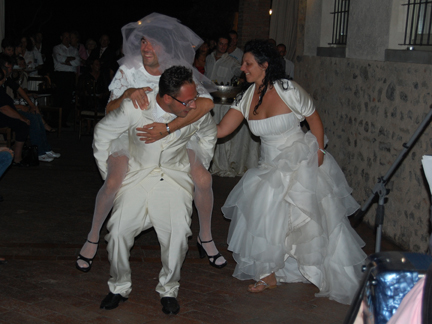
Above: there was a wedding last night in the agriturismo where we stayed in Nigoline near Erbusco (province of Brescia). Newlyweds Sabrina and Emanuel partied long into the night. They seemed like really nice folks and didn’t mind a bit that I got in on the fun. Viva gli sposi! That’s Italian for mazel tov!

Believe it or not, one of the best places to get online in Italy is the Autogrill, the ubiquitous and beloved highway rest stop where the sandwiches are reliably good and the tchothckes abundant. (Does anyone remember Gregoretti’s contribution to the 1962 film RoGoPaG, “Il pollo ruspante”? It’s a wonderful Marxist study of the Autogrill phenomenon in economic-miracle Italy.)

Ben and I are on our way down to Rome and I’m posting today from an Autogrill.

Yesterday, Franco and I tasted some fantastic Franciacorta together.

So much to post and so much to tell… Stay tuned…

Hang time

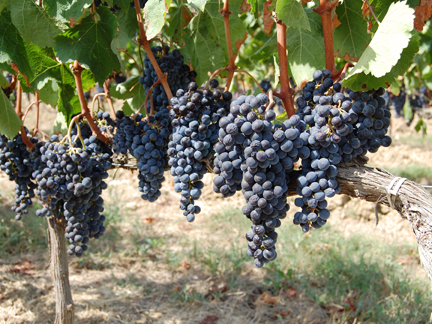
Look at those babies hang! There was a scirocco yesterday in Bolgheri and a hot wind blew from the south. While some wineries had begun to pick their Merlot, these berries still hung on the vine in Ornellaia’s famed Masseto vineyard.

Ben and I are headed up and over to Lombardy today to meet Franco. Still can’t get properly online but was determined to post nonetheless.

Stay tuned…

It don’t get more natural than this

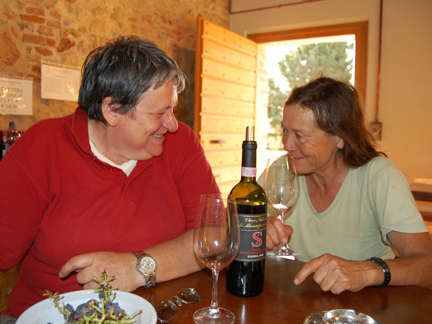
Above: Patrizia and Dora of Sanguineto, producers of a natural, traditional-style Vino Nobile di Montepulciano.

I’m posting today from Bolgheri, where I’m visiting a few wineries. I can’t get online but for a minute: no wifi or other connection, just a shared computer at the hotel’s front desk. But I wanted to share these pics snapped day-before-yesterday at the Sanguineto winery in Acquaviva (Montepulciano). Ben and I had a blast tasting with the girls and their wines are fantastic.

More later…

Say it ain’t so: reporter claims that Banfi’s 03 Brunello contains grapes other than Sangiovese

Above: “no hunting allowed.” Photo courtesy VinoalVino.

Ne nuntium necare. I’m really sorry to report that, according to at least one Italian news service, Banfi’s 03 Brunello contains grapes other than Sangiovese. Read our post at VinoWire and for those of you who speak Italian, read Franco’s post.

I’m in Montalcino as I write this and I am speechless. Non ho parole. This sucks.