La Jolla High Homecoming 2009: Billecart-Salmon Rosé

billecart salmon

It’s that time of year for graduations, commencements, and homecomings and Tracie B and I felt like homecoming queen and king Friday night at Jaynes Gastropub in San Diego where our friends lined up a pretty spectacular flight of wines to welcome us back. It’s only been a few months since our last visit but it was just a thrill to see everyone and catch up. Jaynes has always been great and chef Daniel Manrique has really taken the menu up a notch. The food was excellent: I had my favorite, the Jaynes Burger, rare, topped with brined red onions, and Tracie B had the shepherd’s pie (it warmed our bodies on a mild evening during San Diego’s “June gloom,” which generally sees cooler-than-summertime temperatures).

jaynes gastropub

Above, from left: John and Megan Yelenosky, Jayne Battle and Jon Erickson, and Tracie B and me.

My highschool bud John Yelenosky (top San Diego wine professional) and his wife Megan (one of the city’s leading sommeliers) treated us to a stunning bottle of Billecart-Salmon rosé (on the list at Jaynes). The nose on this wine was so thrilling you almost didn’t want to drink it.

Cerbaiona 2002

Above: I was surprised at how well the 2002 Cerbaiona showed. Not a lot of Brunello producers bottled their wine as such in the rainy 2002 vintage but the “Pilot’s Brunello” tasted like Sangiovese through and through.

One of the surprising wines was a 2002 Cerbaiona Brunello di Montalcino. I used to sell those wines back in the day in NYC. They’re one of my “guilty-pleasure” wines: they’re expensive, they lean toward the modern in style, but they can also be lip-smacking delicious. The wines showed nicely with my Jaynes Burger.

Selvapiana

Above: The Selvapiana Chianti Rufina 2007 by the glass at Jaynes is awesome.

But the wine that really impressed me that night was the Selvapiana 2007 Chianti Rufina: still a little green around the edges but so powerfully tannic and rich. Similarly to the 2007 bottling of Langhe Nebbiolo by Produttori del Barbaresco, Selvapiana’s “entry-level” or “gateway” wine nearly transcends its designation. I haven’t tasted a lot of 2007 from Tuscan yet but anecdotal reports indicate it’s going to be a great vintage for the region, a harvest in which a lot of winemakers were able to make larger quantities of great Sangiovese. It will be interesting to see what this baby does in the bottle.

On deck for tomorrow: CEVICHE PORN!!! Stay tuned…

Giacosa’s 2006 vintage and Decanter’s slopping blogging

As much as I despise the editors of The New York Post, I couldn’t help but laugh out loud when, over a straphanger’s shoulder, I read my favorite example of yellow journalism back in 1999: “The first shiksa wants to be a yenta!” (The article referred to Hillary Clinton’s mention of a Jewish relative.)
I wouldn’t go as far as to call it “yellow” journalism but I was so troubled by a recent post by Decanter.com that I felt compelled to post a few reflections of my own.

On Wednesday, one of Decanter’s writers, a certain Suzannah Ramsdale, wrote that “The renowned Piedmontese wine producer Bruno Giacosa has announced that he will not be bottling his 2006 Barolos and Barbarescos… Company oenologist Giorgio Lavagna says that the wine will be sold on as sfuso (unbottled wine) for use by another bottler.”

First of all, this is not exactly breaking news. Back in April, James Suckling reported in his Wine Spectator blog — with much more restrained and judicious tone — that Giacosa was making a “hard but right” decision:

    It’s a courageous thing to do, and I can’t think of many wine producers who would do the same. I was at the 80th birthday of Bruno Giacosa, the legendary winemaker of Piedmont, about a week ago and he told me that he wasn’t going to bottle his 2006 Barolos or Barbarescos.

    “I just don’t like the quality of the wines,” he said, as we ate lunch and drank some of his fabulous Barolo Le Rocche del Falletto including the 100-point 2000. “I just don’t like the way they are. They are not good enough for me. So I am not going to bottle them.”

Secondly, what really happened was that the British importer of Giacosa announced that it was going to be releasing Giacosa’s 2007 bottlings in February of next year (since the 2006 will not be available). Here’s the release, which was sent to me today by the importer Armit:

    2006 was a difficult year for Bruno Giacosa. He suffered a serious stroke which resulted in him being absent from both the vineyards and cellar for most of the year and into the beginning of 2007.

    Although 2006 was overall a fine vintage in Piedmont, now that Bruno is in a position to judge the quality of the wines personally, he is not satisfied that the Barolo’s and Barbaresco’s [sic] produced at Giacosa meet his exacting standards.

    He has taken the brave and we think highly honourable decision not to bottle these wines, which is clearly a considerable financial sacrifice.

    Bruno’s decision underlines the remarkable recovery he has made. He is now back fully involved, alongside new winemaker Giorgio Lavagna, and after a clearly difficult period, the focus on quality remains as strong as ever at Giacosa.

    As a result of the decision with the 2006s, we now plan to release the 2007 Barbaresco wines in February/March 2010.

I hope this helps to clarify Decanter’s sloppy journalism.

– 2006 was actually a “good” although not “excellent” year in Langa; not everyone made exceptional wine, but the wines will be generally good (Franco and James both agree on this: read this exchange between the two of them on this very issue);

– Giacosa is not going to sell his wine off in demijohns as vino sfuso; that’s just preposterous; he regularly bottles using the Nebbiolo d’Alba DOC and I imagine he’ll sell some of the wine to other notable producers who will bottle it.

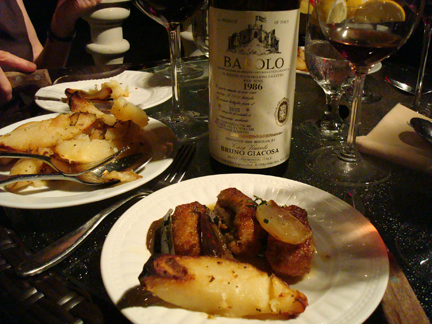
Above: Back in September 2007, Alice, Lawrence, and I shared a wine bottled by Giacosa in a vintage not considered one of the best.

It’s no secret that since Bruno suffered his stroke, his daughter Bruna has been looking for a buyer for the estate. It’s also no secret that last year, Bruna forced Bruno’s long-time protégé Dante Scaglione out of his position. Could it be that internal issues played a role here?

It was irrepsonsible for Ramsdale to make it sound as if Giacosa was patently dismissing the 2006 Langa vintage. When viewed in context, the not-so-breaking news reveals other forces at play.

Twister scare: you’re not in La Jolla anymore, Dorothy…

We interrupt this wine blog to inform you that a tornado warning is in effect for Travis County…

Above: I grabbed these images from the Austin CBS affiliate site, KeyeTv.com. They were all taken not far from where Tracie B and I live.

It was as if the extreme weather was following me: yesterday, I awoke in Dallas at Italian Wine Guy’s to one of the worst storms I’ve ever experienced. On my way to a morning tasting at the Royal Oaks Country Club, I literally saw trees fall along the road, lightening strike not far from me and Dinamite, and a flash flood that had me in a foot of water. When the emergency alerts come on over the radio, one of the things they stress is to avoid deep water because that’s how a lot of folks drown, thinking that they can make across a flooded road. You can lose control of a “standard SUV,” they say, in just 2 feet of water.

Above: It’s not hard to understand why Texas is such a God-fearing country.

At least one of my accounts had to cancel our appointment yesterday because the store had flooded and one of my accounts — a leading Italian restaurant in Dallas, Nonna — had to close for the evening because they had lost power: when restaurants lose refrigeration, tens of thousands of dollars of food can go wasted.

Above: Talk about hail of “Biblical proportions”! My goodness!

As I drove back down to Austin in the afternoon, it seemed I was driving just ahead of the storm. I picked up some pizzas and Tracie B and I hunkered down at her apartment. At a certain point, the storm hovered about a mile away from us as we watched the storm reports on the local news. At that point, tornados had been reported and the storm was heading directly toward us from the north west. We stepped outside to watch it over Ramsey Park (across the street from Tracie B’s apartment complex). It was an amazing, truly awe-inspiring, and beautiful thing to see.

Above: I took this shot in Dallas yesterday from my car using my phone. The two cars had been washed away in a flash flood.

We’re headed to La Jolla today, which is a good thing since triple-digit temperatures are expected today and this weekend. Tracie B and I love our life here and we are so fortunate to enjoy a life so rich with good work, good wine and food, and wonderful loving people around us — literally and virtually, out there in the blogosphere. But, man, I sure understand now why Texas is such God-fearing country!

In other news…

I’m in the Marines Too got married! Congratulations to Philip and ImAMarinesGirl! Tracie B and I wish you all the best and hope you can get over to Japan soon!

In other other news…

Tracie B and I will be dining Chez Jayne tonight. Can’t wait to taste the Terrebrune Bandol Rosé that Jon put on his list… If you’re in San Diego tonight, please stop by…

My first tornado warning, the mystery of lemon peel and espresso, and air guitar nation

My yesterday evening took me from one extreme to another to another. I was traveling from an account visit in Grapevine near Dallas, Texas to downtown Dallas for dinner with colleagues when I experienced my first Texas tornado warning. The voice of an NPR announcer on the radio gave way to an ominous and long monotone followed by “we interrupt this broadcast…” No tornado has arrived but man, they don’t joke around when it comes to weather in northern Texas. The lightening I’ve seen elsewhere doesn’t even come close in spectacle to the fulminous displays you witness around these parts.

The next extreme came in the form of dinner with Italian Wine Guy (above, left) and his ride-with for the day, Andrea Lonardi (right), director of winemaking for one of the world’s largest wine conglomerates, Gruppo Italiano Vini. Veneto by birth, Andrea makes wine across peninsular and insular Italy and beyond our conversation on our shared love of the Veneto and its language and traditions, Andrea unraveled a mystery that has plagued me for many years: why is lemon zest served with espresso? When I lived Northern Italy, lemon zest or lemon juice was served with coffee to stimulate regurgitation: when you’re sick to your stomach, you drink coffee with lemon to help you “evacuate.” Evidently, Andrea’s travels have taken him to corners of rural Sicily where two “shots” of espresso — made from old-style manual espresso presses — are served in one demitasse and the passed from one patron to another: the first patron wipes the edge of the demitasse with the lemon zest for hygiene. In Italian, you say chi non beve in compagnia o è un ladro o una spia, literally, he who doesn’t drink in company is a thief or a spy. Sicilian omertà, noted Andrea, applies also to coffee.

The final extreme came in the form of an encounter with the reigning Air Guitar World Champion, Hot Lixx Hulahan (above, left). He, Stryker (center), and my Nous Non Plus bandmate Björn Türoque are on tour for the U.S. Air Guitar Championship and they happened to have a night off in Dallas. So, we caught up over beers at the end of the night before I drove back to Italian Wine Guy’s place (where he lets me crash when I work the market here) in the rain. It was great to see Björn (aka Dan Crane) and his lovely lady Kate.

Life is certainly never boring and I’m always amazed by its richness and extremities.

But I miss Tracie B and I can’t wait to get back to Austin…

Tracie B and Jeremy P au naturel

Above: Did I mention the girl can cook? Tracie B’s “Potato, tomato, mozzarella Napoleon.” We paired with Laurent Tribut Chablis 2007.

Tracie B and I have been on a bit of an au naturel bender this week after we attended a highly classified and thoroughly delicious dinner the other night in East Austin at an undisclosed location.

Above: Tracie B’s stuffed braised zucchine. She moved on to a glass of awesome Langhe Nebbiolo 2007 by Produttori del Barbaresco (that I had in my wine bag from a tasting I did earlier in the day in San Antonio) but I thought the Chablis — with its tongue-splitting acidity, as Tracie B likes to say — paired beautifully with this dish as well.

One of the guests at the “underground dinner” we attended over the weekend turned us on to Farm House Delivery, a locally based website that brings a small farmer’s market to your doorstep.

Above: Tracie B returned from work yesterday to find the this crate full of yummy stuff at her doorstep.

We had actually missed the cutoff for ordering this week but Tracie B managed to place an order anyway: seems the ladies who run Farmhouse Delivery are from Beaumont, a stone’s throw from Orange, Texas where Tracie B grew up. “We’re everywhere, aren’t we?” they joked with her.

Above: Miso Risotto, Rhubarb, Bok Choy, and Red Chard at the “anti-restaurant” the other night. I had brought a bottle of 2006 Touraine Cabernet Franc by Clos Roche Blanche to the BYOB event (always such a great value and such a great wine).

I first read about “underground dinners” or “anti-restaurants” last summer in the Times: the vegetarian menu last Saturday night featured locally and organically grown produce (including the excellent dish above). Thanks, again, JP and RdB, for including us! Your secret’s safe with me!

Read Tracie B’s reflections on bread crumbs and the secret to her excellent fried chicken here. Did I mention that the girl can cook?

Worth reading: Google Earth, terroir, Italian women in France, and an interesting take on the war of rosés

From the “I wish I would have thought of that” department…

My life in Italian wine began twenty years ago when I first visited Bagno Vignoni near Montalcino and began tasting some illustrious and not-so-illustrious bottlings of Sangiovese thanks to my friend Riccardo Marcucci.

While the single-vineyard system of Barolo and Barbaresco offer the Nebbiolophile a legend by which to navigate the terroir of those appellations, lovers of Brunello di Montalcino have little guidance in negotiating its various and highly diverse subzones.

My friend Alessandro Bindocci of Tenuta Il Poggione has unlocked some of the mystery behind one of the Brunello subzones, Sant’Angelo in Colle (the southernmost growing area in the appellation), in a series of posts entitled Understanding Brunello Terroir Using Google Earth. The most recent post is particularly fascinating: I’ve downloaded and installed Google Earth and it’s amazing to use it as a tool in understanding the unique macroclimate of Sant’Angelo, just as Alessandro suggests in his post. Damn, I wish I would have thought of that!

In other news…

However chauvinist and intrinsically bourgeois, the flier for yesterday’s Paris tasting of natural wines produced by Italian women winemakers is utterly irresistible. Did I hear someone say “movie rights”?

Click the image above to view in detail (hosted at Arianna Occhipinti’s blog).

Lastly…

While nearly everyone was relieved yesterday to see the EU drop plans to alter way rosé is made, Tuscan winemaker Gianpaolo Paglia offered some interesting insight in a comment over at VinoWire:

    I’m a wine producer. I’ve never made nor I do intend to make rosé wine in the future. I’m saying this because I wouldn’t want to be accused of having a vested interest in what I’m going to say now: can someone explain to me why a rosé wine made with the saignée method (salasso, in Italian) would be by default better than a blended rosé? Isn’t Champagne the only wine in EU always been allowed to be made that way and has that consequently resulted in the production of poor quality, but premium priced, Champagne wines? Are all the rosé wines made outside EU, largely produced by blending white and red wines, worse than the worst EU wine made with the saignée method?

    I confess my ignorance, but I don’t see the point in this “battle for quality agro-food heritage and wealth.” To be honest, and perhaps even a bit rude, all this nonsense looks to me [like] a lot of political rubbish.

Thanks for reading!

Petrarch and the unbearable thought of life without the wines of Burgundy

From the “Sunday poetry” department…

Above: In this Renaissance illuminated manuscript (painted book), Petrarch and Laura appear on the banks of a river. Laura, the river (the Sorgue), and the laurel tree (also depicted) are central to Petrarchan iconography. Petrarch knew the wines of Burgundy well but he liked the wines of Italy better.

Petrarch (1304-1374) knew the wines of Burgundy well. He spent most of his early life in and around Avignon, where his father followed the Babylonian exile of the papal court, and where the wines of the Côte d’Or already enjoyed considerable fame. It wasn’t far from Avignon where he first saw Laura, for whom he would write 366 poems, later gathered in his Rerum vulgarium fragmenta (Fragments of Vernacular Things, the title he gave to his Canzoniere or Song Book). Their first meeting took place in Vaucluse in 1327 (according to his own mythology).

Petrarch spent much of the latter half of his life trying to bring the papacy back to Rome. After one of his appeals to Pope Urban V, some of the cardinals argued that a return to Rome would be unthinkable: how could they survive, they told the pope, without the health-enhancing properties of the wines of Burgundy? Petrarch responded with one of his most famous political letters and a passage, often cited but seldom revisited, in which he chastises the gluttonous cardinals. But in the same stroke, he invites them to experience the wines of Italy:

    Is it not a puerile ambition to malign the many types of wines, so plentiful, found in all parts of Italy? … Let them come and see for themselves — all those for whom life would be unbearable without the wines of Burgundy! They will find copious amounts of grain, olive oil, wines, plants, and fruits. Here there are fruits unfamiliar to you and unknown in your [colder] climate. The woods, beasts, wild animals, game, and food and spices are so abundant that no one dies of hunger…

    Seniles 9, to Pope Urban V, August 1366 (translation adapted from Aldo Bernardo)

In last week’s Sunday poetry post, Petrarch flowed the rivers of the world together in verse. Laura is absent and he longs for the river where she appeared: no other river, he cries, could quench the fire burning in his soul.

In this week’s post, he happens upon Laura by a river, innocently washing her veil. She is more beautiful than the huntress goddess Diana who turned Acteon’s dogs upon him when he happened upon her bathing nude in a river.

Magridal 52 is one of the most exquisite compositions in Petrarch’s Rerum. As summer temperatures rise here in Texas, there is a someone special in my life, too, who can still make me “tremble with a chill of love.”

    Not so much did Diana please her lover when, by a similar
    chance, he saw her all naked amid the icy waters,

    as did the cruel mountain shepherdess please me, set to wash a
    pretty veil that keeps her lovely blond head from the breeze;

    so that she made me, even now when the sky is burning, all
    tremble with a chill of love.

    (translation by Robert Durling)

    Non al suo amante più Diana piacque
    quando per tal ventura tutta ignuda
    la vide in mezzo de le gelide acque,

    ch’a me la pastorella alpestra e cruda
    posta a bagnar un leggiadretto velo
    ch’a l’aura il vago e biondo capel chiuda;

    tal che mi fece, or quand’egli arde’l cielo,
    tutto tremar d’un amoroso gelo.

What would the Iron Baron Ricasoli say if he were alive today?

In a 1989 show entitled Le balene restino sedute (Whales, please stay seated), the Bolognese comedian Alessandro Bergonzoni (left) noted that if Sigmund Freud (center) were alive today, he would say: “Well, I sure have lived for a long time.”

Above: The Sala delle Armi or Armory Hall in the Brolio Castle in the township of Gaiole in the heart of Chianti.

Reading Carlo Macchi’s post about yesterday’s conference on the Ricasoli-Studiati Papers, held at the Ricasoli family’s Castello Brolio in Chianti Classico, I couldn’t help but wonder what would the Iron Baron Bettino Ricasoli (1809-1880, above right) say if he were alive today? Among other significant entries on Italian unification, Italian national identity, and the importance of agriculture and winemaking in the forging of a new Italian nation, the correspondence between Ricasoli — Italy’s second prime minister, one the architects of its independence, and a champion of Sangiovese — and Pisan professor Cesare Studiati contains the famed letter in which the Baron described his experimentation with “every grape variety” in his vineyards and his conclusion that Sangiovese — or Sangioveto, as it was called in Tuscany then — was the ideal grape to grow in Tuscany. (You can read my translation of the letter here.) Many claim erroneously that the Iron Baron wrote a formula or recipe for Chianti. He did not. But when he tore out international grape varieties from this vineyards and replanted with Sangiovese, Canaiolo, and Malvasia, the land holders of Tuscany followed suit. If you read the series of letters between the two men during that period, you will discover that he was trying to create (and he ultimately succeeded in creating) a fine wine that could be shipped abroad. He realized that Italian wine could help to fuel the nascent national economy if and only if it could be shipped abroad. And through his experiments, he discovered that Sangiovese grown on Tuscan soil was ideal for this purpose.

According to Carlo, who attended the event yesterday, the discussion — moderated by megawatt Italian television personality Bruno Vespa — centered around the controversial expansion of the Chianti appellation. Would this have concerned the Iron Baron? Perhaps. But if he were to taste the Chianti produced by the “40 or so winemakers” who attended the celebrity-studded event, what would he say? Would he recognize his beloved Sangiovese in those wines, now dominated by Merlot and Cabernet?

I’ll let you fill in the blank…

The “seventh” bullet in my wine bag

Adam Spencer

Above: Adam Spencer aka “Adam Spence,” one of the Clanton Cowboys Gang and one of the meanest sommeliers ’round these parts, faced off with the San Diego Kid (that’s me) in the outskirts of San Antonio yesterday at Saloon Pavil. He was ready for me but he didn’t count on the “seventh bullet” in my six-shooter wine bag.

Dusty and tired after a long day hawking wine in San Antonio, the San Diego Kid had a harrowing brush with death at Saloon Pavil where Adam “Spence” Spencer nearly sent him to his grave. Spence is one of the fastest hands around these parts and one of the best sommeliers the Kid’s ever met on the mean streets of Texas. His wine list is compact, studied, intelligent, original, and surprising. And his palate is as sharp and his wine service as polished as they come. The Kid’s French bottlings were no match for Spence but the Clanton Cowboy wasn’t counting on a 2001 Barbaresco Ovello that the Kid happened to have in his six-pack wine bag — the “seventh bullet.”

Cooper's BBQ

I cannot tell you how good that wine tasted — it had been open all day — with the tender pork loin and pork ribs at Cooper’s. The tannin, the fat of the meat, the gorgeous fruit, and the tanginess of the BBQ sauce made a long day of hawking wine all worth while.

Boy, was the San Diego Kid lucky to get out of San Anton’ alive! Delivered from danger once again by the skin of his teeth and the seat of his pants, he headed out to Cooper’s Old Time Bar-B-Que in New Braunfels where they allow outside wine “but no hard liquor.”

Cooper's BBQ

Above: Cooper’s in New Braunfels. Folks say that the Cooper’s in Llano, Texas is the best one but this one was purdy darn’ good.

The San Diego Kid then made his way to I-35 and sure was glad to get back to the loving arms of his Squaw in Austin.

By now, he knew the way from ol’ San Anton’ to Austin. Riding north from central Texas on his trusty horse and faithful companion Dinamite, he couldn’t help but hum a lil’ new country diddy he’s been working on:

GPS may get you where you wanna go/but it sure as hell don’t get ya’ into heaven…

In other news…

If you visit Do Bianchi, you know how much I love Produttori del Barbaresco. I’ve been collecting my Produttori del Barbaresco posts in a new opera aperta or open work blog called “My Own Private Produttori del Barbaresco”: if you’d like be a contributor, just send me an email and I’ll make you an author (you’ll need to register with WordPress.com first). The idea is that it will be an open blog where we can collect stories, anecdotes, tasting notes, and reflections on Produttori del Barbaresco. Content doesn’t need to be new, either… Thanks for reading!

White, red, and green all over: Obama to eat patriotic pasta at G8

Lately, there’s been so much chatter in the blogosphere about the Obamas’s culinary fondness for Blue Hill in NYC and Five Guys in D.C. that I thought I do a post on a story that’s making waves today in the Italian blogosphere on what Obama will be eating at the G8 Summit in July.

Italian Prime Minister Silvio Berlusconi recently changed the location of the summit to L’Aquila in Abruzzo to raise awareness of the tragedy of the April earthquake there.

According to a report widely circulated today, Berlusconi’s personal chef Michele Persechini will serve a “triptych” of pennette: al pomodoro, al pesto, and ai quattro formaggi — red, green, and white, as in the colors of the Italian flag (no translation necessary here, I imagine).

Above: That’s where Obama will be staying in L’Aquila. “It’s barracks for Obama,” reported the Guardian a few weeks ago, noting that some world leaders may be disappointed about the venue change. You gotta love the Brits’s sense of humor!

In Carlo Verdone’s 1981 film Bianco, Rosso, e Verdone (produced by Sergio Leone), Verdone plays three Italians who each make road trips to their places of birth so that they can vote. (That’s the Roman character, Mimmo, in the image above, left.)

My favorite is the Italian immigrant Pasquale who’s lived in Germany so long that he’s become Teutonified but hasn’t lost his Italian identity. He doesn’t speak for the entire film, except for in the very last sequence when he finally votes and “vents.” You don’t need to understand Italian to watch the clip below: Pasquale’s monologue is nearly unintelligible even for Italian speakers. It is a hilarious but true portrayal of Italian voters’s frustration with their country’s politics and its politicians.

The score is by Ennio Morricone: I love the music in this sequence, its references to the Italian national anthem and the line played by the mandolin.