98 López de Heredia rosé and a gordita at Fonda San Miguel, anyone?

fonda san miguel

As much as Tracie P and I LOVE Austin’s Fonda San Miguel (a restaurant considered by many, and rightly so, one of the best Mexican restaurants in the U.S.), it would be untrue for me to say that we are fans of its wine list (dominated by new world Cabernet, Merlot, Pinot Noir, and Chardonnay). But when we cozied up at the bar the other night for one of our favorite guilty-pleasure dinners, we were thrilled to find the 1999 López de Heredia Viña Gravonia (white) on the by-the-glass list and the 1998 Viña Tondonia Rosado Gran Reserva by the bottle. That gordita paired brilliantly with the acidity and fruit in this gently oxidative wine.

fonda san miguel

I couldn’t resist posting this photo Tracie P snapped that night. You can see the beautiful stained glass in the ceiling reflecting in the wine.

And on the subject of the 1998 Rosado, you can also find it by the bottle at a happy-hour price (too obscene to report here!) over on Josh Loving’s list at Fino, from 5-7 p.m. My advice? Run don’t walk…

In other Spanish-speaking news…

guerrero

Tracie P and I attended a fascinating lecture and presentation by our friend George O. Jackson Jr. at the University of Texas Ransom Center the other night.

George O. (as he is known) has been traveling in and photographing folk culture in Guerrero, Mexico for 20 years. These images are from the jaguar dances and competitions performed by Indian tribes there as an offering to G-d.

guerrero

The pain the participants endure in the dances, George O. explained, is one of the ways they offer sacrifice to their vision of the Judeo-Christian G-d in return for their bountiful rain.

His photos are not yet entirely available for viewing online, but you can see some of them here, from a previous exhibition. Truly fascinating stuff and simply thrilling images…

Happy Friday, ya’ll… I sure am ready to get my weekend on!

The Easter-springtime miracle of Vin Santo

Today, as I watch the events of the Italian wine industry trade fairs unfold from afar, a Facebook friend from Padua, Andrea Fasolo, reminds me of a small miracle that takes place in the Veneto (where the trade fairs take place) and elsewhere in Italy during this time of the year: Vin Santo, via a post by VinoPigro from a few years ago.

It’s natural to think of Vin Santo as quintessentially Tuscan, since Tuscany is the region that continues to produce excellent expressions of Vin Santo with great commercial and qualitative success. But, however small the numbers in terms of volume, Vin Santo continues to be produced in other regions of Italy, notably the Veneto and Trentino-Alto Adige.

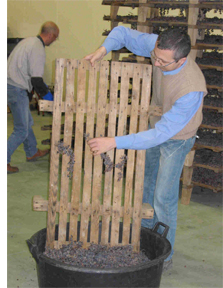
While most wineries finished vinification long before Christmas of 2009, producers of Vin Santo are only now pressing their dried grapes (like those in the image above, left) for fermentation. One of the possible explanations of the name Vin Santo or Vinsanto, i.e., holy wine, is that fermentation is carried during the period of Easter — springtime, renewal, rebirth — when “Christ rises” again. One of the unique elements of Vin Santo is that fermentation occurs not when temperatures are cooling in fall but when temperatures are beginning to rise in the spring.

But the Easter miracle of Vin Santo doesn’t end here. Once vinification takes place, the wine is transferred to small barrels and laid to rest in the attic of a farm house or barn. There, the wine will remain unmolested for two years and it will undergo at least two more fermentations, “rising again” next spring and the spring thereafter.

The images here — like the one to the right, where the grapes are being removed from the racks where they’ve dried during the winter — come from the Canoso winery in Brognoligo, the “hamlet with the most surface area planted to vine” in the “township with the most surface area planted to vine” in all of Italy, Monteforte d’Alpone, near the town of Soave, in the Veneto, just east of Verona. Canoso is one of the handful of wineries that still makes Vinsanto there.

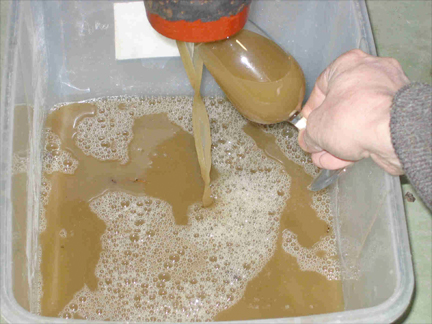
I was happy to sit the wine fairs out this year since I’ve been on the road so much already in 2010. But I’ve been enjoying the coverage on blogs like Alfonso’s and Ale’s. If I were there, I’d just be complaining about being in my region, the Veneto, and not being able to visit with my many friends in Padua and Belluno. But thanks to Andrea, I can still taste the sweet must (above, not yet filtered nor fined) of the Vinsanto that they’re making now… one of life’s holy, small miracles…

An orange wine ante litteram

The Latin expression ante litteram means literally before the letter, in other words, before the written word. I’ve recently had the opportunity to taste what I consider (and others are free to disagree) an “an orange wine ante litteram, id est, an orange wine that was created before the expression or notion of “orange wine” existed: the 1999 Trebbiano d’Abruzzo by Edoardo Valentini. We opened a bottle on Monday at the Orange Wine dinner at Vino Vino in Austin. This wine, made by Valentini himself (as my colleague John Paine pointed out), was fresh and bright, with youthful, powerful tannic structure, nuanced floral notes on the nose, and rich fruit flavor in the mouth. A wine, we agreed, still has many years ahead of it. Truly one of the greatest white wines I’ve ever tasted…

I wasn’t the only one who dug the Valentini and the other wines on Monday night: so did Michael Barnes, social columnist for the Austin American Statesman, who weighed in with this ambrosial post…

The last day of Passover and a time to begin again

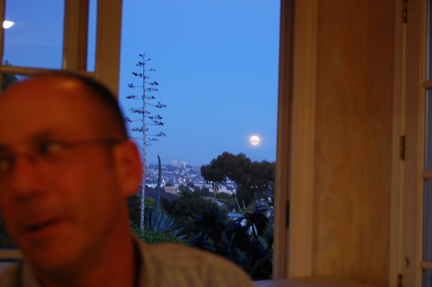
Above (literally “above”): I took this picture of the full moon over San Diego on the first night of the Passover, the night before the first day, during my family’s Passover seder.

The Passover is over. Yesterday was the last day. For the Jews living in Israel, there are seven days of Passover. For Jews living in the Diaspora, there are eight. Yesterday was the last day.

The Passover, Easter, and the Garden of Adonis… All of these rituals have their roots in an ancient (ancient before the time of the written word) cult of death, rebirth, and renewal. Doing some sleuthing this morning, I found this wonderful passage in The Golden Bough (33):

    At the approach of Easter, Sicilian women sow wheat, lentils, and canaryseed in plates, which they keep in the dark and water every two days. The plants soon shoot up; the stalks are tied together with red ribbons, and the plates containing them are placed on the sepulchres which, with the effigies of the dead Christ, are made up in Catholic and Greek churches on Good Friday, just as the gardens of Adonis were placed on the grave of the dead Adonis. The practice is not confined to Sicily, for it is observed also at Cosenza in Calabria, and perhaps in other places. The whole custom—sepulchres as well as plates of sprouting grain—may be nothing but a continuation, under a different name, of the worship of Adonis.

Indeed, the Passover and Easter “may be nothing but a continuation, under a different name, of the worship of Adonis.”

One of the interesting traces of this cult in the Passover is the “burning of the bread” in the Jewish tradition — the banishment of yeast from the home and the dinner table. Once the Passover is over, yeast is allowed again.

Tracie P and I have spent a lot of time thinking about yeast and how it relates to wine — natural yeast, native yeast, ambient yeast, cultured yeast, selected yeast, “killer” yeast — over the last year. One of the things that struck me about the Passover this year (something I’d never thought about before) is how the Passover ritual requires that we remove all yeast from our lives while requiring us to talk and think about yeast at the same time.

And so it is a time to begin again and watch the yeast do its work. In the words of one of my Italian colleagues, ricominciamo…

You just gotta love Italian T.V., right? And man, you gotta love a name like Pappalardo, literally lard soup. Leavened bread, anyone?

Scenes from an orange wine dinner

Tracie P and I had a blast at the orange wine dinner last night, at Vino Vino in Austin, where I poured and spoke about the wines. Life could be worse… Here are some “scenes from an orange wine dinner” for your virtual and vicarious enjoyment… Photos by Tracie P…

movia puro

Got it all going with a little bit of 2000 Puro by Movia, disgorged tableside (not really an orange wine, but a great place to start).

paolo bea

The first three wines were all by the hand of Giampiero Bea. Man, the Arboreus was outta sight… and I always love the Santa Chiara. The Coenobium, always a go-to for us.

gary clark jr

Shared a little Lunar by Movia with B3 player Mike Flanigin and Gary Clark Jr., who played later that night. Man, only in Austin: killer orange wine followed by some of the most insane blues musicians I’ve ever heard… I’m not shittin’ you, either…

lewis dickson

I was geeked to taste with Lewis Dickson, arguably the best winemaker in Texas and probably the only one who uses native yeast and a natural approach to winemaking.

seared flounder

Chef Esteban’s cooking was OFF THE CHARTS AMAZING last night. Seared flounder with purée of English peas. For the complete menu, click here.

vodopivec

I had a second glass of the 2005 Vodopivec Vitovska. Man, I dig that wine.

gravner

No, that’s not old man piss. It’s GRAVNER (2003 Ribolla Gialla Anfora)!

FRANCO ZILIANI ARRESTED FOR DRUNK DRIVING!

well, not really… but he’d like to be arrested… read on…

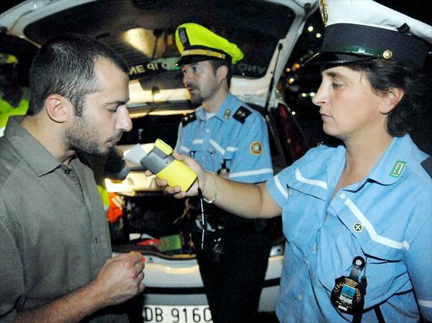
Above: Unidentified man is subjected to a random breathalyzer test somewhere in the Province of Como. Photo courtesy of La Provincia di Como.

According to a blog post published Sunday by Italy’s preeminent wine blogger and re-posted by numerous wine websites and blogs, including the LaVINIum blog and InternetGourmet, said blogger Mr. Franco Ziliani wants to be arrested for drunk driving. More precisely, he wants his alcohol blood content to be tested as he leaves the gates of the annual Italian wine fair — along with that of thousands of other attendees — before he ever gets behind the wheel of his car.

At issue is Italy’s newly instated (quasi-)zero tolerance drunk driving law, enacted in August 2009, whereby a .05-gram-per-liter-of-blood alcohol level is considered intoxication by police. (I found the most up-to-date text of the new Italian legislation at this breathalyzer sales site and for background and for general info on the legal limits allowed across the world, see the Wiki. Most states in the U.S. consider .08 grams the legal limit.)

The legislation was intended to curb excessive alcohol consumption and a rash of drunk driving incidents, mainly involving young people leaving discotheques on Friday and Saturday nights. The new laws require local police to set up random check points and subject drivers to breathalyzer tests, even when said drivers exhibit no outward signs of intoxication.

As a result (and I’ve heard of myriad cases of this during my recent trips to Italy), a number of individuals have lost their driver’s licenses even after only moderate alcohol consumption.

The bottom line: even one glass of wine at dinner can put you over the legal limit, depending on the wine and your body weight at mass etc.

The new laws have been widely criticized — even by Italy’s now former agriculture minister, Luca Zaia — as excessive. Many, including respected wine journalists, have called them a form of neo-prohibition and even neo-fascism applied through the use of unreliable devices by unprepared law officers. The legislation was intended to curb drunk driving among young discotheque-goers, not wine professionals attending tastings or average folks enjoying a bottle of wine at a country trattoria.

Italian wine writer

Here’s where it gets really interesting: Italy’s annual wine trade fair, Vinitaly, begins Thursday in Verona. If you’ve ever been to the fair, you can see what’s coming: of the thousands of people who attend each day, most are wine and restaurant professionals who taste in moderation, spitting, but tasting (as I do) up to 80 wines a day. This is the first Vinitaly since the new legislation has been enacted.

Mr. Ziliani is asking like-minded attendees to gather — in the thousands, he hopes — and march (or be bussed) down to the local police station, where he and his followers will “turn themselves in” and ask to have their alcohol blood levels tested without ever getting behind the wheel. He hopes that the overwhelming number of tests to be administered will demonstrate the absurdity and infeasibility of the law.

Mr. Ziliani’s protest may have “arrived a little too late,” notes the author of the LaVINIum post. But you can email Ziliani here to get protest details.

Me? I decided to sit this Vinitaly (and Vini Veri) out: I’ve got better things to do. ;-)

1989 Produttori del Barbaresco for Easter

produttori del barbaresco

Above: The 1989 Produttori del Barbaresco Barbaresco was truly brilliant yesterday afternoon. We paired with roast leg of lamb and sat outside in the gorgeous weather. Ubi major minor cessat: check out Tom’s excellent profile of Produttori del Barbaresco here. I visited the winery during my March trip to Piedmont and will post on my tasting there in the next few weeks.

Posting in a hurry this afternoon because slammed with work and getting ready for tonight’s Orange Wine dinner at Vino Vino, where I’ll be pouring and talking about some amazing wines. We posted the wines and the menu earlier today. (There are still a few spots open: the wines are great, chef Esteban is pulling all the stops, and in true Austinite fashion, the dinner will be followed by Gary Clark Jr.’s first performance at Vino Vino.)

produttori del barbaresco

We shared our Easter feast with another couple, close friends of ours. I roasted a leg of lamb yesterday afternoon, seasoned with rosemary from our garden. My beautiful Tracie P made all the fixins. :-)

produttori del barbaresco

Tracie P had also dyed some Easter eggs. Our new home is so wonderful. Words just cannot say how much I love her…

In other news…

Alfonso aka Italian Wine Guy has been making his way from Bordeaux down to Italy. I’ve really be enjoying his posts and his travels… Definitely worth checking out…

More tomorrow…

Beppe Rinaldi doesn’t care much for Americans (and he makes truly awesome wines)

citrico

Above: They call Giuseppe “Beppe” Rinaldi the “Citrico” (CHEE-tree-koh), the “citric one.” Photos by Tracie P.

When Italian actor Franco Citti told his mentor Pier Paolo Pasolini that he was headed to the U.S. to make a film with Coppola (The Godfather), the director and poet admonished famously: “Go to America but don’t learn how to speak American.”

I couldn’t help but be reminded of that famous however apocryphal quote when esteemed Italian wine scrabbler Mr. Franco Ziliani took Tracie P and me to visit and taste with Beppe Rinaldi in Barolo.

citrico

Above: We didn’t taste but rather drank 1982 Barolo Brunate and 2005 Barolo Brunate-Le Coste in Beppe’s living room, accompanied by some excellent cheeses that Beppe sliced for us personally and his ubiquitous Toscano, the spicy “Tuscan” cigar favored by many Italians. The 1982 was one of the greatest wines I’ve ever had the privilege to drink — brilliant fruit and exquisite tannin. Beppe spilled a drop on Tracie P’s jeans as he poured. She still hasn’t washed them.

Beppe doesn’t care much for Americans or America, a sentiment not uncommon in a region of Italy that was once dominated (although no longer) by far-left politics, where the cultural hegemony of Americana was seen as a destructive force that could sweep away the genuine traditions and values of life in post-war Italy. He told of us of a trip he made in the 1980s to Davis, California, when he was still working as a veterinarian. Unlike other Italian winemakers who traveled to Napa during that decade, Beppe wasn’t impressed by the squeaky-clean wineries and winemakers of his antipodal counterparts. Nor was he impressed by the purveyors of Italian wine.

giuseppe rinaldi

Above: The Rinaldi cellar, which lies underneath the Rinaldi 18th-century villa, is old-school all the way. The house is truly one of the most beautiful in the town of Barolo. I regret that we didn’t take a picture of the exterior.

We were thrilled, of course, to get to taste with Beppe and we are forever grateful to Mr. Ziliani for such high-level access. To my palate, his wines are among the greatest produced in Barolo and the style has remained entirely unchanged for at least two generations (i.e, the current and that of Beppe’s father, also Giuseppe).

giuseppe rinaldi

Above: Among other wines, Rinaldi makes a blend of fruit sourced from Cannubi, San Lorenzo, and Ravera as well as what is considered his flagship wine, Barolo sourced from Brunate and Le Coste. His expressions of Cannubi and Brunate, in particular, are considered two of Barolo’s historical benchmark wines. To my palate, these are two sine qua non wines, essential to an understanding and appreciation of the greatness of Barolo.

Of all the winemakers we talked to in February in Barolo and Barbaresco (and we asked the very same question during each visit), Beppe was the only one who said he doesn’t use selected, cultured yeasts. “I don’t have problems staring fermentation in my cellar,” he said. On a few extremely rare occasions, he told us, he has used cultured yeast when for whatever reason fermentation needed a nudge, so to speak. When you tour the cellar with him and negotiate the labyrinth of his cluttered laboratory, you cannot help but think that the terroir is not only in the vineyards but also there in the cellar, which has remained unchanged for two generations. It is as if the terroir is “growing” on the sides of the enormous Slavonian casks he uses to age his wines. One of the most fascinating vessels is an enormous fermentation cask built by his father so that he could vinify his entire holding of Brunate in one vat. When you visit this cellar, clean, of course, but not immaculate, you can “smell” the terroir.

giuseppe rinaldi

Above: Playing in a French rock band sure comes in handy sometimes.

Beppe may not be so fond of America and Americans but the “citric one” was an excessively generous host. Maybe he found me slightly more simpatico when Mr. Ziliani told him that I perform and write songs with a French rock band. At the end of our visit, Beppe gave me an unlabeled bottle of 2005 Barolo Brunate-Le Coste.

barolo brunate le coste

Above: I probably hate blind tasting as much as Guilhuame does. But I couldn’t resist “tasting my friends blind on this wine,” as we say in the biz. Of course, they could easily surmise what the wine was because they knew where Tracie P and I went on our honeymoon!

Last night, Tracie P and I shared the bottle with our good friend Mark Sayre and the gang at Trio in Austin (the happy hour there has become our “Mel’s Diner”). What a thrill to share this gorgeous wine with a group of wine professionals here in Austin! It was powerful, with gorgeous fruit and an immensely vibrant acidity (no pun intended!), definitely one of the top 3 examples of 2005 Nebbiolo I’ve tasted.

Beppe Rinaldi is a true iconoclast and his wines are truly iconic expressions of Barolo, sine qua non interpretations of one of the greatest wine producing regions of the world, Langa. Like the man, the wines represent an essential continuity with the past and a hope for the future. Whether you prefer modern- or traditional-style Langa wines, thank your lucky stars for a man who remained true to his people and his land, when others were perhaps seduced by the dollar signs that flashed before them in the 1990s. In the field of trophy wines, Beppe’s bottlings remain more than fairly priced. I cannot recommend them to you enough.

And to be honest, I’m only half-kidding when I say that Beppe doesn’t like Americans. ;-)

barolo brunate le coste