Primitivo (two ways): Italian grape name and appellation pronunciation project

CLICK HERE FOR ALL EPISODES

Since I’ve spent the last week in Apulia, it only seemed appropriate to feature an Apulian grape this week for the Italian Grape Name and Appellation Pronunciation Project. And since we’ve already done Negroamaro, it seemed a propos to feature another one of the most widely planted grapes here, Primitivo. And so, the other day when we went swimming the other day in the Adriatic (at Torre dell’Orso, not far from Lecce), I asked Paolo to pronounce Primitivo for my camera.

Of course, Primitivo is one of the easiest for English-speakers to pronounce. And so I thought it would be fun to spice things up with a dialectal pronunciation.

I’m waiting until after the Radici Wines festival ends to start posting on the wines I’ve tasted, but I’ll give a little preview by revealing that I LOVED the Primitivo by Pasquale Petrera (Fatalone, Gioia del Colle). As it so happens, he uses the dialectal name of the grape on one of the labels of his excellent wines (and I’ll post on my tasting down the road): u Pr’matìv (Il Primitivo, in Italian, the Primitivo [grape]). And so I asked him to take a break from one of the preview tastings and pose for my camera.

Buona visione! And thanks for speaking and drinking Italian grapes!

One of the best tastings and delicious, delicate fiordilatte for lunch

There’s no denying it: so far, the Radici Wines gathering has been one of the best tasting festivals I’ve ever attended in Italy. In past years (now its fourth), the festival was limited to Apulian and Lucanian producers. But this year it includes more than 100 producers from Apulia, Basilicata, Calabria, and Campania.

And even though the unusual “speed-dating” format can lead to some awkward silences, it’s been fantastic to taste and chat one-on-one with so many interesting producers.

There’s no time this morning to begin posting on the many amazing wines (1997 Gaglioppo, anyone? 1975 Primitivo?). But I’ll get to them soon enough.

In the meantime, fiordilatte — literally, crème de la crème, one of the many wonderful “plastic” cheeses produced here in Apulia — and crusty bread were just what I needed for lunch…

Dulcis in fundo: Primitivo di Manduria Dolce Naturale and almond paste pastries

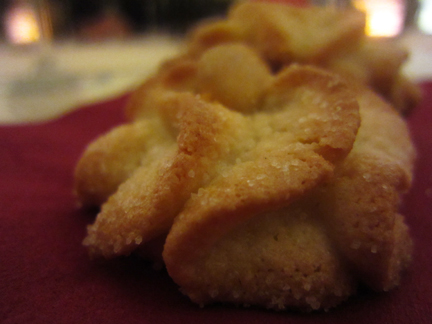
But the dish that really blew me away at last night’s dinner at Le Fabriche was this housemade almond paste pastry, a classic of Apulian gastronomy. The combination of nuanced texture and gentle sweetness was sublime.

The pastry paired stunningly well with Le Fabriche’s Primitivo di Manduria Dolce Naturale, which surprised me with its balanced alcohol and gorgeous fruit (and it thrilled the crowd of top-flight wine writers).

The first tastings of the festival begin this morning and then we head out for a winery visit at Pichierri this afternoon (SUPER psyched for that, one of my favorite Apulian producers)… Stay tuned!

Ciceri e tria ai frutti di mare, at once classic and creative

Paolo and I sat down for dinner at about 9 p.m. last night at La Quinta Stagione in downtown Lecce where this fantastic, creative take on the classic ciceri e tria (chickpeas and long noodles) reminded me of what Tony always says: “For Italian food to be authentic, it must be a balance of the classic and the creative.”

The photos simply do not do justice to Chef Franco Tornese’s deft hand.

That’s the amazing chef Franco (standing) with Cataldo Ferrari, vineyard manager at Paolo’s family’s winery Cantele.

03 Trinchero Barbera and burgers for Memorial Day

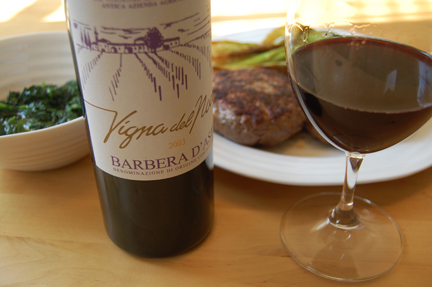
Natural winemaker Trinchero (Asti, Piedmont) has always been one of my favorite producers of Barbera. The 1996 Barbera d’Asti [single-vineyard] Vigna del Noce ranks up there with the greatest bottlings of Barbera I have ever tasted.

And so when I spied a bottle of the 2003 Vigna del Noce at the Houston Wine Merchant, I couldn’t resist picking it up — despite the fact that 2003 was a notoriously difficult vintage because of the extremely hot summer.

Tracie P and I finally opened it over the Memorial Day holiday and paired with some griddle-fired beef sirloin burgers.

The wine — vinified with native yeast and raised in traditional large casks — was hot in the glass, with a lot of alcohol for this house (due, undoubtedly, to the nature of the vintage). But it still had that bright, bright acidity that you find in old-school Barbera. The black fruit and berry flavors were chewy and rich and once the alcohol blew off, I thoroughly enjoyed the wine with my burger.

The wine wasn’t perfect: I found the alcohol out of balance with the fruit and acidity. And it probably should have been opened a few years ago.

But as we Piedmontophiles drink the last of the 03s lying around, I couldn’t help but admire this wine for being true to its place and its vintage.

Sometimes a wine is great… for not being so great…