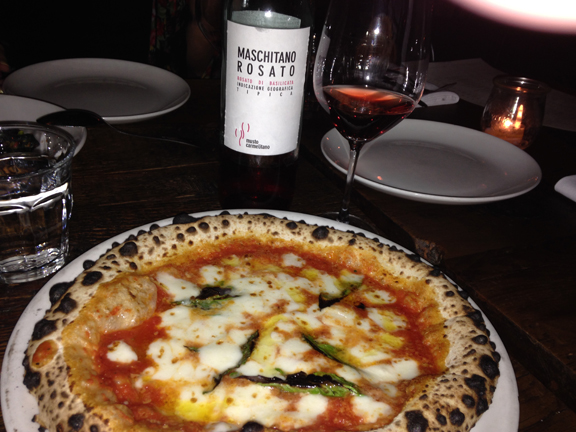
A rare & reluctant Barolo thanks to @BRZimmerman #Boulder

barolo canonica paiagallo

One of the most fun things about what I do for a living is that my colleagues always love to “taste me” on wines I’ve never had before.

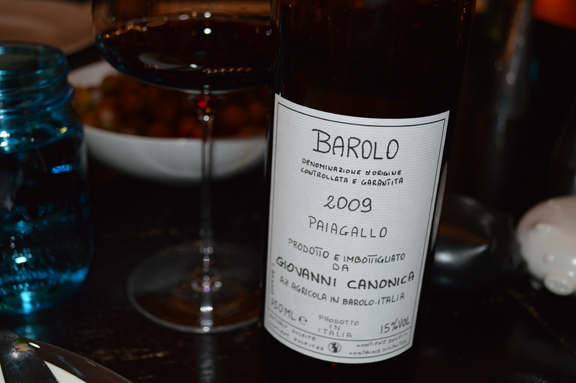
What a thrill for me when Master Sommelier Brett Zimmerman asked me if I wanted to taste the 2009 Barolo Paiagallo by Canonica, one of the appellation’s most coveted “cult” producers!

Brett and his lovely wife Jenn had me over for dinner last night in Boulder, where Brett owns and runs the Boulder Wine Merchant and Jenn works as a lawyer specialized in the restaurant trade (more on my visit with them below).

I’d only ever read about this elusive wine on Levi Dalton’s superb blog. And what Levi wrote about this wine, although from a different and perhaps better vintage in Levi’s case (the 2008), rang so true: this wine has a jaw-dropping “clarity of fruit.”

If ever there were a wine to be called sui generis, this is it. It’s entirely unique and it stands alone, instantly recognizable as Barolo but apart from the canon (similar to the way Soldera’s Brunello di Montalcino is an entirely idiosyncratic expression of its appellation).

I love what the Barolo di Barolo website says in its profile of Giovanni Canonica, who owns just 1.5 hectares planted to Nebbiolo for Barolo: the winemaker “wants to stays as far away from the market” as he can, writes the author of the piece; his wines are “extorted” from him rather than “released” by him, says Canonica.

And I love that this reluctant barolista has named his farm and agriturismo after the iconic painting, “The Fourth Estate,” by twentieth-century master Giuseppe Pellizza da Volpedo.

It’s one of the most extraordinary (literally) bottlings of Barolo I’ve ever tasted, a wine that wears its ideology on its sleeve, and I highly recommend it to you.

boulder wine merchant

I’m in Boulder today because Brett has asked me to become a regular contributor to his shop’s blog. I’ve already begun to publish some wine education posts there and as our work together expands, I’ll be posting on featured wines, wine tourism, and Brett’s work as a wine educator and Master Sommelier (he recently returned, for example, from La Paulée San Francisco, where he and team of his fellow Master Sommeliers oversaw wine service for the event).

Brett and I have known each other for more than seven years now and I’ve always enjoyed following his work and his seminars at TexSom, the annual sommelier gathering in Dallas.

He’s one of the nicest people in the trade and I am entirely geeked and proud to be working with someone of his caliber.

I’m also excited about having an excuse to visit Boulder a few times a year. There are more Master Sommeliers and top-notch wine professionals here pro capite than anywhere else in the country and the general level of food and wine connoisseurship here — among professionals and consumers — is remarkable. It’s one of our nation’s new meccas for gastronomy and I love it here.

Stay tuned… my two-day Colorado adventure has just begun.

What is the plural of Barolo? Brunello? Barbaresco? Prosecco? @FineWineGeek

monforte alba david berry green

Above: Monforte d’Alba, where some of the greatest expressions of Barolo are produced, fall, 2012 (photo by David Berry Green).

It’s one of those linguistic questions that comes up often in my world: what is the proper English pluralization of Italian wine names like Barolo, Brunello, Barbaresco, and Prosecco, Italian proper nouns that end in <o>?

A few days ago, when one of my favorite Italian wine bloggers, the amazing Ken Vastola (check out his super cool site), asked me to share my thoughts on this conundrum, I decided to sit down and right a proper post about it (excuse the paronomasia).

Technically, enonyms ending in <o>, like those above (and all enonyms, for that matter), are singular, masculine, invariable nouns in Italian grammar. And as invariable nouns, their plural and singular forms are the same.

But many Italians will pluralize them based on standard inflection. Just as the plural of pomodoro is pomodori or cannolo is cannoli, where the final <i> makes the words plural, it’s not uncommon to find inflections of wine names like Baroli or Brunelli.

And similarly, English-speakers will commonly pluralize them as Barolos or Brunellos.

There’s nothing “incorrect” about inflections like these: the “correctness” of grammar is ever shifting and the evolution of language is based not on an unattainable ideal but rather practice and usage.

Thirty years ago, there were very few English-speakers in the U.S. who would wonder what the correct plural of Brunello was, let alone know that Brunello was a prized wine. Today, wine lovers, wine merchants, wine writers, and editors are often challenged and sometimes vexed by the question of how to pluralize Brunello.

“I tend to prefer the latter,” traditional style of the wine, wrote Jay McInerney on his Wall Street Journal blog in 2011, “although it’s hard to resist the upfront appeal of some of the more modern Brunelli.”

Would he have been faced with the issue in 1984 when he published Bright Lights, Big City?

I stand by my observation that this and similar inflections are not “incorrect.”

But they are best to avoid.

The reason is that this type of hypercorrective inflection often distances the word itself from its intended meaning.

In the case of Barolo, for example, the enonym is a toponym, a unique place name: Barolo, the village in Cuneo province, Piedmont. When hypercorrectively pluralized as Baroli, the toponym becomes cacophonous (the opposite of euphonious) to the Italian speaker.

The same holds for Prosecco, which is also the Italian name of a village, Prošek in Croatia.

If, for example, you were writing about a flight of wines made from Cabernet Sauvignon grown in Napa Valley, California, you might cacophonously abbreviate the grape name Cabernet Sauvignon as Cab (cacophonous, at least to my ear). But it’s unlikely that you would hypercorrectively pluralize the place name Napa as Napas. It would — more likely than not — sound strange to you.

There are also instances where the enonym is a homophone in Italian.

Barbaresco is the name of a village. But in literary Italian, barbaresco can also mean barbarian or barbaric. To pluralize the wine name as Barbareschi (where the <h> is needed to retain the velar consonant in the pluralized inflection of co; pronounced koh and kee respectively), not only corrupts the toponym Barbaresco but it also creates a superfluous homonym.

If you said, “last night I drank two Barbareschi,” to an Italian speaker, it would sound as if you were saying, “last night I drank two Barbarians.”

In my view, the best way to address this issue is to avoid it gracefully.

In my writing, you’ll often find instances where I use the phrase expressions of Barolo to avoid the wine name’s pluralization: “Monforte d’Alba, where some of the greatest expressions of Barolo are produced.” Bottles of or bottlings of are other common solutions to the problem. And there are plenty of other ways that writers can avoid this type of hypercorrection.

As I wrote above, it’s not “incorrect” to say Baroli but it’s preferable to avoid it (the pluralization of euro as euri, as opposed to sing. invar. euro, is an analogous example where both usages are accepted in standard Italian grammar, but the former is preferable).

Just think how a hypercorrective inflection of Montepulciano d’Abruzzo would sound to an English speaker or Italian speaker, where the wine name includes a grape name and two place names (one homophonous). Montepluciano d’Abruzzos? Monteplucianos d’Abruzzo?

A mouthful better suited for the palate than the pen (or keyboard, as it were)…

Italian wine resources, Prosecco’s lost treasure, and Parzen family update

i love her so much

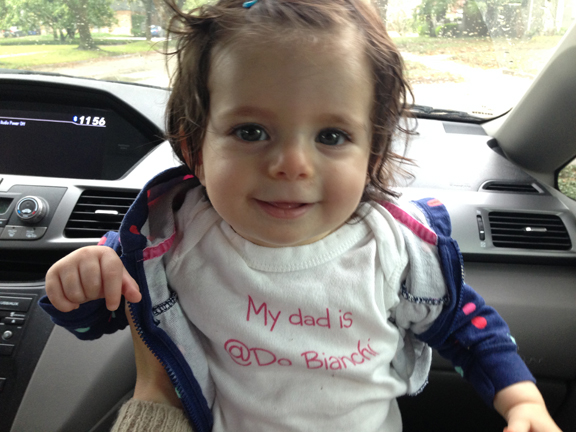
Above: on Sunday morning we took the girls to the Renzo Piano-designed Menil Museum in Houston to see its awesome collection of Magritte paintings. That’s Lila Jane wearing her “my dad is Do Bianchi” t-shirt, given to her by Vinogirl.

Things were a little heavy last week here on the blog. I really appreciate all the folks who shared my post on Friday and offered words of support and solidarity. It was hard to write but I felt it was important.

Now it’s time to get back to what the blog is really about: our lives, our loves, our passions…

cousins at my new house

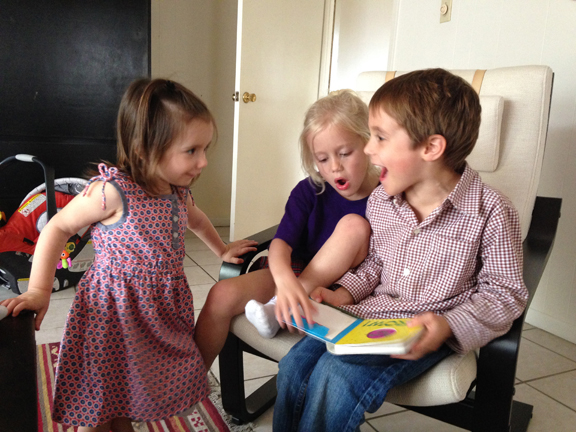
Above: The girls’ Levy cousins, who live here in Houston, came over to play on Friday. We’re so blessed to have a family that loves us. From left, that’s Georgia P, Josie, and Colin.

On Friday, Alfonso aka “the Italian wine guy” posted an excellent aggregate of online Italian wine resources. I was honored to be part of it and I really like his note on how true wine appreciation is like learning to play a musical instrument. Practice, practice, practice… It’s a great post, on many levels (and Alfonso’s blog has never been more exciting imho).

Check it out here.

branch cousins

Above: the Branch cousins came in from Orange, Texas for a few days earlier in the week while I was in Chicago. The main reason for our move to Houston was to be closer to family and we are so lucky to have them. Clockwise, Tobey, Emilee, Brady, Lila Jane, and Georgia P in the center.

In other news…

On Friday, I translated this post on the Bianchetta grape for my client Luca Ferraro at Bele Casel.

Luca’s working with some old-vine Bianchetta that he found in a newly purchased vineyard.

I really love Luca’s approach to biodiversity and his embrace of traditions that span far beyond the Prosecco boom.

With Glera so widely planted in Asolo-Conegliano-Valdobbiadene (thanks to its lucrative returns), Bianchetta is an underdog these days.

It’s going to be really interesting to see what Luca does with these old plantings.

Check out the post here. You might be surprised by Bianchetta’s role in Veneto viticulture before the Prosecco advent.

Above: we are so fortunate to have daughters who love to eat.

In family news…

Friday marked our third week in the new house in Houston. We love it here and we love our new home (a fun Mid-Century Modern three-bedroom in a nice neighborhood just outside “the Loop”).

Saturday, Tracie P and I had our first date night since we’ve moved: we went to Tony’s and were treated to the best table in the house and butternut squash gnocchi topped with Norcia truffles among other delicacies.

And Sunday, we threw our first Houston dinner party (Tracie P’s Carbonara paired with Selvapiana).

It’s a really special time in our lives and our blessings are too many to count.

Thanks for being here… More groovy stuff to come this week.

You can’t put the shit back in the cow: a note on racism in Italy and in Italian wine today

benetton handcuffs ad

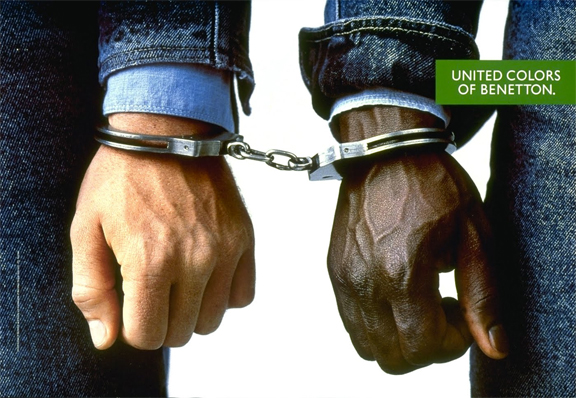
Above: an image from Oliviero Toscani’s 1989 United Colors of Benetton campaign (via the Benetton corporate website).

Responding to an Italian-Swiss reader of his weekly column in Tempo in 1969, Pier Paolo Pasolini wrote on “unconscious class hatred”:

    Racism [directed toward jailed Italians] is unconscious class hatred.

    Compare it to American racism, which, until now and even today, has been unconscious class hatred.

    But from the moment that negroes began to combat it and to become self-aware as an impoverished class, the obscure and indecipherable racial hatred directed toward them has become clear-cut, easy-to-decipher class hatred.

    It is the same type of hatred that an Italian bourgeois feels for a communist but not for “lazy southerner” or a jailed countryman.

(The article was republished posthumously in Il Caos [Chaos], Mondadori, 1979. You can read it in its entirety here. Translation mine.)

I selected this famous quote for my post today because of its reference to racism in the U.S. in the late 1960s.

Continue reading

“The biggest human effect on terroir is ego”: tasting outside my tribe @PasternakWine

beauvenir nerthe

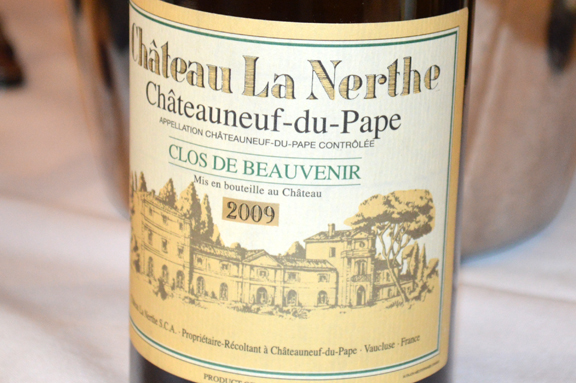
Above: all of the wines in the Pasternak Prestige Portfolio tasting yesterday in Chicago were spectacular. But La Nerthe’s 2009 Clos de Beauvenir is the one I can’t stop thinking about today. A rich blend of Roussanne and Clairette, the wine showed nuanced but intensely focused layers of dried and fresh stone fruit. What a wine!

At last week’s Design Bloggers Conference in Atlanta, my friend Adam Japko delivered a brilliant talk on “moving outside of your tribe.”

When interacting solely within your own tribe, Adam explained, you don’t push yourself toward a new awareness of your potential.

And so, when the marketing team at Pasternak Wines asked me to come up to Chicago to do some live social media from their Prestige Portfolio tasting, it seemed like a perfect opportunity to gaze beyond my comfort zone.

Continue reading

Ceci n’est pas une hot-dog: heading to Chicago to taste @PasternakWine

hot doug

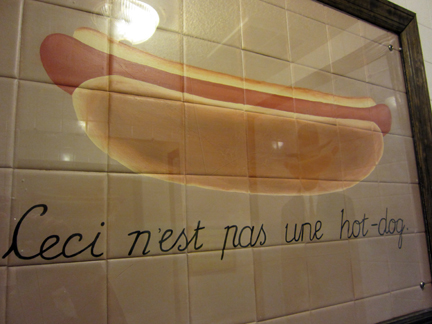
Above: a scene from my second-favorite hotdog joint in the world, Hot Doug’s. I won’t be able to get over there tomorrow while in Chicago for the day, but you can bet I’ll be eating my share of Chicago dogs!

On a flight today to Chicago, where I’ll be attending the Pasternak Prestige Portfolio tasting: the nice folks at Pasternak asked me to come up and give them a hand with social media for the event.

I’m always geeked to visit Chicago, the city where I was born and one of the most fun food destinations in the U.S.

Tonight, I’ll do some wine bar-hopping and I’ll catch with some of the awesome wine pros up there. Thursday, I’ll report back.

Thanks for tuning in and see you on the other side!