2007 Barbaresco for a one-in-a-million friend

barbaresco giamello vicenzianaYesterday’s lunch found me in North County San Diego at the home of a one-in-a-million friend.

He had prepared cheeseburgers and I had brought a bottle of 2007 Barbaresco Vicenziana by Silvio Giamello, a wine that I had cellared in my wine locker in San Diego since its release.

I wanted to bring a Nebbiolo with some age on it: our get-together was long overdue and I was excited to see my old friend; I wanted to share something memorable with him.

You see, he’s that one-in-a-million friend with whom I played in a band and wrote some of my first songs back in high school in La Jolla.

He’s that one-in-a-million friend with whom I went through my teens, the acne, the insecurity, the Duran Duran concert where we locked our keys in the car, the visits to the gym trying (unsuccessfully in my case) to “beef up,” the first experiences in a recording studio, the prom…

Later, he’s that one-in-a-million friend with whom I played in bands in Los Angeles and with whom I went on tour as a cover band in Italy.

In our teens and in our twenties, in high school and then in college (me at UCLA and he at Loyala Marymount), we experimented, played music, partied, and learned through joy and sometimes bitter disappointment about the challenges and rewards of our southern Californian upbringing.

We ended up not opening that bottle yesterday with his burgers.

You see, he’s also that one-in-a-million friend who is battling aggressive melanoma.

We decided, instead, that we’d open it a year from now when he’ll have complete the next phase of treatment.

“In another year,” I told him, “it will only be better for the age.”

I’m looking forward to tasting that bottle and so is he.

Austin: Franciacorta tasting February 25

austin music sceneAbove: Tracie P and I lived in Austin from 2008 until last year. Ginny’s Little Longhorn was one of our favorite honkytonks and Tracie used to go there back during her college days at UT. I tried to get Ginny’s to host our tasting but Vino Vino, the “best little wine bar in Texas,” seemed like a better fit.

Just enough wine was left over from our Feb. 4 Franciacorta tasting in Houston that I have critical Franciacorta mass for a Feb. 25 in Austin at Vino Vino.

Spaces are extremely limited: we only have one bottle of each wine from the Houston tasting.

And Jeff Courington, Vino Vino owner (and my client), is graciously and generously giving us one hour in the back of the bar to taste through these bottles. We’ll start promptly at 4 p.m. and will close shop at 5 p.m. sharp when Jeff’s happy hour starts.

Click here to email me and reserve your spot.

Click here for event details (in case you don’t know where Vino Vino is).

And of course, I’ll be hanging out at Vino Vino afterwards if you want to sip and nosh together. Later that night you can catch me at Ginny’s… Feb. 25 is “Hot Rods and Customs Day” in the parking lot and Carl Hutchens Band is playing that night in the bar.

I know it’s been a little bit Franciacorta-heavy over here on Do Bianchi. We’ll get back on track tomorrow. Thanks for being here!

My new gig: Franciacorta “the Real Story”

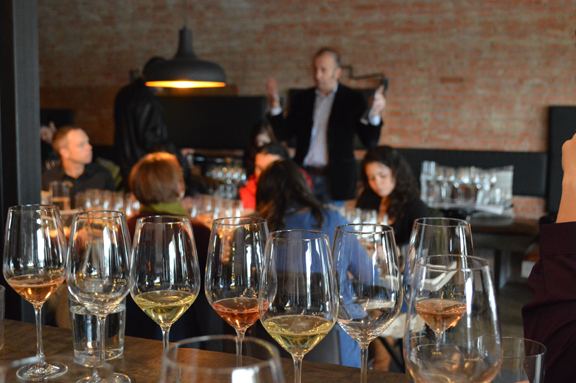
jeremy parzen camerata franciacortaAbove: we poured twenty-two expressions of Franciacorta from eleven wineries yesterday in Houston (photo by David Keck, co-owner of Camerata, Houston’s coolest wine bar, and co-founder of the amazing Houston Sommelier Association).

Last year, in the days that followed Vinitaly (the annual Italian wine trade fair held in Verona), I met up with Franciacorta consortium president Maurizio Zanella for a chat and tasting at his Ca’ del Bosco winery.

We had just tasted though an extraordinary flight of his wines when he asked me a question that took me entirely by surprise.

“What do you think is the best way to market Franciacorta in the U.S.?” he asked (he speaks impeccable English).

Wow, I thought to myself, here’s the guy who singlehandedly built the Franciacorta “brand” in the U.S. and one of the most revered and powerful winemakers in the world. And he’s asking me for my opinion.

I took a deep breath and told him the truth.

“The problem,” I said, “is that Franciacorta has always been positioned as the step-sister of Champagne.” (See my post “Franciacorta and the ‘C’ word” from last summer.)

“Unfortunately,” I explained, “samples are sent to editors at high-profile mastheads who don’t normally write about wine. And when they finally wrap their minds around Franciacorta they invariably call it ‘Italy’s answer to Champagne.'”

“If I were asked to work on a Franciacorta campaign,” I said (and at this point, I could feel a bead of sweat roll down my temple), “I would reach out to the growing number of U.S. wine professionals who are thirsty for Franciacorta knowledge and who have the technical preparation to understand the uniqueness of these wines. They are the ones who work on the front lines of wine education every day and they are the ones that can turn perceptions around. I’d create a blog especially for them and I’d organize ’round-table’ tastings where they could share their impressions of Franciacorta wines.”

houston sommelier associationAbove: the vibe at the Houston Sommelier Association is super friendly and inclusive. Everyone is super professional and the cost of admission is polishing glasses at the end of each meeting.

In November of last year, I met with Maurizio at the offices of the Franciacorta consortium in Erbusco in the heart of the appellation. And he and his team gave me the go-ahead to launch my “Franciacorta, the Real Story” campaign.

For the next eleven months, I’ll be blogging about Franciacorta regularly and leading a series of tastings for wine professionals across the U.S.

Please check out the blog here.

Please follow the blog on Twitter @ClassicMethod.

Please like our new page on Facebook here.

But most importantly, if you’d like to host a tasting, if you’d like to contribute to the blog or if you’d simply like to learn more about Franciacorta, please send me an email by clicking here.

I truly love Franciacorta and I am extremely excited about this new project. You can check out notes from yesterday’s tasting here.

And I’m currently working on doing a mini-version of the same tasting in Austin later this month (stay tuned for details).

do bianchi franciacortaAll images, except for top photo, by Ryan Cooper.

Franciacorta tasting TODAY in Houston: tasting book and useful images

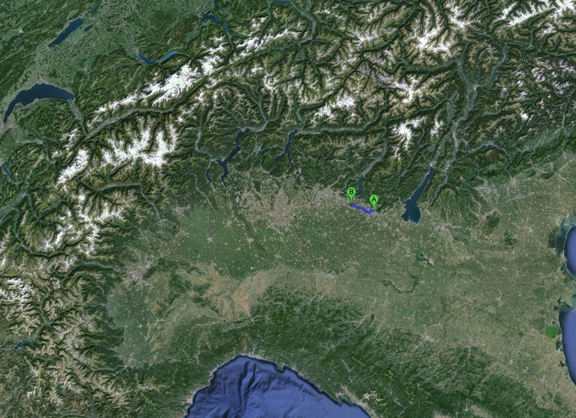
franciacorta alps mapIn case you can’t attend our Franciacorta tasting today at the weekly meeting of the Houston Sommelier Association, please click here for the tasting book and some useful images.

I’m really excited about the event: twelve wineries, twenty-four expressions of Franciacorta.

Thanks again to the Houston Sommelier Association for hosting this extraordinary event.

Amarone: controversial appellation expansion overshadows 2011 debut tasting

hillside vineyard valpolicella amaroneAbove: a view from a hillside vineyard looking out on to the valley floor in Valpolicella (image courtesy the Venturini winery). In a general assembly in May 2013, Valpolicella Consortium members approved a change in appellation regulations that would allow Amarone producers to blend hillside and valley floor fruit in the wines. Some prominent producers and growers groups have vehemently opposed the change.

Members of the Valpolicella Consortium gathered at the Palazzo della Gran Guardia in Piazza Brà in Verona over the weekend to present the 2011 vintage of Amarone (click the link for the list of presenting wineries).

But as top buyers (some from as far away as the U.S.) and leading Italian wine writers and bloggers tasted the soon-to-be released wines, a shadow of controversy hung over the event.

In May 2013, the Consortium proposed a change in appellation regulations that would allow winemakers to supplement hillside-grown fruit with valley floor-grown fruit for the production of Amarone.

The proposed change was ratified in a May 2013 consortium member vote. But it has yet to be approved by the Italian agricultural ministry’s committee on wine. A number of prominent producers and growers associations, including the Federation of Independent Grape Growers (FIVI) and the Amarone Families group, have vehemently and vociferously opposed it.

The as-of-yet unchanged appellation regulations state that grapes grown in “fresh soils on the plains or valley floor must be excluded” from Amarone production (article 4, section 2).

The Consortium had proposed deleting this wording, calling it an obsolete “discrepancy” and a “typo” in an official statement.

While the proposed change would not technically expand the production area, it would allow producers to use inferior quality grapes for the production of the wine — the appellation’s flagship.

“The problem with the valley floor was evident in 2014 because of the heavy rains,” wrote Ilenia Pasetto of the Venturini winery in a recent email exchange. “Valley floor vineyards suffered greatly and the fruit was heavily damaged. At the same time, thanks to the varied shape of hillside vineyards, the rainfall flowed down from the hills toward the valley. Because the water didn’t stagnate and because the hillside vineyards are more ventilated, quality was good even though they produced a smaller amount of grapes than usual. The warm, sunny weather started at the end of August continued through September and it helped to dry the bunches and prepare them for [the Amarone] drying [process].”

Some trade observers have speculated that the Consortium’s move was inspired by the impressive growth in Amarone sales in recent decades.

According to a report published in 2013, the number of bottles of Amarone increased from 2,480,000 to 8,570,000 between 1998 and 2008.

Roughly 90 percent of the wine produced are sold outside Italy, according to the Consortium, mostly in northern Europe, the U.S., and Canada.

In a phone call today, a Valpolicella Consortium representative said it’s unclear when the proposed change will be reviewed by Italian government officials.

Le Logge, a perennial best restaurant in Tuscany, a great white from De Batté, and jazz in Siena

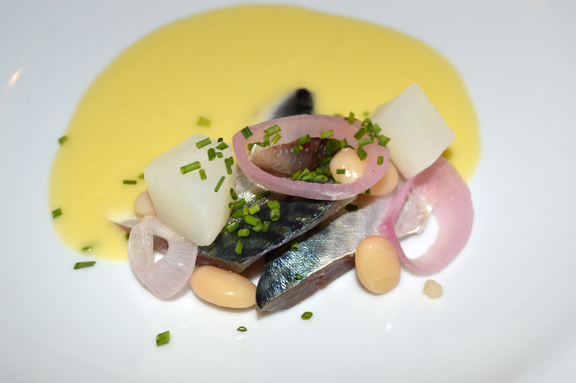
mackarel ceviche recipeLooking back on some of the great meals of 2014 that haven’t yet found there way into my feed, the one that really resonates and reverberates in my mind was a late fall supper at Osteria Le Logge, Laura Brunelli’s amazing restaurant in the heart of Siena’s historic center.

It’s a wonderful place to visit for classic Tuscan cookery (ribollita, fiorentina, etc.).

But the main attraction, at least for me, is Chef Nico Atrigna’s creative cuisine. That’s his mackerel “ceviche,” above.

Chef Nico has cooked so many of my “best” meals in Italy over the last few years. And my visit in early November 2014 didn’t disappoint.

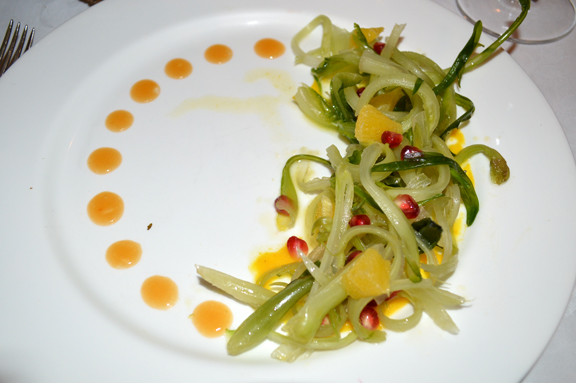
puntarelle roman recipe bestHis dishes are never overly complex. He culls from the mediterranean bounty of materiae primae and masterfully accentuates their aromas and flavors.

This puntarelle salad, above, with citrus was a wonderful study in sweetness, acidity, and astringency.

best lobster pasta recipeBut the plat de résistance was the spaghetti aglio, olio e peperoncino with spiny lobster.

I can’t imagine a more humble dish more nobly executed. It was one of the best things I ate all year last.

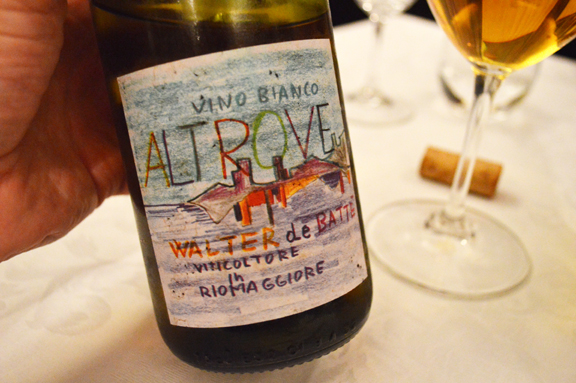
de batte altroveMirco, Le Logge’s wine director, recommended the 2009 Altrove by revered Ligurian winemaker Walter De Batté.

According to an interview I found on the AIS (Italian Sommelier Association) Liguria site, it’s a blend of “Bosco, Vermentino, Rossese bianco, and Marsanne,” but “primarily Roussanne,” in Walter’s words, a grape that the nineteenth-century Italian ampelographer “Gallesio had identified as ‘Nizzardo.'”

The word altrove means elsewhere in Italian. I loved Walter’s post-modern explanation for the wine’s name, which can be found on the back label.

“In the Mediterranean,” he writes, “infinite elsewheres are hidden in every where.”

Notes of thyme played against this macerated wine’s rich minerality and breadth of stone fruit flavors. An extraordinary wine (at a great price).

Mirco, who knows my palate well after all these years, never misses a beat (ask for him when choosing your wine at Le Logge).

best music club sienaDulcis in fundo (Latinists among us will get the paronomasia), Laura has finally opened her subterranean music venue and wine bar called “Un Tubo” (Italophones will get the irony).

The night I was there, a classic rock cover band was seriously rocking out the house.

But from what I glean on the club’s website, jazz is the genre best represented there.

Anyone who’s ever spent any time in Siena knows that the dining and nightlife options there are next to nihil.

Laura has done an amazing and single-handed job of changing that. Beyond the extraordinary daytime sight-seeing there, the trip to Siena is worth it just to eat at her restaurant and drink a glass (or two) of Franciacorta at her super fun music joint.

Taste Franciacorta with me this Wednesday in Houston (FREE)

houston somelier associationAbove: the Houston Sommelier Association is one of the coolest and most friendly wine “study groups” in the country. The mood is always convivial but serious and everyone, even laypersons, are always welcomed with open arms.

Please come out and taste with me: I will be leading a Franciacorta tasting this Wednesday at the weekly meeting of the Houston Sommelier Association.

Here are the details:

Franciacorta “Real Story” Tasting
Wednesday, February 4
10:30 a.m.
Camerata
1830 Westheimer
Houston, TX 77098
(713) 522-8466

It looks like we will have wines from each of the five six Franciacorta wineries currently available in Texas.

And we will also have a number of wines that are not sold in Texas.

It should be a super fun event and if you are in town, please join us.

The event is free: polishing a few glasses at the end of the tasting is the price of admission.

Wine snubbiness and snobbiness, ENOUGH! Marlowe, how low can you go?

The dandy's perambulations : embellished with sixteen caricature engravings (1821)While I was in New York last week, someone from the wine trade was so rude to me — on the floor of a hopping Manhattan restaurant no less — that my dining companions were left speechless by his ill manner.

And so I wrote and recorded a song about it (click, listen, watch, and grab below; for those who don’t know me through music or who didn’t attend my high school, my nickname is “the Jar”).

Snubbiness and snobbi[sh]ness have been since the advent of the modern era. As industrialization reshaped Europe and a new governing “management” class emerged, wine became an emblem and ornament of the haves and the other-halves and their supposed superiority.

In recent decades, in Europe and perhaps to even a greater extent here in America, wine culture has become increasingly demotic. Not only has wine become more accessible and more appreciated by a broader and more diverse group of people, it has also found its way into workaday parlance (that’s why the word demotic is so apropos here).

Despite the wider, however commerce-driven, reach and embrace of wine, a new form of elitism has emerged over the last ten years or so. And sadly, this new snobbiness and snubbiness has also spilled over into the world of wine writing and wine media.

Some have even exploited this newfound aloofness as a marketing tool — and in the name of a faux proletarianism no less!

Who can forget the bully and internet troll who endlessly harassed and berated wine bloggers and social media users who didn’t kow-tow to his party line? His disingenuous, cliquish tactics were a savvy form of marketing: he used snubbery and snobbery as a means to build visibility for his brand.

In the wake of the episode last week, I was inspired to write the song (a “love letter” to the high and mighty among us) and to write this post: it’s time to stand up to bullies and assholes.

After all, hospitality is at the heart of our trade. We live in the post-multi-cultural era, where diversity, pluralism, and inclusion are the bywords of social interaction.

Have you ever been to the famous Subida restaurant in Friuli a stone’s throw from the Slovenian border? As soon as you enter the restaurant, the owner offers you a slice of prosciutto and a glass of wine. It’s an expression of a centuries-old tradition of restauration (in both the etymological and literal sense of the word).

And even when petty competitiveness trumps collegiality (as it did the other night on the floor of a bustling Manhattan restaurant), wine professionals need to remember that the driving force of the trade is the will to embrace our fellows — just as Josko Sirk of La Subida teaches us. If that’s not the reason that you’re in the trade, then you are in the wrong business.

If you’d like to join me for asshole-free tasting next week, I will be pouring what I believe is the largest selection of Franciacorta wines ever presented in the U.S. at the weekly meeting of the Houston Sommelier Association. All are welcome and the price of admission is polishing a few glasses at the end of the tasting.

Grab the mp3 here.


They came for the pizza and stayed for the Champagne: a Houstonian on top of the world in Manhattan

roman style pizza recipeThe pizza at Marta in Manhattan last week was awesome: authentic Roman-style, with perfectly seasoned and fired crust and classic and creative toppings (the Carbonara with potatoes was the biggest hit at our table).

But the thing that impressed me the most was the wonderful wine list and wine director Jack Mason’s grace, ease, and affability on the floor.

To my mind, he is the apotheosis of the modern sommelier: an extremely informed, highly able educator and immensely gracious host.

I first met Jack a few years ago when he was just starting out as a sommelier at Pappas Bros. Steakhouse in Houston. Today, he and his aggressively priced short list of wines from Champagne are at the center of the wine universe.

I phoned him earlier this week and interviewed him for the Houston Press.

He is the nicest guy. And let me tell you, folks, we need more wine pros like him.

Check out my post here. Thanks for reading!

Is Charlie Bird the best restaurant in the U.S.? It’s my current favorite…

razor clam recipeThe meal at Charlie Bird in lower Manhattan was so good the other night that I felt like I was cheating on my wife by eating there without her.

Yes, yes, I know. It’s ridiculous to talk about “the best restaurant” anywhere. I’m a devout anti-listiclist but my experience at Charlie Bird was so thrilling that I’m just going to go ahead and blurt it out like a schoolboy: it’s my favorite restaurant in the country right now.

That’s the crudo we were served, above, razor clams and bay scallops (I wrote up nearly all the dishes over on the Cantele USA blog; the dinner was the culmination of a week in NYC with my super good friend and client Paolo Cantele, who treated me to this extravagant repast).

barbaresco santo stefano giacosaYes, it’s true: the bottle of 1998 Giacosa Barbaresco Santo Stefano didn’t hurt.

Man, what a wonderful vintage of this wine to drink right now! I’m sure it has many years ahead of it but it was an extremely thoughtful (and generous) selection by Paolo, for its elegance, grace, and drinkability. Perhaps more than any other producer, Giacosa’s wines capture the “unbearable lightness,” the ineffable balance of power and litheness that make Barbaresco such a unique expression of Italian viticulture.

Between 1999 and 1998, the former is arguably the better vintage. But this wine drank at what might be the peak of its performance. Simply stunning wine.

roulot tillets mersaultLike nineteenth-century amanuenses, Robert Bohr and Grant Reynolds transcribe their reserve list by hand. How cool is that? Very, in my book.

And every wine on their handlist can be ordered by the half bottle (they pour the rest of the wine by-the-glass on the same night).

I recently hung out with Robert and Grant and they are both such down-to-earth, genuinely nice guys (despite the flurry of media attention they’ve received in recent years).

It’s not hard to understand why everyone in the wine trade wants to eat at their spectacular restaurant (apologies for the superlatives but I just really, really loved this place).

Paolo, thanks again for this truly unforgettable experience. We had a great week together in New York and this was a real treat.

Grant, thanks so much for taking such great care of us and the fantastic wines you shared. The Roulot was so spot-on and a breathless pleasure for me. Your restaurant and wine list are super cool.

On the food: Charlie Bird’s menu is confident without arrogance; it is self-aware without cockiness. That may sound like a weird thing to say about a gourmet experience. But how many dishes are served in Manhattan every night with a side of affectation? Too many to count… Check out my write-up of the food on Paolo’s U.S. blog here.