Like so many things in the new Trump America, the sparkling wine options for New Year’s Eve this year in Houston seem to have been reduced to a zero-sum game: either you drink Champagne and spend a buttload of money to sit courtside; or you drink Prosecco and sit in the nose-bleed seats where you figure you might as well have stayed at home and watched the game on your own big-screen TV.
And like so many other things in the new Trump America, the bogus Champagne vs. Prosecco dichotomy is a bunch of bullshit meant to keep you believing that aged, bigoted, overweight, rich white people who can’t spell are going to save you from the wretched life you live…
It had to have been 2003 when someone graciously offered to take me to dinner at Alain Ducasse at the Essex House. At the time Per Se wasn’t online yet and Ducasse was New York City’s only three-Michelin-star restaurant (remember all those articles about whether or not Michelin-style restaurants would take hold in the city?). Even though the restaurant had been open for 3 years, it was still one of the sexiest and most difficult reservations to obtain. Henry Kissinger was in the dining room the night we ate there.
We were seated in the back, near the restroom, not that that mattered. It was a beautiful restaurant and there literally wasn’t a bad seat in the house.
I had been asked by the host to select the wine and when I spied the 1996 Poderi Colla Barolo Dardi Le Rose on the list for great price (around $130 if I remember correctly), I couldn’t resist ordering it.
The sommelier took my order but then returned to inform me that she wouldn’t be opening the wine for me.
“It’s too young,” she said, “and it isn’t drinking well. We’ve selected a different bottle for you instead.”
She had picked a new-barrique-aged Barbera d’Asti instead. It wasn’t the time or the place to make a fuss (in part because I was someone’s guest). And so, in the spirit of not interrupting the brio of the evening (we could hear Kissinger’s voice booming from the main dining room) and to go with the flow, I bit my tongue (an apt expression!) and didn’t say a thing.
One of my early mentors, the Italian wine maven Charles Scicolone, had first told me about Poderi Colla and the legacy of Beppe Colla, his brothers, and his family’s legacy as winemakers.
You don’t me to recount that story here. Many before me have written ably of Beppe Colla’s herculean contribution to the evolution of the Piedmont wine trade and the many benchmarks that he has set over the arc of a career well spent and a life well lived.
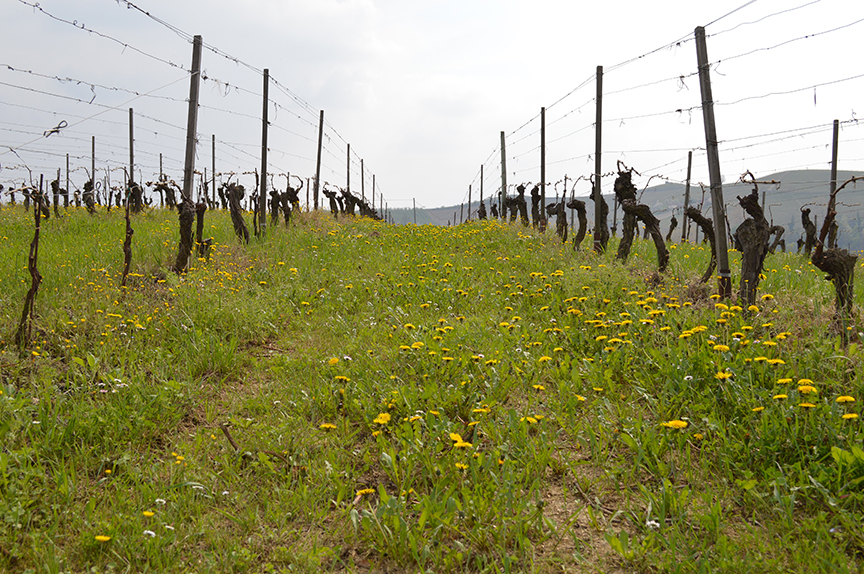
What I will tell you is that until you tread the gorgeous vineyards of this farm and breathe in the salubrious air atop the estate’s Bricco del Drago (“Dragon’s Hill,” in the first photo above), you only know half the story of this magical estate and its enchanting wines.
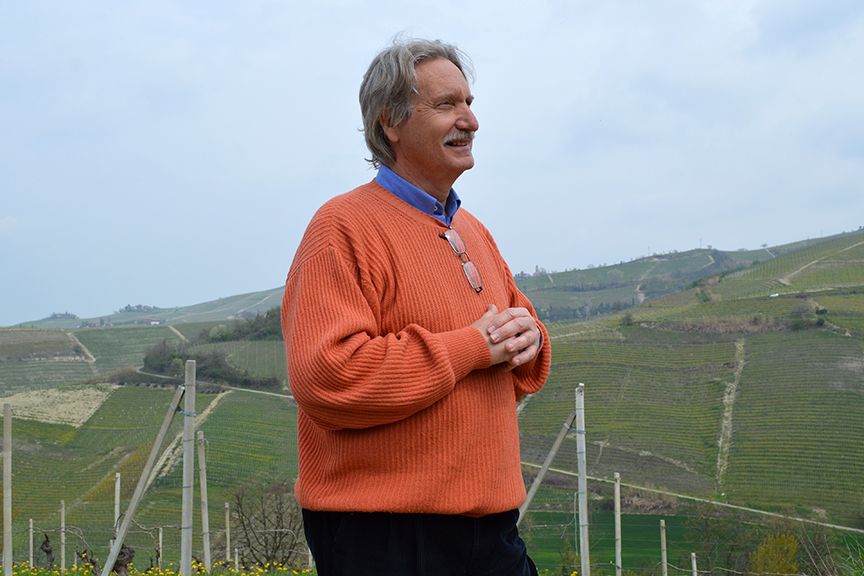
When I visited in the spring, Tino Colla talked at length about organic farming and why his family doesn’t farm organically. It’s all about creating balance in the vineyards, he explained (just look at the flowers growing between the rows in the Bricco del Drago above!).
He laughed as he told our group about a recent visitor from California who was obsessed with organically farmed produce. When she was served an estate-grown peach at the end of a lunch at the estate, he said, she was horrified to find a worm on the piece of fruit. When he tried to explain to her that the worm was a sign of a healthy farm and the absence of pesticides, she wasn’t having it — figuratively and literally.
As he shared his bemusement over her misconceptions about organic growing practices, I remembered the disconnect (literal and figurative) between that first bottle of Colla and me. Looking back, I wonder: was the wine not ready for me or was I not ready for the wine in the sommelier’s opinion?
I hope that that sommelier someday makes it to Poderi Colla. Then she’ll realize that the people who make these wines make them to share with people who want to learn what Langhe wines really are.
I must have visited 20 wineries over the last 12 months and 9 trips to Italy in 2016. Poderi Colla was a visit of a lifetime. The luncheon, the eye-opening tasting, the winemaking museum, and the breath-taking hike through the vineyards. I can’t recommend the estate and the wines highly enough.
Incredible to read this story in the Times after hearing my friend and client Tony Vallone tell it over dinner. I’ve tasted those cannelloni. They are delicious…
HOUSTON — They still talk about the Saturday night here 27 years ago when Donald J. Trump partied with former President Richard M. Nixon.
Dressed in tuxedos, they sang “Happy Birthday” to Texas royalty — former Gov. John B. Connally and his wife, Nellie, whose birthdays were a few days apart — as Nixon played the tune on a white baby grand piano. They dined at Tony’s, the “21” Club of Houston, and Nixon was so fond of the cannelloni pasta that he asked the owner, Tony Vallone, to write the recipe for him on a yellow legal pad. And when it was all over, Mr. Trump flew Nixon back to New York on his 727 private jet.
This year on December 24, humankind will witness an epochal event of a lifetime (if you’re a millennial): The first night of Chanukah will fall on Christmas Eve. That’s only happened one other time in my lifetime (I belong to Generation X), in 1978. And it only happened one other time in the last 100 years, in 1940.
The first night of Chanukah has fallen on Christmas Day twice over the last 100 years, in 2005 and 1959. And Christmas and Chanukah (a historic festival and not a religious holiday for self-aware Jews) often overlap. But when the first night of the Jewish festival of lights aligns with the vigil for the birth of Jesus Christ, it just feels different — magical as if there were some type of confluence of cosmic forces. It can literally take a lifetime for the two to coincide (if you were born in the 80s).
The date for Christmas is determined by the Gregorian Calendar and the date for Chanukah, like all Jewish holidays and festivals, is determined by the Hebrew Calendar, a lunisolar calendar (based on the moon phase and the tropical calendar).
If you’re wondering how I figured this out, it was actually easy: I used HebCal.com.
Christmas and Chanukah aren’t historically related, even though they often overlap. Only in America is Chanukah associated with Christmas as a gift-giving occasion (a contamination of the Hallmark gift card military-industrial complex). In most countries, children may receive dreidels (dice with spindles) and coins for Chanukah. But gifts are not exchanged.
Sephardic Jews often make and serve donuts during Chanukah. That’s because donuts are fried in oil and oil is central to the Chanukah story: According to Jewish tradition, the amount of olive oil needed for one night during the rededication of the Second Temple (in Jerusalem in 165 BCE) miraculously lasted for eight nights.
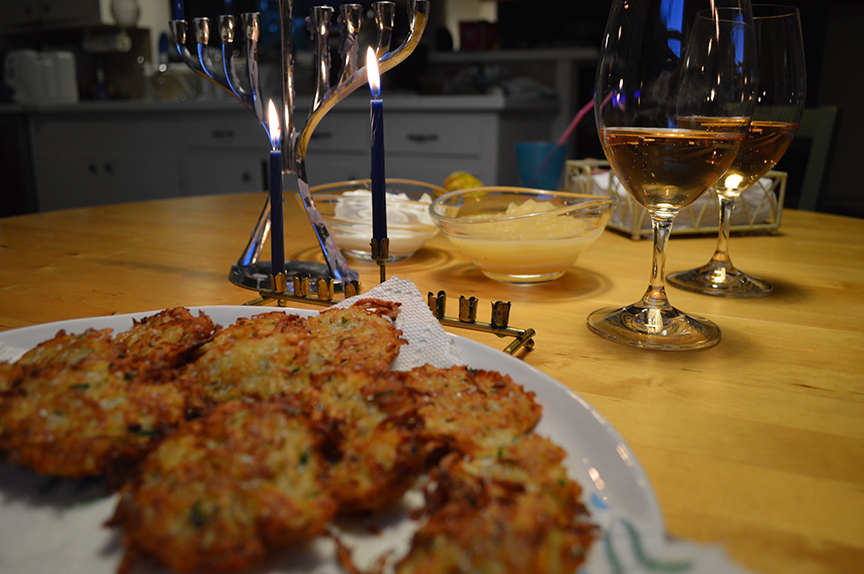
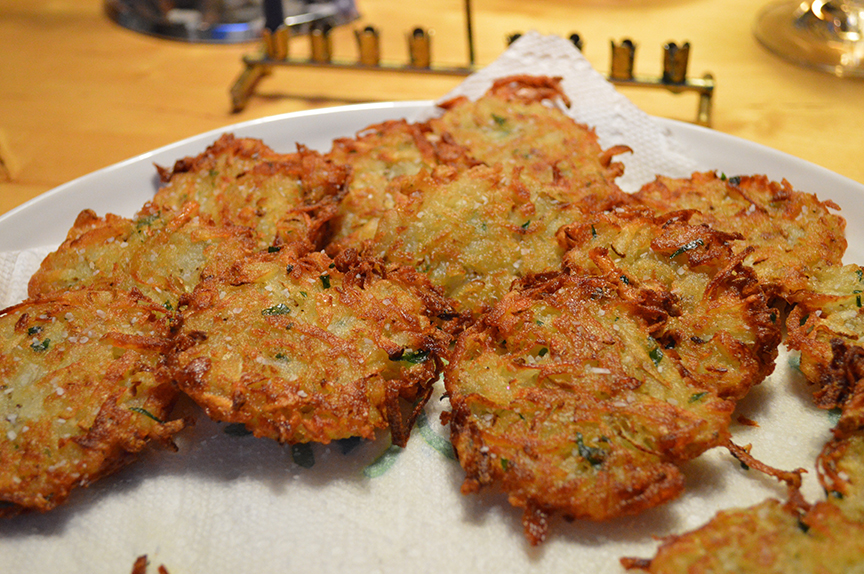
Ashkenazi Jews serve potato latkes or potato pancakes, which are fried in oil. Many Texans will recognize potato pancakes as part of their own culinary tradition: Early German settlers in Texas, many of whom came here seeking religious freedom in the 19th century, also enjoyed potato pancakes.
And that’s why, in the spirit of coming together and sharing our rich cultural diversity in Trump America, my number one recommendation for wine this Chrismukkah (the bogus pop-culture intermingling of religious rituals) is German-speaking wine.
New York-style pizza and pepperoni pizza in particular are among my greatest guilty pleasures.
In the decade that I lived and played music in New York City, I came to learn all the best spots for late-night Manhattan slices as my band’s drummer and I lugged our gear back uptown from our downtown gigs. Oh man, who doesn’t relish a hot slice at 2 a.m. after a night of drinking flat beer and strumming a Telecaster???!!!
Today, the question of pizza and the existential question of pepperoni or regular? play a new and outsized dialectical role in my life: our youngest daughter prefers “cheese” while our oldest waivers between her allegiances to pepperoni and cheese.
The joy, alone, in hearing the word pepperoni uttered by a child, with its trochaic mellifluence, is truly priceless, btw: peh-peh-ROOOOOOH-nee.
My parental pondering of pepperoni pizza led me recently to reflect on the origin of the nomenclature. After all, in Italian, peperoni denotes what we call bell peppers in English. If you ordered a pizza ai pep[p]eroni in Italy, they’d bring you a pizza with bell peppers and not with thinly sliced, slightly spicy sausage.
What, exactly, is pepperoni? It is an air-dried spicy sausage with a few distinctive characteristics: it is fine-grained, lightly smoky, bright red and relatively soft. But one thing it is not: Italian.
“Purely an Italian-American creation, like chicken Parmesan,” said John Mariani, a food writer and historian who has just published a book with the modest title: “How Italian Food Conquered the World.” “Peperoni” is the Italian word for large peppers, as in bell peppers, and there is no Italian salami called by that name, though some salamis from Calabria and Apulia are similarly spicy and flushed red with dried chilies. The first reference to pepperoni in print is from 1919, Mr. Mariani said, the period when pizzerias and Italian butcher shops began to flourish here.
Evidently, the sausage name is a corruption of the Italian peperoncino, as in the little peppers used to impart heat and color to the salami.
Digging a little deeper into my philological neuroses, I discovered that the earliest known printed reference to pep[p]eroni sausage actually dates back to 1888 (the year Nietzsche began to lose his mind) in the Times of London.
This early mention of pepperoni in a list of types of dried sausage leads me to believe that pepperoni might not be an Italian-American invention but rather a food product that is Italo-Britannic in origin (something that is highly plausible).
But I found an even more significant and telling mention in the United States government Yearbook of Agriculture for 1894 (published by the U.S. Government Printing Office), a mention that appears some 25 years before Mariani’s editio princeps.
The author of the entry for sausage wrote the following:
A mealtime and snacktime favorite of millions of Americans, sausages include a wide assortment of seasoned and processed meat products… Some sausages are dried during processing. Dried sausages like pepperoni, thuringer, and dry salmi are quite firm, very flavorful, and normally do not need to be refrigerated.
Herein lies the rub, as it were. Pizza, as we knew it in the 1970s, 80s, and 90s before the pseudo-Neapolitan pizza craze of the 2000s, probably emerged during the “Me” era (that’s the 1970s for you millennials). We think of pizza as an ancient food form. And it is. But the pizza of the 1960s probably didn’t resemble the pizzas pictured in this post, for example. It was the rise of canned tomatoes and processed cheese in the post-war boom of the 1960s that probably made pizza as-we-knew-it possible in the decades that followed.
The passage from the 1894 yearbook reveals that pepperoni sausage was already popular (at snacktimes and mealtimes) in the U.S. by the dawn of the 19th century, long before the great waves of Italian immigration began to take shape in north America. And its popularity was probably owed in some measure to the fact that it didn’t require refrigeration.
Ding! Ding! Ding! That’s probably why it became such a popular pizza topping: it was easy and inexpensive to store.
Regardless of its origins and its linguistic and cultural disconnect, pepperoni pizza is one of America’s great gifts to the world imho. There’s just nothing like a late-night slice after a gig and there’s nothing like the smile on a child’s face as she contemplates: cheese or pepperoni?
Another one of the revelations from that November trip was tasting Marilena Bambinuto’s Greco di Tufo, above.
There are so many great expressions of Greco di Tufo out there but Marilena’s have what the Italians call a marcia in più, an extra “high” gear.
Beautiful focus and purity in this wine, with a gorgeous balance of acidity, alcohol, and fruit and mineral flavors that really danced in my mouth as we tasted the wines paired with her butcher’s sausage and boiled potatoes.
Greco di Tufo can be such a richly flavored wine and, at least in my experience, certain winemakers will go for a ripe style or an intensely mineral style of the wine. But Marilena’s really hit a sexy harmony of all the elements in this appellation, with a classic but fresh and electric interpretation of this incredible appellation.
It may not mean much to the casual wine lover but a stroll through her organically farmed vineyards (see the grassy rows below) revealed a lot about why the wine has such a magic buoyancy to it.
Why is no one bringing this in to the U.S.? It’s made by a small, family-run and owned estate. It’s organically farmed and only native yeasts are used in fermentation. The wines are a pure and purely delicious expression of the appellation. And Marilena, her family, and her wines couldn’t be a more authentic expression of wild Irpinia.
I owe this discovery to my friend and colleague Marina Alaimo, a writer, blogger, and sommelier based in Naples. Anyone who follows Italian wine, and especially southern Italian wine, knows Marina from social media (if you don’t, friend her here). And she graciously organized my visit that day (and a lot more that I will write about in an upcoming post).
Thank you again, Marina, for such a thoughtful choice of winery for me to visit and taste on my first trip to Irpinia. And thank you, Marilena, for the time and the wine. I can’t wait for someone to bring your wines to America.
To quote a Joni Mitchell song, I could drink a pallet of Bambinuto!
Thomas Moësse is one of the top Italian-focused wine professionals working in Texas and he’s just launched a new wine bar/wine shop concept in Houston’s ritzy West University neighborhood, the first of its kind for the Bayou City.
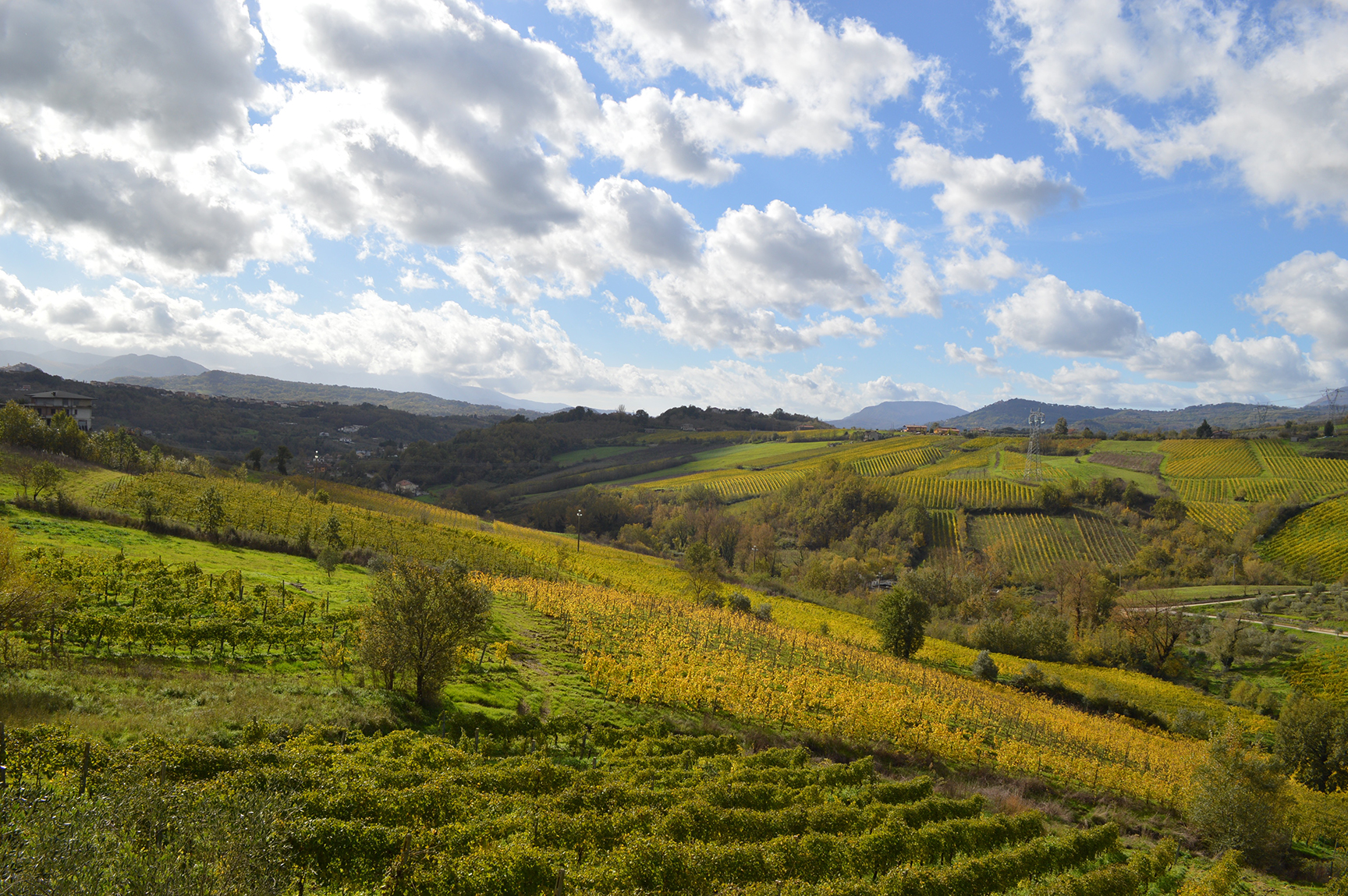
Above: Irpinia, the wild volcanic highlands of Campania where some of Italy’s most extraordinary wines are raised (click the image for a higher-resolution version.
Of the nine trips I made to Italy this year and the literally hundreds of wines I tasted, one of the most remarkable visits was with Daniela Mastroberardino, co-owner of the Terredora winery, who took me on a tour of her family’s vineyards in Montefusco township in Irpinia, Campania’s wild volcanic highlands.
Like many U.S.-based Italian wine professionals, I’ve logged countless hours of vineyard tours and winery tastings in northern Italy between Piedmont, Lombardy, Veneto, and Friuli. And there are few Tuscan hilltop villages between Montalcino and Rùfina that I haven’t visited over the nearly 30 years that I’ve been traveling to Italy.
Of course, I’ve also tasted (and have drunk with gusto) more than my fair share of Irpinia wines: Taurasi, Fiano d’Avellino, Greco di Tufo are all appellations whose wines are increasingly available to American fine wine consumers like me. But until this year, I had never spent any time with those wines in situ.
What a revelation to tour these forgotten, untamed hills of southern Italy’s wine country! As we drove up and down the steep roads that lead to and from Montefusco village (one of the hubs of Irpinian viticulture), I remembered hearing Italian wine maven Charles Scicolone talking about his early visits to Italy in the 1970s, when Italian farmland was just beginning to be developed by big industry. “There were vines everywhere,” he would tell me, noting that the Italian countryside has been radically transformed since those years. Driving through Irpinia, I imagine that it resembles the Italy that Charles saw when he first visited some 40 years ago.
Above: the only industry in Irpinia is grape growing and winemaking, Daniela explained. These highlands, with their volcanic top soil, are bordered on every side by active and extinct volcano mountain chains. As you drive from Naples up into the hills and then past Avellino, your ears begin to pop from the change in altitude and you enter into a viticulture landscape seemingly suspended in the sky with volcanoes as its moorings (click the image for a higher-resolution version).
Although fine wine has been produced in Irpinia for millennia, the volcanic top soil — mostly the fallout from ancient eruptions on Mt. Vesuvius, I was told — played a fundamental roll in the development of the wine trade here in the 19th century: the tiny grains of volcanic sand that form the top layer of farmland here made it impossible for phylloxera to thrive. Echoing what grape growers told me in Santorini, for example, the little creatures simply can’t negotiate the fine soil (or as one winemaker put it, they can’t jump from one grain to the next, making it impossible for them to survive).
Above: one of my top meals of 2016 was at the Antica Trattoria di Pietro dal 1934, where Daniela treated me to these Campania-style cavatelli (different from Puglia-style) dressed with tomato and wild herbs. This dish and the entire meal at Pietro alone would have been worth the journey. Di Pietro doesn’t seem to have a website but it does have a website but it does have a Facebook. Note to Italian gastronauts: seek this place out and you won’t be disappointed. And note to Italian wine connoisseurs: a deep-reaching cellar brimming with older vintages of Taurasi, including the 1998 Terredora that I enjoyed thoroughly.
The other revelation for me was tasting current and older vintages of her family’s wines with Daniela. As she opened an unforgettable flight of wines from the 2000s and even late 1990s, I was reminded of what a wise wine buyer told me many years ago in Austin: trust the wine, not the story.
Daniela’s wines have always been marketed and positioned as excellent restaurant-friendly expressions of Campania winemaking, with an emphasis on their modern-style and their appeal to modern sensibilities in wine tastes. And her family’s wines are immensely successful in the U.S., where you can find them on a wide range of wine lists.
But as we tasted over dinner and tasted through the wines, and then the next day, as she gave me and a pair of Milanese wine merchants a tour of Irpinia wine country, I realized that no one had every told me the real story of these wines. There’s a lot more soul in these bottles than I think a lot of people understand. To see the pristine wild areas where they are grown and to hear the tale of blood, sweat, and tears that the Mastroberardino siblings (the children of Walter Mastroberardino) shed as they built a winery from scratch in the earthquake-prone highlands in the 1990s, I began to wrap my mind around these wines and what they mean in the context of Irpinian viticulture.
Above: this 1998 Taurasi was just one of the older vintages of her family wines that Daniela opened for me. What an eye-opening wine! Very fresh, with perfectly integrated wood and super vibrant fruit flavors. Tasting this wine and learning the story behind it, really helped me to understand what these wines are about.
I also really loved an older vintage of Fiano that she poured for me: with aging these wines achieve nuanced layers of fruit and mineral flavors, notes that you miss — I believe — when you taste the current vintages.
When I really took the time to learn more about the places where they are grown and to taste them patiently and in context (and not just wine a sales rep who’s pulled them out of a chilled wine bag on a hot summer day in Los Angeles), I realized that these wines have a lot more substance than their deep-punted California-style bottles reveal at first sight.
Both the 1998 classic Taurasi and the 2004 single-vineyard Taurasi Pago dei Fusi (which I don’t believe is available in the U.S.) really blew me away with their sheer beauty. Great wines with a great story that has yet to be told…
Thank you, Daniela, for the wonderful visit and the gracious hospitality. That was such an eye-opening and memorable visit!
This is just the first in my series of posts from Naples and Campania. Stay tuned and thanks for being here…
A lot of people have asked me to share my insights into Sunday’s referendum on political reform in Italy and the implications of the Italians’ resounding “no” vote. (In case you’re not following the New York Times, check out this recent coverage of the fallout from this week’s vote, an overview of why it could prove to be a pivotal moment in Italy’s new future and the stability of the European Union and its currency.)
On my last visit to Italy, the first night I was in the country in early November, I was invited to a dinner party at the home of a successful hairdresser. The 8 or so guests (give or take a few that stopped by to say hello) were all progressive middle-aged professionals, people more or less my age and like me. Naturally, they grilled me not for dinner but on my thoughts about Donald Trump and could he possibly be elected president?
As in many Italian homes during dinner, the television was on full-blast throughout our repast. There was a lot of coverage of earthquake relief (central Italy has been struck by a series of major earthquakes this year and many ill-prepared hilltop towns there have been devastated by the powerful seismic activity). Art historian Salvatore Settis (whom I knew during my Scuola Normale and Getty days during grad school) was on, talking about his new book, If Venice Dies. And of course, there was coverage of the December referendum on constitutional overhaul.
When I shifted the conversation from Trump to the referendum, the table fell silent. Not one guest at the dinner party wanted to break the brio of the evening by unleashing polarizing, divisive thoughts and feelings on the subject. Amen. And so it was.
According to most accounts, youth unemployment in Italy continues to hover at 40 percent. When we complain about the lack of job opportunities for young people in the U.S., we often don’t realize that our outlook is much rosier than for nearly all of our European counterparts. And Italy, where economic recovery from the years of the financial crisis has yet to take hold, is facing challenging times ahead.
I work in and write about Italian wine, but my life in Italy brings me into contact with people there from all walks of life (thanks to the many years I lived, studied, and worked there). Among my peers, the only people I see who are thriving are those who have created their own small businesses. Most of the people I went to school with enjoy job security (mostly in publishing and marketing) but many are deeply disheartened by their inability to change their economic status or provide greater economic mobility for their children.
I even have a few friends who are postermen for Italian mammismo. The only difference is that, at 50 years old (like me), living with your mother is no longer cute.
The economic challenges of middle-class life in Italy have been weighing on my peers and counterparts for more than a decade (the seeds of the current status quo go back to the demise of the corrupt socialist coalition in the 1990s). This seemingly unsurmountable intractability was likely what prompted the silence that fell over the table when I asked my dinner companions to share their thoughts about the referendum. Better to embrace the brio of the moment than to bust open the fears and insecurities that brimmed beneath.
On Sunday night, after the results of the referendum were clear, a good friend of mine wrote the following on his Facebook. He’s a successful winemaker who also works in a political lobby for farmers and grape growers.
Listening to [Massmo] D’Alema laughing on the radio, saying that today was a great day, with the Elio e Le Storie Tese song “Land of Persimmons” in the background, makes me realize that we are definitively SCREWED [sic] as a nation.
Happy Monday to all the people who will continue to break their backs to make their businesses succeed, to all the people who are creating jobs as they try to show foreigners that we are something more than the “Picturesque Country” in [actor and comic] Enrico Montesano’s “English Lady” [skit].
I’ve embedded the videos of the song and the skit below. His mood, I believe, is representative of many successful middle-aged Italians who view the EU and constitutional reform as vital to Italy’s future.
The populist movements, on both the far right and far left in Italy, see the outcome of this week’s vote as an opening for their agenda (although a streamlining of the Italian parliament, which would have been set into motion had the result been “yes,” would have also opened political channels for Italy’s rising populist parties).
“The political demise of Mr. Renzi, the Italian prime minister, and his reform agenda removes an unabashedly pro-European leader who had hoped to ignite economic growth by ending an era of crippling budget austerity. Instead, he may be remembered for creating an opening for politicians who are openly hostile to Europe and the euro.”
Renzi’s fall could very well usher in an era when Beppe Grillo’s Five Star movement enters into the mainstream of Italian politics (again, see the Rubin’s piece for the Times). It’s probable that Grillo will call for a referendum on leaving the Eurozone (the first step in leaving the EU). If Italy, a founding member, were to leave the EU, it’s likely that the union would collapse.
It’s hard for me to believe there would be a moment in my lifetime, let alone my children’s lifetime, when the future of the EU could be in question. But then again, I never thought it possible that a populist candidate like Donald Trump could be delivered to the White House on a fundamentally bigoted platform.
The one thing that is certain about the results of Sunday’s vote in Italy is uncertainty. So many Italian wine bloggers love to quote the famous line from The Leopard: “everything needs to change, so everything can stay the same.” Scarcely do they know the portent of this utterance in the historical context in which it was first spoken and its deep-reaching relevance today.
In the wake of this week’s vote, maybe it’s more fitting to say: everything needs to stay the same so everything can change.










 Do Bianchi