From the department of “I get a nose bleed if I travel north of 14th St.”…
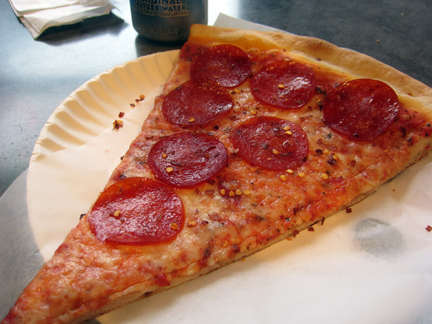
There are others but Village Pizza is always a winner in my book…


From the department of “I get a nose bleed if I travel north of 14th St.”…
There are others but Village Pizza is always a winner in my book…
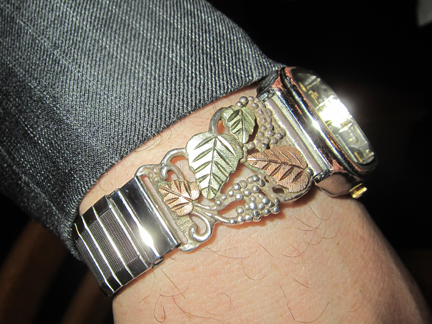
“My mother was disappointed that I didn’t become an architect,” said Victor Pinkston as he opened and poured me and my good friend Jeff a bottle of 1999 Barolo Villero by Brovia on Thursday night in Manhattan at Otto. “But then I showed her the watch that she gave me [above] when I was a kid and told her that ‘it was meant to be.'”
Victor’s done pretty well for himself: after five years as a company man in the Bastianich-Batali dynasty, he’s landed the job as wine buyer and head sommelier at the empire’s pizza joint.
And while he and I may disagree on the finer points of the modern vs. traditional dialectic, the dude definitely knows his shit.
When I lived in the City, Otto was one of my best-kept secrets: although not a fan of the university and tourist crowd that hangs there (Otto is, after all, “Molto Mario Light,” if such a thing can exist in the rational and sensual world), I knew I could always find some older Nebbiolo there at reasonable prices. Back in the day, I practically depleted an allocation of 1993 Barbaresco Nervo by Pertinace at $75 a pop (there are still some bottles left although at a higher price). And when I asked Victor what trick he had up his sleeve, he suggested no fewer than five labels from the 90s under $150, including an Oddero Barolo (classic) 1996 (wow!).
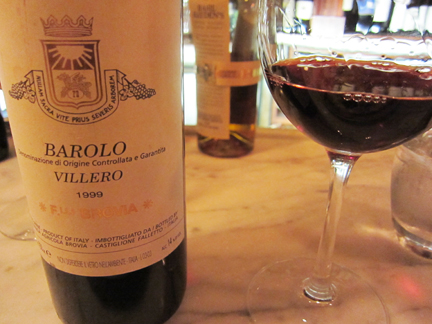
But it was the 1999 Barolo Villero by Brovia at $140 that spoke to me. (Remember this post by Saignée on our visit to Brovia a few years ago?)
I am no fetishizer of old wine and you’ll never hear me cry infanticide when a great one is opened before its time. But I must admit that this bottling was going through an extremely tight phase.
It was dense and deliciously chewy, with mushroom and earth dominating the fruit. But as Jeff and I slowly nursed this spectacular bottle, the berry fruit began to emerge, as did a delicate eucalyptus note, with the zinging acidity — the nervy backbone, as the Italians say — plucking on the strings of fruit and earth like Jimi Hendrix playing the first notes of “Little Wing.”
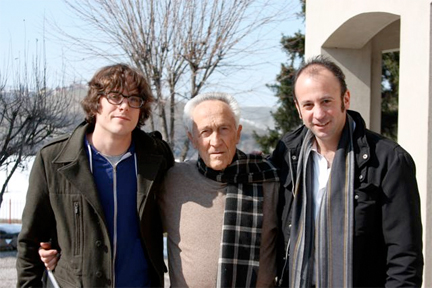
That’s me and Cory aka Saignée (left) with Giacinto Brovia back in March 2009 (photo by Brunellos Have More Fun). And here’s what Saignée had to say about our visit there.
Let’s just hope that Victor saves a bottle of this truly thrilling wine for us to taste next year.
Stay tuned for New York Stories II: Alice and I visit Maialino… or “two Jews walk into a Jew-owned bar named ‘suckling pig'”…
Not a lot of time to post today… slammed with meetings in NYC…
Here’s what I ate last night at Tertulia, an awesome new Spanish joint in Manhattan…
I didn’t get a picture of the FANTASTIC Brussels sprouts, roasted with a generous dash of cumim. They had me cumin in my…
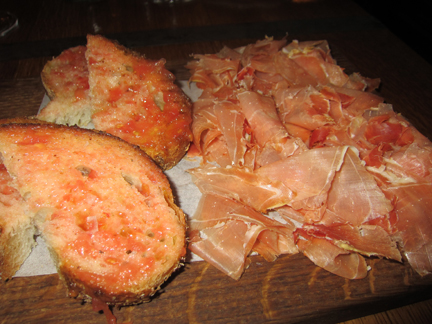


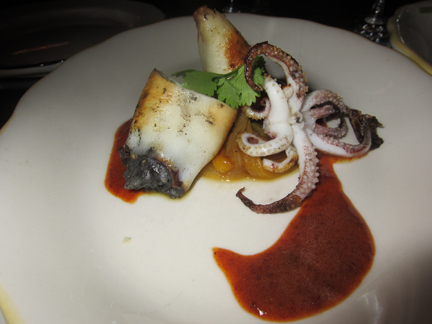
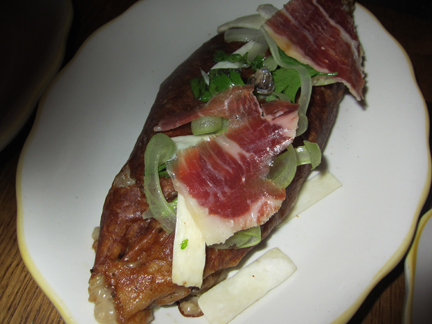
Stay tuned for my notes on the 1999 Barolo Villero by Brovia that we drank later in the evening…

Photo by Giovanni.
Heading this morning to New York City for meetings and some wine bar hopping… See you on the other side…
Lou Iacucci, I remember the night he died so well,” said thirty-something Edoardo Falvo, scion of the Avignonesi family and co-owner, with his brother Alfredo, of the Masseria Li Veli winery in Puglia.
The glamorous Edoardo and his effervescent wife Alessia Nebuloni were in Austin, working the market with their wines from Salento and my good friend, Master Sommelier Craig Collins, regional sales manager had asked me to join them for dinner.
In case you don’t know who Louis “Lou” Iacucci was, just ask anyone who worked in the New York wine business back in the 1970s and 80s: as the owner of Gold Star Wines and one of the founders of Vias Imports, Lou started importing fine wines from Piedmont and Tuscany before anyone could imagine the renaissance of Italian wines in our country that emerged in the 1990s. Every New York-based Italian wine professional over the age of 50 remembers Lou (whom I never met) as the great pioneer of the contemporary era of Italian wine in our country. The legendary wine cellar at Manducatis in Long Island City, Queens was shaped by his palate and the then unknown wines he imported — particularly from Piedmont.
“I remember that night very well,” recounted Edoardo. “Fabrizio Pedrolli [his partner in Vias] called to say that there had been an accident. He was crying and he told us that they had been driving in two separate cars. Fabrizio had passed a truck on the road and Louis followed him. Fabrizio made it but Louis had a frontal collision. They were driving from Siena to meet my father [Alberto Falvo] at the winery [Avignonesi].”
I imagined that Edoardo would remember that night because a number of people who knew him had told me that he was driving to Avignonesi when the accident occurred.
Lou was taken to the hospital in Siena where he died the next day, said Edoardo.
Even though I never met him (and he passed long before my time), Iacucci sits supremely in my mind’s vision of the Italian wine Olympus. And his hagiography is as fascinating (at least to me) as the Nebbiolo he brought to this country in a time before the American media reinterpreted the iconic wines of Italy — just ask Charles Scicolone, Alfonso Cevola, Livio Panebianco, Francesco Bonfio et alia…
Edoardo’s reminiscences of the evening sent goosebumps traveling across my skin… The night that Lou Iacucci expired was, in many ways, the day the music died.
(BTW, Googling around before I composed this post, I came across this excellent and superbly detailed account of the recent sale of Avignonesi and its new owner and her biodynamic conversion of the estate. Fascinating reading imho.)
In other news…
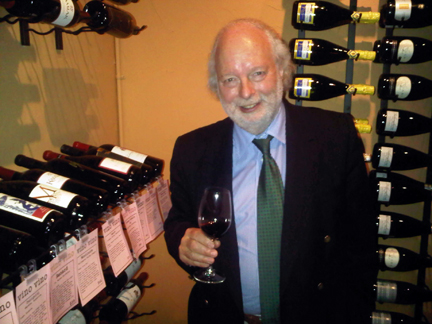
Yesterday wine legend Christopher Cannan (above) was also in the River City (that’s Austin to the rest of yall) at the best little wine bar in Texas, Vino Vino, pimping his new project, the Clos Figueras (Priorat).
He seemed most geeked to taste me on the white he produces on the newish estate, a blend of stainless-steel fermented Viognier with smaller amounts of cask-fermented Grenache Blanc.
“They were supposed to send me Cabernet Sauvignon [rootstock],” he told me, “but they sent Viognier instead. And so I decided to plant it.” The wine was fresh, with bright acidity, and I was impressed by how the Viognier’s unctuous character was kept in check by the wine’s overall balance. It was delicious.
To all those folks who were worried about me not having any good wine to drink down here in Texas, not to worry. We do alright… ;)
 Looking back on September 11, 2001, I know I am not the first to think of it as a catastrophic tragedy comparable to the Sack of Rome in the 16th century. But, today, as I reminisce about the gigs I played at The Greatest Bar on Earth — 1 World Trade Center, NY NY 10048, on the top floor of the north tower — I realize that, like the Sack of Rome, the tragedy of 9/11 marks a cultural watershed: it’s as if our frenetic quest to document our lives through digital images and information began after September 2001 (in the same way that art historians and literary scholars point to the Sack of Rome as a cultural turning point, when there was an overarching shift in our self-awareness).
And so I dug up some old photos and fliers from my pre-9/11 world when my band (above) was still called Les Sans Culottes (today Nous Non Plus).
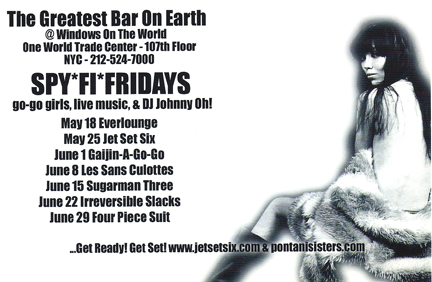
Back then, we played at The Greatest Bar on Earth nearly once a month.
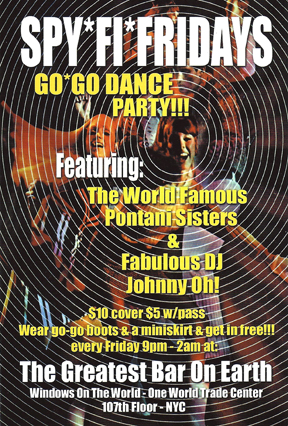
Remember the World Famous Pontani Sisters? We did a lot of shows there together, with the Pontanis on stage with us. “Wear go-go boots and a miniskirt and get in free!” That pretty much sums up the spirit of those days in New York. We played some wild shows back then.
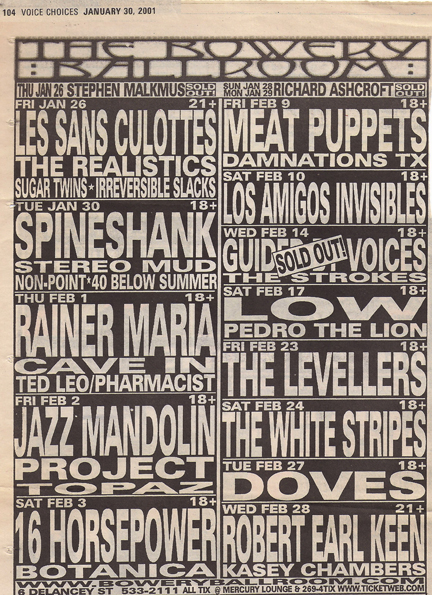
Those were wild, fun years in my life, when I was still in my early thirties and had moved to NYC just a few years previously. Back then, my day gig was writing about wine for La Cucina Italiana. The band played roughly 50 gigs a year in NYC, where we had a great following. It was a super fun time (look at the other bands that were playing the Bowery Ballroom, above, where we often were the headliners). Seems like a lifetime ago now. It was…
On my September 11, I awoke in Brooklyn and learned that something had happened — although I didn’t know yet what — when I called a colleague in TriBeCa to confirm a 9 a.m. morning meeting. I didn’t have a TV back then. And so I tuned in NPR on WNYC on my Mac over the internet. As soon as what was happening sunk in, I picked up the phone and called my mother who was still sleeping in California, three hours behind NYC time.
“Mom, sorry to wake you.”
“That’s okay, honey.”
“Something’s happened in New York. Something bad. I’m not going to be able to call you later. But I’m calling to let you know that I’m okay.”
“Okay, honey. Thanks for calling.”
She hung up and fell back asleep. The whole world had changed.
By the end of the day, singed shards of paper, business documents, rained gently down on my neighborhood in Park Slope, fluttering as they fell back to earth. I’ll never forget that image.
I was very lucky that I didn’t head into the city that day. I would have been on the 2 or 3 train, passing under the WTC.
G-d bless all the people who suffered and lost and gave their lives that day.
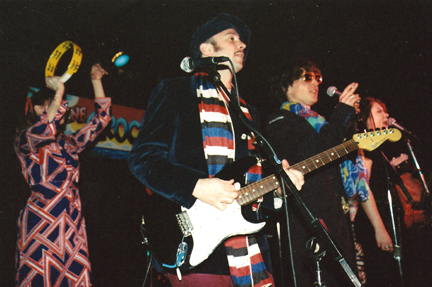
Above: This shot is from Arlene’s Grocery in Lower Manhattan but that’s pretty much what I and the French band looked like in 2001, when we used to perform regularly at The Greatest Bar on Earth (Windows on the World) in the north tower of the World Trade Center.
“There’s no fucking meeting today,” said the French voice on the other end of the line. “Turn on the news.” It was 9:00 a.m. and I was heading out the door from my apartment in Park Slope, Brooklyn to a 9:30 a.m. meeting with a client on Desbrosses Street in TriBeCa. Thank goodness I didn’t get on the 2 train. I’m not sure if the second plane had crashed at that point but by the time I was able to tune into WNYC on my Mac (I didn’t own a television then), the south tower had been hit as well.
I picked up the phone and called my mother in California. She was still asleep. “Something’s happened, mom,” I told her. “You won’t be able to reach me today but I’m calling to let you know I’m okay.”
“Thanks for calling, honey,” she said yawning. She went back to sleep and would only learn what had happened when she woke up. By that time, my cellphone (my only phone) no longer worked.
My upstairs neighbor and landlord Janet knocked at my door. She was in tears and hysterical. She asked me to sit with her in her living room until her husband and son could make it home. I did.
Later in the day, singed pieces of paper — from all sorts of documents — gently rained down on our neighborhood. All of the fire fighters from our local fire station — just a few blocks away — perished in the tragedy. In the days that followed, we learned that some of the terrorists had resided just a few blocks from the house where I lived. I passed in front of their mosque nearly every day on my way to the YWCA gym where I had a membership. On my way home from my workout, I would often buy falafel at the deli next door on Atlantic Avenue.
All of these memories flooded into my mind last night when I came home from a food and wine event in downtown Austin and Tracie P had the TV on: “President Obama is going to make an announcement,” she said. Osama bin Laden was dead.
Between 1998 and 2001, the French band (above) performed once a month at The Greatest Bar on Earth (Windows on the World) in the north tower of the World Trade Center. Burlesque was the new fashion in hipster circles and we often played with The Pontani Sisters, who danced on stage as we played. Giuliani was mayor and you could still smoke cigarettes (and pot) in NYC nightclubs.
When I finally made it back into the city to visit my client, Desbrosses Street was closed to the public but the police let me through because I had business to conduct there. The staff in my clients office were literally shell-shocked by what they had seen and heard. I saw David Bouley cooking on Canal Street for the fire fighters and police.
Later that week, I interviewed Drew Nieporent for a trade publication. He told me that the entire morning staff at Windows on the World had perished in the tragedy. I’ll never forget how he choked up during our conversation…
All this memories flooded my mind when Tracie P and I heard the news last night.
It seems like a lifetime ago… and it was… I had just purchased my first digital camera. It used 3½-inch floppy disks as memory cards. Today, I can take larger and more photos with my phone. I didn’t even know what (we)blog was.
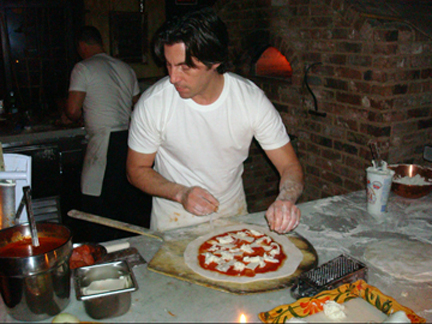
Life was very different for me when I first discovered and wrote about pizzaiolo Mark Iacono and his amazing pizzeria Lucali in Brooklyn back in January 2008.
Today, as The New York Times reports, Mark is recovering after being stabbed not far from his restaurant in Carroll Gardens.
He is in our thoughts and our prayers…
In the course of just a week, I’ve received roughly twenty new audio files to post in the Italian Grape Name Pronunciation Project. Rest assured: I’m going to post them all (next week’s post will feature a “family” of grape names). THANK YOU to everyone for supporting this project and for the words of encouragement. :-)
In the meantime, it seemed appropriate to move forward with a grape name that represents a true tongue-twister… not just for non-Italophones, btw… even Italian folks have trouble with this one.
That’s Gambellara producer Angiolino Maule’s youngest son Tommaso in the vineyards. Tracie P, Alfonso, and I tasted with Angiolino and met Tommaso on our recent visit to Gambellara and Valpolicella. I’ll post my notes from the tasting tomorrow. So stay tuned!

Above: My friend Wayne Young, whom I met in 1998 in New York when he had already been working within the then-expanding Bastianich empire for three years. In the photo, Wayne is standing atop the amphitheater growing site where the top wines for the Bastianich winery are grown in the Colli Orientali del Friuli.
Babbo changed everything. It was “a fine-dining Italian à la carte restaurant below 14th St.,” as Joe Bastianich put it when I first met him in 1998 (when I was working as an editor at La Cucina Italiana in the City).
Ruth Reichl’s watershed New York Times review of the place in April 1998, “A Radical Departure with Sure Footing,” marked a point of no return for pseudo-Italian restaurateurship in the U.S.
I remember that Wednesday in August 1998 well: it was the day that Italian gastronomic irony died and the newly minted craze of Italian regional cuisine took firm hold in North America. Whether you liked Babbo or not (and who didn’t want to get a table at Babbo?), from that day forward, if you cooked Italian food in the U.S., you had to do it earnestly: your food was only as good as the authenticity that stood behind it.
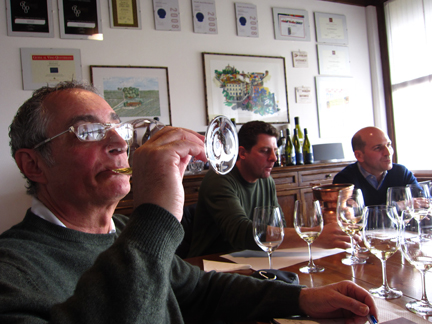
Above: Alfonso tasting with the COF2011 blogger team and winemaker Emilio del Medico and winery GM Dennis Lepore.
Wayne Young and I first met back in those heady days of New York’s Italian food scene. We all knew a revolution was taking place even though, from the eye of the storm, we didn’t realize its portent. Today, Wayne — who has worked as a sommelier at Bastianich outposts Becco and Babbo — serves as the Bastianich winery’s “special ops” man on the ground in the Colli Orientali del Friuli (the blogger project there was his idea). He is involved in every aspect of the operation, from winemaking (a wasp in his pants is what gave him the idea to call the winery’s flagship white “Vespa”!) to sales (ask him what it’s like to sell wine in Serbia!) and marketing (he is the only Friulian winemaker to author a winery blog).
Wayne is a remarkable man, with great generosity of heart and a warm gentleness. I’ve never heard him say a nasty word about anyone and I admire him for the way he lives his life perfectly integrated into Friulian society where he is welcomed and beloved by all we met. Despite his nordic locks, everyone calls him “a local” up there in northeasternmost Italy.
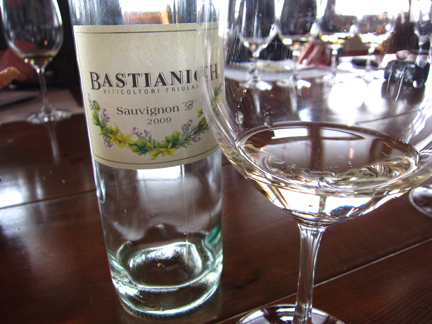
Above: In our tasting last week at the winery, my favorite wine was the 2009 Sauvignon Bianco. Fresh and clean, with balanced aromatic character and that bright acidity that I want (and need), it should retail for under $20 in the U.S. The Bastianich Sauvignon has a screw cap, a feature that allows the winemaker to add a smaller amount of sulfite to the wine, because the screw cap allows less oxidation (where a cork, an organic substance, would allow more).
Like Wayne, the Bastianich family has been welcomed in the Colli Orientali del Friuli as winemakers. President of the COF consortium Pierluigi Comelli told us the story of how Joe and mother Lidia came to him asking for advice on where to buy property and set up their facility. Ultimately, on his advice, they revived a winery that had abandoned after the owner’s untimely passing. And they bought uncultivated growing sites where they cleared the woods themselves to make way for vineyards. After a week in the COF, I had a clear sense that winemakers there appreciate the expanded exposure and bandwidth that the Bastianich brand brings with it. “Everyone rises with the tide” seemed to be the consensus.

Above: On Friday evening, the last of our trip in the COF, we took time out to celebrate with a beer in Cividale del Friuli. You can’t really help but smile when you’re around Wayne — it’s contagious. That’s Nicolas, David, and Alfonso to the right.
Spending the week tasting and comparing notes with Wayne (who, as a local winemaker, shared a lot of interesting insights with the group), I couldn’t help but think back to 1998, when we first met and none of us really understood what was about to happen. As Eric the Red recently pointed out to me, it was a time of Italian gastronomic “innocence” (it is Eric whom Mario Batali’s father Armandino credits for having “discovered” his son’s talent in 1993).
I’m glad to know that the fame and the celebrity hasn’t changed my old friend Wayne.
 Do Bianchi