Italian Lessons

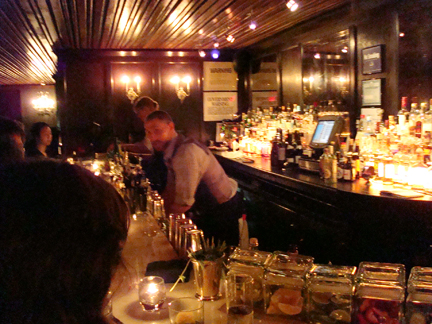
Above: the upstairs bar at Accademia di [sic] Vino. “Talk to my agent before you take another one,” snapped the bartender after I snapped this pic. “Don’t quit your day job,” I thought to myself.

It is my steadfast conviction that food and wine professionals have a responsibility to divulge and disseminate correct information. Just as practitioners of medicine take the Hippocratic oath, practitioners of the culinary arts enter into a social contract with restaurant-goers, a Gastereic vow, if you will, whereby they swear to tell the truth and nothing but the truth (to borrow from Brillat-Savarin’s tenth muse, Gasterea).*

And while none of us are perfect and we all make mistakes (myself included), egregious transgressions of this unspoken pact are committed freely on a nearly daily basis by insouciant restaurant owners, chefs, sommeliers, maîtres d’hotel, and waiters.

The Accademia di [sic] Vino in Manhattan seems to bill itself as a would-be “Italian Wine Academy” (at least that’s what I’ve read in The New York Times. I can’t seem to find the academy’s website). Evidently, they offer wine classes and seminars there and the space itself is dressed as a classroom: the walls of this beautiful restaurant are adorned with wine-related images and their Italian translations and there are chalkboards in the bar and the dining rooms with explanations of the Italian appellation laws etc.

There’s only one problem (two, actually): the name of the restaurant. In Italian you don’t write/say “accademia di vino.” You correctly write/say “accademia del vino.”

And it gets worse. Last night, when I sat down for a glass of wine with a colleague in the downstairs bar, I was handed a wine list that read: “vini a bicchiere.” I hate to be a stickler but… in Italian you correctly write/say “vini al bicchiere” (“wines by the glass”).**

It reminds me of a joke from the 1999 parodic mafia movie, Mickey Blue Eyes, where Hugh Grant’s character points out to his fiancée that her father’s restaurant is called “The La Trattoria,” or “The the trattoria.”

Although our hosts were exceedingly gracious (and the overwhelmingly gorgeous space was jam-packed with patrons), I’m sorry to report that the diced prosciutto on our grilled, “seasonal” pumpkin pizza was so hard I thought I was biting into stone.

The wines-by-the-glass list offered a wide range of price points and I had a glass of Inzolia by Valle dell’Acate and my friend a glass of Pinot Bianco by Hofstätter and the pours were generous, I must say.

The Accademia had been on my list of new places to try for a while. But when I got off the 6 train at Hunter College and walked down to 3rd Ave. and 64th St., I just couldn’t believe my eyes when my gaze fell upon the restaurant’s marquee: ACCADEMIA DI VINO.

Ask me “what’s in a name?” and I will tell you that a “Rose is a rose is a rose is a rose.”***

But “Accademia di Vino”? Give me a break.

Notes:

* Brillat-Savarin’s “tenth muse,” Gasterea, first appeared in 1825 with the publication of his Physiologie du Goût, ou Méditations de Gastronomie Transcendante (The Physiology of Taste; Meditations on Transcendental Gastronomy):

“Gasterea is the Tenth Muse; the delights of taste are her domain.

The whole world would be hers if she wishes to claim it; for the world is nothing without life, and all that lives takes nourishment.

Her chief delight is to linger on hillsides where the vine grows, or the fragrant orange-tree in groves where the truffle comes to perfection, and in regions abounding in game and fruit.

When she deigns to show herself, she appears in the guise of a young girl; round her waist is a flame-coloured girdle; her hair is black, her eyes sky-blue, and her figure full of grace; as beautiful as Venus, she is also extremely pretty.

She rarely shows herself to mortals.”

Brillat-Savarin, Jean-Anthelme, The Physiology of Taste, translated by Anne Drayton, Harmondsworth, Middlesex, England, Penguin, 1994 (1970), p. 287.

** del and al are articulated prepositions, di + il and a + il, respectively. The usage of articulated prepositions is always tough for students of Italian (I remember well from my days teaching Italian language at UCLA). In many cases, usage is idiomatic. In the instances cited above, however, the definite article is necessary because the terms vino and bicchiere refer to wine and stemware as general concepts.

*** Gertrude Stein, Sacred Emily, 1913.

Made it to Momofuku

Sunday evening, I finally made it to Momofuku Ssäm Bar in the East Village. I’d been inspired by two of my favorite bloggers. Winnie, a great food writer and friend, is an expert on all things pork in NYC and she has often remarked that Momofuku is one of her favorite places (I love the motto of her blog, ad astra per alia porci). The other is Lyle Fass, whom I really only know through the blogosphere and a few emails we’ve traded but whose wine knowledge I really admire and whose sometimes stinging straightforwardness and genuine humor I greatly appreciate.

I’d learned that Momofuku allows corkage (thanks to Lyle’s blog), and so Winnie and I made a plan to meet there, me with a bottle of 2003 Trebbiano d’Abruzzo by Edoardo Valentini in hand.

Above: spicy squid salad and Trebbiano d’Abruzzo… the wine held up well with the spiciness and intense flavors of the dishes we ordered.

Menu as follows (I asked Winnie to order):

steamed buns stuffed with pork belly

these were great, the buns warm and puffy, the hot pork fat melt-in-your-mouth gelatinous…

spicy squid salad

this was also very good, and, if I recall correctly, there was also some tasty baby octopus in this dish…

Mutsu and Macoun apple kimchi with crispy pork jowl and arugula

here we began to veer slightly into NYC too-precious foodland… the dish wasn’t exactly unforgettable and Winnie explained “kimchi” was a little bit of a misnomer since the apples weren’t really fermented…

báhn mì

from what I could glean, this is the classic Vietnamese sandwich and it was fantastic… highly recommended… it was billed as a “three terrine sandwich”… I’m not sure of all the ingredients but this is rightly one of the joint’s signature dishes…

chicken ballotine

underwhelming, flavorless, and hard to eat with chopsticks!

spicy honeycomb tripe with poached egg and frisée

I loved this dish and its harmony of flavors and textures — caramelized tripe, poached egg, and the crisp bitter frisée lettuce — came together gloriously…

Above: seems that tattoos are not required but encouraged for staff at Momofuku.

Our servers were polite and attentive and all sported impressive tattoos and piercings. The decor is modern downtown chic and the atmosphere is New York hip.

I’ve read on Lyle’s blog that he has opened old Nebbiolo there (even some 1950s Oddero). I’m not sure that I would go that route at Momofuku since the cuisine is so spicy and the stemware is cheap (the glasses arrived at our table warm, right out of the dishwasher).

If you’ve ever had Valentini’s Trebbiano d’Abruzzo, you know that this is no ordinary white wine. Its rich mouthfeel, its subtle tannin (yes, in a white wine), and its intense aroma and flavors sang out over the medley of ingredients that tap-danced their way to our table. Winnie said it was probably the best white wine she’d ever tasted and I believed her… it’s certainly one of the best I’ve ever had.

When we stepped out on to Second Ave., we were both surprised by how cold it is already (or suddenly) in NYC. Fall has finally arrived. Me? I’m California dreaming right now.

*****

I’d be safe and warm
if I were in L.A.

— The Mamas and the Papas

sento solo freddo
sento tanto freddo
fuori e dentro me
fuori e dentro me
ti sogno California
sogno California
e un giorno io verrò

— Mogol

Amphoras vini aperio: the band is back in town

Nous Non Plus has been back in town for the College Music Journal festival and the sexy sixsome played three shows (a showcase and a couple of parties). And we’ll be playing a Halloween show at Rubulad (undisclosed location in Brooklyn) on Friday.

Above: Our track “Lawnmower Boy” was just used in a TV commercial in Slovenia. The spot is a lot of fun…

In other news, bassist and singer Jean-Luc Retard (aka Bjorn Turoque) and our track “Château,” a song about the Château Marmont in Los Angeles, were recently featured in The Los Angeles Times (click to read).

giusto_prod.jpg

Last night we took time out to enjoy steak and wine chez Céline. Our friend Patrick Woodcock, a former member of the French band Air and the founder of Mellow, was in town. Patrick is always very generous with us when we play in Paris, giving us a hand with gear and transportation, etc. We always try to do something special together when he’s in NYC (and he loves steak and red wine).

steaks.jpg

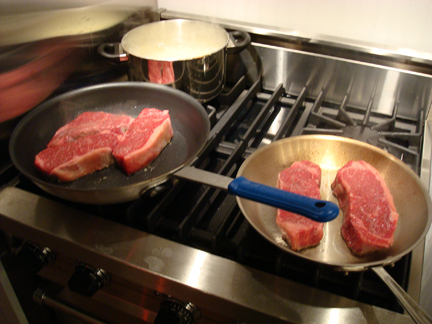
Above: Jean-Luc was in charge of searing the shell steaks. Like Patrick, the band likes its steak rare (although Bonnie Day is vegetarian).

Since my living situation changed this summer and I no longer have anywhere to store my wine, there’s really nothing left to say or do but to drink the wine.

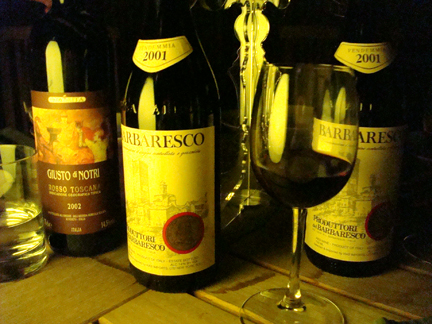
We opened two bottles of one of my favorites, 2001 Barbaresco by Produttori del Barbaresco. This wine has many years ahead of it but was drinking great nonetheless. As Patrick noted, this very traditionally made wine had a wonderful “chewy” mouthfeel and its tannins cut right through the nicely marbled fat of the shell steaks. As go I through the “cellar” (essentially a bunch of cardboard boxes), I’ve stumbled across a few surprises, like the 2002 Giusto dei Notri by Tua Rita above. I know that Patrick likes wines from Bordeaux and everyone enjoyed this opulent Bordeaux-style Cabernet and Merlot blend from Bolgheri (Tuscany).

With all this recent talk of oak vs. no oak, I thought it only right and fair to open this modern-style bottle and reflect on the dialectic from the other side of the table, so to speak. Of the many famous Bolgheri producers, Tua Rita and Grattamacco seem more reserved in their style. I’ve met Rita at Vinitaly… she’s a nice lady.

patrick_celine.jpg

Above: Céline and Patrick on Céline’s terrace.

The tannin and the wood on the Tua Rita weren’t entirely “integrated,” but I liked the goudron, tar notes on the nose. However you feel about oak and/or international grape varieties grown in Italy, no one can deny that Tua Rita’s wines are very well made. It’s only a pity it couldn’t have laid there forgotten for another 5-10 years in the back of the closet where I used to store my wines. But then again, there seem to be no certainties in life these days and while some people might advise carpe diem, my thought is aperi amphoras vini.

mash.jpg

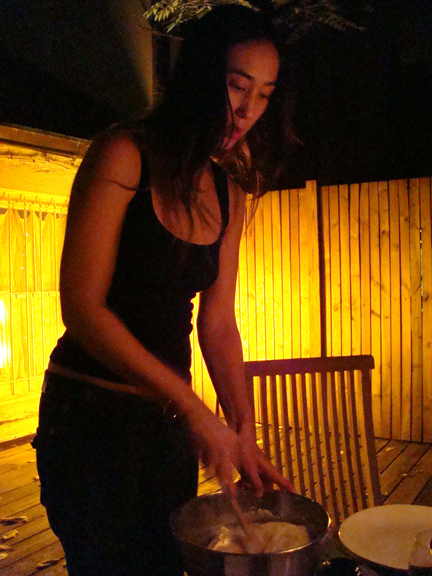
Above: you wouldn’t think it but Céline is an excellent cook and made fantastic mashed potatoes, roast carrots, and wilted spinach.

In other news, the fires in California continue to burn out of control. My family is fine but the air quality is getting really bad. My brother Tad and his wife Diane have been housing some evacuees and it’s still not clear whether or not my friend Charlie lost his house. I found this map, updated regularly, of the fires and evacuation sites.

Impossible Pairing: Sushi, Me, & NYC

Having grown up and come of age in southern California, I have had the opportunity to experience some of the best “sushi” and Japanese cuisine in the country. During the 1990s when I was a graduate student at U.C.L.A. (and when the sushi craze was rippling through the U.S.A., with its epicenter in Los Angeles), I was fortunate enough to dine at the now legendary Katsu (first in Los Feliz and then in Beverly Hills), opened by Katsu Michite who now works in Studio City at my fav LA sushi place, Tama Sushi (no website, unfortunately, see info below).* Then came Hirozen (in an unassuming strip-mall, still fantastic, a must), R23 (downtown, disappointing the last two times I visited), and one of the most beautiful restaurants I’ve ever eaten in, Thousand Cranes, which is supposedly returning to its former glory (the traditional Japanese breakfast there is worth a visit if you’re staying downtown).

Down in San Diego, where I grew up, Zenbu can be a lot of fun. So crowded and popular (and expensive) these days, it has its ups and downs but I still love their “aggressive” dishes like live prawns and giant clams (and by live, I mean literally). I also like the colorful cocktail menu inspired by local surf spots and surf lore. The lounge is very hip there and one of my best friends, Irwin, performs electronica there on some nights. The restaurant’s owned by another of my high-school friends, Matt Rimel, a huntsman and fisherman, whose fishing crew provides nearly all of the fish, working with eco-friendly and dolphin-safe fishing techniques.

mano.jpg

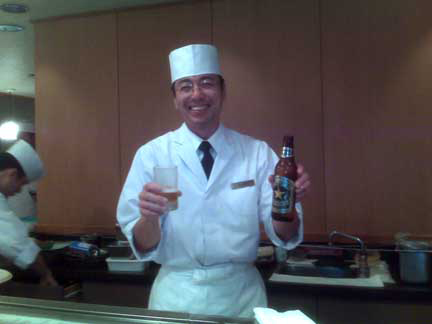
Above: I felt like I was a tourist in my own city when I asked our sushi chef Mano, at Sushi Ann, NYC, to pose for a picture (with a beer we bought him in gratitude).

I had always found NYC sushi disappointing, even though I’d been treated to some of the finer and pricier venues in town. But now I have seen a new dawn on my NYC sushi horizon at the wonderful and very reasonably priced Sushi Ann.

The Odd Couple — that’s me (Felix) and Greg (Oscar) — dined there last night on the recommendation of friend and colleague, top NYC Italian restaurateur and wine maven, Nicola Marzovilla (who owns I Trulli and Centovini). We asked our chef to prepare whatever he liked — really, the way to go at the sushi bar — and we were delighted with each serving. The fish was fresh and he avoided the sushi stereotypes. One sashimi dish was tuna belly cubed (not sliced) and drowned in a miso reduction sauce (sinfully good). Mano, our chef, also liked to counterpose bitter and sweet, as he did in some rolls, which he served together, the one made with Japanese basil and pickled radish, the other with scallion.

basil.jpg

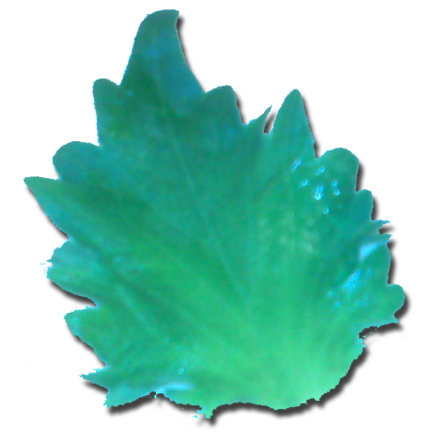
Above: Mano offered me a leaf of Japanese basil, sweeter than the western variety.

Most of the fish seemed to be flown in from Japan (Japanese Red Snapper, Japanese Mackerel, etc.) and tasted fresh (didn’t have that freeze-dried taste that find in so many of the Lower East Side sushi joints). The restaurant was very clean (important for sushi restaurants, in my opinion) and the waitstaff polite and attentive.

octopus.jpg

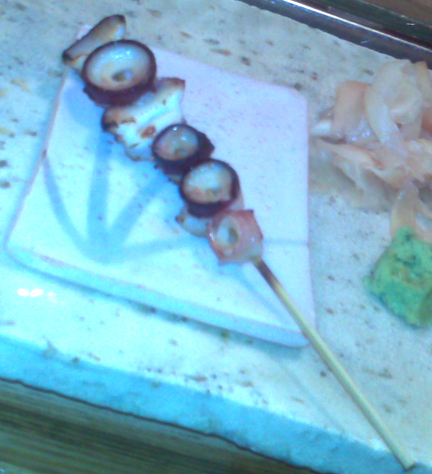
Above: skewered octopus tentacles, raw but seared with a torch.

One of my favorite dishes was the seared octopus tentacles, dressed with just a little bit of lemon juice.

Greg drank a cold, unfiltered sake (which was a little too sweet for my taste, although our waiter said it’s very popular in Japan) and I stuck to beer. I’m sure we could have spent a lot more had we indulged in a bottle of fine sake — the list was alluring but it wasn’t the night for that. Our bill was very reasonable for an excellent experience in a high-end midtown neighborhood (51st between Park and Madison).

After ten years in this town (I got here in 1997), I finally found a great sushi restaurant. Who knows? After the recent crazy changes in my life, maybe I should stick around after all.**

*Tama Sushi
11920 Ventura Blvd
Studio City, CA 91604
(818) 760-4585

**So all you newsy people, spread the news around,
You c’n listen to m’ story, listen to m’ song.
You c’n step on my name, you c’n try ‘n’ get me beat,
When I leave New York, I’ll be standin’ on my feet.
And it’s hard times in the city,
Livin’ down in New York town.

— Bob Dylan

At Gemma, a Bartender Can Be Your Best Friend

The rain has finally started to fall in NYC and the city has turned grey as it does every year around this time. My heart is heavy and my life unsettled but I am trying to pick up the pieces in the wake of this summer’s tsunami.*

Friends have been reaching out, lending support, sometimes with an email letting me know that they think of me, sometimes with an invitation to dinner and/or a bottle of wine, checking in and catching up.

Ben Shapiro — an old buddy, a great drummer, and radio producer, cinematographer, and journalist — wrote me the other day and we made a date to check out one of the many new downtown places.

I wasn’t inclined to like Gemma. I figured it would be another Da Silvano, Morandi, etc. rip-off, yet another Disneylandish, faux trattoria. And frankly, The New York Times food critic Frank Bruni wasn’t too off the mark when he wrote that Gemma is “a cheat sheet of a restaurant whose proprietors take fewer risks than a hurricane-insurance agent in Nebraska.”

faux_trattoria.jpg

Above, you’ve seen it before: faux trattoria chic. It’s like dining in Fantasyland… Europe via Anaheim.

So, when I arrived (shortly before Ben), and sat at the bar where I chatted briefly with NYC restaurateur Chris Cannon (my only pseudo-star siting), I decided to get right down to business.

“Do you have any white wine that doesn’t see new wood?” I asked the bartender. And I was pleasantly surprised when he said, “Yes, of course, I’ve got a beautiful stainless-steel Sauvignon.”

He proceeded to pour a fresh and delightful 2006 Sauvignon Blanc by Poggio Salvi (who makes both barriqued and traditional wines, btw). You don’t commonly find bartenders with such wine knowledge in places like this, let alone someone who can appreciate that there are those of us who don’t like oaked wine. (In his column this week, The New York Times wine critic Eric Asimov pointed out rightly that “Oaky may be bad, but oak is good.” I may have tempered that by saying “but oak can be good.” Nonetheless, I was glad to see such a widely read authority like Eric tackle such a sticky subject.)

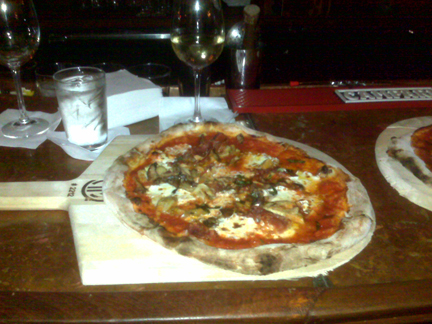
Ben arrived and we decided to let our bartender order for us: excellent Quattro Stagioni pizzas and a simply gorgeous bottle of 1999 Brunello di Montalcino by La Torre, a winemaker you don’t see very often in the U.S. (I remember it from my days in Bagno Vignoni where I first learned about Brunello nearly twenty years ago with my friends, the Marcucci brothers). Traditional in style, this wine had natural fruit on the nose and in the mouth, bright acidity and tannins that probably could have used a few more years in bottle. Case, our bartender, insisted on decanting the wine for us and the aeration helped it to open up.

gemma_pizza.jpg

Above: the Quattro Stagioni pizza at Gemma, I have to say, was among the most authentic Italian pizza I’ve had in NYC. The crust was light but crispy and firm, the topping savory but not overly salty.

Truth be told, the list at Gemma isn’t exactly overflowing with wines that I like (at the end of the night, one of the sommeliers poured us a barriqued Aglianico del Vulture that tasted like industrial coffee syrup). But there are some true gems at Gemma, like a 2006 Verdicchio dei Castelli di Iesi by Villa Bucci (one of my all-time favs).

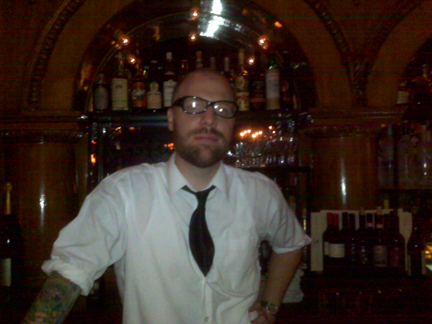
But what made the night was a great bartender, who knew his stuff and who understood my palate from the moment I sat down. Maybe Frank should have eaten at the bar.

gemma_tender.jpg

Above: Case Newcomb, a great bartender and this man’s best friend at Gemma. Pour me some Brunello and I’ll tell you some lies.

*This old earthquake’s gonna leave me in the poor house.
It seems like this whole town’s insane.

— Gram Parsons

Nothing to write home about but a good Bordeaux white

New York is one of the great restaurant cities of the world. So many restaurants and wine bars open and close so quickly in this town, that it’s often hard to keep track. And while there is a lot of great food here, there’s plenty of bad to go around as well. I’ve had a lot of free time on my hands lately and no kitchen to cook in, so I’ve taken the opportunity to try some new — well, new for me — places.

white_talbot.jpg

Above: the only thing I liked about Quality Meats was a few interesting wines on the list, including this Caillou Blanc 2004 Château Talbot.

A few nights ago, Greg and I — we’re both steak lovers — dined at Quality Meats, a recent addition to the Smith & Wollensky mediocrity group. The decor was kinda cool: the restaurant is dressed as a old-school meat locker, with hooks on the ceiling etc.

Our gracious waiter — who later abandoned us when the restaurant got busy — recommended that we not order the rib steak for two (“it can be too fatty,” she said) and so we both ordered the sirloin, bone in, black and blue. Greg’s came so charred that he said it tasted like charcoal. Mine was medium rare and not charred at all on the outside. We also both ordered Caesar salads: the dressing was insipid (“no anchovy,” our waiter said) and the croutons store-bought.

While the wine list was laden with the classic, over-priced, over-oaked, and overblown “Napa Cabs,” there were a few interesting wines like Sinskey, Olga Raffault (we drank the 2002 Les Picasses at a really great price), and a wine I’d never had, Caillou Blanc 2004 Château Talbot, a white made from Sauvignon and Sémillon. You rarely see white Bordeaux in NYC and Greg and I immensely enjoyed this dry, structured wine.

rice_balls.jpg

Above: the chef at Centro Vinoteca needs some Italian lessons.

Another recent outing took me to the very new Centro Vinoteca in the Village to meet a good friend of a friend, Ariel, who has just joined the ranks of us wine professionals. I really wanted to like Centro Vinoteca: the list is all Italian and has some great stuff, including a Verdicchio dei Castelli di Jesi Classico Superiore Vigna delle Oche 2002 San Lorenzo that was fantastic. I got there early (about 5:50 p.m.) and the place was empty and I sat at the bar. My waiter was knowledgeable and skilled and was happy to open a new bottle for me when I told him the wine he had poured — open from the night before — was dead. They serve wines by the quartino there and the prices are very reasonable for the quality (“wine by the quartino,” equivalent to roughly 2.5 glasses depending on how you pour, is a Batali-Bastianich affectation, but more on that below).

But by the time Ariel arrived, about 20 minutes later, the place was packed, we lost our good waiter, and our new waiter simply didn’t know how to open a bottle of wine. Ariel wanted to try the Verdicchio and so our new waiter opened it by swirling the bottle around to rip the capsule off; she inserted the worm incorrectly and broke the cork as she pulled it out; and then — to my disbelief — she inserted the worm again, put the bottle between her knees (!!!), and ripped the cork out. After Ariel tasted the wine and opted instead for a Falanghina, the waiter poured the Falanghina into the Verdicchio glass. Oy…

Trying to move past this mishap, we did order a few things from the menu. The arancine (above) turned out not to be arancine but just simple fried rice balls dusted with some grated pecorino. Throughout Italy, arancini (masc.) are fried rice balls stuffed with meat, cheese, and/or peas. A classic Sicilian dish, the are called arancine (fem.) in Palermo and Western Sicily, arancini (masc.) in eastern Sicily and the rest of Italy.

We also ordered — partly because it seemed so preposterous — the mortadella pate [sic]. I guess the person who types up their menus doesn’t know how to use diacritics. This dish consisted of ground mortadella. I know that mortadella is “in” these days but why ruin it by destroying its texture?

My first waiter, whom I liked, mentioned that the chef at Centro Vinoteca had been Mario Batali’s sous chef on the Iron Chef TV show. Evidently she learned a lot from Molto “make-it-up-as-you-go-along-and-then-claim-it’s-authentic-Italian-food” Mario. The so-called quartino is another Batali-Bastianich affectation that you never see in Italy. It’s really too bad… I really wanted to like Centro Vinoteca. The wine list there is interesting but the service and the affectation just ruined it for me.

Summer 07 Ends, Eating Raoul’s and Drinking 1990 Chinon

raffault_1990.jpg

The summer of 2007 will be remembered — in my mind at least — as the summer that I quit my full-time day gig (September 7 was my last day as Marketing Director at the group that runs Centovini, I Trulli, and Vino), the summer that Nous Non Plus went back to France for the second glorious time, the summer that I turned 40, the summer of my official mid-life crisis, and the summer that I fell in love with Cabernet Franc and Chinon.

The seemingly endless and at-times-painful summer of 07 (for there was a promise that unraveled sadly, as well) came to an end on Sunday, September 23 at 5:51 a.m. (or so they say), the day after Yom Kippur and the day after my mother’s birthday.

The night before I left for California (to spend Yom Kippur and my mom’s birthday with the family) was a summery evening in New York and the city was bustling with the last notes of warm-weather partying. I found myself downtown with a wine biz bud and we couldn’t get a table anywhere: Blue Ribbon was packed to the gills, Balthazar was as bustling as Belshazzar’s Babylonia, and a Bellini sludge sparkled and shimmered as it oozed over the sidewalk at Cipriani into the gutter.

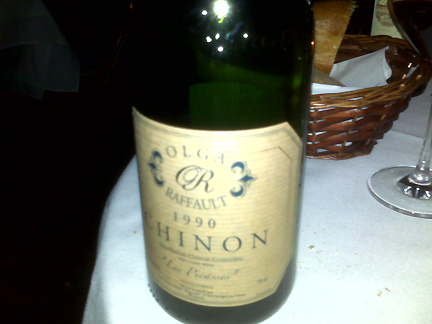
The solution? Raoul’s… where the colorful characters and the Negronis (with maraschino garnish) took the edge off a thirty-minute wait for a table. Our reward? The best seat in the house — the deuce in the corner of the dimly lit garden — and a wine list that included a 1999 Lopez de Heredia Viña Bosconia (“the best Burgundy in Rioja,” our skilled and sharp-witted sommelier noted), and a 1990 Domaine Olga Raffault Chinon Les Picasses, both at very reasonable prices.

I had never been to Raoul’s, a true downtown New York experience where locals with thick eastcoast accents and full heads of hair (some real, some faux) gather, an authentic 1970s scene, too upscale for Scorsese’s Mean Streets but not mundane enough for Allen’s Manhattan.

The Viña Bosconia was light and fresh and went well with my frisée salad (laden with lardoons and topped with a runny egg).

The 1990 Chinon was simply sublime. I’d been drinking Chinon all summer (in Paris and New York) but had never had the chance to drink any older vintages. The 1990 single-vineyard Raffault teemed with the wonderful vegetal flavors that Robert Parker seems to despise — he once wrote infamously, “I have found the majority of these wines (made from 100% Cabernet Franc) to be entirely too vegetal and compact for my tastes” — and it paired beautifully with my steak au poivre, the house specialty at Raoul’s. The wine had a delightful freshness — impressive for a seventeen-year-old wine — and we enjoyed every drop.

By June of 1990, I had finished my first year of post-grad studies at the Università di Padova (where I met my friend, cineaste and novelist Mauro Gasparini, whose excellent blog, I recently discovered). I spent the rest of the summer in San Diego living at home and working as a bike messenger, preparing for the doctoral program at the UCLA Italian Department where, in September, I began teaching Italian language.

I never could have imagined that the summer of 2007 would find me working as a writer and a copywriter on the New York food and wine scene. But stranger things have happened. Hopefully, even stranger things will happen yet.

eating_raoul.jpg

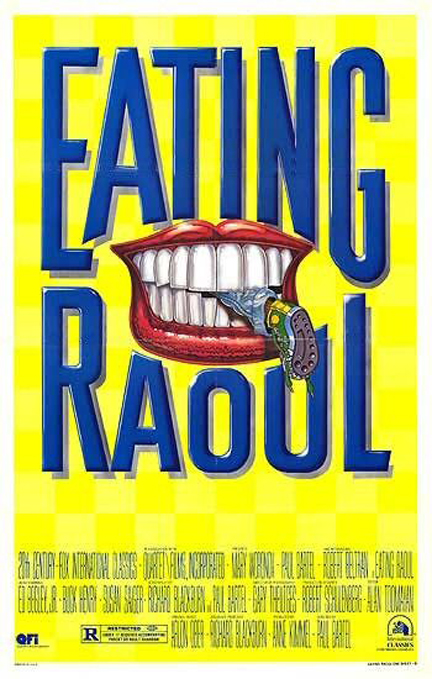
Above: Eating Raoul, 1982. Isn’t funny that the male lead works in a wine store? Well, it seems funny now.

Style Wins over Substance: Downtown Cocktails

pdt1.jpg

Last Thursday I joined a wine-and-cocktail-savvy crew (including my new friend Jordan Mackay, who is possibly the funniest wine writer I know) for a crawl through the East Village and the Lower East Side.

First stop was PDT (Please Don’t Tell), a speakeasy style, super-affected, reservations-only bar connected and related to Crif Dogs on St. Marks (Crif Dogs’ website doesn’t seem to be working but maybe they’ll get that together one of these days). You have to go through the hot dog joint to a faux phone both where you then call and they let you in.

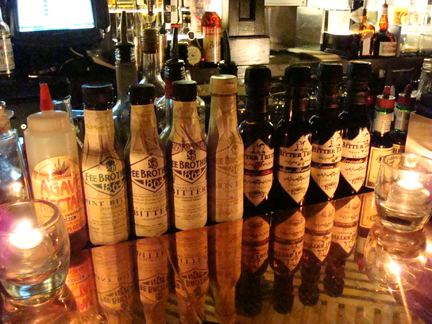
The bartenders at PDT are very creative and the shelves are stocked with unusual bottlings, like the bitters collection above. Our bartender poured us a taste of Lucid, which is purported to be the first legal American-made absinthe.

pdt2.jpg

Frankly, the drinks weren’t that good (mostly sugary to my palate) and the chili dog tasted like a whatever NYC street vendor dog with bland tomato sauce on it.

Flash photography is not allowed and I got kicked out after I took the above photo of the weasel (?). Evidently, PDT’s decorator is really into taxidermy.

death_co.jpg

Next stop was Death & Co. (above), which is also a super-stylized and affected place. I really liked the look and feel of this 1920s tavern and its quasi-Edward-Gorey feel. I genuinely enjoyed my cocktail, a Company Buck, which is made with dark rum and housemade ginger beer. Our waiter was glib and professional and really knew her stuff.

little_giant.jpg

The end of the night found us at Little Giant where I was very impressed by the wine list but underwhelmed by the yes-I-hate-to-say-it way too affected food (panzanella with steak in it? oy…).

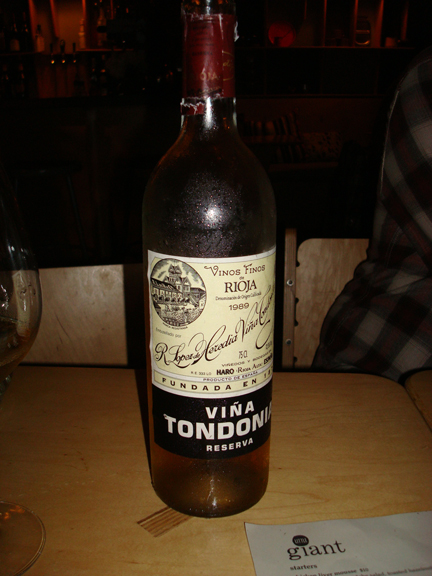
I made the mistake of ordering a 2003 Sassella by Sandro Fay, which was too modern (for me and my dining companions). I had never tasted the wine and, hey, you win some and you lose some. But the 1989 white Rioja by Lopez de Heredia (above), which we ordered upon being seated, was stellar. I had only tasted the winery’s whites back to 1994 and this was, by far, the best I’d experienced.

After so many cocktails and bottles of wines, our crew had achieved a certain brio and the confluence of a lot of style and some substance seemed to have blurred the lines between aesthetic experience and downright, pure-and-simple fun.

Tommaso’s: “No good wines… just good bottles…”

sign.jpg

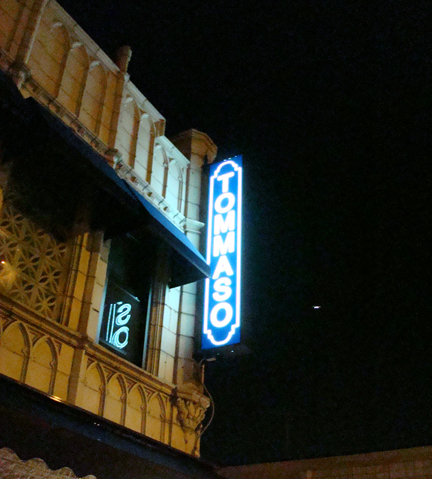
Above: Tommaso Restaurant is located in Bensonhurst, Brooklyn, one of New York City’s thriving Little Italys.

Words of wisdom were imparted to us last night by restaurateur Tommaso Verdillo of Tommaso Restaurant in Brooklyn where I joined Alice Feiring, Elizabeth Spiers, and Lawrence Osborne for some old wine, great food, and a truly enjoyable and stimulating confabulatio.

Tommaso and his restaurant may be counted among NYC’s best-kept secrets and so be it. Perhaps because Bensonhurst, Brooklyn (one of New York’s true Little Italys) seems so exotic to the uninitiated, perhaps because Tommaso hasn’t received the attention his food and his wine list deserve, his excellent cooking and thrilling-if-ecclectic cellar (a true trésor of old wine) just aren’t on the culinary radar of Manhattanite would-be gourmets.

When it became clear to Signor Tommaso that we were there to raid his cave, he warned, “You never know how these bottles will drink. There’s a wise, old saying: ‘there are no good wines… just good bottles.'” And he’s right: when it comes to old wine, even when provenance is unquestionable and a given bottle has been cellared properly, age invariably increases the chance that a bottling will have gone bad.

The menu and pairings:

Polpettine di Riso and Mozzarella in Carozza

St Joseph Offerus 1999 Chave

Porcini-Filled Tortellini dressed with melted Castelmagno Cheese

Corton Bressan Grand Cru 1983 Chandon de Briailles

Spiedini alla siciliana (breaded and skewered veal served with roast potatoes)

Barolo Le Rocche di Castiglione Falletto 1986 Bruno Giacosa

While the mozzarella in carozza was superb, the tortellini were by far the stand-out dish (I couldn’t resist sopping up the melted Castelmagno in my dish).

The St Joseph lacked the depth that I expected from such a highly touted producer but was good (granted, this is the winery’s “entry-level” wine). The 1983 Burgundy was very tired and had lost most of its body and acidity but its astoundingly low price made it well worth the experience (there are some great bargains on Tommaso’s list).

When we asked Tommaso about the Giacosa Barolo on the list, he told us he would go down in the cellar to see what was actually there. He returned with three bottles and proposed that we open the 1986 Barolo Le Rocche di Castiglione Falletto.

The 1986 harvest was a sleeper vintage, he explained, probably because it was overshadowed by the more famous and much warmer 1985. He and Bruno Giacosa were old friends, he said, and the winemaker had often spoken to him about the underrated and underappreciated ’86. The fact of the matter was that none of us had could remember having tasted ’86 Giacosa. And while I’ve tasted many excellent bottlings of Barolo Falletto by Giacosa, I’d never tasted the cru “Le Rocche di Castiglione Falletto.” (I’ve just discovered this excellent Table of Bruno Giacosa Barolo by nebbiolophile Ken Vastola. It reveals that 1987 was Giacosa’s last bottling of this cru.)

Now in the autumn of his life and career, Bruno Giacosa is one of Italy’s most revered winemakers and many would argue that his wines are among the best Italian ever (the 1990 Red Label Barolo Falletto is certainly one of the best wines I’ve ever tasted in my life). According to legend, Giacosa never studied winemaking. Tommaso told us that during the 1960s, before Italy’s economic miracle reached the Langhe hills (where Barolo and Barbaresco are made), many winemakers were forced to abandon their vineyards and travel abroad to find work to support their families. Giacosa, he told us, generously offerred to make their wines for them while they were gone, thus ensuring that their land would not be snatched up by unscrupulous speculators in their absence. This experience, he said, allowed Giacosa to refine his skill and knowledge and helped to shape his legacy as one of Italy’s greatest vintners.

Although it showed admirably for its age, the 1986 Le Rocche di Castiglione Falletto was tired (it had some good fruit left in it but the tannin had faded). It would have been better a few years ago and I wished we had opened the 1990 Villero (another cru I’ve never tasted from Giacosa). But the price was reasonable and the experience truly memorable. And after all, our simpatico host had gently warned us beforehand, “there are no good wines… just good bottles.”

giacosa.jpg

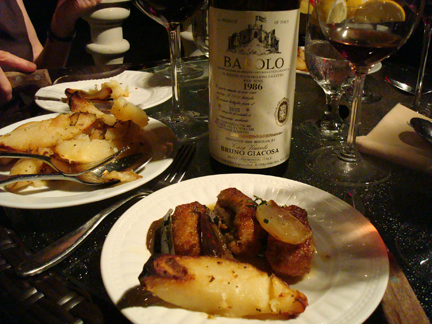
Above: Barolo Le Rocche di Castiglione Falletto 1986 Bruno Giacosa paired with Spiedini alla siciliana and roast potatoes at Tommaso’s. The bottle of 1986 Giacosa didn’t have the government warning “front label” on the back of the bottle (yes, it’s called a “front label” by the TTB, the Alcohol and Tobacco Tax and Trade Bureau, even though it appears on the back of the bottle). But it did have a strip label that reported the following text: “Experience, love and passion allows [sic] us to obtain this product of the highest quality coming from grapes chosen and selected exclusively by us.”

Under the Bridge Downtown

eels.jpg

Above: live eels at the daily market under the Manhattan Bridge (on the Manhattan side) in Chinatown. One had slithered its way out of the tub. Most of the vendors sell produce but there are also a number of seafood mongers (sea snails, fishes, and seemingly any sort of sea creature). There are also a seamster and a cobbler. Sometimes I feel just like that eel.

Under the bridge downtown
Is where I drew some blood
Under the bridge downtown
I could not get enough
Under the bridge downtown
Forgot about my love
Under the bridge downtown
I gave my life away.