The saga of 2006 Nebbiolo continues…

produttori del barbaresco

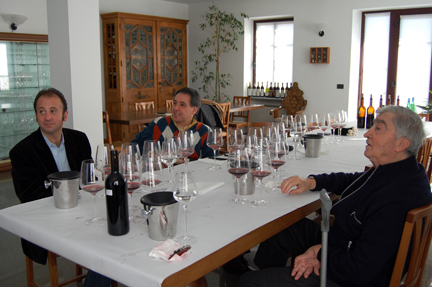
Above: I snapped this photo when I visited what may be my favorite winery of all time, Produttori del Barbaresco, in March of this year. Are the 09s destined to be bottled as crus?

Yesterday, in the wake of the publication of Antonio Galloni’s superbly written and recently published notes on 2006 Barolo, friends Thor and Scott brought to my attention the fact that Aldo Vacca of Produttori del Barbaresco has decided not to bottle his 2006 crus.

Aldo’s been traveling in the U.S. and while I haven’t spoken to him directly about this, various emails and links thrown about led me to a thread in the unforgiving landscape of WineDisorder.com, where a kind gentleman named Bob wrote the following:

    Attended a Produttori event last night. Asked Sr. Vacca about the 2006 standard. He mentioned a couple of items that went into the decision re: no riservas. One was the concern that the standard bottle would be be too unbalanced with not enough fruit to match the structure. Too lean for the style that they try to produce. They take the standard bottling very seriously at the co-op. Also, given the embarrassment of riches in recent vintages, he felt that the co-op could go a vintage without the range of riservas for one year. He mentioned experience with previous vintages like 1995 (riservas made because none since 1990, but standard was perhaps too lean) and 1998 (standard might have been too lean, so riservas not produced after a few vintages in a row that were) that informed their thinking in 2006. Also, there was first lot of standard released locally in Albese before the potential riserva juice was blended in. All lots since then have been blended, including what’s in international markets now. Co-op’s current plans include riservas in 2007 and 2008.

And so the saga of 2006 Nebbiolo from Langa continues…

In other news… that’s what friends are for…

poggione

Got to drink the above last night thanks to my friend Tom. Wow… Did I mention that I love Il Poggione? Both wines were simply stunning. Thanks, Tom! You R O C K!

And in aesthetic news…

chicago

Chicago is such an interesting city to look at. Whenever I visit the city, I can’t help but think of how it represents an encyclopedia of and monument to America’s industrialization and its twentieth-century pre-imperial glory. It was a beautiful day in the city yesterday when I arrived. Snapped the above walking from the L Train to my hotel.

Gotta run now… Meetings, meetings, meetings… Thanks for reading, ya’ll!
Gaja and Grimaldi’s?

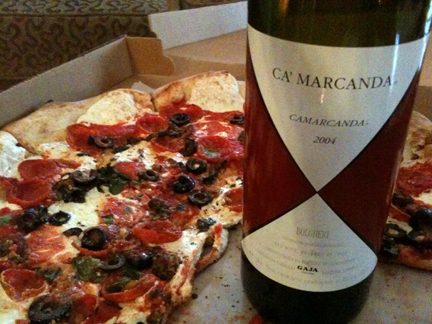
I guess I’m not the only one who dares to pair pizza and fine wine: my friend Rob sent me the above photo yesterday, a pairing of one of his favorite wines and his favorite pizzas, olives and pepperoni (from the legendary Grimaldi’s, originally of Brooklyn).

Rob was celebrating the opening of his new movie, Hot Tub Time Machine.

Congrats, Rob! Mazel and more mazel on ya brotha…

More chestnut-flour polenta and pork facial glands

polenta

Wow, thanks, everyone, for all the wonderful comments and emails about yesterday’s post on dinner in the home of the lovely Bindocci family in Sant’Angelo in Colle (Montalcino, Siena). I thought I’d post a few more photos from the dinner. And thanks, especially, to Stefania and Fabrizio, who so graciously welcomed us into their home. That’s Stefania, above, slicing the chestnut-flour polenta with a string.

polenta

The incredible sensual experience of the chestnut-flour polenta is its combination of its sweet, chestnut flavor combined with its inimitable texture. The night we were invited, Fabrizio’s niece was there with her husband. They had just returned from Libya, where they had been living (they’re agricultural engineers and they work to create sustainable farming in the third world). To celebrate their return, Stefania had created this traditional Mt. Amiata menu (she was born in the mountains, while Fabrizio was born on the Orcia River Valley floor).

polenta

@BrooklynGuy the delicate but firm-to-the-bite texture of the pork facial glands (almost like candy), which have imparted their flavor to their cooking liquid, combined with the pillowy softness of the polenta was an unforgettable sensorial event in our mouths. The porousness of the polenta proved an ideal receptacle and medium for the rich jus of the offal. The two worked in concert, in a dynamic dialectic that rewarded the senses with its seamless ingenuity.

polenta

In another era, the slaughter of a pig was an important event in the familial and societal rhythm of life. While most of the pork was “put up,” as they say here in Texas, in the form of cured thigh and sausage, the offal was consumed in celebration of the good fortune of avere le bestie, as they say in Italian, of having beasts (i.e., livestock) on your estate. One of the coolest things about Il Poggione is that it is a working, integrated farm, where livestock is raised and sent to pasture in fields adjacent to the vineyards and olive groves. The integrated approach, says Fabrizio, is an important element in creating the terroir-driven wines for which their winery is so famous. We paired the 2006 “owner-selection” Rosso di Montalcino with the chesnut-flour polenta and pork facial glands (we served the 07 Rosso di Montalcino by Il Poggione at our wedding reception).

polenta

Some of the most memorable meals I’ve had in Tuscany have been centered around pig and boar liver. It’s so important to experience the wines of Montalcino (and Sangiovese in general) in the context of food and pairing. The 2001 Brunello by Il Poggione was such a fantastic wine — a great vintage from a great producer. But the greatest treat was to taste it in the context and flavor “economy” of traditional pairings. The tannin, red fruit, and acidity of Il Poggione’s Brunello, paired with nearly impenetrable richness and deep flavor of the liver, assumed a new ontographical significance, by which, I mean our ability to describe the nature and essence of things.

We ate liver again on the next day of our trip in Bologna… and there was an important reason for that. More on that later…

Please stay tuned and thanks, again, for reading and for the thoughtful comments… :-)

Tuscan Rooms with Views

One of the highlights of our honeymoon was the Tenuta Il Poggione farm house where we stayed on our first two nights of our trip. The old farm house, located in the middle of the estate, surrounded by olive groves and vineyards, has seven guest rooms, all with air conditioning, heating, and kitchen. We stayed in the room called “Pero,” the pear tree.

farm house

This amazing olive tree is about 50 yards from the farm house. Il Poggione is one of my favorite wineries and I’ve been friends with the Bindocci family, who runs the estate, for many years now. Winemaker Fabrizio Bindocci told me that some of the trees in this grove are nearly 200 years old.

farm house

Can you see why I love her so much? :-)

farm house

This is the view from the farm house, looking northward. That’s Sant’Angelo in Colle (where we ate at Trattoria Il Pozzo).

farm house

That’s the view from the farm house looking south. There are few signs of modernity here. Just looking at this photo, the mimetic desire kicks in and I can still smell the dolce aere tosco, the sweet Tuscan air that Petrarch reminisced about and longed for in his Rerum vulgarium fragmenta, his Fragments of Vernacular Things (194.6).

farm house

The farm house seen from the south. The property also includes an Olympic-sized swimming pool (that was covered, of course, when we were there). The rooms are cozy and each one has a kitchen. I’m hoping that one of these days we can make a family trip there.

farm house

Even an amateur photographer like me feels like a Rembrandt in this immensely photogenic land. To get to the farmhouse, you have to drive about 10 minutes from the town of Sant’Angelo on a dirt road through woods, vineyards, and olive groves. And when you get there, you feel like you’re in a 19-century grand tour landscape… that’s some room with a view… I highly recommend it!

For more information and booking, email the estate at agriturismo@ilpoggione.it.

tracie parzen

Happy Friday, ya’ll!

One last note on Giacosa Asili 07 from Antonio Galloni (and the complete wedding album online)

From the department of “wine geekery”…

Above: I wish words could convey Bruno’s bright smile that day and the pleasure he seemed to take in tasting and talking about his wines with Franco, Tracie P, and me. Photo by my better half.

One last note that I wanted to share, for the record, culled from emails I traded yesterday with one of the wine writers I admire most and one of the greatest English-language authorities on the wines and winemakers of Piedmont, Antonio Galloni (who also happens to be an extremely nice guy).

His comments speak to Bruno’s observation that you could “smell Asili” in the 2007 Asili white label bottling (even in the light of the fact that the wine was made predominantly from grapes sourced from a parcel previously classified as Rabajà).

“Because of the freakish growing season in 2007 that you describe,” i.e., with an extremely mild winter and consequently anticipated vegetative cycle, wrote Antonio, “the 2007 Asili white label does actually reflect a lot of that vineyard’s characteristics, even if it is 80% juice from Rabajà.”

He also pointed me to this passage, lifted from his October 2009 tasting notes: “Curiously, the 2007 Asili is a very soft wine, considering it is made mostly from vines that informed such majestic Rabajas as the 2001 and 2004.”

All of us present at the tasting a week ago Sunday were impressed with how approachable the wine was. And Bruno’s observation, “you can smell Asili in this wine,” was significant, indeed, especially in the light of the unusual vintage and the reclassification of the Barbaresco cru system. Antonio noted that in the wake of the reclassification, “you will soon see a host of new, single-vineyard bottlings from places you probably never knew existed.”

Food — or grapes, as the case may be — for thought.

Thanks again to Ken for asking me to look more carefully at Bruno’s observation and thanks to Antonio for his truly invaluable insights.

In other news…

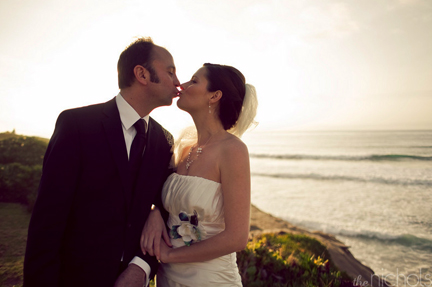
It will remain one of the great mysteries in the history of humankind: how did a schlub like me end up with a beauty like Tracie P née B?

The complete wedding album is online here. Thanks again to Jennifer and CJ for an amazing job!

And thanks to my gorgeous bride Tracie P: words could never express the happiness and joy that you have brought into my life, an endless Valentine, every night when I kiss your sweet lips good night and when they greet me in the morning. I love you so very much… What a miracle you are!

Wedding photography is here!

tracie parzen

Every since we got on a plane, two Wednesdays ago, to leave for La Jolla for our wedding, life has been nothing but a dream: the preparation for the wedding, the rehearsal dinner, the ceremony (the incredible moment the stunningly gorgeous Tracie P née B appeared to walk down the aisle!), our first kiss and embrace as wedded couple, the reception, the Bollinger NV rosé (and the 1998 Grand Dame!), New York, Sant’Angelo in Colle, Bologna, Barolo, Barbaresco, Rome, and then finally the long trek homeward. At the end of those two weeks, Tracie P and me were ready to come home.

The best news? Next week, we finally move into our first home together, a little house we’ve rented on the north side of Austin.

As hard as it is to come down from the high of the last two weeks, we’ve been enjoying the afterglow of these magical days, cooking at home and staying in to watch movies at night.

The other good news: the first official wedding photos, by our lovely and immensely talented (you’ll see) friends Jennifer (Tracie P’s childhood friend) and CJ Nichols, are here!

In Tracie P they found a cover-girl as their materia prima. In me? Well, they found the same old schlub I’ve always been. But, hey, Tracie P must see something in me, right? I guess she loves me for my brain… ;-)

Enjoy the wedding photos here!

Ray Benson and me “Stand for Haiti” tonight at Vino Vino

From the “shameless self-promotion” (and “after all, it’s for a good cause”) department…

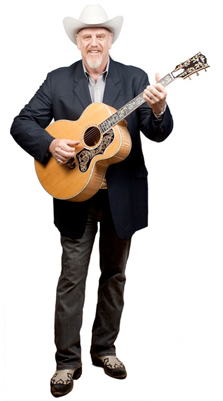
I wasn’t allowed to announce this until now since it was “top secret” until this morning: Austin music legend Ray Benson (and one of my personal musical heroes) will be appearing tonight at the “Stand for Haiti” benefit at Vino Vino in Austin where I will be emceeing.

I cannot conceal that I am completely and utterly geeked and psyched to be sharing the stage with him and all the other great Austin musicians who are donating their time tonight to help out the folks in Haiti.

If you happen to be in town, Tracie B and I will be there from 6 p.m. onward ’til the end of the night.

The photo, left, is by Austin music photographer Ed Verosky, who generously donated rights to the photo to help us promote the event. Thanks, Ed!

Black truffle porn and a great wine from Montenegro

truffle porn

Above: Scorched earth, lunar landscape, extraterrestrial poop? No, black truffles from Umbria. The surface reminds me of the cratered earth you see in Tuscany and Umbria when they till the land.

Yesterday, found me “working the market” with colleagues in Houston, pouring and talking about wines, meeting with sommeliers and wine buyers, and being extremely well fed by some of Houstons top restaurateurs. One of the city’s top gourmets let me take this snap of his black truffle booty. I’ll post on the fantastic lunch he prepared for me and cousin Marty on Monday.

montenegro

One of the cool things about what I do for a living is what I like to call the “collegiality” of the wine biz. When I met with one of the top Italian wine buyers in this country, Joseph “Grappa Joe” Kemble, who buys Italian wines for behemoth retailer Specs, he invited me to taste a fantastic wine from Montenegro, made froma grape I’d never tasted nor heard of before, Vranac or Vranec by a winery called Plantaže.

I really dug this juice: it was earthy, with a light goudron note on the nose, balanced alcohol at 12%, and gentle red fruit in the mouth. I’ve never been to Montenegro and I really don’t know much about how the wine is grown or produced, but it had that “original” quality to it, that uniqueness that makes me believe it speaks of the land where it’s made and the people who make it.

Thanks, Grappa Joe! Keep on selling that Italian juice the way you do! (You should hear the guys on his team quote all 12 Calabrian appellations like baseball stats! I only would have got about 6 off the top of my head!)

It’s not easy being green

From the “what have you been smoking?” department…

It was like a scene from the Beatles’s Yellow Submarine: I parked outside a Starbucks (so I could get online) on my way back into Austin after meeting with a client in Driftwood, and a flock of bright green parrots suddenly appeared on the grassy knoll before me. I have no idea where they come from or why they are here.

All I do know is that in this cold weather (and with Austin awash in the pumpkin orange of the Longhorns), it can’t be easy being green!

The parrots appeared in Alfonso’s blog here.

More wine and cinema, Italian and Italian (and thoughts on ya’ll vs. y’all)

san dona del piave

Click here or on the image to view a short documentary (infomercial) about wines produced in the Veneto, made in 1969.

A lot of folks commented and/or retweeted my post from the day before yesterday, on Wine in Fellini’s La Dolce Vita. Thanks to all for the link love! :-)

This morning, I poked around in the Archivio Luce website (the Istituto Luce was founded by the fascists to create propaganda films, LUnione Cinematografica Educativa or The Educational Cinematic Union) and found this clip from 1969 about the “ichthyic wines,” i.e., the seafood wines of the Veneto.

The short film (essentially an infomercial for the Canella winery in San Donà del Piave) is interesting for a lot of reasons. Tocai, Verduzzo, Merlot, and Cabernet from the Veneto (Tocai and Verduzzo to pair with seafood, Merlot and Cabernet with roast meats and game), are top exports to the gourmets of the world, says the narrator. But the thing I find the most fascinating is the music and the chipper style and feel of the film — reminiscent, however distantly, of the feel of Fellini’s La Dolce Vita.

Watch the clip and let me know your impressions.

In other news…

Thanks to all the folks who retweeted yesterday’s post! :-)

lunar

I wanted to post another picture of Tracie B’s peepaw and meemaw (above) since Tracie B pointed out to me that peepaw wasn’t smiling in yesterday’s photo (it was the only one I could find with a glass of orange wine in it).

He just turned 90 and well, you don’t ask a lady her age, but the two of them are pretty amazing: peepaw may not be as spry as he once was but they both get out to all the family functions (meemaw drives) and they enjoy all the festivities, food, fixings, and the wines, too…

Honestly, there are not a lot of options for fine wine in Orange, Texas, and Texas retailers do not ship within the state. It is legal for out-of-state retailers to ship here but few have jumped through the hoops that allow them to do so. If Lunar made it to Orange, Texas, on the Lousiana border, it was ’cause Tracie B and me brought it! :-)

Thanks for reading!

In other other news…

In recent months, I’ve received a lot of comments (even some ugly ones) about my usage of the expression ya’ll. I addressed some of the linguistic issues and implications in this often heated debate in a comment thread the other day and would like to repost it here for all to consider. Thanks for reading!

“My thoughts on the (often heated) ya’ll vs. y’all debate.”

@TWG and IWG the ya’ll vs. y’all question has become contentious at times! There’s no doubt in my mind that the “more correct” inflection is “y’all” since nearly everyone agrees that the expression is a contraction of “you all”. I also believe it is the more correct inflection because it is the more common: orthography and the “correctness” of language are determined by usage and frequency. There are more occurrences of “y’all” than there are of “ya’ll” and so “y’all” wins as the “most correct.”

Having said that, a little research reveals that the earliest inflection is “yall”, written without the inverted comma denoting the elision (btw, an entire chapter of my doctoral thesis is devoted to the history of the inverted comma and its early usage to denote elision in the transcription of poetry in incunabula in 15th-century Venice tipography — no shit!). It appears in transcriptions of early 20th-century African-American (read “black”) parlance. So, technically, the most correct form is “yall”.

Having said that, “ya’ll” is an accepted form and I’m not sure why it evokes so much ire among observers. I, for one, will continue to use “ya’ll” because I like the way it mirrors the dialectal pronunciation of the vowel cluster, where the greater aperture of the “a” seems to take precedence in the enunciation of the contraction and elision.

Language is by its very nature a balance between idiolect (a language spoke by one person) and dialect (a regionally inflected and mutually comprehensible corruption of a standardized linguistic code).

In other words, “ya’ll” feels just right to me and I know that everyone understands it. So, as they say, if it ain’t broke? ;-)

Clearly, I’ve spent some time thinking about this.