The Story Behind Nascetta (and Anascetta)

I get so many emails from folks saying how much they appreciate this post on the story behind the ampelonym Nascetta that I thought I’d repost it today. Buona lettura!

*****

Romeo, doff thy name!

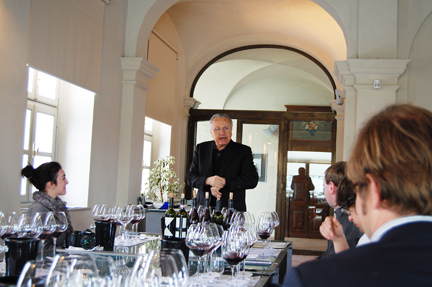
Above: Valter Fissore of Elvio Cogno (Novello) single-handedly delivered the Nascetta grape from oblivion after he tasted a wine made using this once highly praised grape in 1991. The wine had been bottled in 1986.

It’s regrettable that when I tasted the Nascetta grape for the first time last year, it was served to me ice cold and was described as a “light-bodied white wine.”

While in Piedmont in March of this year, I happily learned that Nascetta is actually a noble white grape variety that can produce long-lived, structured wines. And I had the great fortune to taste Valter Fissore’s excellent 2001 bottling — a nearly decade-old expression of this grape. In my notes, I wrote “rosemary, sage, petrol,” and was blown away by the structure of the wine, its lively acidity, and most of all its gorgeous, unctuous mouthfeel.

Yesterday, in a wonderful post on drinking the last extant bottling of a vintage, Cory nudged me to fulfill a promise to explore the origins of the name. And so here it is.
First of all, a little history.

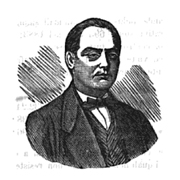
The name Nascetta was coined by 19th-century Piedmontese enologist Giovanni Gagna (left, 1833-1881), who believed erroneously that the grape was related to the Sardinian grape Nasco (from the Sardinian nuscu, from the Latin muscus, meaning moss). Remember: for the better part of the 18th and 19th centuries, Sardinia, Nice, Savoy, and Piedmont were ruled by the House of Savoy (the Kingdom of Sardinia), with its court in Turin and so commerce between Sardinia and Piedmont was fluid during that period.

In 1877, Count Giovanni di Rovasenda listed the grape using its dialectal name, Anascetta, in his landmark Saggio di una ampelografia universale (Essay on Universal Ampelography). The fact that he uses the dialectal inflection of Gagna’s name for the grape is an indication of how popular the grape was in Piedmont at that time, when it was commonly blended with Favorita (Vermentino) and Moscato. (In Piedmontese dialect, an initial a is added to certain words to compensate for syncopated, i.e., lost vowels; in this case, the acquisition of the initial a would appear hypercorrective, a phenomenon not uncommon in the morphology of Piedmontese.)

Here’s where it gets a little complicated.

Above: The confusion regarding the name of this grape was created in part by Valter’s frustration with labeling requirements. In 2001, he bottled the wine as a non-vintage vino da tavola (table wine) because the grape was not yet authorized for the Langhe Bianco DOC appellation.

Let’s start with some chronology:

1991 – Valter tastes a bottling of 1986 by farmer Francesco Marengo (Novello).
1994 – Valter produces 800 bottles from his own planting of the grape, labeled as Nas-cetta; following this vintage, Valter is forced to stop labeling the wine as Nas-cetta after he is fined for listing an unauthorized grape variety name on the label.
2000 – Nascetta (the grape) is added to the catalog of authorized grape varieties for Langhe.
2004 – Valter bottles the wine as Langhe Bianco DOC but cannot list the grape variety on the label; he labels the wine “Anas-cëtta” using a “fantasy” name because the grape is not authorized for the Langhe Bianco DOC labeling (it’s authorized for the blend but not the label).
2010 – After Valter’s successful lobbying, the 2010 vintage will be first labeled as Langhe Nascetta [sic] DOC.

Above: Valter’s Nascetta is an excellent value for a structured, age-worthy white. Be sure to serve it at cellar or room temperature.

When I asked Valter directly about his use of diacritics (in this case the umlaut and the hyphen), he told me flatly that he introduced them in the labeling for purely proprietary reasons. The mutation of the grape names Nascetta and Anascetta was inspired by his frustration with labeling requirements. The good news is that the confusion has been resolved and this noble white grape will be labeled as “Langhe Nascetta DOC” beginning with the 2010 vintage.

While in Piedmont in March, I also tasted another excellent bottling of Nascetta by Rivetto.

Be sure to read Cory’s post on the last bottle of 2001 and Whitney’s post, too.

… O, be some other name!
What’s in a name? that which we call a rose
By any other name would smell as sweet;
So Romeo would, were he not Romeo call’d,
Retain that dear perfection which he owes
Without that title. Romeo, doff thy name,
And for that name which is no part of thee
Take all myself.
Pergola-trained Schiava that blew us away… @MasVinoPorFavor

From the department of “ampelography and vinography as exegetic tools that help us to achieve a more profound understanding of the human experience and condition”…

schiava

Photos by Tracie P.

Every once in a while, you stumble upon a bottle of wine that expands your vinous horizons.

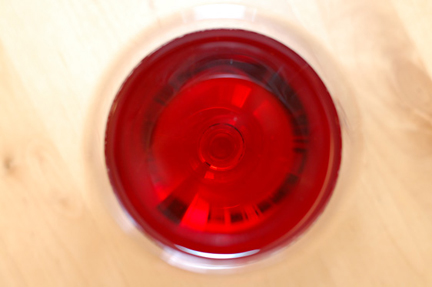
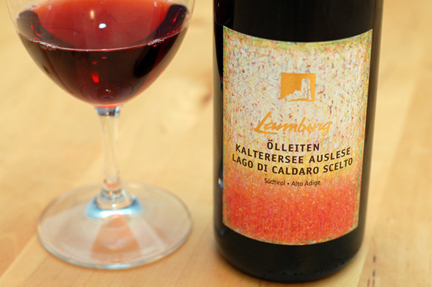
Once such bottle came into our lives the other day after wine seller Marcy Jiminez in Houston recommended it to me: the 2008 Laimburg Alto Adige/Südtirol Kalterersee Auslese Classico Superiore DOC Ölleiten (Kalterersee is German for [Lago di] Caldaro Scelto; “Ölleiten” refers to the fact that the vineyards lie adjacent to olive groves).

Here’s the link to the winery and link to the wine and fact sheet.

The wine was bright and fresh, with the zinging acidity and balance of technicolor (red berry and black cherry) fruit and earthiness that really turn us on. And even in a market like Texas, where we pay more for European wines than our counterparts in New York and California (thanks to higher alcohol tax, higher storage cost, and the big distributors’s choke-hold monopoly on the Texas legislature), this wine weighed in at only $23.

We love, love, loved it…

Especially after tasting a wine like this, it’s not hard to understand why Schiava was such a popular grape in another era.

As editors Calò et alia write in Vitigni d’Italia (Grape Varieties of Italy, Calderini, Bologna, 2006), Schiava (pronounced SKEE’AH-vah) “was one of the first grape varieties to be cited in the legal documents and treatises of the Middle Ages.” Its popularity was so great that “it represented the viticultural model for Slavic grape growing by antonomasia.”*

The name Schiava comes from the High German Schlaff, an ethnonym denoting “A person belonging by race to a large group of peoples inhabiting eastern Europe and comprising the Russians, Bulgarians, Serbo-Croats, Slovenes, Poles, Czechs, Slovaks, etc.” (Oxford English Dictionary). And it is related to the Italian schiavo (meaning slave, from the Latin sclavus) only in its morphology.

In other words, it was (and is) an ampelonym that, by synecdoche,** represented a cultural epoch in which Slavic culture dominated that part of the world.

When I attended Vinitaly earlier this year, I asked Florian Gojer of the Gojer winery to pronounce Lagrein for the Italian Grape Name & Appellation Pronunciation Project. When I asked him to pronounce Schiava, he insisted on using the German name, noting that in “Alto Adige, we use the German” Vernatsch.

My philological intuition points me to a relationship with Vernaccia but that inquiry will have to wait for another day. In the meantime, here’s Florian…

* antonomasia: “The use of a proper name to express a general idea, as in calling an orator a Cicero, a wise judge a Daniel” (Oxford English Dictionary).

** synecdoche: “A figure by which a more comprehensive term is used for a less comprehensive or vice versâ; as whole for part or part for whole, genus for species or species for genus, etc.” (Oxford English Dictionary).

My life as a Knight of Malta (and why wine blogging matters)

Above: The amazing Hawk Wakawaka posted this wonderful depiction of our family yesterday on her blog. Click the image to enlarge.

For many years now, I’ve thought of enogastronomy as an exegetic tool that can be mustered to achieve a deeper and greater understanding of the human experience and condition.

And over the course of nearly five years that I’ve maintained my blog, I’ve discovered that above and beyond the epistemological discourse spurred through the enoblogosphere’s hypertext, wine blogging has also unexpectedly delivered other rewards through intensely and intrinsically meaningful friendships with other wine bloggers across the world.

Alfonso (Dallas) is one such friend. Brookyn Guy (Brooklyn) another. And there are so many others, many of them in Italy, France, Britain, and even Australia.

Of course, Tracie P and I met through wine blogging (here’s the post on the story of how we met). Our union ultimately led to the birth of our beautiful daughter, Georgia P (who, as you can imagine, already has a blog).

Earlier this year, when Alfonso suggested that I contact Hawk Wakawaka and ask her to join the Colli Orientali del Friuli blogger project, I knew that I would find in her a friend, colleague, and peer: our tightly knit community of wine bloggers prizes collegiality and camaraderie, professionalism and courtesy, brilliance and acumen.

You can imagine my joy this morning when I awoke to discover that Hawk Wakawaka had depicted me as a Knight of Malta and a protector of my family (in the image above).

I’ll point you to her post for the story behind the drawing and our experience together in Friuli.

And I’ll send her a heartfelt thanks for helping me to understand the human condition and experience in a new and newly meaningful way… all thanks to wine blogging…

Magliocco: Italian Grape Name & Appellation Project

Here’s the link for previous entries in the Italian Grape Name & Appellation Pronunciation Project.

When I first launched the Italian Grape Name & Appellation Pronunciation Project I wanted to give a voice to Italian winemakers by creating a public platform where they could “speak” their grapes. The pronunciation of their grape names — their ampelonyms — can often prove challenging for Anglophones.

But as the project expands, I’m including a “layperson” of wine in this entry.

My friend Giovanni Gagliardi is not a winemaker: he’s what I call a “cultural entrepreneur” of Italian wine. A native of Calabria, he curates a website devoted to the wines of Calabria (VinoCalabrese.it) and he travels the country attending and speaking at all sorts of wine festivals (that’s how we met).

But most of all I wanted to include him because he is a simpaticone (see photo taken from his Facebook below).

In this week’s entry, Giovanni speaks “Magliocco,” a grape that we’ve seen very little of in the U.S. but that is making new inroads here.

Where Cirò is known for its Gaglioppo, the winemakers of Cosenza view Magliocco as the greatest indigenous expression of their enologic landscape.

In the U.S., I’ve tasted superb bottlings of Magliocco, including wines by Terra di Balbia (by my good friend Giampaolo Venica) and Librandi. And there are more and more wines making it here.

Magliocco (also called Magliocco Canino, Magliocco Ovale, and Magliuacculu) is a tannic grape with a wonderful roundness to it (when vinified monovarietally), good dark red fruit, and healthy acidity. The Terra di Balbia Magliocco is one of the best selling wines by the glass at Sotto in Los Angeles (where I author the wine list).

Thanks for speaking Italan grapes!

Mussolini’s Brunello

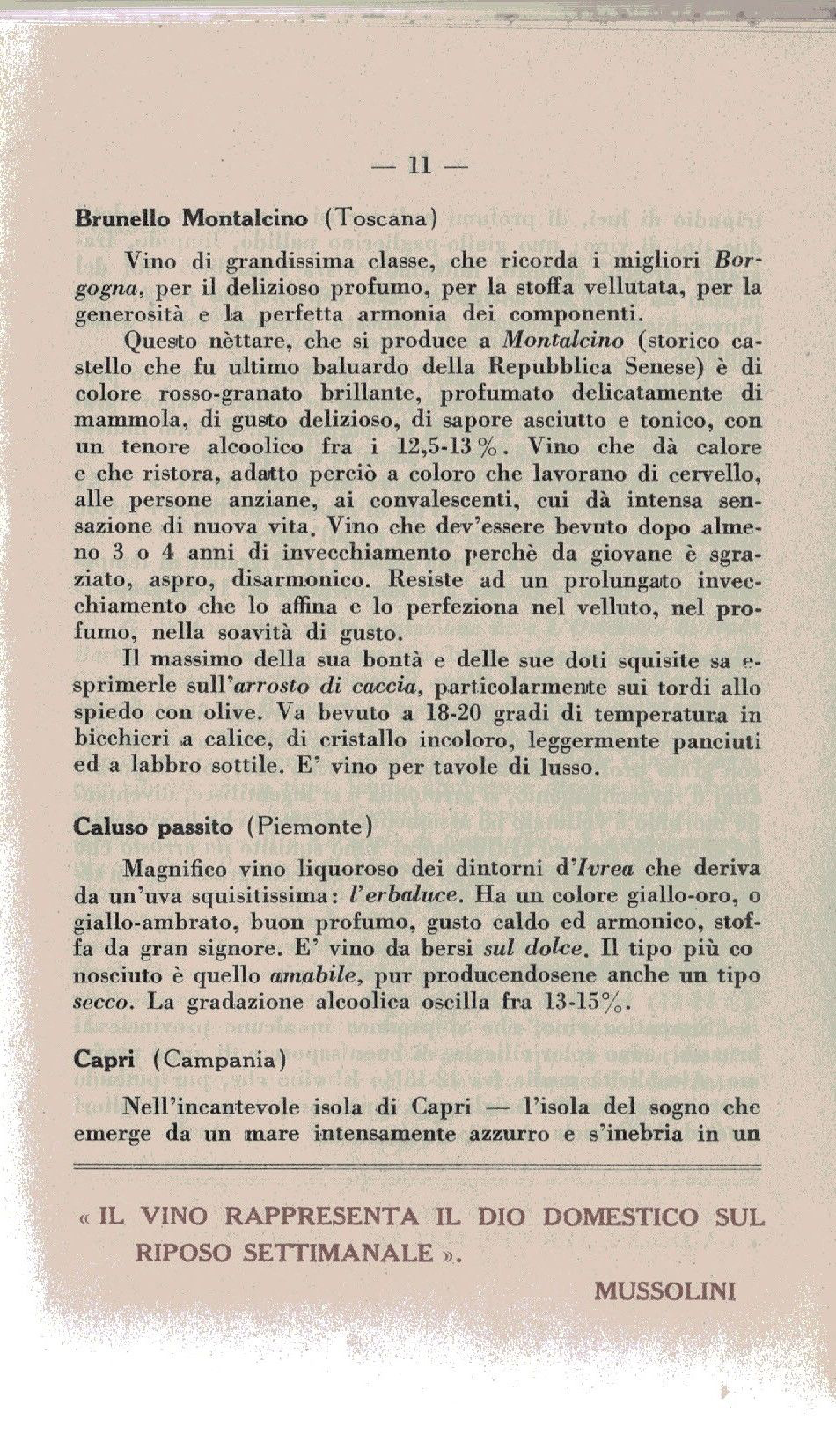
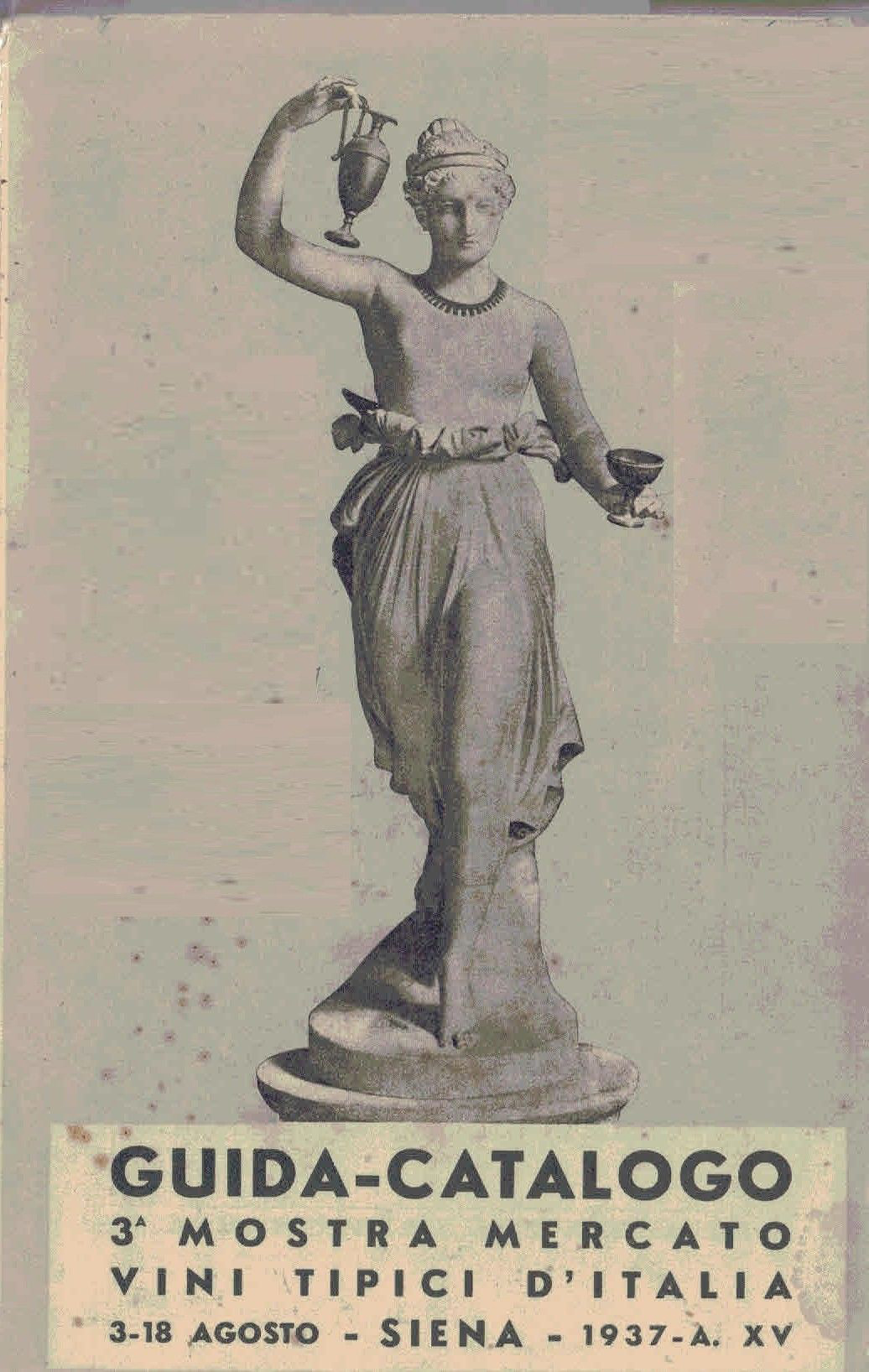
I was thrilled to read this translation of the entry for Brunello di Montalcino in a 1937 (fascist era) catalog for an exhibition of Italian wines in Siena by my friends at Tenuta Il Poggione.

The document offers us a window onto how Brunello was perceived in another era. In 1937, fascism was at its zenith and Mussolini had yet to adopt Hitler’s race laws (1938). It was a time filled with national pride for many Italians (members of the fascist party) and the exhibition of “typical Italian wines” in Siena that year was indicative of the spirit of italianità that gripped the Italian collective psyche.

Alessandro Bindocci, who posted the document and translation on his blog, neglected to translate the quote from Mussolini at the bottom of the page (btw, I asked Ale to send me hi-res versions of the document; click the images here to view), il vino rappresenta il dio domestico sul riposo settimanale: wine represents the domestic god of weekly rest.

The quote is significant for many reasons. But most importantly in my mind, it offers us a trace of how fine wine was considered a medicine with health-enhancing properties in the era before the Second World War.

Brunello di Montalcino, write the editors of the catalog, has an alcohol content of “12.5-13%” (!!!) and is recommended for “those who work with their brains, the elderly, and those recovering from illness. It will give the drinker a sensation of new life.” They even suggest that Brunello di Montalcino has a “tonic” (i.e., medicinal) flavor.

It’s a fascinating however short text and I highly recommend it to you.

I hope to consult the catalog when I visit Montalcino later this year.

Buona lettura…

Lagrein: Italian Grape Name & Appelllation Pronunciation Project @EricAsimov

Eric the Red was right to “have a little fun with it” when he wrote me asking about the pronunciation of the Italian grape name Lagrein last year.

“FEW things are simple in northeastern Italy,” he wrote, “least of all lagrein, a red grape that can produce fresh, aromatic, highly seductive wines. Why, just last week, I asked a linguistically minded friend who is fluent in Italian for the proper pronunciation of lagrein. Here is his response, or part of it:”

    “Lagrein is a tough one,” he said, “in part because it’s pronounced using a Germanic, as opposed to an Italianate vowel system.” He went on to offer his preference, lah-GRAH’EEN, but allowed that lah-GRINE and lah-GREYE’NE (where greye rhymes with eye) were also acceptable. Well, linguists are nothing if not perfectionists. But even allowing for such hairsplitting, lagrein comes with ample grounds for confusion. It is grown primarily in Alto Adige, a region so far to the north in Alpine Italy that it practically touches Austria and Switzerland. There, the culture is more Tyrolean than Italian, and the first language is often German. Many wines from the region are labeled in both Italian and in German. Even the name of the region, Alto Adige, does not speak for itself; it is generally rendered bilingually with its German counterpart, Südtirol (South Tyrol, using the Germanic vowel system, of course).

Here’s the link to his profile of Lagrein and tasting panel notes.

When I headed to Italy at the end of March to attend the annual Italian wine trade fair, Lagrein was on the top of my list of new ampelonyms to capture for the Italian Grape Name and Appellation Pronunciation Project.

And so I made a beeline to the Franz Gojer stand — in my view, one of the greatest producers of Lagrein — and asked Franz’s son Florian to speak for my camera. While Florian is bilingual (and of course, we spoke in Italian), German is his first language. And as per what I told Eric above, Lagrein, linguistically speaking, is first and foremost Germanic.

Thanks for speaking Italian (grapes)!

Frito pie, meditations and contemplation…

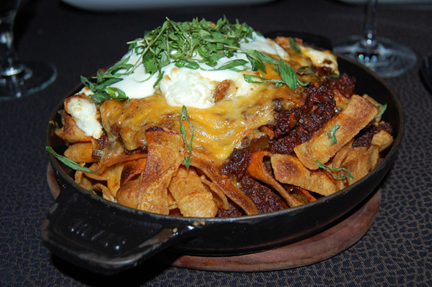
There is perhaps no dish that inspires connoisseurship among Texans as much as Frito Pie.

Shrouded in mystique and lore, this mighty staple of rigorously authentic Texas gastronomy, speaks to the citizens of our state like no other in our culinary canon. By combining indigenous ingredients and formulas — Fritos, invented in San Antonio, and chili con carne, actually known simply as chili in our state, as one adoptive Texan learned dutifully when he made the mistake of calling “turkey chili” chili — this supremely Texan of victuals marries all the things we love best: Fat and spice.

Click to continue reading my post for the Houston Press today…

An American in Brescia and “una fiera di merda”

Above: A repast of hard-boiled eggs, piada (savory Lombard flatbread, akin to Emilia’s piadina), housemade gardiniera, and “peperoni bresciani,” brined “peperoni lombardi” that have been tossed with extra-virgin olive oil and freshly grated Grana Padano.

It’s not easy to describe the utter fatigue that comes with Vinitaly — for the exhibitors and fair-goers alike. For folks like me and Alfonso (who’s been coming to the Italian wine trade fair for 30+ years), you make the trans-Atlantic journey and then you hit the ground running as you attempt to fit in as many meetings and tastings as possible from early in the morning through dinner and beyond.

On the eve of the last day of the fair, I headed with my good friend Giovanni (who showed his wines at the fair) to Brescia, where we decompressed over dinner at the Trattoria Gasparo and later back at Giovanni’s place with a bottle of Camossi Franciacorta (vinified and disgorged by him) paired with Francis Lai and Truffaut.

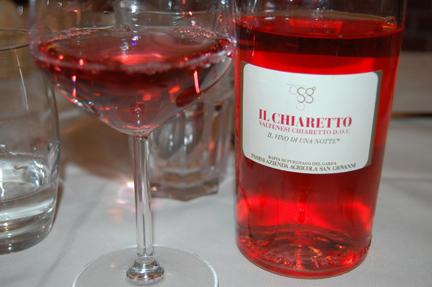
Above: Valtènesi (Garda) Chiaretto was one of the last DOCs to be approved by Italian authorities before the EU’s CMO reforms of the Italian appellation system went into effect. At dinner we drank Giovanni’s brother-in-law Luca Pasini’s Chiaretto, made primarily with Groppello and macerated with skin contact for “one night,” hence the wine’s subtitle, “vino di una notte.”

According to a press release issued by the fair’s organizer VeronaFiere, “Vinitaly won its gamble and earned the satisfaction of exhibitors, with an increase of professional visitors from abroad and especially from the Italian horeca (hotel/restaurant/catering) channel.”

There may be strength in record numbers but the truth is that the execution of the fair was thoroughly disastrous.

On Sunday and Monday, when attendance hit its peak, a mishap with the wifi network at the fair caused fair-goers to lose all cellular service. As a result, you couldn’t call, text, or message in any format.

And because, once again, the organizers failed to address parking and congestion issues, fair-goers and exhibitors spent up to 1.5 hours every night just trying to leave the grounds.

Nearly every producer I visited with told me privately, è stata una fiera di merda (it’s been a shitty fair).

But despite the logistical challenges, my personal Vinitaly was rewarding and I have many tales to tell.

And, thankfully, the aches and weariness of an American in Brescia were soothed by the bubbles and saltiness of Giovanni’s Franciacorta and a tune from the year that Vinitaly and I were born…

Today I’m in Tuscany for a few meetings and Saturday I head to Friuli for the COF2012 blogger project. Stay tuned…

Alice and I pay a visit to the “Wine Seer” (New York Stories III)

@Levi_opens_wine an amazing wine seer, don’t you think, @DoBianchi?” tweeted Alice at the end of the night after we visited with Levi and Brooklyn Guy uptown last Friday night.

In my view, Levi is arguably the coolest sommelier in the U.S. right now and beyond his razor-sharp expertise in Italian wine, he always seems to be just one step ahead of the curve, shaping the discourse and defining the dialectic — a wine “seer,” as Alice put.

It’s not that I didn’t want to see all of my other friends last week in the City. I only had about 48 hours on the ground and they were consumed mostly by meetings with my top client. And Alice, Brooklyn Guy, and Levi were the people I needed to see on this trip.

It was also great to catch up with celebrity sommelier Michael Madrigale, who was working the floor at Boulud Sud that night with Levi.

But it was Levi who had the goods and the dope that I wanted to smoke.

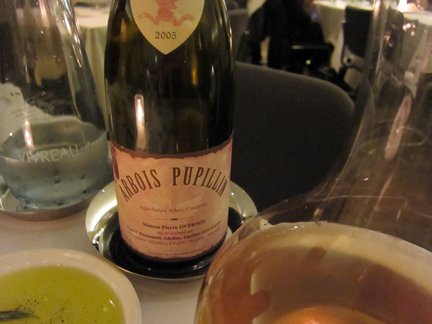
The first wine he opened was the 2005 Overnoy Arbois Pupillin (made from Savagnin), a wine that Levi knows is hard to find beyond the island of Manhattan. An oxidative, tannic, orange wine from the Jura… In many ways this wine represented a synagoga (a coming together) of fascinations that have exited some of us over the last decade. The wine was salty and dense, with its muscle dominating its grace; its delicacy and nuance emerging and revealing itself only as we patiently observed its evolution.

Brooklyn Guy offered that this was an ideal expression of this wine, noting that he had seen a lot of bottle variation in his purchases.

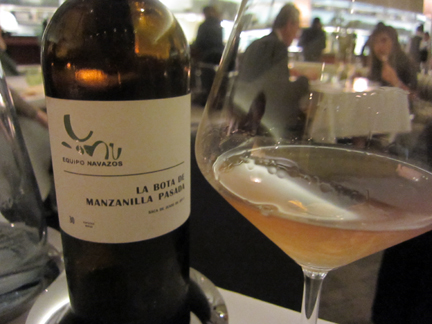
But the pièce de résistance was the Equipos Navaros Bota de Manzanilla Pasada (Sherry).

Brooklyn Guy (aka “the Brook,” as Eric the Red calls him) and Levi have both visited Jerez in the last few years and it was thrilling to hear them hold court on this wine, produced by a generic, commercial winery that holds back certain privileged casks.

“Sherry is a forgotten wine,” said Brooklyn Guy, as Levi expressed his view that the category delivers wines that should be served with food instead of as an aperitif, as do the English and Anglophilic Americans.

I highly recommend checking both of their blogs — Brooklyn Guy and So You Want to be a Sommelier, respectively — and their threads on Sherry and their discoveries.

Is Sherry going to be the next big thing in the U.S.?

@Levi_opens_wine an amazing wine seer, don’t you think, @DoBianchi?

Angelo Gaja’s State of the Union Address: “the winery next door isn’t an enemy”

Above: The last time I tasted with Angelo Gaja was in March 2010 at his winery in Barbaresco.

Earlier this week Angelo Gaja sent out one of what I call his “papal bulls.” As an elder statesman of Italian wine, he often issues these statements via email — on the state of the Italian wine industry, on the Brunello controversy, on the distillation crisis in Piedmont etc. And a number of Italian bloggers repost them.

As I prepare to leave for Italy to attend the Italian wine trade fair Vinitaly (and to lead a group of bloggers to Friuli the following week), I decided to translate his most recent “state of the union” address.

Whether you agree with him or not, I think that you’ll find his insights and observations as interesting as I did.

For the record, I am the author of the translation below and while you can find the piece on many Italian-language sites, I read it on I Numeri del Vino (an Italian wine industry blog that I highly recommend).

I also highly recommend checking out this post by Alfonso on the DOC(G) to DOP migration (part of the same EEC Common Market Organization Reforms that Gaja references in his statement).

Europe’s Winds of Change

by Angelo Gaja

The Italian wine market is going through a phase of profound change that offers contrasting clues for interpretation.

Domestic consumption is dropping while exports are growing. There are producers who are finding it hard to sell their wines and their cellars are still full of wine. Others take advantage of market opportunities and they empty their cellars with ease.

The current trend of pessimism contrasts with the rhetoric of optimism. Where does the truth lie? The numbers don’t tell the whole story but they help us to understand the current situation.

Nearly twenty-five million hectoliters of Italian wine are exported annually and domestic consumption is just over twenty million hectoliters. Together, these numbers constitute a demand of forty-five million hectoliters, to which we need to add the demand for wine by vinegar producers and users of industrial alcohol. The annual average production of wine in Italy in recent years has strained to meet demand. Will Italian wine fail to rise to the occasion?

Causes that Contribute to a Balancing of the Market

Global warming has contributed to this stress, as has the advanced state of obsolescence of 50 percent of the vineyards in Italy today. But it has also been accelerated by the effects of the European market reforms that were called for, imposed, and implemented by Brussels on August 1, 2009.

These reforms were inspired by common sense — a rare commodity these days. And they were intended to put an end to the waste perpetuated by more than thirty years of public subsidies devoted to the elimination of surplus. And they were implemented by the introduction of measures aimed at re-balancing the wine market.

Once squandered, [European Economic] Community contributions are now devoted to the co-financing of promotion of European wineries beyond Europe’s borders and they have helped exports take off despite the current crisis.

In a short period of time, the number of wineries exporting their products has grown more than 30 percent. A significant number of artisanal producers has begun to ship wines abroad and their success has encouraged to them to combine their resources and to travel beyond Italy’s borders to tell their stories and share their passion, traditions, and innovations. And in doing so, they have helped to contribute to the greater respect that Italian wine now commands throughout the world. As a result, there are many who now believe that the Italian wine market is undergoing a profound and unprecedented structural change that requires them to adopt a new and different cultural approach.

Think Differently

More must be done to monitor and prevent the production of counterfeit wine.

We must stop thinking that we need to compete with one another and that the winery next door is an enemy.

It’s inconceivable that the windfall of European Economic Community contributions for the co-financing of exports beyond Europe’s borders continue uninterrupted: why should European citizens be taxes to achieve this goal?

We must learn how to build business networks using only our own funds.

The domestic market continues to be the most challenging. But its value is undiminished because it’s what shapes and builds business: it’s a mistake to dismiss and neglect it.

The producers whose wines enjoy a healthy presence in the Italian market are often the same producers who reap the rewards of foreign markets.

The balance between supply and demand puts the greatest responsibility on all of our shoulders. And it should impel producers to grow and to become more capable businessmen who are better prepared to rise up to meet the challenges of the market.

Angelo Gaja, March 19, 2012