It’s a bloggy blog world (and more on Mascarello).

Before my gig on Saturday night in Alphabet City, I stopped by Terroir on East 12th St. to connect with friend and polemical wine blogger Lyle Fass, author of Rockss and Fruit, for a glass of — yes, you guessed it — Riesling (Eugen Müller Rheinhessen 2005).

The post the other day on Mascarello the new Che generated a lot of feedback and so I snapped the above and below pics of the Terroir Mascarello T.

Terroir’s website is now online. I applaud the owners’ militant spirit but I feel that their “No barrique, no Berlusconi” motto/mantra is misguided. Mascarello’s famous Berlusconi label was released in a particular moment in Italian history and had a historical meaning within the context of contemporary Italian politics (remember: when the wine was released, Berlusconi was prime minister and Italian troops had been deployed in the Bush-legacy war). There’s a lot more to Mascarello’s wines and to the concept of terroir than just “no barrique.” I hope to see Maria Teresa Mascarello when I taste at Vini Veri next week and get her take on it.

Check out these images of the labels on collector Ken Vastola’s site.

Terroir sells the shirts for $25.

That’s Lyle and me in the above pic. Lyle’s one of many friends I’ve made through the blogosphere.

Terry Hughes, author of the controversial blog Mondosapore, is another friend I’ve made through the blogosphere. He and I grabbed a glass of 1989 Clos Baudin Vouvray yesterday evening at the bar at Gramercy Tavern.

One of the most rewarding things about my experience blogging is the interesting and caring people I’ve met along the way (look for more in upcoming posts about blogger/friends). If Snoop Dog had a blog, he would say that it’s a bloggy blog world.

That’s me and Céline Dijon at our show on Saturday night. We debuted our new song “Catastrophe,” about a relationship gone bad but a chance to start anew and make a better life — a reversal of a reversal, to put it in the context of peripeteia.

Our April 10 date in Ljubljana has been confirmed: I can’t reveal the name of the private club where we’ll be playing but if you’d like to attend, email me (jparzen at gmail) with the word “fidelio” in the subject line and I’ll send you the secret password together with the name of the club a few days before the show. As soon as our April 9 date in Gorizia is confirmed, I’ll post the info.

Shouts-Out

It was the best of times, it was the worst of times…

I got a couple of shouts-out in the blogosphere yesterday.

One was from top food and wine blogger McDuff, who wrote a no-holds-barred post on a recent De Grazia tasting he attended. I was really impressed with the candor of his post (and I am a regular reader and fan of his blog). (Another favorite blogger of mine, Brooklynguy, also wrote a powerfully honest and critical post on the Gambero Rosso Tre Bicchieri tasting in NYC. I’m planning to start a “Brooklynguy Amarone Fund” and will personally contribute a bottle of Le Ragose.)

The other came from masterful sage Messere Alfonso Cevola, who takes the art of wine and food blogging to a new level of style and substance. His humor is Pirandellian, his enologic insight Sciasciaesque, his writing style Lampedusian. And his hilarious post on the mishaps of would-be fine Italian dining brought some sunshine into my otherwise dreary and Woody-Allenesque Manhattan day.

Blog on, brothers, blog on….

Gambero Rosso in San Diego (or What Would Happen if All Tuscans Became Super Tuscans?)

Above: Giovanni Folonari pours his new Super Tuscan, Campo al Mare (Bolgheri) at the Gambero Rosso Tour in San Diego, California.

Does the world really need another Super Tuscan? This question plagued me as I tasted through the wines on display at the Gambero Rosso “Top Italian Wine Roadshow” at the San Diego Wine and Culinary Center in downtown San Diego.

Otherwise useful as a directory of Italian wineries, the Gambero Rosso Guide to the Wines of Italy favors the big “lip-smacking,” luscious wines that seem do sell well in the United States. The three-glass scoring system used in the guide is yet another – however poetically veiled – points-based system, and while the same big-name wines seem to score well year after year in the guide, few small producers and even fewer lower-end wines make it up the ladder.

When I asked how the guide has grown in the 20+ years he’s served as editor-in-chief, Marco Sabellico told me, “the guide hasn’t grown because Italians are making more wines. The guide has grown because Italians are making more higher-end wines.”

It’s not really clear to me how the wines are chosen for the Gambero Rosso “Top Italian Wine Roadshow” (held this year in San Francisco, Los Angeles, and for the first time San Diego). Its “Three Glass” tasting features only those wines that have won the guide’s top award. For the roadshow, it seems that Marina Thompson PR might have something to do with the selection. Marina happens to be Gambero Rosso president Daniele Cernilli’s wife.

What lured me to the event this year was the fact that it was held for the first-time in San Diego, California.

Above: Tim Grace of Il Mulino di Grace, a Chianti Classico producer in the township of Panzano.

I was asked by many presenters to taste this or that “new” Super Tuscan.

Giovanni Folonari had me taste his Campo al Mare, made from Merlot, Cabernet, and Petit Verdot (no Sangiovese). The estate, he told me, lies between Sassicaia and Ornellaia. The wine was well made, not overly woody, and not too high in alcohol. But does the world need yet another Super Tuscan? Maybe it does and since I’m not a fan of Merlot and/or Cabernet Sauvignon in the first place, maybe I should just keep my mouth shut. Giovanni told me it will retail for about $35 and that’s good news, I guess. Maybe the world does need a new reasonably priced Super Tuscan.

I also tasted a Super Tuscan (Gratius) by Mulino di Grace (Panzano, Chianti Classico). The Grace family’s Chianti Classico is a blend of Sangiovese with smaller amounts of Merlot and Cabernet. I kinda liked its Chianti Classico, where the addition of small amounts of international grapes give the wine more color and forward fruit, thus making it more modern in style. But I really liked the Gratius, 100% Sangiovese, a wine that showed the balance of fruit, acidity, and gentler tannin, and the lightness in the mouth that you get with Tuscany’s Sangiovese. To my palate, the Gratius tasted the most like Chianti Classico of all the wines he was pouring (in fact, owner Tim Grace told me, the wine could have been classified as Chianti Classico DOCG).

Some believe that the term Super Tuscan was coined by Nicolas Belfrage and was first used in print in Life Beyond Lambrusco (1985), co-authored by Nicolas and Jancis Robinson. The early Super Tuscans were generally made with international grape varieties and the wines generally saw some time in new wood. Because the wines — most famously, Sassicaia and Tignanello — did not meet standards for any existing appellations at the time they were first released, they were officially classified as vini da tavola or table wines, even though they were marketed as high-end wines.

According to usage, a Super Tuscan is a Tuscan-made wine that 1) does not meet requirements set forth by local appellation laws (in many cases, this is due merely to the fact that a given wine uses grape varieties not allowed by the appellation); or 2) has been intentionally declassified by the producer (as in the case of Tim Grace’ wine). While barrique aging is often used for Super Tuscans, barrique is not a sine qua non.

One of the reasons why the term Super Tuscan helps winemakers to sell wines in the United States is the moniker itself: it just sounds good and it implies that the wines are somehow better, that they surpass the rest of the field. I certainly can’t blame Tim for declassifying his wine. Chianti is a confusing appellation for Americans and if declassification helps him to promote awareness of his wines, more power to him (and his wines are good and deserve attention).

But because the term Super Tuscan is now applied to wines made in Bolgheri (on the Tuscan coast), Chianti Classico, Chianti Rufina, Chianti Colli Fiorentini (and other subzones), Montalcino, Montecucco, Montepulciano… and the list goes on… it has became a de facto über-classification that eclipses the personality of those places and the character of the persons who make those wines.

Tuscans are a highly diverse group of people and their language, their food, their traditions, and their wines change from city to city, town to town, from village to village (and from principality to principality, we would have said in another age). Just ask a Florentine what s/he thinks of the Pisans and you’ll see what I mean (and I won’t repeat the colloquial adage nor the often quoted line from Dante here). I’ve traveled extensively in Tuscany and have spent many hours in its libraries, its trattorie, and wineries. I would certainly be disappointed if the Tuscans, like their wines, all became Super Tuscans.

VinoWire, news from the world of Italian wine

It took a little bit longer than we had expected but Franco Ziliani and I have finally launched our new project, VinoWire.com, a “news wire” devoted to the world of Italian wine (click on the image above to view).

Franco (left) is one of Italy’s leading wine writers and one of its most respected wine critics. Those of you who read my blog know I consider his blog, Vino al Vino, the best source for cutting-edge Italian wine news (in Italian) undiluted by the Italian wine industry’s PR machine.

Vino al Vino takes its name from the Italian proverb, vino al vino, pane al pane, call wine wine, call bread bread. Franco is not afraid to call a spade a spade and his blog is at once informative, enlightening, and entertaining — and often controversial (as Italophones can gather from reading his comment threads).

Call it another one of my Quixotic adventures: Franco and I hope to fill a gap that we perceived in the English-speaking world by creating an unmitigated transatlantic news source (see our press release below).

Please have a look, send it to your friends, and add it to your blogrolls… Thanks!

For Immediate Release

Tuesday, March 4, 2008

VinoWire.com goes live.

Esteemed Italian journalist and wine critic Franco Ziliani and American writer, blogger, and translator Jeremy Parzen, Ph.D., announced the launch of VinoWire (www.VinoWire.com) today, a news wire devoted to Italian wine. VinoWire, conceived by Ziliani and Parzen, provides a “wire service” feed of current news and events from the world of Italian wine.

“Italian wine is now the number one imported category to America,” said Parzen, “and while North American and British editors do devote attention to Italian wine and food, relatively little news coverage reaches the English-speaking world directly from Italy. VinoWire’s primary goal is to offer English-speaking wine lovers an unbiased, direct, timely, and journalistic source of information on Italian wine, the people who produce it, and the places where it is made.”

What began as a trans-Atlantic virtual conversation between Italian wine writer and pundit Ziliani and food and wine historian and Italian translator Parzen has evolved into an online editorial collaboration, providing unfiltered, balanced news direct from Italy’s base of media and wine professionals.

“The goal is that of creating something different, a confluence of news, ideas, comments, recommendations, tasting notes, opinions, and much more – a site that helps wine enthusiasts around the world to come into contact with Italian wine, to understand it better and appreciate it even more,” said Ziliani. “We hope to open the eyes of American readers who wish to reach beyond the official vulgate of popular magazines with their glossy photographs.”

“Regrettably,” noted the VinoWire creators on their site, “much of the news that makes the crossing to North American loses something in translation: As a twentieth-century Italian poet once said, there is no greater misunderstanding than the Atlantic Ocean.”

In addition to VinoWire’s weekly coverage of Italian wine-related breaking news and events, it will include feature-length editorial addressing a broad range of issues, points-free tasting notes and guest opinion editorial by additional journalists.

VinoWire is hosted by Simplicissimus Blog Farm and was designed by Lorenzo Giuggiolini.

For more information about Franco Ziliani, click here.

For more information about Jeremy Parzen, Ph.D.: click here.

www.VinoWire.com

Analog Wine in a Digital Age

Above: a vintage Neve “mic pre,” one of the microphone pre-amps developed in the 1960s that shaped the sounds of the recordings made then. I guarantee you that some of your favorite recordings were made using this technology (click on the image to read more about Neve consoles and mic-pres).

I really liked this post by Dave Buchanan, author of Wine Opener, where he writes about European winemakers who are pushing the envelope “in terms of getting their grapes ripe enough and using questionable winemaking techniques to produce wines that will mimic and sell as well as the full-throttle big reds first made popular in California”:

    That’s bad news to those of us who still seek those analog wines somehow surviving in a continually more digital world. We want wines that speak of their vineyards and their traditions, not of technological innovations designed to make them not simply drinkable but (more importantly to the winemaker) commercially successful.

The digital/analog analogy resonates with me: it reminds me of my experience in the recording studio with my high-school friend, über-producer and vintage-gear nut Mike Andrews, who taught me how to “record digitally” using “analog ears” when he produced a record I co-wrote and played on a few years ago (with a band I am a “former member of”). In the mid-1990s, producers and recording engineers began using digital technology in new ways to capture analog sounds. Mike was one of the trailblazers and he and the new generation of “analog ear” recording artists rallied around TapeOp magazine, published by my friend and gourmet John Bacigaluppi.

The post also made me think of something Jean-Georges’ wine director Bernard Sun said to me the other day when he had me taste a wine that he is making in California, III Somms, a Cabernet Franc-based blend that surprised with great balance, low alcohol, nice acidity, and even-handed fruit (Bernie, who is one of the nicest people you’ll meet in the wine trade, created the wine with two other sommeliers, hence the name, and he pours this food-friendly wine by the glass in the Jean-Georges group restaurants). “With all the wine trickery out there today,” Bernie said, “there’s no excuse to make an imbalanced wine.” He’s right: while so many are using “questionable wineamaking techniques,” as Dave points out, to make “full-throttle big reds,” they could be harnessing technology to make more balanced wine.

The records made during the golden age of recording — 1950s, 1960s, and 1970s — continue to shape the way music is recorded today. Recording and mixing music is a lot like making wine: it’s all about taste, texture, and balance. A glass of 1961 Giacomo Conterno Monfortino as we listen to that last take, anyone?

The Squires Paradox

Unfortunately your registration at Mark Squires’ Bulletin Board on eRobertParker.com did not meet our membership requirements. Therefore your registration was deleted. Sorry, Mark Squires’ Bulletin Board on eRobertParker.com team.

The above message was sent to me the other day, about four hours after I tried to register for the Mark Squires’ Bulletin Board. I didn’t really want to join the Mark Squires’ Bulletin Board. After all, Squires doesn’t seem to like the natural-wine-loving kind. He already booted two of my favorite wine bloggers, Alice and Lyle. I only wanted to read a post by Mark Fornatale, who works for Skurnik (an importer). He had written about recent managerial changes at one of my favorite wineries, Borgogno: the prince of modern-style Barbaresco, Giorgio Rivetti of La Spinetta, he reported, would be revising vinification practices at the winery. I had been alerted to the post by Franco, who, upon reading Mark’s report, promptly contacted Borgogno’s new owner, Oscar Farinetti, and asked him point-blank if he would allow Giorgio to modify the style. Oscar answered via SMS (entrepreneur Farinetti is the creator of Eataly in Turin):

    Borgogno has no need for any changes in the cellar. As far as Rivetti is concerned, he will play no internal role. He will give us a hand with exports. The following is Borgogno’s corporate strategy: no change in the cellar or in winemaking [and] elimination of wines not internally produce… Borgogno will continue to produce [its wines] using the classic method. (translation mine, see the Franco’s post in Italian with quote from Squires BB in English).

Thank goodness Franco was able to clear things up: to lose Borgogno to the realm of homogeneous modern-style wine would be a tragedy.

Groucho Marx
(above, left) once said famously, “I refuse to join any club that would have me as a member.” Squires would not have me as a member so I guess I can’t refuse membership. But why did Squires refuse me membership? On paper I met all the “requirements.” Did he see Alice and Lyle on my blog roll? did he visit DoBianchi.com and browse disapprovingly through my blog? (You can’t register with a gmail account so I used my dobianchi.com email.)

I wonder what the great logician Bertrand Russell (left), discoverer of “Russell’s paradox”, would have said about Groucho’s paradox. Russell recognized that self-reference “lies at the heart of paradox.” Groucho’s self-referential line is a not-so classic but very funny example of Russell’s paradox: “I refuse to join the set that would have me as a member of that set,” Russell might have joked. I would have liked to join the club of bloggers who had joined Squires BB and then were booted. But Squires wouldn’t even let me on in the first place. I guess I’ll never know what I’m missing. But who can see the logic in that? Sorry, Mark Squires.
There may be many wine cellars in Valpolicella but…

valpolicella map vineyards crus

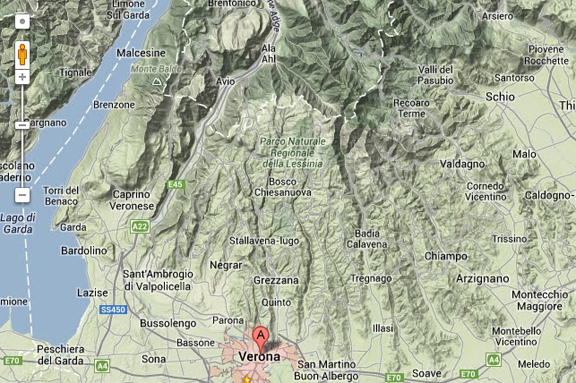
Above: Google’s “terrain” map shows the “wrinkles” of Valpolicella. The topography of the Valpolicella or “valley of alluvial deposits” is defined by a series of small rivers.

From the Greek topos or place and onoma or name, toponymy is the study of place names.

As is the case with many wine-related place names, the names themselves reflect the vine-growing practices of the place. One of my favorites is the Côte-Rôtie or the roasted slope, so-called because the slopes are “roasted” by the sun and there are countless others.

While many erroneously claim that the toponym Valpolicella comes from a hitherto undocumented Greek term for valley of many cellars, it is widely accepted that the name first appeared in the twelfth century (in a decree by Frederic I of Swabia, aka Barbarossa or Red Beard) and by the sixteenth century was widely found in Latin inscriptions as Vallis pulicellae, literally the valley of sand deposits, from the Latin pulla, a term used in classical Latin to denote to dark soil and then later to denote alluvial deposits.

In fact, Valpolicella is not a valley but rather a series of “wrinkles” defined by the Marano, Negrar, Fumane, and Nòvare torrents (streams).

If you’ve ever traveled through that part of Italy, you’ve seen how the hills roll gently across the landscape. There are other Veronese place names that reflect this tradition, like the towns Pol, Pol di Sopra, and Santa Lucia di Pol where pol denotes the presence of a stream or torrent and the pebbly, sandy deposits it forms.

There are some who point to the lass or pulzella portrayed in the device (emblem) of the town of San Pietro in Cariano as the origin of the name. But this theory seems as unlikely to me as the oft-repeated valley of many cellars (another facile faux ami or false cognate).

Valpolicella’s wines were praised highly by Latin authors, notably Virgil and Cassiodorus. Etruscan and proto-Roman winemakers recognized early on that Valpolicella’s undulating landscape was ideal for growing wine grapes.

As Virgil wrote famously, Bacchus amat colles, Bacchus loves hills.

An Auspicious Year for Amarone

Above: the Masi tasting last week featured Campolongo di Torbe 1988 and 1983, top vintages for Amarone.

Dr. Sandro Boscaini (left, owner of Masi) paid a visit to New York City last week to celebrate the 50th Anniversary of his winery’s single-vineyard Amarone, Campolongo di Torbe, a bottling believed by many to be the first Amarone cru.

Amarone della Valpolicella and Recioto della Valpolicella are unique appellations in the panorama of Italian enology and they arguably represent its most misunderstood. They are made from blends of dried Corvina, Rondinella, and Molinara grapes grown in Valpolicella in the province of Verona (Corvina is the primary grape and other grapes, including international varieties, are allowed by the appellation). Although vinification practices vary significantly, fermentation is stopped sooner in the case of Recioto, resulting in a sweeter flavor profile; longer fermentation creates a drier flavor profile for Amarone. Sometimes winemakers use a process called ripasso, literally “second passage,” whereby the wine is aged with the skins and lees (dead yeast cells) leftover from previously vinified wine.

Masi’s wines are made in a modern style (as Dr. Boscaini is proud to point out) and the oaky flavors of the younger wines are a big turn off for me (we tasted a horizontal of the winery’s four 2001 crus and a vertical of the Campolongo di Torbe). The 1983 and 1988 — outstanding vintages for Amarone — were however fantastic and the 1988 in particular was stellar. Boscaini noted that 2007 will be a great vintage for these wines and will rival 97, 88, and 83.

But the 2001 Vaio Armarone was a pleasant surprise: this wine, made in collaboration with the Serego Alighieri winery, is aged in cherry-wood casks, and even at a young age, showed beautiful natural fruit. It stood out against the other young wines and weighed in at a slightly lower price point ($75 retail). Serego Alighieri — pronounced seh-REH-goh AH-lee-GHEE’eh-ree — was purportedly founded by Dante’s son Pietro Alighieri in the mid-fourteenth century: following his exile from Florence, Dante Alighieri (left) found his “first refuge” in Verona and his son ultimately settled there. (See Purgatorio, XVII, 70. Check out the awesome Princeton Dante Project to read the line in context — in Italian and translation — and commentary.)

Dr. Boscaini — “Mr. Amarone,” as he likes to call himself — spoke at length about his family’s decision to “modernize” the winery in 1983 (the same year that Veronelli implored Italian winemakers to revisit their growing and vinification practices; see my post on Veronelli). He sought to eliminate “oxidation” and “unpleasant aromas” in his family’s wines, Boscaini told the group of journalists who had gathered to taste the wines. In doing so, he claimed, he single-handedly created a market for Amarone in the U.S. (an assertion we should take cum grano salis since it was a combination of modernization, more aggressive marketing, and renewed interest in Italian wine that opened a new market for Amarone in the U.S.).

I found his lecture fascinating and he made a number of points I found interesting and topical to understanding Amarone in a historical perspective:

  • Recioto, Recioto Amarone, and Amarone are names for a wine that has always been made, he believes, in a dry and sweet style (many believe that Amarone was vinified as a dry wine for the first time in the twentieth century);
  • botrytis or noble rot, he claimed, is a key element in Amarone and gives it an “illusion of sweetness” (many would counter this claim; he showed data to support it but it wasn’t clear how the information was gathered);
  • only Corvina, Rondinella, and Molinara should be used to make Amarone, he said (others would say that true Amarone is made from “field blends,” i.e., where Corvina, Rondinella, and Molinara are the primary grapes but others are used — sometimes even unspecified and/or grapes growing spontaneously in the vineyard);
  • the term Recioto probably comes from the Latin name for wine produced in Valpolicella, reticum, rather than the commonly accepted recia, Veronese dialect for “ear” or “top bunch” of grapes (I believe he’s right: recioto could very well be a metathesis of reticum);
  • the term Amarone could come from Armaron, a toponym, name of one of the appellation’s oldest growing sites (if this were true, it would indeed bolster his thesis that the wines were always made in a dry style since it would weaken the theory that the wine is called amarone — a linguistic combination of amaro or “bitter” and the augmentative suffix -one — due to the fact that it is dry as opposed to sweet);
  • one of the earliest appearances of the term Amarone on a label was on Masi’s 1948 Recioto Amarone (although he acknowledged that the term appeared as early as the 1930s on bottles produced by the Cantina Sociale Valpolicella).
  • I certainly couldn’t drink Masi’s wines every day: they’re too modern in style for my palate. No matter what the price point (and these wines are expensive), I want to drink something more food friendly (he claimed exactly the opposite: because they are made in a “contemporary style,” he said, his wines are more food friendly). But the wines are very elegant and I can see they can appeal to the modern-style lover while retaining a sense of place.

    If you’ve read this far, then you, too, would have enjoyed Mr. Amarone’s prolixity. I’ll taste his wines with him — however modern they may be — anytime.

    Alice B. Toklas, Wine Critic

    Tirelessly mordacious wine blogger Terry Hughes recently published a post in which he compared contemporary wine writing to New Criticism. His spirited, pungent observations reminded me of my graduate-school days when I used to wrustle with deconstructionists, structuralists and post-structuralists, formalists, and Lacanians (some of whom i actually liked).

    According to the Encyclopedia Britannica, New Criticism was a “post-World War I school of Anglo-American literary critical theory that insisted on the intrinsic value of a work of art and focused attention on the individual work alone as an independent unit of meaning. It was opposed to the critical practice of bringing historical or biographical data to bear on the interpretation of a work.”

    I found Terry’s analogy apt because the current trend of wine writing, with its emphasis on subjective tasting notes, seems entirely bent on disregarding historical, biographical, and – most regrettably – topological information. Like the New Critics who conjured up a new critical theory to deal with modernity, the “New Wine Writers” have concocted a language that disregards history, people, and place: ecce points-based, florid tasting notes.*

    That’s not to say that I don’t like “modern” and “post-modern” literature. In fact, I am a lover of that Caesar of modernity, Gertrude Stein, who published The Autobiography of Alice B. Toklas in 1933 (that’s Alice, above, left). In this work, Stein writes her own auto-biography by writing the “auto-biography” of Alice. In doing so, she reveals that the process of writing is by its nature subjective, intrinsically and inexorably. Consider the following notion: when a wine writer writes her/his impressions of a wine, she/he is really writing her/his autobiography. Voilà, Alice B. Toklas, wine critic. I’ll say no more…

    In other news…

    Although she did not write The Autobiography of Alice B. Toklas, Alice B. Toklas did write a very famous cookbook, the aptly titled Alice B. Toklas Cookbook (1954), which included a now famous recipe for hashish fudge (the precursor to many of the now ubiquitous pot brownies recipes).

    Does anybody remember Peter Sellers’ hilarious 1968 film I Love You Alice B. Toklas?

    I bet Terry does.

    The “Groovy Brownies” clip below is long and corny but worth it.

    * I owe Peter Hellman this classic example of modern wine writing, where two famous wine writers review the same lot with almost diametrically opposed results:

    Parker: “The 2003 Cornas La Louvee is a blockbuster. Glorious aromas of flowers, blackberries, roasted meats, espresso roast, and white chocolate flow from this full-bodied, concentrated, modern-styled, impressively-endowed, full-throttle Cornas. Drink it now and over the next 15+ years. 93pts”

    Wine Spectator: “Tight and structured, with lots of iron and mineral notes framing the black cherry, plum, briar, tar and olive paste flavors. Long finish sports mouthwatering acidity. Very impressive for Cornas in 2003. Best from 2007 through 2015. 800 cases made. 92pts”

    The Spinetta Affair (and the Virtuous Burglar)

    Who dunnit? Neither Franco Ziliani nor I could have done it because on the night of Tuesday, February 12, Franco was at home with his family typing away at his computer and rubbing sleep from his eyes in Bergamo and I was eating a porterhouse at Keens in midtown Manhattan.

    Who were the daring thieves who, according to La Stampa, arrived at the winery in a van that night, entered the cellar through an unlocked window, opened and tasted a few bottles, and then carried away more than 1,000 lots of La Spinetta’s “top-Wine Spectator-rated” wines? (Click the image above, left, to read the account in Italian, published February 14.)

    Could it have been the mysterious underground organization The Committee for the Liberation of Barolo and Barbaresco from Modernist Hegemony?

    Joking aside, the thieves knew what they were doing because they took only top-rated bottles: “evidently they had read the [wine] guides in which Spinetta has been one of the most highly rated wineries for the last three years.” It’s remarkable to think that the thieves, who somehow carted away more than 1,000 bottles of wine, took the time to uncork a few bottles and sample their booty.

    Reading the account (sent to me by Franco), I couldn’t help but think of the classic play by Italian anarchist and Nobel laureate Dario Fo (left): “Non tutti i ladri vengono per nuocere,” literally, “not all thieves come to do harm” (the title has also been translated as “The Virtuous Burglar” and “Some Burglars Have Good Intentions”).*

    Here’s the opening of the play:

    A half-dark stage. Sound of breaking glass. Enter burglar. His flashlight shows a living room filled with expensive things. Phone rings. Pause. Rings again. Burglar picks up phone. Very long pause. Burglar, into phone: “How many times have I told you not to call me at work?**

    The caller is the burglar’s wife.

    The play — a farce — is a about a thief who spends an evening in the home of bourgeois family. As he leafs through their belongings, the man of the house comes home with his mistress. The thief hides but when he can no longer conceal himself, the couple contemplate how they can dispose of him so that he will not reveal their secret. Then, the lady of the house appears and her husband asks the burglar to pretend to be the husband of his lover. Then the burglar’s wife appears and then… well, you’ll just have to read the play yourself.*** In this satire of bourgeois hypocrisy, it turns out that the thief is the virtuous one.

    By virtue of their theft, the Spinetta burglars didn’t do anyone any good and I sincerely hope the Rivetti family gets their wine back. So be on the look out for:

    160 6-packs Barolo Campè 2003
    20 6-packs Barbaresco Valeirano 2004
    360 6-packs Barbaresco Gallina 2003
    600 bottles Barbaresco 1999, 2000, and 2001****

    That is to say, look out for those wines if you like the same wines as the editors of The Wine Spectator.

    Notes:

    * First printed in 1962 but first performed in the late 1950s.

    ** For brevity’s sake, I’m borrowing Ben Sonnenberg’s paraphrased version from his 1993 Nobel recommendation of Fo (The Washington Post, December 5). “The main reason I choose Fo,” wrote Sonnenberg, “is because he writes satirical plays that people applaud and governments fear.”

    *** For an English translation, See “The Virtuous Burglar,” translated by Joe Farrell, in Dario Fo. Plays: One, Portsmouth (NH), Methuen, 1992, pp. 313-49. I also found this flawed translation online.

    *** As reported by the Rivetti family.

    Interesting, miscellaneous facts about Dario Fo:

    – He won the Nobel Prize in 1997.

    – In 1980, the U.S. State Dept. refused him (and his wife Franca Rame) entry to the country. He was supposed to attend the Festival of Italian Theater in New York. Arthur Miller, Norman Mailer, and Martin Scorsese — among others — attended a rally to protest the U.S. denial of his visa.

    – As is the case with “Non tutti i ladri vengono per noucere,” most of Dario Fo’s titles have a proverbial or aphoristic sound to them. My favorite Fo title is “La marijuana della mamma è sempre la più bella.” I’ll let you translate that yourself.