BrooklynGuy’s best value Champagne

Above: This and the images below were all captured in September 2008, when Franco and I visited the truly marvelous and amazing Ca’ del Bosco in Franciacorta. That’s Anna Caprini, director of media relations, who gave us an excellent tour of the winery.

In the case you don’t know or read BrooklynGuy’s blog, you don’t know what you’re missing! His blog is everything a great wine blog should be: open, honest, with no hidden agenda other than sharing his impressions and knowledge and entertaining us with his wry and dry (pun intended) humor.

BrooklynGuy has one of the purest palates in the blogosphere and even though he doesn’t work in the wine industry, he is often asked to take part in tasting panels — by both major magazines and high-profile trade personalities who want to get his impressions.

Above: Ca’ del Bosco produces a wide range of superb champagne-method wines. And while technology prevails there (after all, Champagne and champagne-method wines are, perhaps more than any other, the fruit of technology), works of art also punctuate the winery tour experience, like this rhino suspended, seemingly precariously, from the facility’s ceiling.

But the greatest thing about his blog, for those of us who have been following it for a while now, is BrooklynGuy’s (and I mean this in the most complimentary way) “Rain Man” approach to tasting and wine writing. He’s never lost that sense of innocence that sets his blog apart from the pack (otherwise dominated by folks who think they’re doing the world a favor by sharing their informed and informative palates).

BrooklynGuy loves him some bubbles (as evidenced by his nearly weekly series Friday Night Bubbles).

Above: The remuage or riddling process was the leap in technology that made Champagne and champagne-method wines like those produced in Franciacorta possible. The bottles are stored in these racks and then “riddled”: every day they are turned, gently, by hand, so that the lees of the wine will settle in the neck.

I asked him to cull his blog for some great-value Champagnes and otherwise bubbly wines and he graciously obliged.

As the Latins used to say, ubi maior, minor cessat

*****

I am not someone who sees Champagne as a seasonal beverage. I drink it the way I drink any other wine — as often as I can. That said, there are many people who will buy champagne in the coming week who do not ordinarily do so, and the variety and prices can get a bit overwhelming. Here are some of my favorite sparkling wines at a few different price points (NYC prices, anyway). These are wines that I are available now, that I would confidently purchase for myself or to share with others at a celebration. There are loads of other great choices too, and these are all rather small production wines, so if you don’t find these, ask your friendly knowledgeable wine clerk, or leave Dr. J [editor’s note: that would be me] a comment and he’ll try to get back to you.

—BrooklynGuy

Under $20

Domaine de Montbourgeau Cremant du Jura NV
$20, Neal Rosenthal Imports.

A delicious Blanc de Blancs made from Jura Chardonnay. Refreshing and balanced, very earthy.

Under $30

Huet Vouvray Petillant Brut 2002
$28, Robert Chadderdon Selections.

The finest of the sparkling wines from Vouvray, from one of the finest producers in Vouvray. This is incredibly high quality wine, and at this price it’s a steal.

Above: A detail of the lees (the dead yeast cells) that will be disgorged before the wine is bottled and released.

Under $40

Pierre Brigandat Champagne Brut Reserve NV
$32, Bonhomie Wine Imports.

A lively and expressive Blanc de Noirs that offers ripe and clean fruit, but also a definite sense of soil and mineral.

Chartogne-Taillet Cuvée Sainte-Anne Brut NV
$38, Terry Theise Selections, Michael Skurnik Imports.

This to me is a classic Champagne — floral and biscuit aromas, great acidity and tension, a chalky finish, just delicious. A blend of equal parts Chardonnay and Pinot Noir.

Pierre Gimmonet Champagne Selection Belles Années Blanc de Blancs Brut NV
$35, Terry Theise Selections, Michael Skurnik Imports.

A new cuvée from Gimmonet made of a blend of two vintages of the Cuvée Gastronome, the wine bottled at lower pressure so as to be more harmonious with food. A lithe and tasty wine.

Thanks, again, BrooklynGuy! You ROCK! And happy new year, everyone!

Champagne by any other name…

From the semiotics department…

champagne

Above: A few weeks ago, Tracie B and I attended a “Champagne Party” in south Austin hosted by wine collectors.

Champagne is a place (a province of eastern France).

Champagne is an adjective, “something exhilarating, excellent” (“It was of the two Lytteltons, Alfred and Edward, that the phrase ‘the champagne of cricket’, was first used,” 1928, OED online edition). Champagne is a color.

Champagne is also a compound attributive adjective: you can have “champagne” tastes; you can be a “champagne” socialist (I, for one, certainly am one, although I prefer Brunello socialist); you can even have a “champagne” cocktail.

Champagne is also a wine — a sparkling wine made in the region of Champagne, twice-fermented in bottle.

champagne

Above: It was like a scene from Man Bites Dog when fellow Austinite blogger Alcoholian and I faced off with our cameras at the Champagne party. Meta-blogging at its best!

Champagne perhaps more than any other wine (with Bordeaux a distant second) evokes an ethos, a zeitgeist, an aura, a sentiment, a sensation, a sensual experience…

On any given day, you will find at least three bottles of wine in my refrigerator: a bottle of Prosecco, a bottle of Moscato d’Asti, and a bottle of Champagne. The Prosecco for celebration and/or a great pairing for a small plates dinner (cicchetti). The Moscato d’Asti, with its low alcohol and bright fruit flavors and residual sugar, a great brunch wine, a great a-friend-just-dropped-in wine, a great wine to pair with fresh fruit. But the Champagne? When it comes to a truly special occasion, I wish for no other wine to grace the palate of my beautiful Tracie B than Champagne. Is there any other wine where refinement and elegance meet power and structure as in Champagne? Is it just the ethos behind the wine that inspires this reverence in me?

Today, I’ll leave the technical discussion of Champagne to Eric and BrooklynGuy (I highly recommend both posts, the one on some great grower-producers, the other on varietal expression in Champagne).

I’ll just invite you to consider the word… say it aloud, roll it around your mouth… think of the imagery and ethos it evokes… Champagne… the very word titillates the senses, no? Champagne by any other name just wouldn’t be the same, would it?

Tracie B and I will be opening a Champagne on New Year’s Eve this year but we haven’t decided which one. What’s your “best Champagne” pick?

More tomorrow…

In other news… There is a G-d!

pastrami

Yesterday, Tracie B and I stopped in Houston on our way back to Austin from Orange, Texas and had lunch at Kenny and Ziggy’s Delicatessen. The day I decided to leave New York City, I had resigned myself to never eating great smoked fish and pastrami again (at least, not on a daily basis). But, man, let me tell you: the pastrami at Kenny and Ziggy’s ranks right up there with Barney Greengrass and Katz’s.

I never thought I’d utter the words, “there IS great deli outside of New York.”

Who knew?

Impossible wine pairing? Chicken and dumplings

Above: Did I mention the girl can cook? Tracie B made chicken and dumplings last night for the whole B family. Photo by Rev. B.

In Emilia-Romagna they eat tortellini and cappelletti in brodo (filled pasta in capon broth). In Central Europe they eat knödel served in broth. At the Jewish deli, they serve kreplach in broth. And in the South, they make chicken and dumplings.

Above: Tracie B’s chicken and dumplings. I can only wonder what Dr. V’s user-generated content would have to say about this most impossible impossible wine pairings — chicken and dumplings. But, man, were they good! This and below photos by Tracie B.

By its very nature, broth is an inevitably impossible wine pairing: the temperature alone makes pairing like grabbing the moon with your teeth as the French say.

Heeding the adage by restaurateur giant Danny Meyer, if it grows with it, it goes with it, I should have paired Tracie B’s delectable dumplings with Lambrusco (my top pick would have been a Lambrusco di Sorbara). In Emilia, versatile Lambrusco is served throughout the meal, with the appetizer of affettati (sliced charcuterie), with the first course of tortellini in brodo, with the second course of bollito (boiled meats and sausage), and even with the dessert of Parmgiano Reggiano served in crumbly shards, perhaps topped with a drop of aceto balsamico tradizionale di Modena or di Reggio Emilia (none of that hokey, watery aromatic vinegar). Lambrusco would have been perfect here.

Above: Don’t try this at home. Frankly, the 2004 Barbaresco Pora by Produttori del Barbaresco is going through a nearly undrinkable stage in its evolution.

But as food writer Arthur Schwartz says of pizza, if you can’t be with the one you love, love the one your with.

Before heading to Orange for the Christmas holiday celebration with the B family, I had reached into our cellar and pulled out a bottle of 2004 Barbaresco Pora by Produttori del Barbaresco. Frankly, the wine was too tight, overwhelmingly tannic, and even though it opened up over the course of the evening, it’s going through a nearly undrinkable period in its evolution. But that’s part of my love affair with this winery: experiencing the wine and the different single-vineyard expressions at different points in its life. And there are more bottles of 04 Pora to be had in our cellar. We ended up lingering over wine, sipping it is a meditative wine as we retired to the living room and watched a movie together and munched on oatmeal cookies that Tracie B and Mrs. B had baked that afternoon.

Above: Nephew Tobey wasn’t concerned with wine pairing. But he sure loved him some chicken and dumplings!

Happy Sunday ya’ll and thanks for reading!

Xmas eve gumbo (and they called me “Tex”)

Above: “You’re a cowboy, Je-emy,” said Tobey (left) when I tried on the cowboy hat that Melvin Croaker gave me as a Christmas gift last night. When I was his age, I dreamed of being a cowboy… Don’t all little boys?

According to the Oxford English Dictionary (online version), the word gumbo comes from the Angolan kingombò or quingombo, meaning okra.

Uncle Tim’s gumbo doesn’t have any okra in it, nor does he make it with seafood. But, man, is it delicious: Texas is the only place I’ve lived in the U.S.A. where folks are so passionate about the food they make and eat and where there exists (what I call) idiosyncratic cuisine, where every family (and seemingly every family member) has its own interpretation and expression of traditional dishes and recipes.

Above: You pour the gumbo over boiled short-grain rice (do not used parboiled rice) and then dress with potato salad (made with hard-boiled eggs).

Uncle Tim makes his gumbo as such:

    Prepare 2 gallons chicken stock using chicken thighs (discard the bones if necessary and shred and reserve the chicken meat). Prepare a roux using 2 cups flour and 2 cups vegetable oil (rendered lard was traditionally used), whisking constantly (about 45 minutes) until the flour has browned. Filter the roux using cheesecloth (or paper napkin) and reserve. Combine the roux and stock, add finely chopped yellow onions and green onions, and then add smoked sausage sliced in rounds, including the casing (Tim uses deer sausage, made from deer he hunts himself). Season to taste with Tony Chachere’s Creole seasoning (some use Tony Chachere filé, a powder made from finely ground sassafras leaves). Add the reserved chicken to the pot and simmer for 3 or 4 hours, as necessary, until the desired consistency is obtained. Serve over boiled rice, dressed with potato salad.

Above: Folks in coonass country all have their own idiosyncratic approach to making gumbo but one thing they all seem to agree on is Tony Chachere’s seasonings.

One of the keys to great gumbo, says Uncle Tim, is smoked sausage: the smokey notes, he explains, are what gives his gumbo its distinctive flavor. Be sure not to use Minute Rice (or any other parboiled rice): it will absorb and mask too much of the flavor, he says.

Tracie B and I paired with Luneau-Papin 2006 Muscadet Sèvre & Maine Clos des Allées: the intense aromatic nature of the grape and its bright acidity were great with the spiciness and moreish fattiness of the gumbo dressed with the potatoes, hard-boiled eggs, and mayonnaise in the potato salad.

Above: Uncle Tim and his dog Zsa Zsa. I asked Tim if her nails were painted red for Christmas but that’s her regular color, he said.

Beyond the excellent gumbo, the highlight of the evening for me was a special gift that Melvin and Pam Croaker gave me. You see, they’re very close friends of the B family and so they feel very close to Tracie B. Ever since Melvin got a Facebook, he’s been following my metamorphosis of Calfornian turned Texan (via Italy and New York).

cowboy

Above: That’s me with Melvin. When we left at the end of the night, Aunt Ida Jean said, “we’ll see you tomorrow, Tex!”

At a certain point after dinner was served (they’d been serving gumbo at Tim and Ida Jean’s house since 2 p.m.), Melvin asked for the roughly 20 guests to join him in the living room and he sat me on the one side of him, Tracie B on the other.

“I’ve been following Jeremy’s transformation of becoming a Texan,” he told the room. “He’s found himself a beautiful Texan girl, he’s been learning about barbecue, and he’s even got himself a Texas driver’s license. But he’s still missing a few things.”

He then proceeded to give me a six-pack of Lonestar Beer: “Now, I want you to go analyze this the way you do with your wine,” he said. But most importantly, “you need to start dressing like a Texan. And so I got you this hat.” And then he proceeded to fulfill a childhood wish of mine: he gave me a real cowboy hat, a Justin “cutter straw western.”

Tracie B’s little nephew Tobey jumped up and exclaimed, “you’re a cowboy Je-emy!”

Thanks again, Melvin and Pam, for the generous and thoughtful gift and for welcoming me to Texas and the extended B family: I guess some dreams do come true on Christmas…

Zaia watch: Italy’s agriculture minister’s tenure much ado about nothing?

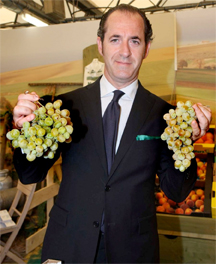
It’s already been a big week for Italy’s agriculture minister Luca Zaia, left (note the signature black tie and the green pocket square, both very powerful and provocative symbols for a public minister who’s role is to protect the best interests of the entire country).
His recent and controversial call to arms, exhorting Italians to drink only Italian sparkling wine on New Year’s eve, has been the subject of a tide of chatter in the Italian blogosphere. I agree with Franco when he writes that the self-proclaimed prince of Prosecco is a servant to self-serving provincialism and his “despotic” exhortation reeks of the same self-serving italianità that prevailed in another era in his country when the trains ran on time.

Zaia was also the subject of a wonderfully satiric but ultimately poignant post by the Italian Wine Guy, “The Mark of Zaia.” IWG’s insights are invaluable here and his overview tracing the trajectory of Zaia’s meteoric rise is as frightening it is revelatory.

But the biggest news to arrive from Zaialandia this week was the breaking however much anticipated story that he has received the nomination from separatist, secessionist, racist, and xenophobic political party Lega Nord (Northern League) as its candidate for soon-to-be vacant governorship of the region of the Veneto. He even has a shiny new Facebook fan page for his candidacy.

As Franco pointed out in a recent post, the news is good and bad: on one level, many observers, including those of us who sell and promote Italian wine abroad, will be happy to see the Venetophilic pol leave a position he had no business occupying in the first place (I’ve been told that Zaia started his professional career as a nightclub bouncer); on another level, the news is bad since, in the light of the fact that Zaia will probably win the election and become governor of the Veneto, he will be the leader of one of Italy’s richest and most important wine-producing regions (home to some of Italy’s most important exported wines, namely, Prosecco and Amarone).

The news inevitably fills me with sadness. Ultimately, Zaia’s tenure as the steward of Italian agriculture and the Italian wine industry, was the product of political posturing and maneuvering. An ambitious and able politician, Zaia clearly had set his sights on higher political office and when Berlusconi appointed him agriculture minister, it was not because Zaia was the best man for the job but rather as a political payback to the Lega Nord for their support in Berlusconi’s 2008 bid to reattain the prime minister’s office.

Photo courtesy Alexnews.

Sadly — for Italy, Italians, Italian winemakers, and foreign lovers and promoters of Italian wines — Zaia has presided over one of the greatest crises in the history of contemporary Italian winemaking. And it was all much ado about nothing.

His frequently updated blog has never even made note of the recent news that a new adulteration scandal has surfaced in Tuscany.

In Lombardy, there’s a self-effacing, ironical joke that the intellectuals tell about the peoples of northern Italy, based on a folkloric paradox, probably uttered by an old man on the streets of Milan not so many years ago: Rasista mi? Ma se l’è lü che l’è negher! [You’re calling] me a racist? But he’s the one who’s black! (In an essay he published after Berlusconi’s famous gaffe calling Obama “tan” following the 2008 elections, Umberto Eco cites this phrase as an example of northern Italians lack of self-awareness.)

I can’t help but be saddened to think that the Veneto (my beloved Veneto!) will be governed by a racist, xenophobic man who has asked Italians to boycott Chinese restaurants, to avoid eating pineapple, and to open only Italian bubbles on New Year’s eve (Prosecco perhaps?), a man would almost certainly tell the above joke without the self-effacing irony.

But for him to achieve such self-awareness and to grasp its irony would be like the teapot calling the kettle black.

An orange, natural wine from the Veneto (and my very own mimetic desire)

Above: One of my favorite places in the world, a scene from Petrarch’s house in the hilltop town of Arquà in the heart of the Colli Eugenei (the Euganean Hills) in the province of Padua. One of my mentors, Professor Vittore Branca, believed that Petrarch spoke with a northern cadence, even though he was born to Tuscan parents in Arezzo. Petrarch spent most of his life in southern France, Milan, and Arquà. (Photo courtesy Padova Cultura.)

Nearly every Italian who’s ever heard me speak Italian will remark that I speak Italian with a simpatico Veneto accent. Some will place it in Padua, others (when I’ve got a belly full of wine) in Treviso (non è vero, Briciole?). But the many years I spent of study and touring with my Italian-based band in the Veneto profoundly informed and shaped my “Italian” identity.

When I saw that Franco had posted about what must be a truly wonderful orange, natural wine from my beloved Euganean Hills outside Padua, I couldn’t resist the mimetic desire it stirred in me.

Were they not the site of countless Sunday evenings spent with friends eating roast pollastro and patatine fritte, accompanied by side-splitting joke-telling in Veneto dialect and carafes of Malvasia and Cabernet Franc! Were they not the home to some of the most unique, distinct, and distinctive wines produced in the Veneto! Did they not abound with a dolce aura, a sweet air, and immense beauty!

The Euganean Hills would still hold a special place in my heart for it is there that my beloved Petrarch spent the last years of his life, under the protection of the Carraresi family, the lords of medieval Padua, and it is there he finished the final notes of the transcription of his autograph and idiograph version of the Rerum vulgarium fragmenta (Fragments of Vernacular Things), his song book, his 366 poems devoted to the blond-haired and fair Laura (a laical breviary, with a poem for every day of the year and a proemium). Today, that beautiful book — singular also for its humanist script and the unusual binding format — resides in the Vatican Library (Codex Vaticanus 3195). It was the subject of my doctoral thesis: I have examined it myself, I have held it in my hands and run my fingers across its vellum leaves and scrutinized their pores, and I have felt its aura.

O to see those hills again! Someday, I’ll take Tracie B to visit them and and breath in their dolce aura, to see Petrarch’s house, and to taste the wines.

And I will tell my sweet Tracie B (my Laura and my dolce aura, with her fair skin as white as ivory, her eyes as blue as the fresh, clear water that flows in the streams of trans-Alpine lands)… I will tell her the same thing the vecchiette, the little old ladies, in Monselice at the foot of the Colli Euganei say as you begin your ascent to Arquà: non dimenticare di salutare la gatta del Petrarcadon’t forget to say hello to Petrarch’s cat

Above: The famous “gatta del Petrarca,” Petrarch’s female feline, who, as Modenese poet Alessandro Tassoni wrote in the 17th-century epic poem, The Rape of the Bucket, still bars the tops from crossing the dotta soglia, the erudite threshold. (Photo by Arquà Petrarca.)

Someday Tracie B will see it, too. In the meantime we can only dream of natural skin-contact Garganega and roast poissons.

Click here to read my translation of Franco’s post.

Buona domenica a tutti!

Che bigolo! A sexy pairing with Pierre Péters

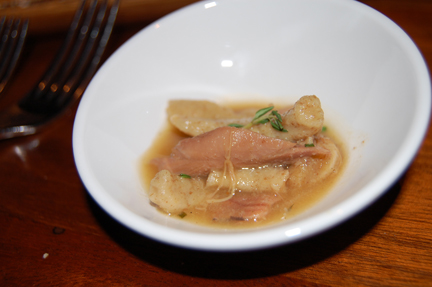
Above: Not exactly traditional but delicious. Buckwheat bigoli with guinea hen last night at Trio in Austin.

My Italian friends will get the joke from last night. When Tracie B and I saw that Trio chef Todd Duplechan was offering buckwheat bigoli on his menu at Trio, I couldn’t resist the pun: I turned and asked sommelier Mark Sayre, “do you think that Todd will let me taste his bigolo?”

Here’s what “Trevisan humanist” Bepo Maffioli had to say about bigoli in his landmark Cucina Veneziana (1982):

    “Brown” bigoli — the buckwheat long noodles of Bassano and Treviso — went through a dark period because Italian law requires that only durum wheat flour be used to make pasta. As a result, bigoli were considered an adulterated product. But then, sentence was passed, and they were found to be a traditional product and thus were permissible for consumption. Since the time of the “vigils,” bigoli a puro oio, in other words, dressed with just extra-virgin olive oil, has been one of the most common dishes for abstinence and fast days. Christmas Eve, Ash Wednesday, and Good Friday have always been holidays for bigoli in salsa (literally, bigoli in sauce) in nearly every city of the Veneto. This dish was almost always made by pairing bigoli and salt-cured sardines but the ingredients could change depending on the city and province and sometimes even the township.

[His thoughts on “adulteration” and culinary law (playful in this case) might seem ironic in the light of the pasta price fixing scandal that surfaced this week in Italy and the Chianti adulteration controversy that first raised its ugly head last week. Ne nuntium necare!]

Like the Tuscan pinci or pici, the Veneto word bigoli is a generic term that denotes long, round artisanal noodles. Most believe it comes from baco or worm. Many Veneto cookery authors use it interchangeably with spaghetti, which simply means little strings (from spago or string). In English, the term spaghetti evokes a particular shape of long noodle. But in Italian, it is a generic term that can be used in certain contexts to denote a wide variety of long, round noodles. The expression bigoli in salsa, literally bigoli in sauce, is used elastically to denote the traditional Venetian dish bigoli with sardines or anchovies as well as other preparations.

For obvious reasons, bigolo, when singular, is a euphemism for the male sex.

Todd served his buckwheat bigoli with guinea hen. They were shorter than traditional bigoli but delicious nonetheless.

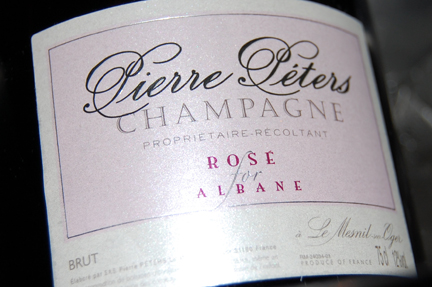
Above: Pierre Péters rosé at Trio. I had never tasted this superb wine before. What a fantastic, exquisite expression of Champagne! There is so much great wine in the world. Anyone who’s really into wine will tell you, the more I learn, the more I realize how little I know.

Our friends April and Craig Collins graciously and generously treated us to a bottle of Pierre Péters rosé to celebrate the holiday season. What an amazing wine! Ubi major minor cessat: for notes on the producer and the wines, I’ll point you to the experts here and here.

As we sipped this delicious and gorgeous pink wine (full of luscious fruit balanced by stern minerality), I couldn’t help but think to myself about how some of my wine blogging colleagues warned me (fruitlessly) that I wouldn’t find good wine to drink in Texas. Well, I’m here to tell ya, they got them some pretty darn good wine down here in this fine state!

Above: Master sommelier candidate Craig Collins and his lovely wife April are the leading man and lady of the Austin wine scene.

Thanks again, April and Craig, for turning us on to (and treating us to) such an amazing wine!

Stars fell on Toscana…

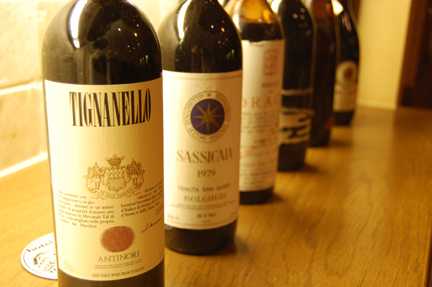
Above: The 1990 Tignanello was youthful and powerful and had a woody note on the nose that some folks like but a turn-off for me. The 1979 Sassicaia was unbelievably good and had that goudron, tarry note that you find in left-bank Bordeaux yet still tasted uniquely Tuscan — at least to me. Photos by Tracie B.

In what seems to me such an uncanny confluence of events, Tracie B and I had the wonderful opportunity to taste two truly iconic wines of Tuscany, from two (arguably) outstanding vintages, on Saturday night — 1990 Tignanello and 1979 Sassicaia. I say “uncanny” partly because there was a white elephant in the room: despite the festive nature of our get-together a casa di Alfonso, no one could ignore the news that broke in Chianti last week. Alfonso had graciously offered to open not just a few gems from his cellar, inspired in part by BrooklynGuy’s recent post on one of the wines he happened to have in his collection. But when he “stood the bottles upright” last week in anticipation, none of us imagined that Tuscan wine would once again find itself in crisis.

Above: Ace made one of his signature dishes, grilled eggplant layered with hard-boiled eggs and tomato sauce, topped with grated pecorino romano and the fired au gratin.

Eric’s exquisite post from last week added another layer of uncanniness to our fête. Tempus vincit omnia: the owner and curator of the Tignanello estate, the Antinori family and enologist Renzo Cotarella, recently told Eric that they plan to replant the legendary Fiorano estate near Rome, where its now defunct master, Prince Buoncompagni Ludovisi, purportedly once swore (as legend has it) that he had ripped out his vines so that his son-in-law, Piero Antinori, would never have the chance to bring modernity to the farm. Tempus vincit omnia.

Above: The 1994 Primitivo di Manduria by Savese was still a baby! It was such a wonderful treat to get to taste this wine with some age on it — a fantastic example of how traditionally made wine, even when made from a grape lacking tannic structure like Primitivo, can achieve ineffable nuance with age.

But like the grated pecorino romano that Ace used to finish his eggplant pie, a final layer of uncanniness was provided by the superb 1994 Primitivo di Manduria from Savese, which we paired with dried figs from Calabria. He stood the Primitivo upright after reading Franco’s wonderful post on his visit with Vittorio Pichierri at the Savese winery. Our “blend” of wines from Tuscany and Apulia seemed to unwittingly match the rumors that arrive these days via the internet from Etruria (I hope they’re untrue but I fear they are not).

Thanks again, Ace, for a truly unforgettable serata da leoni. It felt like stars fell on Toscana that night…

Sing these lyrics, substituting “Toscana” for “Alabama”…

We lived our little drama,
We kissed in a field of white,
And stars fell on Alabama,
Last night.

I can’t forget the glamour,
Your eyes held a tender light,
And stars fell on Alabama,
Last night

I never planned in my imagination,
A situation — so heavenly,
A fairy land where no one else could enter,
And in the center — just you and me.

My heart beat like a hammer,
My arms wound around you tight,
And stars fell on Alabama,
Last night.

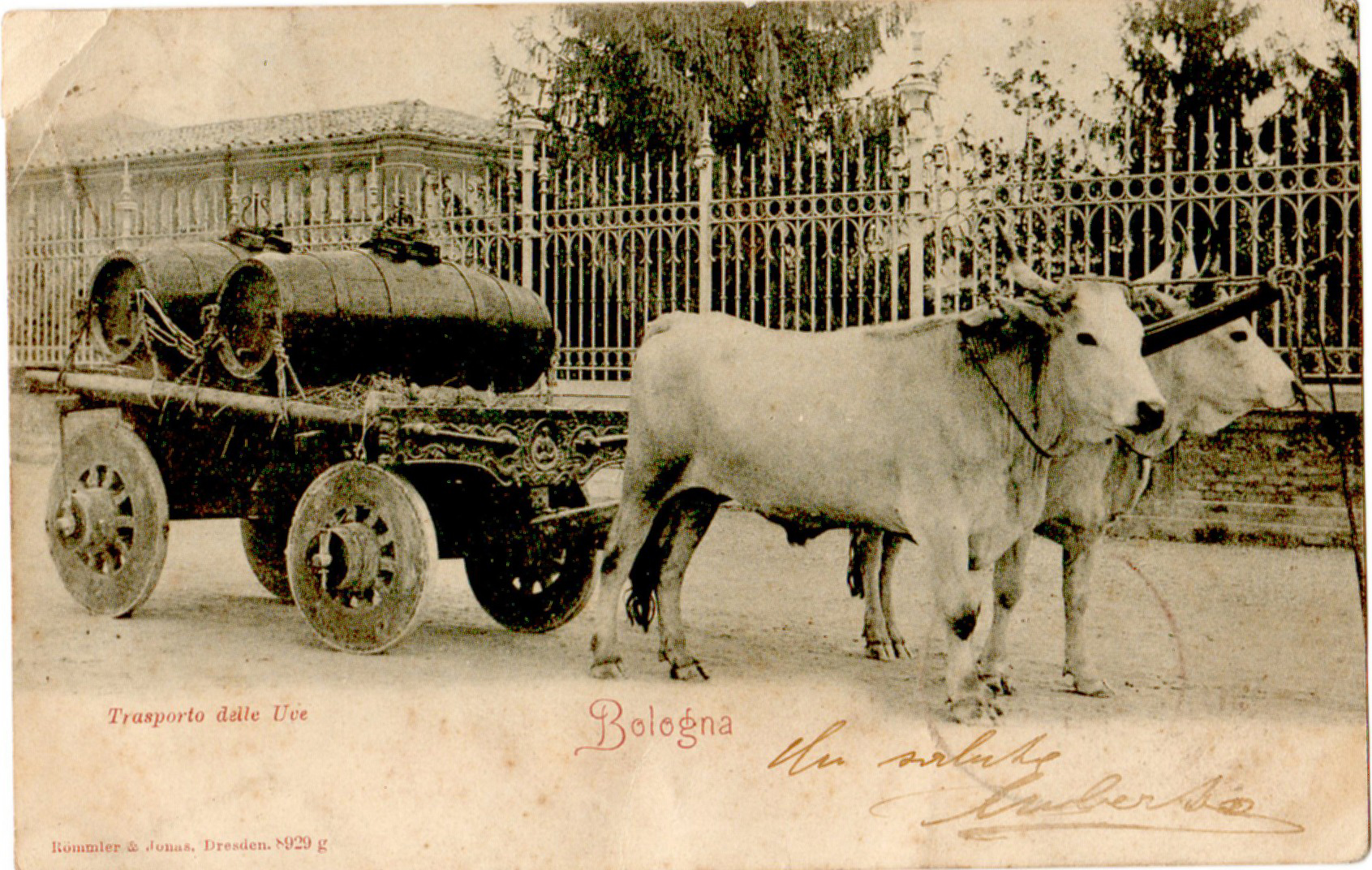
A vintage image of an Italian vintage long forgotten

Above: Grape transport early 1900s (?), Bologna, signed “Greetings from Umberto.” It makes me wonder if fermentation has already begun in those casks. Click the image to see a hi-res version.

So much junk mail appears in my inbox these days, most of it from publicists who haven’t really taken the time to see what my blog is really about (BrooklynGuy gets his share, too, and he wrote this funny post about the phenomenon).

But every once in a while, I find myself on the user-end of a mass mailing that catches my eye.

Today, I received an email from a man I’ve never met, nor heard of, Carlo Cassinis, who writes:

    We have started a collection of postcards having the theme “agriculture and enology.”

    Please find attached the last postcard we have received. We are asking you to look in your attics and cellars to unearth postcards like this.

    We are sending this message to all of our friends with the hope that they will read it and pass it on to all of their friends and everyone in their address books.

    As soon as we have enough interesting material, we will mount an exhibit in the cellars of the Vicara winery.

    If you have any material like this, please send it to Carlo Cassinis V.lo S. Sebastiano 13 15020 Ponzano Monferrato (Al)

    Thank you and looking forward to hearing from you.

    Carlo Cassinis

Carlo didn’t include a link to his winery’s website but it wasn’t hard to find.

I like the postcard and the image made me think about how much the Italian wine industry has changed over the last century. I’m still reeling from the news of yet another adulteration scandal in Tuscany. As the Italian Wine Guy said to me today, we’ve been working so hard for so many years to promote Italian wine in this country because we love it so much. And then something like this happens and it seems as if we have to start all over again, sharing the true greatness of the wines of Italy.

The weather is cold here in Austin and it’s a melancholy Friday “deep in December” sitting at my desk…

Try to remember the kind of September
When life was slow and oh, so mellow.
Try to remember the kind of September
When grass was green and grain was yellow.
Try to remember the kind of September
When you were a tender and callow fellow.
Try to remember, and if you remember,
Then follow.

Follow, follow, follow, follow, follow,
Follow, follow, follow, follow.

Try to remember when life was so tender
That no one wept except the willow.
Try to remember when life was so tender
That dreams were kept beside your pillow.
Try to remember when life was so tender
That love was an ember about to billow.
Try to remember, and if you remember,
Then follow.

Follow, follow, follow, follow, follow,
Follow, follow, follow, follow.

Follow, follow, follow, follow, follow,
Follow, follow, follow, follow.

Follow, follow, follow, follow, follow,
Follow, follow, follow, follow.

Deep in December, it’s nice to remember,
Although you know the snow will follow.
Deep in December, it’s nice to remember,
Without a hurt the heart is hollow.
Deep in December, it’s nice to remember,
The fire of September that made us mellow.
Deep in December, our hearts should remember
And follow.

Chiantigate? News of a new controversy breaks in Italy

When the first dispatch arrived in my inbox this morning with my nearly daily dose of WineNews.it, I just didn’t want to believe it was true. But then, after lunch, when Franco’s post appeared in my feed, I knew there was no ignoring it: Italian authorities believe that roughly 10 million liters of current-release Chianti and Toscana IGT and purportedly smaller amounts of Brunello and Rosso di Montalcino have been “cut” with inferior wines not in accordance with appellation regulations. News of the authorities’s investigation and their subsequent request for a preemptive seizure of wine was widely reported today in the Italian news media. Seventeen persons and forty-two wineries, including some of the big players (according to the reports), are under investigation.

What can I say? It literally makes me feel sick: I love Italy, I love Italian wine, I have more good friends in Italy than I can count, and the majority of Italian winemakers I know personally (and I know a lot) are honest, earnest, hard-working folks. And I will continue to buy, drink, enjoy, love, and write about Italian wines. But the news of yet another controversy makes me feel sick. Franco has stated openly that he no longer wants to write about the Brunello controversy or any other Italian wine controversy for that matter. But as a chronicler of the world Italian wine, he felt obliged today to repost the story for the sake of “the completeness of information.” And, so, as his colleague, friend, and partner, I, too, feel obliged to report it here.

When I was a child my family went through a crisis that was reported by the media. And whenever there was a story in the papers, my mother taught me to be the one to tell my friends — so that they would hear it from me and not from a stranger. It was one of the best lessons she ever taught me.

Well, here I am again, and my “family” is in trouble. And I want you to hear it from me. So be it. Surely, it is the saddest form of wine writing.

Ne nuntium necare.