Joe Dressner tributes…

Today, my Houston Press post features some of the many tributes to Joe Dressner that have appeared since the news of his passing hit the feed.

My roundup includes 6 different posts by some of my favorite wine writers as well as Eric the Red’s obituary of Dressner (Eric’s post on the Diner’s Journal blog, “Joe Dressner, an Importer With No Use for Pretense, Dies at 60,” is amazing).

Here’s the link to my round up.

But there were many, many more like those by Brooklyn Guy and Levi, among others.

Joe Dressner requiescat in pace Iosephus

Pasolini wrote about Naturalism as a form of transgression and subversion of Bourgeois and Materialist values.

Joe Dressner embraced that spirit in what he shared with us through wine while on this earth.

Today, he has passed to another world

Requiescat in pace Iosephus.

Harvest dispatches from Europe are changing the way we understand “vintage”

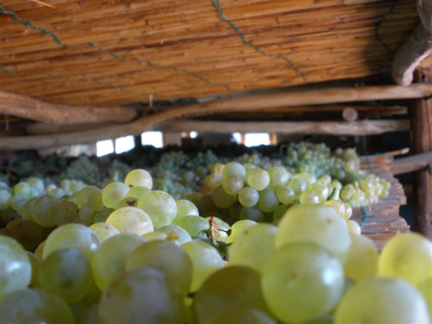
One of the coolest things about the enoblogosphere this year is the number of European wineries who are posting dispatches from the harvest. I loved the above photo of grapes for Vin Santo posted by my friend Ale at Montalcino Report (he’s been posting regularly about weather conditions and harvest progress).

My friend Laura, also in Montalcino, posted this brutally honest report about the recent heat spike there, entitled “Can someone please turn the hairdryer off?” Not everyone in Montalcino has embraced transparency but a few brave souls like Ale and Laura have.

It’s been a few weeks since he’s posted, but my buddy Wayne in Colli Orientali del Friuli has posted some great photos of harvest (like the one above), including some shots of the young Ethan Bastianich!

Back in July, Wayne did this amazing however sad post of images documenting hail damage in Collio.

Today at the Boutari blog, we posted some images and a report from the harvest in Naoussa by enologist Vasilis Georgiou. Those are Xinomavro grapes, above, waiting to be picked.

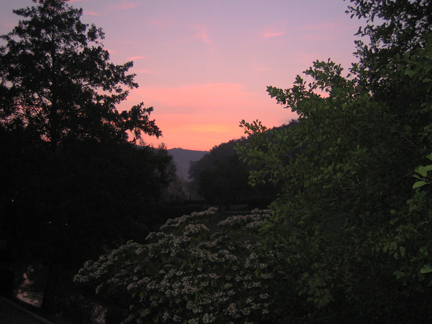
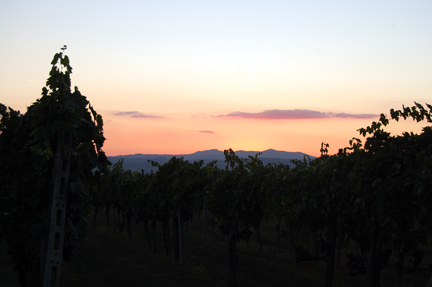
Although he doesn’t have a blog, my good friend and Pasolinian comrade Giampaolo Venica has been using social media to document the harvest in Collio. He sent me the gorgeous photo of dawn (above) to illustrate the time of day that they begin picking the grapes, when temperatures are coolest. Beautiful, no?

There’s no doubt in my mind that the 2011 harvest in Europe has been documented like no other before it… all thanks to the internets and a growing number of forward-thinking winemakers.

Know a winery that’s posting about harvest this year? Please share a URL in a comment and let’s a list going! Buona vendemmia yall!

Taurasi, a guest post from Naples (and a vertical of Taurasi tomorrow in LA)

I’ve been doing my homework, getting ready to present a mini-vertical of Taurasi by Struzziero tomorrow, Friday, and Saturday nights at Sotto in Los Angeles (where I curate the wine list). Yesterday, I reached out to my friend Marina Alaimo who works with top Southern Italian wine blogger and journalist Luciano Pignataro in Naples. Here’s what she sent me. Buona lettura!

Dear Jeremy,

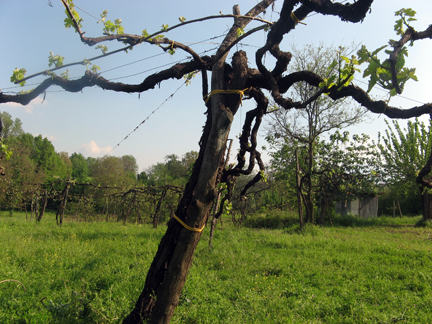
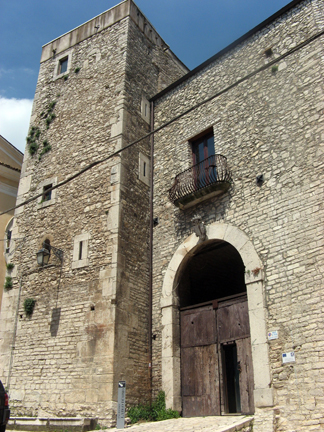
In the attached photo, you’ll see old plantings of Aglianico Taurasino. This type of training method is called starzete: it’s a type of high trellis, with four long canes. It allowed the farmers to grow vegetables and other crops below the vines and to bind the canes to trees. As a result, the farmer could use the available land to its greatest potential by employing integrated farming. Furthermore, the starzete training system guaranteed an abundant crop of grapes. As you know, in the past, grape growers aimed for quantity. I’ve also sent you a photo of the Castello di Taurasi, symbol of the appellation.

Marina

My gig at the World Trade Center, remembering September 11

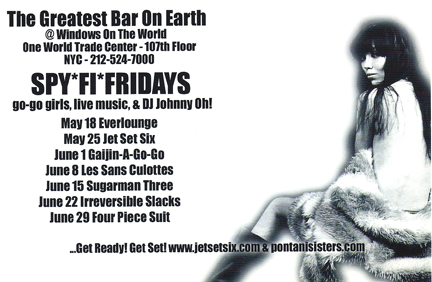
Looking back on September 11, 2001, I know I am not the first to think of it as a catastrophic tragedy comparable to the Sack of Rome in the 16th century. But, today, as I reminisce about the gigs I played at The Greatest Bar on Earth — 1 World Trade Center, NY NY 10048, on the top floor of the north tower — I realize that, like the Sack of Rome, the tragedy of 9/11 marks a cultural watershed: it’s as if our frenetic quest to document our lives through digital images and information began after September 2001 (in the same way that art historians and literary scholars point to the Sack of Rome as a cultural turning point, when there was an overarching shift in our self-awareness).

And so I dug up some old photos and fliers from my pre-9/11 world when my band (above) was still called Les Sans Culottes (today Nous Non Plus).

Back then, we played at The Greatest Bar on Earth nearly once a month.

Remember the World Famous Pontani Sisters? We did a lot of shows there together, with the Pontanis on stage with us. “Wear go-go boots and a miniskirt and get in free!” That pretty much sums up the spirit of those days in New York. We played some wild shows back then.

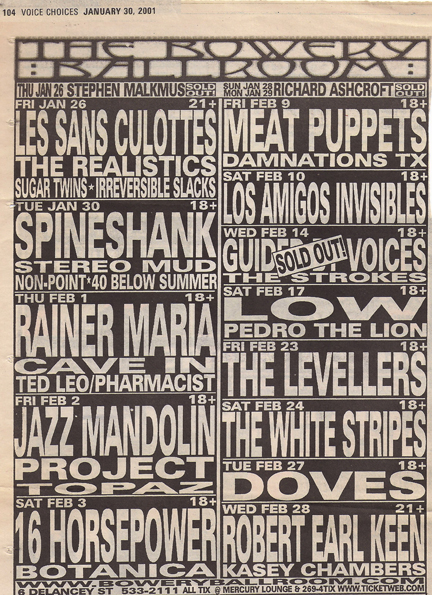
Those were wild, fun years in my life, when I was still in my early thirties and had moved to NYC just a few years previously. Back then, my day gig was writing about wine for La Cucina Italiana. The band played roughly 50 gigs a year in NYC, where we had a great following. It was a super fun time (look at the other bands that were playing the Bowery Ballroom, above, where we often were the headliners). Seems like a lifetime ago now. It was…

On my September 11, I awoke in Brooklyn and learned that something had happened — although I didn’t know yet what — when I called a colleague in TriBeCa to confirm a 9 a.m. morning meeting. I didn’t have a TV back then. And so I tuned in NPR on WNYC on my Mac over the internet. As soon as what was happening sunk in, I picked up the phone and called my mother who was still sleeping in California, three hours behind NYC time.

“Mom, sorry to wake you.”

“That’s okay, honey.”

“Something’s happened in New York. Something bad. I’m not going to be able to call you later. But I’m calling to let you know that I’m okay.”

“Okay, honey. Thanks for calling.”

She hung up and fell back asleep. The whole world had changed.

By the end of the day, singed shards of paper, business documents, rained gently down on my neighborhood in Park Slope, fluttering as they fell back to earth. I’ll never forget that image.

I was very lucky that I didn’t head into the city that day. I would have been on the 2 or 3 train, passing under the WTC.

G-d bless all the people who suffered and lost and gave their lives that day.

“If it’s a blend, I will not attend!” (And the Texas fires)

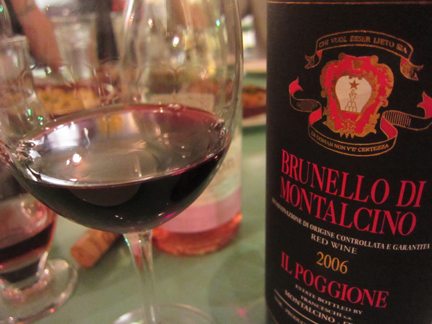
Cousin Marty had a hunch about what wine I’d be bringing to our BYOB dinner last night in Houston with friends. And when I arrived and revealed my bottle of 2006 Brunello di Montalcino by Il Poggione, he opened the evening with the line of the night: “If it’s a blend, I will not attend!”

Of course, he was referring to yesterday’s news that Montalcino producers voted NOT to allow international grape varieties in Rosso di Montalcino, a step that many of us feared would irrevocably reshape the appellation.

According to results posted by the Brunello producers association, roughly 2/3 of voting members voted not to adopt either of the two options proposed by oligarchy that controls the body’s technical council. One option would have created two categories of Rosso; the other would have created three; in either case, international grape varieties would have been allowed in wines labeled Rosso di Montalcino.

But that figure is misleading because consortium president Ezio Rivella had called for an “ordinary” assembly whereby the number of votes is allocated according to the size of the winery. In other words, larger wineries had more voting power than smaller wineries. If the voting had been based on a one-vote-per-winery basis, the results would have been a landslide against the proposal to change the appellation.

I am fully convinced that efforts by my colleague and partner in VinoWire, Franco Ziliani, played a fundamental role in shaping public awareness of the issues in question.

Chapeau bas, Franco! IF IT’S A BLEND, I WILL NOT ATTEND!

The 2006 Brunello by Il Poggione was gorgeous last night, rich in body, bright in acidity, with ripe red fruit and that wonderful horse sweat note that often distinguishes great Brunello. The wine was muscular and still very, very tight, young in its evolution. But the green notes that emerged the last time I tasted the wine about 6 months ago have disappeared. There’s no doubt in my mind that this is going to be a great vintage for Il Poggione.

In other and sadder news…
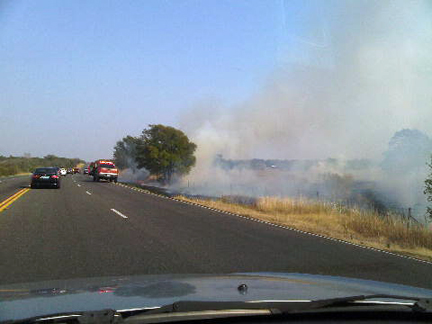
I wanted to share these photos that I took on Hwy. 290 from Austin to Houston of the Texas fires.

In the first photo, above, taken about 20 minutes west of Giddings, the fire had just started and the firefighters had just arrived. Man, it was scary and you could see the fear and the stress in the faces of the firefighters. G-d bless them.

In this second photo, you can see a plume northwest of Houston. Pretty spooky and so sad.
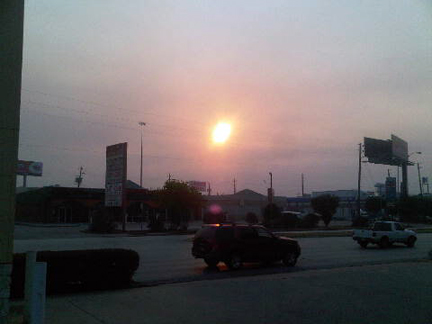
In this last photo, you can see the smoky haze over Houston this morning. That’s not morning mist. It’s ugly, brown smoke. My eyes are burning and my throat is itchy. It reminds me of LA during the riots when I was a grad student at U.C.L.A.

Tracie P and Baby P are fine and even though there are uncontained fires burning not far from our house in Austin, the smoke is not affecting us there.

Please say a prayer for all the folks who are suffering here… It’s so sad…

Francesco Illy asks Brunello consortium to postpone assembly

Above: Grape growers began harvesting Sangiovese today in Montalcino. Photo by Montalcino Report.

Franco and I have obtained a copy of a letter written and circulated today by Mastrojanni owner Francesco Illy. The following is my translation of the letter.

*****

Dear Mr. President and Council Members,

On August 21, a heat storm [spike] with strong winds and temperatures reaching 41° C. [106° F] struck Montalcino. Grapes that were ripening have been dried up in quantities that vary between 5-50% depending on the zone and the age of the vines.

This event will add difficult, prolonged work for producers and consortium members: we are currently harvesting and many of us are bottling. Regardless, this is the toughest time of the year and the heat damage makes it even more difficult. None of us have the time, energy, or desire to attend the meeting called by you for September 7, 2011.

Without even speculating on the reasons that lead you to call an Assembly when the greater part of those with the right to vote will be absent, I denounce your insistence on maintaining this date. Beyond the evident facts that I have listed here, it is weighty proof of your total lack of sensitivity to the interests of your producers and consortium members.

Therefore, in the name of my winery and in the name of all those who will endorse this letter, I ask that the Assembly of the Brunello di Montalcino Consortium scheduled for September 7, 2011, be changed to a later date to be determined because of the difficult conditions of the harvest.

Hoping that I have reawakened your dormant however duty-bound sensitivity, I thank you for your consideration and send you my regards.

—Francesco Illy

*****

I’d also like to bring to your attention a tweet by my friend Laura Gray who manages the Palazzone estate in Montalcino:

    How did we get from a pro-Sangiovese petition to a forced meeting to include different % int. grapes but no option to vote for status quo?

I’m posting in a hurry from the road today but will post again just as soon as I have the chance to share some insights into today’s developments.

Thanks for reading!

What the hell is going on in Montalcino???!!!

In the wake of my Friday post where Franco and I revealed one of the “hypotheses” for a new Rosso di Montalcino category that would allow the use international grape varieties, a lot of folks have been asking, what the hell is going on in Montalcino, anyway???!!!

Today, on his blog, Franco asks rhetorically, is the proposed change prompted by market demand or does it reflect the interests of certain actors?

The fact of the matter is that there is an oligarchy of commercial, big-business, industrial wineries that want this change. Their baron-robber chum and ringleader Ezio Rivella — gerrymandering president of the Brunello producers association — says that before the Brunello controversy of 2008, 80% of Brunello (which by law must be made from 100% Sangiovese grapes), was blended in part using international grape varieties. (Here’s my post and translation of that story.) He and his gang claim that the market (read AMERICA) wants international grape varieties from Tuscany. What he doesn’t acknowledge is that the overwhelming majority of Brunello growers and producers — 90% by most counts — want to protect their appellation from internationalization in the name of Italian and Tuscan cultural heritage. The last time that Rivella tried to hold a vote on changing the appellation to allow other grape varieties, he had to retreat at the last minute because he knew he would lose. (Here’s the post on VinoWire.)

In the days that led up to the aborted vote, Francesco Illy — scion of the Illy coffee dynasty and owner of Montalcino estate Mastrojanni — published two open letters exhorting his peers and colleagues to protect the identity of Montalcino’s iconic wines. (Juel Mahoney posted English versions of the letters here.)

Comparing the crisis in Montalcino to the hard times faced by his father in the coffee industry, he wrote that “Experiences tell us [sic] that those who have managed to defend its identity in the end he won [sic].”

The bottom line is this:

1) The big-money, establishment producers want to make the rules more flexible so that they can make more wine, even in bad vintages, when Sangiovese is more difficult to cultivate (and Merlot and Cabernet Sauvignon are more consistent and reliable).

2) The overwhelming majority of smaller producers do not want to change the appellations because they feel a deep connection to their land and their traditions and they do not want to see their wines internationalized (Rivella is from Piedmont, btw, not Tuscany). Ultimately, they realize, if Rivella and his gang prevail, there will be no space left in the market for their products (Walmart wins again).

3) The industrialists continue to create new scenarios that would allow them to use international grape varieties through a “back door” or “loop hole”; in other words, let’s create a new category that allows us to use Merlot when we need or want to. In keeping with the current strategy, Rivella continues to water down (forgive the pun) the different scenarios, hoping that eventually one will be approved.

If Rivella prevails, everything will be lost in Montalcino. Clear some trees, build a golf course, and, hell, why not turn all of Tuscany into a Disneyland-run tourist attraction? And after we build Disneyland in Tuscany, we’ll start working on Disneyworld in Piedmont. After all, the American boom times will return and all those fat cat brokers in Manhattan are going to need more Tuscan Merlot, Cabernet Sauvignon, and Syrah to wash down those steaks. Shit, Tuscan Merlot costs less than Californian anyway!

O tempora o mores! Pasolini, Gramsci, Marx? Therein lies the answer…

Breaking news: Rosso di Montalcino proposed changes (documentation)

It is with a heavy heart that I share today’s news from Montalcino.

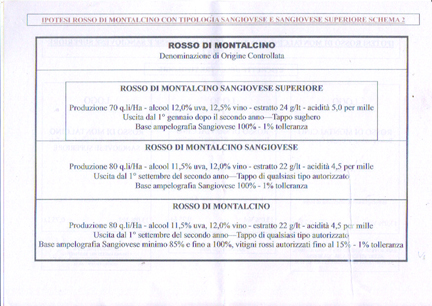
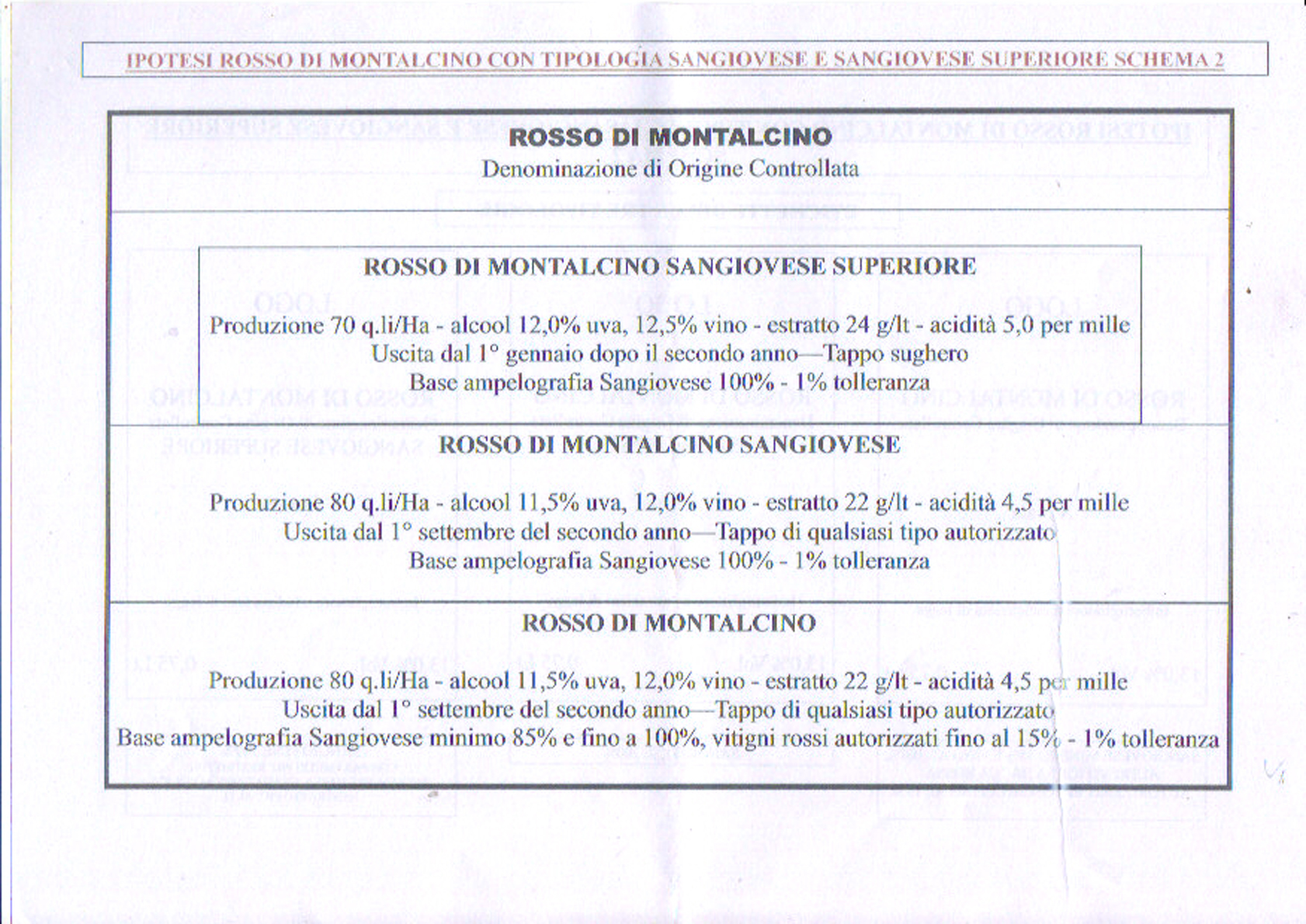
Italy’s top wine blogger Franco Ziliani (my partner in and co-editor and founder of VinoWire) has obtained a document that specifies proposed changes for the Rosso di Montalcino appellation. I haven’t had time to review them carefully but I am very alarmed by the “hypothesis for three typologies [categories] of Rosso di Montalcino”:

1) Rosso di Montalcino Sangiovese Superiore: 100% Sangiovese (with a 1% “tolerance” of other grape varieties).

2) Rosso di Montalcino Sangiovese: 100% Sangiovese (1% tolerance).

3) Rosso di Montalcino: minimum 85% and up to 100% Sangiovese, “authorized” red grape varieties up to 15% (1% tolerance).

Click here to view a full-sized version of the document.

Although it doesn’t appear that the Brunello oligarchy plans to call a vote on the proposal anytime soon, it has called for “ordinary assembly” of producers to put the modifications to the floor (September 7).

Rosso di Montalcino with up to 15% Merlot (see the third category)? Please say it ain’t so…

Anecdotally, Franco reports today on his blog that producers are “optimistic” that only 10% of them would vote to adopt the changes.

At least one producer wondered rhetorically and philosophically, “why isn’t there a proposal to not change the appellation?” It seems that the powers-that-be are hell bent on opening the floodgates of Merlot in Montalcino.

Last week, Montalcino experienced some heat spikes, as warm weather arrived from Africa. I regret that this doesn’t bode well for the 2011 vintage (although at least one producer is reporting cool evening and morning temperatures).

I’m with Franco when he says he hopes that the heatwave will pass quickly and stop “cooking the brains,” as they say in Italian, of the Montalcino establishment.

Ligurian wine and pasta aglio olio peperoncino, perfect summer supper

It’s pure coincidence that we happened to open a bottle of Bisson Ü Pastine last night with some penne aglio, olio, e peperoncino for a light supper — one of the most simple things and one of my most favorite dishes to prepare. This afternoon, Facebook friend Evan R sent me a link to Alan Tardi’s article on the Bisson winery, its owner Piero Lugano and his underwater-aged sparkling wines, which appeared today in The New York Times. (The article is great, btw.)

I always crave wines from Liguria during the summer. From the light-colored, nearly rosé Rossese to bright Pigato and Vermentino, the wines tend to be light and low in alcohol, fresh and spicey- and fish-friendly.

Frankly, before last night, I’d never had a wine made from 100% Bianchetta grapes from Liguria. In fact, Bianchetta is more famously grown in the Veneto and South Tyrol, where it is used to make an easy-drinking, food-friendly light white wine.

The Bisson was delicious, more unctuous than any other Bianchetta I’ve ever had, very salty and with nice white stone fruit. I was worried that the 2009 would be a little tired but it wasn’t. The acidity was kicking and happy (like little Baby P inside Mamma P’s belly!) and I saved a glass to taste tonight at dinner.

Of course, my philological curiosity got the better of me this morning, and so I did a little research on the name of this wine, ü pastine.

Regrettably, the importer’s website reports that the name is “local dialect indicating a very special product.”

And equally lamentable, a major U.S. retailer reports “‘U Pastine’ in the Ligurian dialect means, essentially ‘a gift that is specially crafted by someone for someone in particular in order to be an extra special present.'”

With all due respect, where do these people get this information? Beats me.

In fact, ü pastine is a Ligurian dialectal term that denotes the [a] field reserved for grape-growing. Used also in Tuscany and even as far south as Latium, pastine or pastene comes from the Latin pastinum, denoting a kind of two-pronged dibble, for preparing the ground and for setting plants with. In Ligurian dialect, pastinare means to till. In other words, ü pastine denotes the parcel of land chosen for grape growing because of its ideal conditions for raising wine.

I’m glad that we cleared this up!

And I plan to add pastene and pastine to my Italian winery and vineyard designation project, which I will revisit this fall.

Alfonso is coming over for dinner tonight and I’m not sure what we’re opening to pair with Tracie P’s pasta con i porri e la pancetta but I’m sure it will be good! Stay tuned… and thanks for reading!