Killer Nerello from the “highest” vines and fried oysters

austin

Above: At $10 a glass (!), this 2008 blend of Nerello Mascaelese and Nerello Capuccio from “2,100-2,900 feet above sea level” (!) BLEW ME AWAY. The pairing with fried gulf oysters was a great example of how the right red wine, not to heavy in body, can be ideal for seafood.

It’s been just over a year now since I moved to Austin and there are still a few culinary destinations that I haven’t made it to yet. Last night finally found me at appetizers and a glass of wine at Jeffrey’s in Austin. It’s one of the more elegant rooms here, well laid out architectonically for intimate dining (despite a couple who had brought their crying newborn and a table of five older ladies who complained vociferously — more loudly, in fact — about the child’s lachrymatory suspiration).

I’ll have to take Tracie B back for a proper dinner soon: I liked the wine list and was surprised by some interesting choices but I was BLOWN AWAY by a wine I’d never had before, the 2008 Etna Rosso by Tenuta delle Terre Nere — at $10, yes $10! by the glass (“BTG” in restaurantspeak).

aetna

Above: Tenuta delle Terre Nere doesn’t have a website but I used PagineBianche.it to find the address and then Google-mapped it and switched to “satellite” view. That’s the peak of Mt. Aetna in the center. I love how you can see the black soil (the “terre nere”) from space!

I wasn’t expecting to like this wine but was curious about it. I’d heard a lot of people talk about it since I moved to Texas but was nonetheless skeptical: it’s owned by a famous importer of Italian wines, who tends to favor modern-style wines (historically and commercially) and I’ve often been disappointed by wines created by importers for the American market. But a little research this morning revealed that Tenuta delle Terre Nere sells its wines actively and aggressively in Italy. In other words, it’s not just a winery created for a foreign market and has a true connection to the place where it is made.

austin

Above: There is tartare and then there is tartare. The fried potato puffs were a little soggy unfortunately but the tartare was delicious and paired magnificently with the Nerello.

According to the importer’s website, grapes for this wine are grown “at extremely high altitudes, ranging from 2100-2900 feet above sea level” and the winery owns the “highest-altitude red-grape vineyards in Europe” (although that fruit doesn’t go into this wine).

This wine was all black earth and dusty minerality (like putting lava in your mouth) yet fresh and bright, with a seductive aromatic profile that made me think of dried figs. (I apologize for the “precious” tasting notes but this wine really turned me on.)

I loved it. I loved the price, I loved the body, aroma, and flavor. I loved the food-friendliness of it. I even loved the label (honest, clean, elegant, true to the style and origin of the contents). The only thing I don’t like about it is how so many wine writers compare it to Burgundy and to Pinot Noir (to my palate, Nerello and Pinot Noir have little in common, other than the fact that they can produce light-colored tannic wines). When they do that, they only reveal their ignorance: this wine is one of those truly terroir-driven wines, a wine that could only be made in the volcanic subsoils of Mt. Aetna, from Nerello grown in the “highest” vineyards in the world…

Run don’t walk…
Che bigolo! A sexy pairing with Pierre Péters

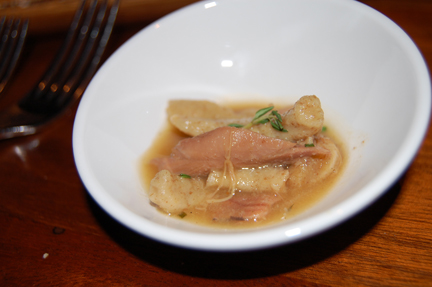
Above: Not exactly traditional but delicious. Buckwheat bigoli with guinea hen last night at Trio in Austin.

My Italian friends will get the joke from last night. When Tracie B and I saw that Trio chef Todd Duplechan was offering buckwheat bigoli on his menu at Trio, I couldn’t resist the pun: I turned and asked sommelier Mark Sayre, “do you think that Todd will let me taste his bigolo?”

Here’s what “Trevisan humanist” Bepo Maffioli had to say about bigoli in his landmark Cucina Veneziana (1982):

    “Brown” bigoli — the buckwheat long noodles of Bassano and Treviso — went through a dark period because Italian law requires that only durum wheat flour be used to make pasta. As a result, bigoli were considered an adulterated product. But then, sentence was passed, and they were found to be a traditional product and thus were permissible for consumption. Since the time of the “vigils,” bigoli a puro oio, in other words, dressed with just extra-virgin olive oil, has been one of the most common dishes for abstinence and fast days. Christmas Eve, Ash Wednesday, and Good Friday have always been holidays for bigoli in salsa (literally, bigoli in sauce) in nearly every city of the Veneto. This dish was almost always made by pairing bigoli and salt-cured sardines but the ingredients could change depending on the city and province and sometimes even the township.

[His thoughts on “adulteration” and culinary law (playful in this case) might seem ironic in the light of the pasta price fixing scandal that surfaced this week in Italy and the Chianti adulteration controversy that first raised its ugly head last week. Ne nuntium necare!]

Like the Tuscan pinci or pici, the Veneto word bigoli is a generic term that denotes long, round artisanal noodles. Most believe it comes from baco or worm. Many Veneto cookery authors use it interchangeably with spaghetti, which simply means little strings (from spago or string). In English, the term spaghetti evokes a particular shape of long noodle. But in Italian, it is a generic term that can be used in certain contexts to denote a wide variety of long, round noodles. The expression bigoli in salsa, literally bigoli in sauce, is used elastically to denote the traditional Venetian dish bigoli with sardines or anchovies as well as other preparations.

For obvious reasons, bigolo, when singular, is a euphemism for the male sex.

Todd served his buckwheat bigoli with guinea hen. They were shorter than traditional bigoli but delicious nonetheless.

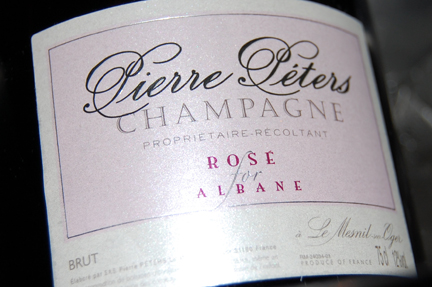
Above: Pierre Péters rosé at Trio. I had never tasted this superb wine before. What a fantastic, exquisite expression of Champagne! There is so much great wine in the world. Anyone who’s really into wine will tell you, the more I learn, the more I realize how little I know.

Our friends April and Craig Collins graciously and generously treated us to a bottle of Pierre Péters rosé to celebrate the holiday season. What an amazing wine! Ubi major minor cessat: for notes on the producer and the wines, I’ll point you to the experts here and here.

As we sipped this delicious and gorgeous pink wine (full of luscious fruit balanced by stern minerality), I couldn’t help but think to myself about how some of my wine blogging colleagues warned me (fruitlessly) that I wouldn’t find good wine to drink in Texas. Well, I’m here to tell ya, they got them some pretty darn good wine down here in this fine state!

Above: Master sommelier candidate Craig Collins and his lovely wife April are the leading man and lady of the Austin wine scene.

Thanks again, April and Craig, for turning us on to (and treating us to) such an amazing wine!

Best airport food? Guess where…

Tracie B and I love to travel. No matter where we’re going, as long as we’re together, the trip to the airport is always a fun one for the two of us.

But the one thing that really sucks about traveling is the awful food options in airports. Even with all of today’s fancy concessions, the food is nearly always a smorgasbord of Sysco-kissed processed foods. Well, friends, I am here to tell ya that there is at least one airport in our country where there’s a local and very tasty food option. It may not look pretty but, man, I was so hungry yesterday by the time my lady and I got to the airport!

Salt Lick BBQ at the Austin airport:

bbq

The real thing (when I took Mama Judy there the other day while she was visiting us in Texas):

bbq

Hungry?

Amphora-aged Primitivo, pozoles and old Rioja, and a Texas wine I liked

Above: This week, Tracie B and I attended our first holiday party of the year at the home of Texas “natural treasure,” author, radio personality, blogger and all-around delightful host, Mary Gordon Spence.

Man, has it been a crazy week — between work, Tignanello triage, the new Amarone DOCG, and the holidays upon us!

Above: Everyone who knows me knows that I rarely eat sweets. But homemade flan? Mary Gordon found my weakness!

Tracie B and I are headed to La Jolla for the weekend, a good thing since snow is expected today in Central Texas!

I’m working on my “interesting wines coming out of Tuscany these days” post and I received a lot of great recommendations from a bunch of Italian wine professionals and bloggers. Thank you, all. I’ll post them next week.

Above: George O brought this bottle of what I’m guessing is a dried-grape red wine from the Texas Hill Country made by Tony Coturri at the La Cruz de Comal winery. It was a great pairing for the flan.

If you haven’t seen it already, please check out this wonderful post authored by Franco (and translated by yours truly) on the amphora wines made by Vittorio Pichierri in Sava (Manduria, Apulia). Amphora wine is all the rage these days. Gravner started making wine in amphora in the late 1990s? Pichierri has been aging his wines in interred amphora since the 1970s and beyond (he uses an ancient format called capasone).

Above: We were joined by the inimitable Bill Head, whose tall Texas tales alone are worth the price of admission (seated next to Tracie B), his lovely SO Patricia, and George O. Jackson (right), photographer and author of a photo collection I am dying to see, Essence of Mexico 1990-2002, images of folklore he captured traveling through rural Mexico.

Dinner at Mary Gordon’s was just the excuse I’d been waiting for to open some older López de Heredia that a client gave me. The 1990 Tondonia white was stunning, as was the 1991 Bosconia. We opened both bottles as we sat in Mary Gordon’s living room and munched on jícama and chips and salsa: I couldn’t help but think about how great these oxidative wines are with food. The 2000 Bosconia Reserva was great with Mary Gordon’s excellent pozoles.

The conversation turned from tales of larger-than-life Charlie Wilson from Bill’s years in Washington to Mary Gordon’s memories of working for President Lyndon B. Johnson, to George O’s adventures in rural Mexico. I spent the whole evening on the edge of my seat. Maybe it’s because I live here now but it always impresses me how Texas often finds itself at the center of the American collective consciousness and American iconography.

Thanks again, Mary Gordon, for such a wonderful evening! And happy holidays to all ya’ll!

Happy Thanksgiving (and some culinary anamorphism)

ginger bread

Details from the Ginger Bread Charity Diorama at the Four Seasons Hotel, Austin, Texas. Photos by Tracie B.

Maybe it’s the little boy in me… I’ve always been fascinated with culinary anamorphism — a cultural phenomenon whereby food is refashioned to resemble something else, edible or otherwise.

ginger bread

The tradition of fashioning food to look like buildings stretches back to the Renaissance. One of the most famous examples is torrone nougat: on the occasion of the wedding of Bianca Maria Visconti to Francesco Sforza, October 25, 1441, the bride and groom were presented with a nougat replica of the city’s church bell tower, the so-called Torrione (today known as the Torrazzo) from which the sweet derived its name.

ginger bread

Another such example from recent memory is Abe Lebewohl’s depiction of Manhattan’s Twin Towers, fashioned out of chopped liver from the Second Avenue Deli.

ginger bread

The Art of Cooking by fifteenth-century Italian chef Maestro Martino (which I translated for UC Press, 2005) offers many examples of culinary anamorphism, mostly for the sake of recreating milk and eggs on days when they were forbidden by the Catholic church.

ginger bread

Last night Tracie B had to drag me away from the ginger bread diorama in the lobby of the Four Seasons Hotel in downtown Austin. Our good friend chef Todd Duplechan oversees the creation and construction of this wondrous little city. Each edifice is auctioned off for charity (last year, a celebrity loved it so much, she paid for it to be recreated and reassembled in Las Vegas, “just so she could show how cool Austin is,” said chef Todd).

Happy Thanksgiving, ya’ll!

An Italian wine walks into a bar…

austin wine merchant

Above: Yesterday, I tasted through the current releases of Fèlsina with my friends, from left, Craig Collins (who works for the winery’s distributor in Texas), John Roenigk (owner and manager of The Austin Wine Merchant), and Chiara Leonini, Fèlsina’s export manager. For the record, Fèlsina is pronounced FEHL-see-nah.

It’s a labor of love and it’s my self-appointed duty: I just spent the first hour of my day translating Franco’s editorial on the list of The Wine Spectator’s top 100 wines and the Italian showing in the list. You’ve heard me say it before: Franco (the “Giuseppe Baretti” of Italian wine) is a friend, a colleague, a mentor, a partner, and one of the wine writers whom I admire most. I encourage you to read what he has to say: here in America, where few read the Italian wine media, we are often unaware of how the Italians view us and our wine media and how our wine media generally ignores the wines and the styles of wine that Italians hold to be the best representation of their enology.

In another editorial published today, by a young wine blogger and marketing consultant based in Apulia, the author writes: “Just think that the first wine in the list is an American wine that costs $27 and the second is a Spanish wine that also costs $27. In order to pay the tidy sum of $110, you have to get to the eighth place in the list for a Tuscan wine that costs a hefty $110!”

Today, I’ll leave the editorializing and pontificating to others, but I do encourage you to put it in your pipe and smoke it, so to speak.

As it just so happens, yesterday I tasted with the export manager for a winery that landed the thirteenth position in the magazine’s list: Fèlsina, whose Fontalloro, a barriqued 100% Sangiovese that has long been a popular wine in the U.S.

“Some would call it a Super Tuscan,” said Chiara (above), “even though I don’t like that term.” And, in fact, the wine actually qualifies as a Chianti, even though the winery has chosen historically to declassify it, initially to vino da tavola status and now IGT (it was first released in 1983, she said, the same year as the first release of the winery’s “cru” Chianti Classico, Rancia).

I’m a bona fide fan of Fèlsina but my favorites are always their entry-level wines, made from 100% Sangiovese grapes, vinified in the traditional style, and aged in large old-oak casks that have been used over and over again. The wines generally cost under $25 and I highly recommend them. The 2006 harvest was a good vintage for these wines, 2007 a great vintage. (I also had fun trading notes with Chiara about our university days in Italy. She studied Chomsky and generative linguistics at Florence, around the same time I studied the history of the Italian language and prosody at Padua and the Scuola Normale in Pisa. We knew a lot of the same professors!)

I’ve spent enough time in front of the computer this morning and it’s time for me to head to Houston, where I’ll be speaking about and pouring Italian wine tonight. So I’ll leave the punch line up to you Italo Calvinos out there…

An Italian wine walks into a bar…

Best Thanksgiving wines (or at least, what me and Tracie B will be drinking)

Above: Tracie B and I held an informal wine tasting last night with our friends CJ and Jen, who made some excellent pulled pork for dinner (photos by CJ).

It’s that time of year again and everyone’s doing their “Best Thanksgiving Wines” posts. So I figured I’d do mine. Seems like there’s more humor and a greater twang of irony this year in the otherwise traditionally Hallmark consumerist spirit. Maybe ’cause everyone is so broke (or at least I am), it feels like you’re reaching beyond the perfunctory when you compile these lists. It does occur to me that we in the U.S. of A are probably the only folks who believe in these “best” and “top” lists. I just can’t imagine Franco writing a “Top Ten Christmas” wine list. Can you?

My favorite top Thanksgiving wine post so far was authored by Saignée, “I Feel Obligated to Do a ‘Thanksgiving Wine Pairing Post'” (it’s worth checking out but it also sports a NC-17 rating).

Above: The only wine that exceeded my $20-or-under-rule for this year’s holiday was the 2007 Bucci Verdicchio dei Castelli di Iesi, which you should be able to find for under $30. Man, I love that wine.

The Solomon of wine writing and blogging, Eric, poked some fun (or at least, I read it that way) at the Grey Lady’s perennial Thanksgiving suggestions (marked this year by the absence of Frank Bruni) in his post “Six Years of Thanksgiving Wisdom.” I love the wine that Eric brought to the paper’s Thanksgiving tasting, a Frappato by Valle dell’Acate (Sicily). I also love the new wine descriptor, coined and used by Eric to describe it, and I love that it made it past the paper’s grammarians: “earthy chuggability.”

And lest he think that I’ve forgotten him, I got a genuine chuckle and chortle out of Strappo’s “THANKSGIVING WINE STUNNER: EXPERTS CLAIM RED OR WHITE OK!”

This year, Tracie B and I will be heading to Orange, Texas, just like last year, but this year, we’ll also be bringing Mamma Judy with us — her first visit to Texas since I moved here last year. Mrs. B and Rev. B are expecting 24 people at this year’s festivities. Since finances are tight for this fiancé (especially in view of our upcoming nuptials), I tried to keep my wines under $20 (and, for the most part, I succeeded on that part, as they say in the south).

Bucci 2007 Verdicchio dei Castelli di Jesi
($22.99 at Jimmy’s in Dallas)

CJ and I really dug the crunchy mouthfeel of this wine and its elegant, lingering finish. The acidity was “tongue splitting,” as Tracie B likes to say.

Domaine Fontsainte 2008 Corbières Gris di Gris
(rosé, $17.50 at The Austin Wine Merchant)

We all agreed that the fruit in this wine was approachable and fun, juicy and tangy. This could go with just about anything at the Thanksgiving table.

Marchesi di Gresy 2007 Dolcetto d’Alba Monte Aribaldo
($18.75 at The Austin Wine Merchant)

I just can’t believe what a value this wine is at under-$20. It’s rich and chewy, surprisingly tannic, and has that noble rusticity that you find in the Marchesi di Gresy.

Mas Lavail 2007 Terre d’Ardoise Carignan
($11.25 at The Austin Wine Merchant)

Tracie B called this “salty” wine “the stand alone” wine of the flight we tasted with Jen and CJ. The price-quality ratio here is stellar (at $11.25? HELL YEAH!) and the wine is chewy, rich, with dark fruit and lots of savory flavors. I can’t wait to pair it with Tracie B’s Meemaw’s deviled eggs and Mrs. B’s sweet potato pie.

AND HERE IT IS, THE MOMENT YA’LL HAVE BEEN WAITING FOR… MY NUMBER 1 THANKSGIVING WINE FOR 2009!!!

Selvapiana 2007 Chianti Rufina
($16.25 at The Austin Wine Merchant)

Selvapiana is one of my all-time favorite producers (one of Franco’s favs, too) and Rufina is one of the greatest expressions of Sangiovese. This wine is tannic and will benefit from a little aeration before serving but once it opens up it’s all about bright acidity and plum fruit flavors. The price range will vary for this wine across the country but it’s always a tremendous value.

Thanks for reading ya’ll! I’m wishing you a great (and safe) holiday with your loved ones.

In other news…

I had a blast pouring and talking about wine and pairing European and domestic wines with Asian food at the Saheli “Discover Asia through Wine” event on Saturday night. The Tandoori chicken (above) was one of the hits of the evening, as was the Selvapiana Chianti Rufina, which I paired with the Chinese roast duck. Donations support battered Asian women and immigrants in the greater Austin area.

In other other news…

I’ll be pouring wines from Piedmont and Tuscany this Thursday at the Galleria Tennis and Athletic Club in Houston. Click here for details.

1970 Sassicaia (no, I didn’t drink it)

Above: One of the very few things I miss about living in New York City is the availability of good smoked fish and New York bagels. We get frozen H&H bagels at our local Central Market. Scrambled eggs and bagels and lox have become a happy Sunday habit.

Kermit is coming to town and I’m prepping today (following our now traditional late-morning breakfast of toasted H&H bagels, cream cheese salmon, thinly sliced tomatoes and red onion, salted capers, brined olives, and eggs scrambled with Parmigiano Reggiano and an onion soffritto, a casa della bellissima Tracie B) for my presentation of the wine-industry great and singer-songwriter tomorrow night at Vino Vino in Austin.

I’ve been rereading his most recent book, Inspiring Thirst, an anthology of his newsletters stretching back to the beginnings of his career in the wine industry in the early 1970s (the first newsletter in the collection is dated 1974). In many ways, the gathering of glosses and notes is an excellent primer on how to sell wine. I don’t think its unfair to say that Kermit essentially invented wine blogging with his “little propaganda pieces,” as he called them.

The corpus of his blurbs is also an amazing historical document with fresh tasting notes and observations on now-nearly-forgotten vintages, like his take on 1970 Sassicaia, penned in 1975:

    1970 Sassicaia

    Unlikely, perhaps, but here we have a very impressive Cabernet Sauvignon made in Italy. It shows a pronounced varietal nose, while the effect upon the palate is akin to Bordeaux, explained by the fact that the winemaker is French and is using Bordeaux barrels. Regardless, the wine is extremely well made; to my taste it compares easily with over-$8 California Cabernets. Highly recommended! $5.50 per bottle $59.40 per case

The first commercially released vintage of Sassicaia was 1968. Darrell Corti told me that he sold it at Corti Brothers in Sacramento for $6.99 (Kermit was selling it for more than 20% less!).

Kermit talks a lot about how the 1970s recession led a lot of importers to “advance” their inventory to him. “Pay me when you sell it,” they would tell him, and he would pass the excellent pricing on to his customers. His description of the economic climate sounds a lot like the situation today and his blueprint for selling (and marketing) wine is good advice for anyone involved in the wine industry today — on any level, be it importing, wholesale, on premise, or retail.

Tomorrow night Kermit, Ricky Fataar (his producer), and I will be talking about Kermit’s new record, Man’s Temptation (and the event is already sold out) but I hope to get a chance to ask him about Sassicaia at $5.50 a bottle. The wines sells for $599.00 a bottle today.

In other news…

The fall weather’s been fantastic here in Texas and the sunsets and the Texan sky are amazing, as always. I took this photo yesterday evening before Tracie B and I headed out for the night. Happy Sunday, ya’ll!

Jimmie Vaughan’s Gulf Coast picking and the best steak frites in Austin

From the “life could be worse” department…

louann barton

Last night found me and Tracie B at Austin’s top music destination, Antone’s, for a Doug Sahm tribute (Doug Sahm is considered by many the father of the Central Texas music scene). We were there to see legendary bluesman Jimmie Vaughan. Since I moved to Austin nearly a year ago, I still hadn’t see him play and it was a thrill to hear his Strat from the edge of the stage (one of the things that’s so cool about Austin is how the venues, even Antone’s, which is one of the largest, are just small enough that you can still hear the music directly from the amps on stage instead of through the PA). But the most amazing thing was that our friend Felice’s boyfriend Ronnie James is Jimmie’s go-to bass player and so Tracie B and I got to go back stage and meet Jimmie. Now, I’m all growed up and have met plenty of famous folks but I can’t conceal that I was downright star-struck to shake Jimmie’s hand last night. I couldn’t resist ask him about his right-hand pick-less picking and hammering technique (he’s flat-picking in the photo above with LouAnn Barton on vocals).

“That’s the Gulf Coast style,” Jimmie told me. It was created by Clarence Gatemouth Brown and was also used by Albert Collins (another native Texan and one of my personal favorite bluesmen), he said.

That’s a detail from a photo of Gatemouth, left: you pick using all your fingers on your right hand while you finger and hammer with your left hand. There is just so much great music in this town and you can hear a blues or country great on nearly any given night. Man, I love that Tracie B for bringing me here! Her cooking ain’t bad either…

In other news, the best steak frites this side of Manhattan…

Above: Steak frites at Chez Nous in Austin.

I’m dying to try the new Relais de Venise Entrecôte in New York (as reviewed by Sam Sifton in The New York Times), but there is no dearth of great red meat in Texas.

In what seems to be becoming a bad habit of mine, I played hookey again Friday after being shanghaied for lunch by my friend John. We headed over to Chez Nous with a collector friend/client of his and opened a few interesting bottles that “needed” to be tasted.

Above: The 1994 Trimbach was tighter than I would have expected but it opened up nicely with a little aeration. The pairing with the duck pâté was sublime.

Chez Nous is everything that you wish it would be: quiet, unassuming, and friendly, with solid bistro cuisine that may not win awards but never disappoints. Owner Jacques always delivers classic staples of French cuisine — the pork rillettes and duck pâté always excellent. (I don’t know where Jacques sources his bread but it’s probably the best I’ve had in Austin.)

Above: Duck liver pâté at Chez Nous — highly recommended.

The Gimonnet premier cru Cuis also paired deliciously with the pâté but then again so did the 2006 Les Palliéres Gigondas (which we tasted in honor of Kermit’s visit to Austin on Monday, since Kermit owns the winery together with the Brunier brothers).

Jimmie Vaughan and 94 Trimbach on the same day? Life would be rough if I didn’t have such a beautiful lady in my life. ;-)

tracie branch

A benefit for battered Asian women Nov. 14 and weird Austin painted cars

Above: Austin loves to keep itself weird and even has a website for the sake of weird. I don’t know the phenomenon’s origins but Austinites love to paint their cars. All of the images were taken using my Blackberry, captured as Tracie B and I drive around town.

Support, Advocate, Heal, Empower, Listen, Inform: saheli means friend in Hindi. Linda Phan, the executive director of Saheli Austin, a non-profit group that provides support for battered Asian women, has asked me to speak about wine and wine pairing at the organization’s November 14 fundraiser event.

A week from Saturday, we will be pairing European and Texan wines with Asian food at Saheli’s “Discover Asia Through Wine” benefit for victims of domestic violence.

Riesling and Grüner Veltliner are obvious choices when it comes to pairing wine with the often intensely spicy flavors of Asian cuisine, and both grapes will be well represented, of course.

But I think we’re also going to have fun with some Rhône varieties and — I couldn’t resist — some Sangiovese from Chianti Rufina as well.

Suggested donation is $45 (a great value for all the great food and wine) and the event should be a lot of fun. Click here to RSVP and to donate. Hope to see you there if not before!

Buon weekend ya’ll! (how’s that for fusion?)