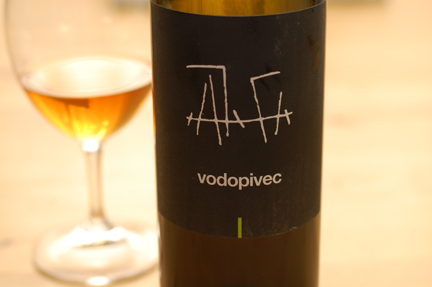
Pork chops with braised fennel (recipe) and 2005 Vodopivec Vitovska

I’m adding a new category to the blog today: de arte copulandi vinorum…
Photos by Tracie P.

1 bulb fennel, washed and trimmed
2 cloves garlic, peeled
extra-virgin olive oil
kosher salt
1 cup white wine
1 cup chicken stock
2 porter house pork chops, about ½ inch thick

Slice the fennel vertically into rounds about ¼ inch thick.

In a wide sauté pan, heat 3 tbsp. olive oil over medium heat. When smoke begins to rise from the pan, add 1 clove garlic. When the garlic has begun to brown, add the fennel rounds, sprinkle with salt, and brown on both sides.

Deglaze with ½ cup white wine. When the alcohol has evaporated, add ½ cup chicken stock and simmer over low heat until the cooking liquids have reduced by half. Transfer the fennel to a mixing bowl, discard the garlic, filter the sauce using a fine strainer, and add the sauce to the bowl. Reserve.

Preheat oven to 200° F.

Gently season the pork chops with salt on both sides.

Add 3 tbsp. olive oil to the same pan used to braise the fennel and brown the remaining garlic clove over high heat. Add the pork chops and brown on both sides (n.b.: it’s important to brown the pork quickly over high heat; they don’t need to cook through).

Once browned on both sides, transfer the pork chops to an oven-ready dish and cover with aluminum foil; transfer to the pre-heated oven.

In the meantime, add the remaining wine to the pan over medium heat. When the alcohol has evaporated, add the remaining stock, the reserved fennel and its sauce, and reduce to desired consistency. Remove the fennel from the pan and reserve and then filter the sauce using a fine strainer (n.b.: in the time that it takes you to reduce the sauce, the pork chops will have cooked through).

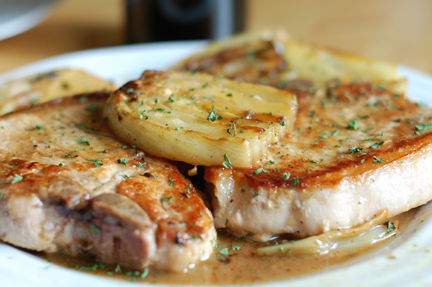
Arrange the pork chops on a serving dish and then top with the braised fennel and sauce.
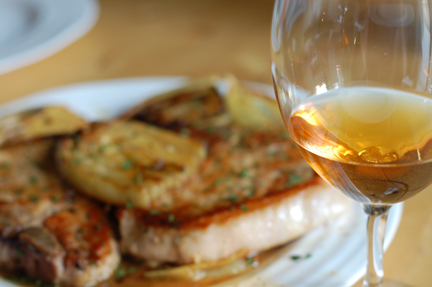
The tannin of the skin-contact, amphora-aged Vitovska was ideal with the fatty, juicy chops and its nutty fruit flavors the perfect complement to the sweetness and tang of the fennel.
Buon weekend, yall!
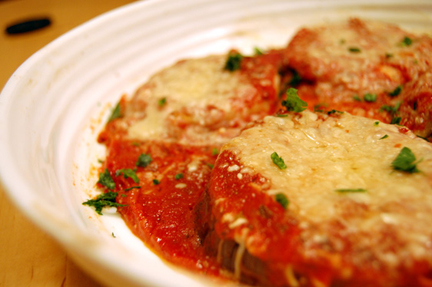
Melanzane alla parmigiana (Eggplant alla Parmigiana) my recipe

From my post today for the Houston Press

Slice one medium-sized black beauty aubergine into ¼-inch rounds (I know that you Solanaceae geeks out there would cringe if I called a western variety eggplant). Arrange in a colander and sprinkle with kosher salt. Set aside for 30 minutes to purge its bitter liquid.

Pre-heat the oven to 350° Fahrenheit.

In the meantime, make the tomato sauce by sautéeing 1 or 2 peeled whole cloves of garlic, 2 tbsp. finely minced onion and 1 tbsp. finely chopped well washed flat-leaf parsley in extra virgin olive oil (reserve a tbsp. of flat-leaf parsley to finish the dish). Add your favorite tomato purée (ideally unseasoned; my favorite is the Central Market brand in bottle). Season with 1 bay leaf, and salt, pepper, and chili flakes to taste. Once the tomato has begun to simmer, add ½ cup of white wine. By the time the eggplant has entirely purged its liquid, the sauce will be ready.

Grease a medium-size, oven-ready, deep casserole dish with unsalted butter. Distribute the aubergine rounds in the bottom of the dish and sprinkle generously with freshly grated domestic cow’s milk mozzarella. Pour the sauce into the dish, making sure to cover the aubergine completely. Top generously with freshly grated Parmigiano Reggiano and bake until the Parmigiano Reggiano begins to brown.

Serve hot sprinkled with finely chopped flat-leaf parsley.

In summer, when locally grown fresh basil is available, use the basil instead of the flat-leaf parsley. This dish is best if you can prepare it beforehand and let it cool, reheating it immediately before you serve it.

10 Tips for Holiday Wine Shopping @EatingOurWords & Venison Carpaccio @CanteleWines

My post today over at the Houston Press is devoted to 10 Tips for Holiday Wine Shopping.

The one tip that they wouldn’t let me put in my post: don’t ever buy La Spinetta! (just kidding)

Seriously, I’ve been having a lot of fun posting for Eating Our Words and my editors are the best…

And over at the Cantele Wines blog, I posted my translation of a wonderful recipe for venison carpaccio and polenta medallions topped with braised pork skins and chopped walnuts by one of my favorite Italian-language food bloggers, Appunti Digòla.

I really loved the way author Stefano Caffarri composed this recipe and his humor. Great stuff…

Buona lettura, yall!

Best Piedirosso I’ve tasted this year and the world’s craziest sandwich

It’s been more than a month since I returned from Apulia where I sat as a judge in the Radici Wines festival, celebrating the indigenous grapes of Southern Italy and I still haven’t caught up on all the great wines I tasted during the event. Here’s another one…

The wines of Paola Mustilli first came to my attention back in 1998 when I was writing about wine for La Cucina Italian in New York. I cannot conceal that I’ve been a devoted fan ever since and I was thrilled that I finally got to meet her in early June at the festival, where the first two days included “speed-dating” with producers (although some of those têtes-à-têtes proved to be a little awkward when the wines were less than satisfying or the enologist decided to lecture on “how wine is made”).

I guess I’m thinking about her Piedirosso because when I landed in sunny San Diego this morning and saw the blue waters of the Pacific Ocean, I got a craving for this wonderful wine — grapey and slightly chewy, with clean berry and red fruit flavors, sturdy acidity and judicious alcohol. The day I tasted with her she served it slightly chilled and it was perfect. And when I wrote home about it, Tracie P responded with a note of enviable nostalgia, reminded of how she used to enjoy this relatively inexpensive wine during her years on the Amalfi coast. Piedirosso is such a fantastic, user-friendly grape, so versatile and flexible, and when it’s done right, its downright delicious.

The wine was definitely a highlight of the festival for me, as was Paola’s Falaghina, which really stood out for its faithfulness to the variety. Overall, the flights of Falanghina were disappointing (and I got into some hot water after Jancis suggested that I mention my impression in my address to the conference). There were a few solid entries for Falaghina but even those tasted yeasted and spoofed to me. Paola’s really stood apart and I cannot recommend it highly enough to you: it was bright and clean with the white fruit aromas and flavors that I look for in real Falaghina (not honeydew and bubblegum that you find in the tricked out bottlings).

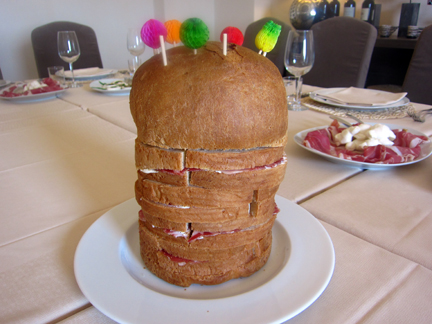
One of the other highlights that day was what I have dubbed the world’s craziest sandwich.

The food at Alessia Perucci’s Masseria Le Fabriche was exceptional and the meals rigorously traditional yet equally and wonderfully creative. But, standing nearly 2 feet in height, no one could quite figure out how to consume this brioche stuffed with prosciutto and cheese. It was a sight, nonetheless, to behold!

In other news…

Vai Sotto! Taste with me “down under” tomorrow and Thursday nights at Sotto in Los Angeles where I’ll be pouring wine on the floor and chatting with guests both nights.

One of the best fish dinners I’ve ever had in Italy

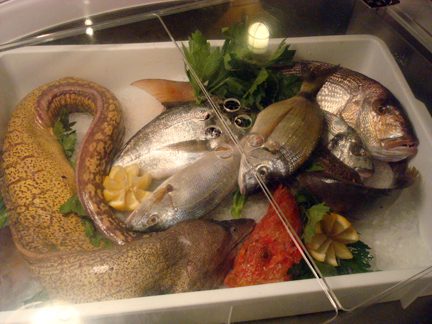
Last night I was treated to one of the best fish dinners I’ve ever had by Giampaolo Paglia (you may remember him from a recent post here). The restaurant was the Oasi in Follonica, a seaside venue where you can rent beach chairs and tents by day and lunch and dine on the freshest of fish. I was completely floored by the quality of the materia prima and chef/owner Mirko Martinelli’s deft hand. Follonica may not exactly be on the conventional tourist’s radar: should you be willing to make the detour, I can assure you that you will be rewarded by Mirko’s magic.

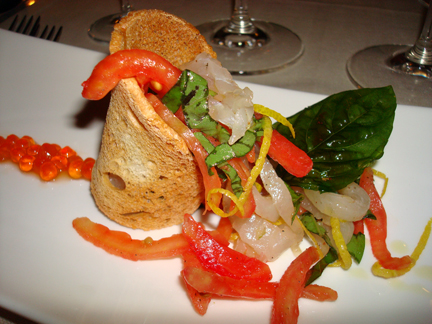
Raw sea bream with tomato, fried basil, and salmon roe.

Sargo with mushrooms and black truffles over creamy polenta. THIS DISH WAS INSANELY GOOD!

The combination of the lightly fried shrimp and the moray eel (see the photo at the top) was truly SUBLIME. The texture and flavor of the moray was ineffably delicious.

Gianpaolo’s skin-contact Ansonica Bucce (bucce = skins) was my favorite pairing of the night. (When I have time down the road, I’ll recount our conversation about Gianpaolo decision to abandon his barriques.)

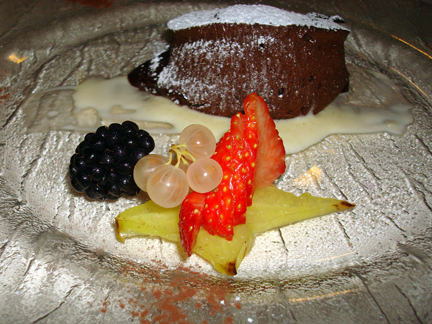
Tracie P will tell you that I rarely eat dessert but how could I resist?

Chef Mirko, left, with Gianpaolo… simply amazing dinner… I can’t wait to bring Tracie P here…

95 Raveneau Monts Mains (!) and my guacamole recipe

From the department of “dreams do come true”…

Our new friends Sonia and Steven came over for a school-night dinner last night and what a school-night it was! We were utterly floored by the bottle they brought over: 1995 Raveneau Monts Mains 1er Cru.

“I thought you might enjoy this,” said Steven wryly.

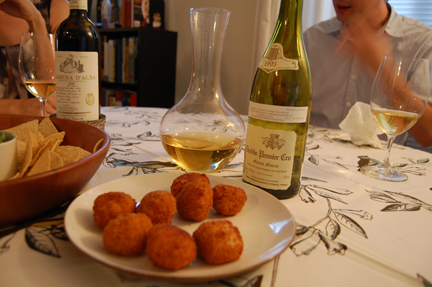
My goodness, what a bottle of wine! Such a nuanced nose of fruit and herbs, so steely and rich in the mouth. At 12.5% alcohol (according to the label), one of the most balanced and complete wine. Simply stunning. (Those are Tracie P’s rice balls in the photo btw.)

With Labor Day imminent, I’ve been wearing my Seersucker jacket all week and indulging in the foods of summer, including my guacamole (of which, I will admit it, I am extremely proud). The trick is to purge the tomato of its water before assembly. Check out the recipe below.

Steven’s from Texas originally and has recently returned to Austin: he and Sonia have a lot of big plans, culinary and otherwise… More on that later.

In the meantime, seems that Tracie P and me aren’t the only ones eating and drinking well this summer. Pastrami mia: I guess Alfonso gave up on his health kick when tempted with the pastrami of Shapiro’s in Indianapolis. I think I feel an acute case of pastrami envy coming on!

Happy Labor Day ya’ll!

Jar’s Guacamole*

American Spanish guacamole, adaptation of Nahuatl ahuacamolli, from ahuacatl avocado + molli sauce (OED online edition).

1 medium-sized tomato
1 bunch cilantro
½ white onion
1 jalapeño pepper
1 clove garlic
2 ripe avocados
2 limes
kosher salt
freshly ground pepper
chili flakes

Finely dice the tomato and transfer to a colander. Sprinkle lightly with kosher salt and allow the tomato to purge its water for about 30 minutes.

In the meantime, rinse the cilantro, dry well, and finely chop. Peel and mince the white onion. Deseed and finely chop the jalapeño. Peel and mince the garlic and combine all of the above ingredients, including the tomato (water purged), in a mixing bowl. Peel and finely dice the avocado and fold into the mixing bowl. Squeeze and strain the limes directly into the guacamole. Season with kosher salt and freshly ground pepper to taste. Add chili flakes to obtain desired heat (and/or use some of the discarded seeds from the jalapeño).

* Jar, my nickname from childhood, still used by my rock ‘n’ roll friends.

The basil of Salerno and Lisabetta’s tears

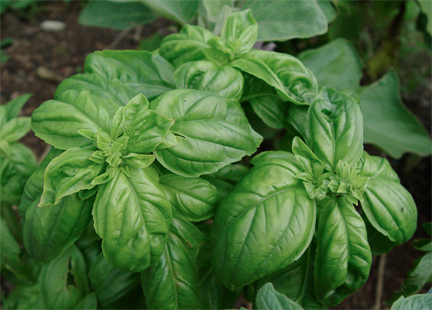
Above: Basil was prized for its healing properties for external wounds in the Middle Ages. The image of basil (note the presence of a woman and man) on the verso (left) is taken from the Tacuinum Sanitatis, in this case Codex Latinus 9333 from the Bibliothèque de France in Paris (click here to view a larger version). It was also a symbol of hate (read on).

I never imagined that my post the other day on Fake Pesto would lead to such a long comment thread here at the blog and over in the Facebook feed.

Here at the blog, Hande pointed out rightly that pesto, literally pestle, denotes the dressing for pasta made of ground basil, cheese, pine nuts, garlic, and olive oil. I was surprised to learn that the Genoese Pesto Consortium’s officially sanctioned recipe allows for walnuts (as a substitute for pine nuts) and Parmigiano Reggiano along with (the more traditional, in my view) Pecorino. As per Hande’s comment, when I wrote that pesto is traditionally served with boiled potatoes and green beans, I should have noted that the dish is properly called pesto avvantaggiato, literally, enriched pesto, whereby trenette or trofie (noodles) are tossed with the pesto, the boiled potatoes and green beans, and some of the cooking water from the vegetables. Thanks again, Hande, for keeping me on my toes!

Image via SchoolGardenWeekly.

But when friend Leslie noted (over in the Facebook thread of the post) that basil is an anti-depressant, I began to think about one of my favorite novelle from Boccaccio’s Decameron, the Tale of Lisabetta da Messina.

    Lisabetta’s brothers slay her lover: he appears to her in a dream, and shews her where he is buried: she privily disinters the head, and sets it in a pot of basil, whereon she daily weeps a great while. The pot being taken from her by her brothers, she dies not long after.

    And so, saddest of women, knowing that she might not bewail him there, she would gladly, if she could, have carried away the body and given it more honourable sepulture elsewhere; but as she might not so do, she took a knife, and, as best she could, severed the head from the trunk, and wrapped it in a napkin and laid it in the lap of her maid; and having covered the rest of the corpse with earth, she left the spot, having been seen by none, and went home. There she shut herself up in her room with the head, and kissed it a thousand times in every part, and wept long and bitterly over it, till she had bathed it in her tears. She then wrapped it in a piece of fine cloth, and set it in a large and beautiful pot of the sort in which marjoram or basil is planted, and covered it with earth, and therein planted some roots of the goodliest basil of Salerno, and drenched them only with her tears, or water perfumed with roses or orange-blossoms. And ’twas her wont ever to sit beside this pot, and, all her soul one yearning, to pore upon it, as that which enshrined her Lorenzo, and when long time she had so done, she would bend over it, and weep a great while, until the basil was quite bathed in her tears.

    Fostered with such constant, unremitting care, and nourished by the richness given to the soil by the decaying head that lay therein, the basil burgeoned out in exceeding great beauty and fragrance.

There is so much I’d love to share about this truly fascinating (at least to me) story and the role that basil plays in it. Boccaccio’s Decameron has so many wonderful references to food and wine in it. (Read the entire tale in English here.) But, ahimè, professional duties call… I hope you enjoy it as much as I do.

In the meantime, here’s a scene from Pasolini’s version of the tale:

This man can COOK! Dinner with Bill and Patricia

Photos by Tracie P.

Just had to share some images from last night’s dinner in the home of our good friends Patricia and Bill.

Tracie P and I met Bill last year at a Valpolicella tasting and we’ve been friends ever since. Dinner began last night with jumbo shrimp wrapped in bacon and grilled (below). Only after I recited Artusi’s open letter to meatloaf did Bill acquiesce and agree to let us try his meatloaf from the night before.

“Signor polpettone venite avanti, non vi peritate,” wrote Pellegrino Artusi in La scienza in cucina e l’arte di mangiar bene (Science in the Kitchen and the Art of Eating Well, first published in 1881). “…lo so bene che siete modesto e umile…”

“Please step forward Signor Meatloaf and please don’t be shy… I know that you are modest and humble.”

He cubed it for us and we ate it cold. It was delicious.

It’s hard to describe how much sheer, pure fun we have when visiting with Patricia and Bill. Patricia is an interior designer by trade and their lovely Mediterranean-style home above Pease Park in Austin is a happy labyrinth of wonderful artifacts, paintings, and beautiful objects.

From his tales of working with the Israeli army to his anecdotes of Charlie Wilson and his time working in Washington, D.C., there’s never a dull moment in Bill’s presence. And the man can COOK. Bill made an unusual pasta shape, lanterne, dressed with a vodka-tomato sauce inspired by the Trattoria alla Vecchia Bettola in Florence. We paired with a bottle of 2008 SP68 by Occhipinti (which just came into the market here in Austin, available at the Austin Wine Merchant).

Next came involtini di vitello, veal rolls stuffed with mozzarella and accompanied by roast potatoes. We paired with a superb bottle of 2007 Bourgueil Cuvée Alouettes by Domaine de la Chanteleuserie (not sure where Bill picked that up, but I would imagine the Austin Wine Merchant). A supremely delicious pairing however you sliced it.

Customarily, one dines in the dining room when attending a dinner party chez Patricia and Bill. But on this special night it was just the four of us and so we ate in Tracie P’s favorite room in their house, the cappella. My lady loves her a turret!

Thanks again Patricia and Bill, for an excellent meal and a fantastic evening. We mustn’t let so much time pass between our visits again!

Fake pesto, real good

pesto

Summertime means fresh basil and pesto chez Parzen. Last night, before me and Tracie P cozied up on the couch for a Saturday movie and some Lini Lambrusco, I whipped up some “fake” pesto with some beautiful basil we found at the Central Market on Lamar.

True pesto is made with Pecorino, pine nuts, boiled potatoes and green beans, and extra-virgin olive oil, ideally from Liguria.

Pan-Italian pesto is generally made with Parmigiano Reggiano and omits the potatoes and green beans. And while true pesto should be milled by hand, using a mortar and pestle, fake pesto is super easy to make: just combine the ingredients in a food processor and pulse until you obtain the desired consistency.

Here’s how I made my “fake” pesto:

Pan-Italian Pesto

serves 4

1 handful pine nuts
1 heaping handful cubed Parmigiano Reggiano
(avoid pre-grated cheese!)
2 small bunches fresh basil (or 1 large bunch)
2 medium-sized cloves garlic, peeled
pinch of kosher salt
¼ extra-virgin olive oil (I love Sardinian San Giuliano)

Combine all the ingredients in a food processor and mill using short pulses. Add the olive oil as needed to obtain the desired consistency.

In the meantime, in a large pot, cook the pasta (long noodles, no short pasta!) in generously salted water until slightly undercooked. Before straining, add a few tablespoons of the cooking water to a large mixing bowl. Strain the pasta and transfer to the mixing bowl. Fold in the pesto, reserving a dollop per serving to top the pasta.

Et voilà!

And remember: the chalice from the palace has the brew that’s true! NOT the vessel with the pestle!

Eating our way through California

california tomatoes

Above: Top Italian wine writer Mr. Franco Ziliani (possessor of a palate I admire immensely) likes to tease me (rightly) about how I’m so crazy for the wines of Piedmont, I’ll even drink Barolo in the middle of the “scorching hot” Texas summer (and believe me, it’s been a hot one in Texas this year!). Well, yesterday I quit the California dreaming and did me some serious California eating! Those are tomatoes from Chrissa and Dan’s garden.

grilled marlin

Grilled marlin, scallops, and shrimp for lunch with client and new friend Mike K at the classic ol’ San Diego downtown eatery Dobson’s. (Thanks again for lunch, man!)

baker and olive

Savory San Diego Bread and Cie bun with locally sourced olive oil from Baker and Olive, and Fra’ Mani salame at epicurean Chrissa and Dan’s place (a truly yummy locus amoenus their house is!).

california produce

Dan’s excellent heirloom tomato salad, sourced from their garden (what’s the name of the Polish cultivar?).

california sushi

Late-night sushi at Miso Harney sushi in Old Town (they serve until 12 a.m.!) after Tracie P got in from Austin (I got in the day before). Geared for a young crowd, Miso Harney is a great place for later-in-the-night super fresh San Diego sushi and an SD-restaurant-industry fav.

california traffic

Of course, there’s also the California summer traffic to contend with. Ugh… Not so bad though, considering the view!

I bet you’re gonna like where we’re headed today… Stay tuned… It’s a special one…