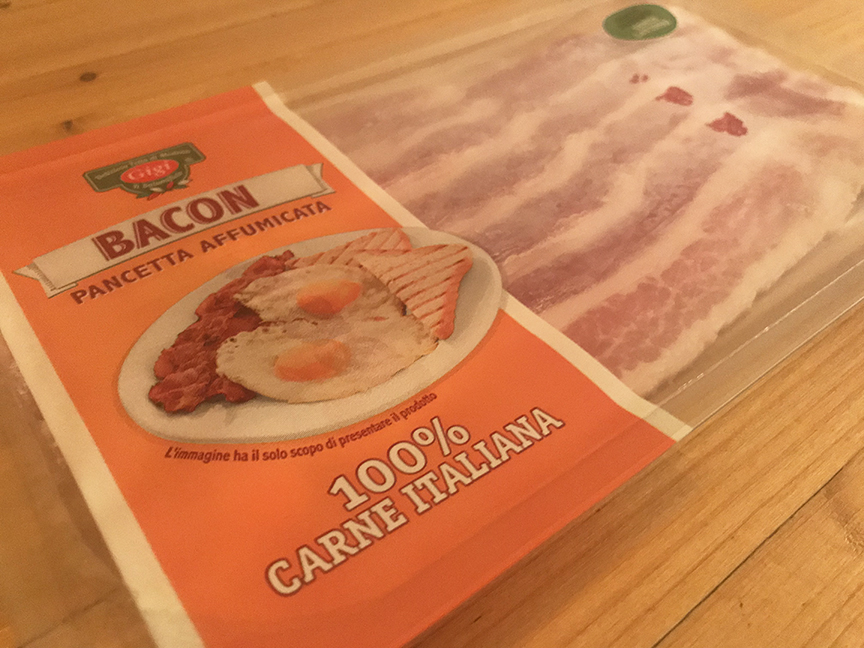
Italian bacon and eggs: Italy’s obsession with American food (no, this isn’t a joke)

Above: when I first started coming to Italy 30 years ago, bacon was still called pancetta. Now it’s called “bacon” in Italian.

Tracie and I landed in Italy yesterday with our daughters, ages 4 and 6. It’s their first real trip to Europe (since our oldest doesn’t have any recollection of our visits here when she was just one year old; and our youngest only made it here previously in utero).

When we told them about our summer trip this spring, they were concerned — gastronomically speaking.

“Daddy, daddy, we can’t go to Italy!” they protested vehemently. “They won’t have the things we like to eat there!”

“They have LOTS of good things to eat in Italy!” Tracie and I laughed and smiled.

“Do they have pizza in Italy?”

“Yes, of course they do,” I told them. “In fact, the Italians invented pizza! They have the best pizza in the world.”

They seemed genuinely impressed by this historical tidbit but then came the culinary litmus test that would determine their willingness to join their parents in the Garden of Europe:

“But daddy, do they have bacon in Italy?”

Above: bacon and eggs is now commonly found on menus in northern Italy.

It must have been seven or so years ago when my Italian bromance Giovanni took me out for (truly excellent) hamburgers and I noticed that the cured pork belly was cut and smoked not like traditional Italian pancetta but like American bacon.

In the time since, “bacon” — as it is now called in Italian — has become ubiquitous in northern Italy.
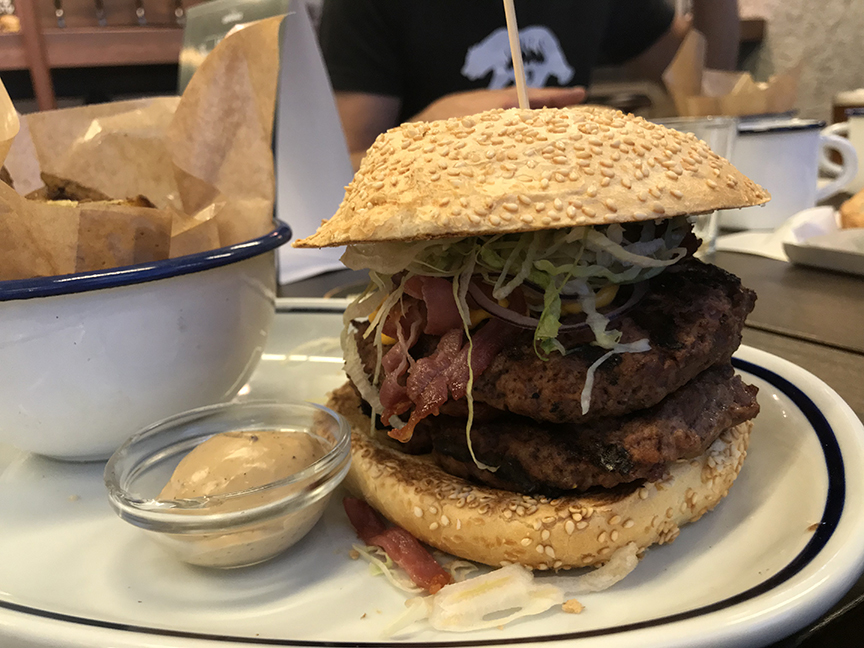
Above: a hamburger I ate last month in Franciacorta. Note the bacon.

Italians love LOVE hamburgers. They love them so much that they don’t use butcher scraps to form the patties. They use the highest quality beef they can find. And beyond the myriad fast food restaurants that now sadly dot the northern Italian countryside, the omni-present amburgheria (hamburger house) never uses the hydrogenated-oil buns that we adore in America. Instead, they use artisanal buns.

I’ve had some of the best hamburgers of my life in Italy in recent years. And that’s coming from an all-American, huge bacon-cheeseburger fan.

Bacon and scrambled eggs are also immensely popular now in northern Italy. Two years ago, I snapped the above photo of the dish in a run-of-the-mill trattoria in downtown Milan, ordered at lunch à la carte.
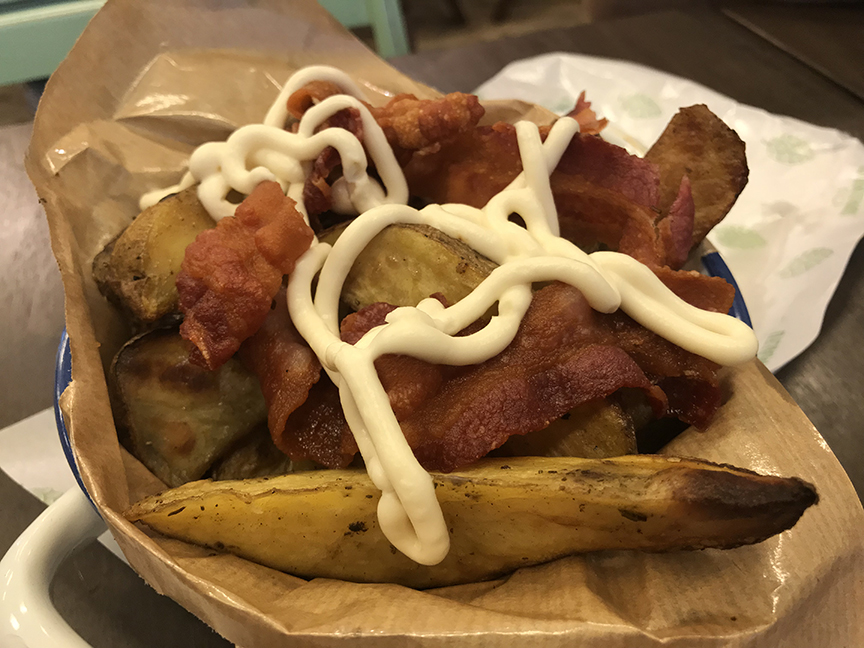
Above: bacon fries with Pecorino sauce (no joke) at the same amburgheria in Franciacorta.

Giovanni is graciously hosting our family this month at his place in Franciacorta. And being the generous and thoughtful friend that he is, he went grocery shopping for us before we arrived. The bacon in the top photo is awaiting our girls in his fridge as they slumber.

Back at home, we spend SO MUCH money on high-quality, wholesome bacon. Here in Italy, even when they cut the bacon from top hogs, the price is still very reasonable.

Leave it to the Italians to “misunderstand” American cuisine and make it all the better along the way. My only worry is: will our children ever want American bacon again?

We arrived safely and soundly yesterday afternoon in Milan and made our way to Franciacorta before the heavy rain began to fall. The girls have already spotted their first bunnies outside of Giovanni’s apartment and they loved the fresh fruit that Giovanni’s mom had prepared for them. Aside from a lost bag (mine, thank goodness, not Tracie’s with all the girls’ things), we’re already having a great time. Thanks for reading and buon weekend a tutti!
Barbera, the origin of the grape name (a philologist’s perspective)

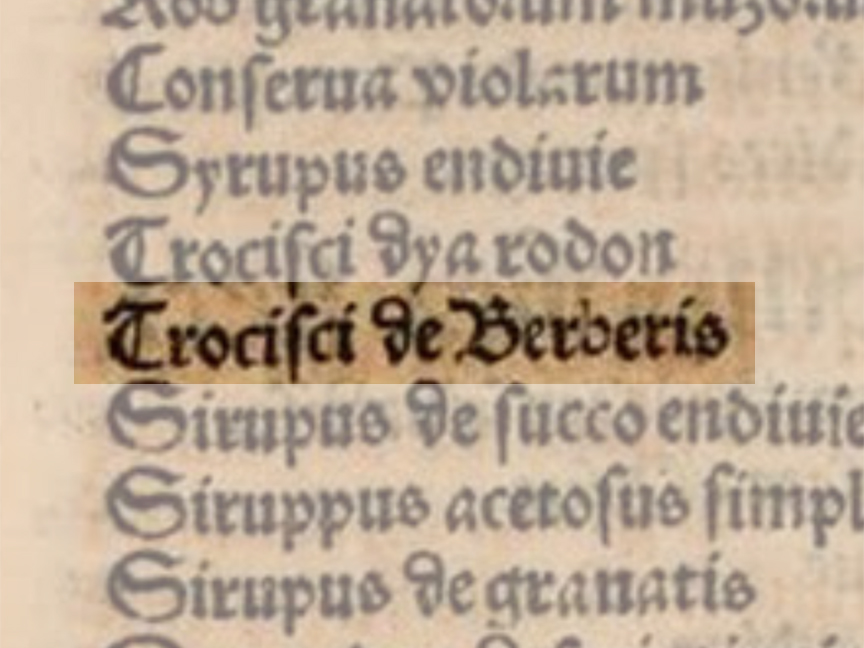
Above: An early 16th century medical manual lists barberry lozenges as a commonly used cure.

In today’s world of hypercorrective ampelography, it’s hard to believe that people didn’t used to care as much about grape names as we do in the contemporary age.

Writers on agriculture didn’t began to record grape variety names on a wide scale until the latter half of the 19th century. And even those early modern ampelographers couldn’t rival today’s giddy obsessions with the etymologies of grape names.

Contemporary wine writers can’t seem to resist the urge to dip their toes in the etymological waters. And despite their access to Google Books and the growing legions of searchable encyclopedic resources available online, they continue to wax philologic (and errouneous) over the origins of ampelonyms like Sangiovese and Aglianico (even though the former doesn’t mean “the blood of Jove,” nor is the latter a cognate for Hellenic).

But in the case of Barbera, Hermes generously let the experts off the hook: Most concede that the origin of this grape name, which didn’t begin to appear in print until the 18th century, is unknown.

Ian D’Agata sums up the current state of Barbera philology in his landmark work Native Grapes of Italy (which I highly recommend to you).

    The origin of its name is unclear; Pietro Ratti of Renato Ratti feels it’s a derivation of barbaro (barbarian) due to its deep red color, while others believe the origin is vinum berberis, an astringent, acidic, and deeply hued medieval drink. Vinum berberis is different from the vitibus berbexinis referred to in a 1249 document located in the archives of Casale Monferrato, which was most likely another variety, Barbesino or Berbesino, better known today as Grignolino.

For the record, vinum berberis was a barberry elixir. And medicinal barberry extract was more commonly applied on a lozenge (a troche, in English, trochiscus in Latin) than in a vinum or wine.

Even when we turn to a more authoritative source, our grand desire to uncover Barbera’s origin story remains unfulfilled.

The Treccani Italian dictionary (a benchmark of the Italian academy) offers two possible etyma.

The first is the Latin grape name albuelis, notably mentioned in Columella and Pliny. It’s a linguistic stretch, however possible (Barbera could be a metathetical reduplicative contamination).

Click here to continue reading my post today for the Barbera d’Asti growers association…

My Italy, although speech does not aid those mortal wounds: the Italian Republic’s populist tide

Above: the Euganean Hills where the Italian poet Francis Petrarch (1304-1374) spent his last years transcribing his life’s work.

“My Italy, although speech does not aid those mortal wounds of which in your lovely body I see so many, I wish at least my sighs to be such as Tiber and Arno hope for, and Po where I now sit sorrowful and sad” (translation by Robert Durling).

The above passage, the opening of the most famous of Francis Petrarch’s political poems in Italian, came to mind last week when I read the news that Italy would have a new governing coalition formed by racists and nationalists.

The news also made me think of my dissertation advisor, the Italian poet Luigi Ballerini, whom I recently saw in Milan where he was born in 1940. His earliest memories, he has often told me, are of Nazi soldiers retreating from the city atop their tanks, bare-chested in the heart of winter. Luigi never knew his father, who was killed by fascists on a Greek island.

Today, Matteo Salvini — an avowed racist, nationalist, and Euroskeptic (not to mention a confidant of Steve Bannon, who now resides in Rome) — has come to power in Italy (see this Fox news account of one of Salvini’s campaign rallies from earlier this year).

The Italian papers reported yesterday and the English news media is just beginning to file its reports on Salvini’s freshly forged alliance with Viktor Orbán, the hardline anti-immigrant and openly anti-Semitic prime minister of Hungary. Together, they plan to re-write the EU’s rules on immigration — Salvini and Orbán’s shared cause célèbre.

Before he cleaned up his act and tried to affect an air of respectability, Salvini was renowned in Italy for his overtly racist rhetoric. In 2009, he proposed (as a joke, he later claimed) that foreigners riding the subway in Milan be forced to wear stars on their clothing to denote their immigration status.

Even when I’m Italy teaching for an Italian university, I’m technically an extracomunitario, an alien. Will he require that I wear a star when I take the train?

Tomorrow, I’ll head off again to Italy for another two weeks of teaching at a university there. This time, I’m taking my wife and our two young daughters with me. We took our oldest daughter to visit the country when she was just a baby. She has no memories of our time there. So this trip, which we’ve been planning and talking about for weeks, is their “first trip to Italy.”

It makes me think of my first trip to Italy, in 1987 when I studied the history of Italian language at the University of Padua. I’ll never forget meeting and interacting with other foreign students from the Middle East and Africa then. I can only imagine, with dread, how they perceive Italy’s current political climate. I can hardly fathom their concern for their children’s futures.

When I saw Luigi last month in Milan, where he is living permanently now, he told me that he doesn’t recognize the Italy of his adolescence, a time when economic prosperity and liberal attitudes locked arms to create a culture of hope, tolerance, and humanism there.

Machiavelli famously closed The Prince with these lines from the same poem by Petrarch:

“If only you would show some sign of piety, then virtue against rage will take up arms, and battle will be short, for all that ancient valor in the Italian heart is not dead” (translation by Mark Musa).

Hope still shines in the distant future, dimmed and diminished but still flickering. Let us pray that the not-so ancient valor in the Italian heart is not dead.

Au revoir, Oregon, until we meet again…

A week of Oregon and the Willamette Valley wine scene has really swept me off my feet.

Since arriving on Monday, my Slow Wine colleagues and I have tasted hundreds of wines and met so many cool people. And we’ve enjoyed some extraordinary meals, including an unforgettable dinner at Recipe Part Deux in Newberg where we’ve been staying.

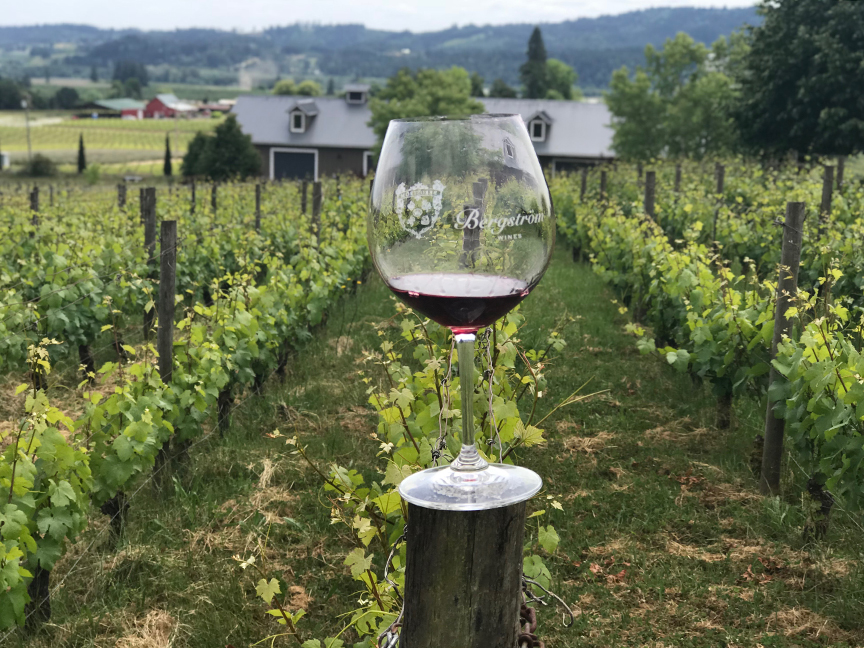
The shot above comes from the biodynamic farm at Bergström. What pure and vibrant wines… One of the many highlights for me.

Today, Slow Wine editor-in-chief Giancarlo Gariglio and I will head to Napa where we start all over again: hundreds of California wines await us for our 2019 guide panel tasting.

I’ll already be back in Texas by then but on Wednesday, June 6, the Fiorello Olive Oil company in Fairfield, California will be hosting a tasting of wines from our panel sessions from 6-9 p.m. All proceeds from the event will go fire-affected Sonoma and Napa residents and winery workers. Giancarlo will be presenting the walk-around tasting.

Here’s the link for details and registration info.

And back in Houston… I’ll be in Italy by then but on Wednesday, June 13, my wine friends Patrick Comiskey and Taylor Parsons (two of the U.S. wine pros I admire most) will be hosting a seminar and lunch featuring the wines of Georgia at one of the city’s favorite wine bars.

The event is open only to trade and media: reserve by emailing azarr@marqenergie.com.

What a week it’s been up here in the Pacific Northwest, where the forest meets the sea! Thank you, Oregon, for your beauty, your warm hospitality, and your delicious wines. I can’t wait to get back in February when we’ll present the new guide.

The amphora of the future is here (in Oregon’s Chehalem Mountains)

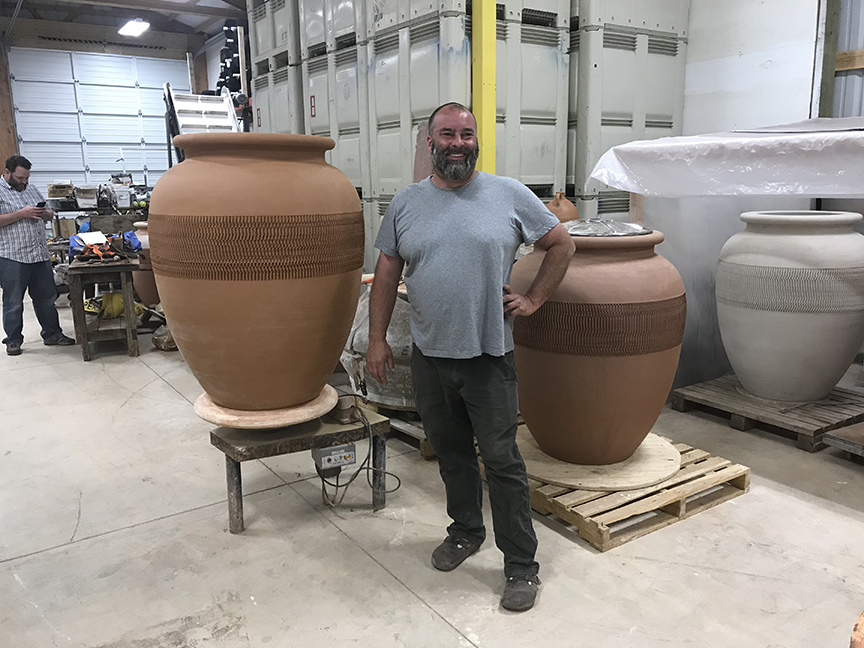
What an incredible visit yesterday to Andrew Beckham’s pottery studio and winery in Oregon’s Chehalem Mountain AVA!

That’s Andrew above with the first full-size winemaking amphorae that he’s churned out of his kiln (above and below).

He’s produced a video about the project that you can watch on his family’s winery’s site here.

I had already tasted and admired some of the excellent wines that he and his wife Annedria produce there. And it was exciting to taste through their full line of wines, including their wines vinified in his smaller hand-thrown amphorae.

He may be the only amphora potter cum winemaker on the planet and it was fascinating to hear his insights into why the vessels make for such a unique winemaking tool.

Lovely people and extremely compelling wines.

The Slow Wine team has been on the ground here all week and today we have our big panel tasting. I’ve been blown away by the caliber and quality of the wines I’ve tasted over the last few days. And the hospitality and food have also been fantastic. It feels like Oregon, between its old and new guards, is poised to reshape the way the world perceives American wines. Andrew and Annedria are undeniable stars of that growing wave.

Writing in hurry this morning as I prepare for a BIG day of tasting. Wish me luck and wish me speed… Thanks for being here.

Don’t miss the tripe at Nick’s Italian Cafè in McMinnville #SlowWine #Oregon #Willamette

Posting on the fly this morning as we head out for another day of touring and tasting in the Willamette Valley.

It’s our second day on the ground tasting for the 2019 Slow Wine guide, which will include Oregon — for the first time ever.

Our day ended yesterday in one of Willamette’s wine epicenters, the wonderful little town of McMinnville where de rigueur we ate at the legendary Nick’s Italian Cafè.

I loved the restaurant and it was a true pleasure to get to chat with Nick himself. The tripe (above) was off-the-charts good.

We even learned Oregon wine pioneer David Lett’s favorite dish there. And man, our tasting at the Lett family’s Eyrie Vineyards was truly extraordinary! Thank you again, Jason, for a unforgettable visit!

So much to tell, so little time… Stay tuned!

Portland mon amour (the #SlowWine Oregon project begins)

What a fantastic American city…

Slow Wine editor-in-chief Giancarlo Gariglio and I spent the better part of yesterday touring Portland with our senior editor for Oregon, Michael Alberty (one of my favorite people in the wine writing biz). We were scouting locations for the Slow Wine tasting that we will present here in February 2019. It will be the first guide to include the wines of Oregon and it will be the guide’s first time in Portland. We are super geeked…

One highlight for me was our visit and tasting at Jacobsen Salt Co. (above). Really cool stuff.

Of course, no visit to PDX would be complete without a stop at a coffee bar. We went to Coava, which was lovely.

The aperitivo hour found us at the newly opened Enoteca Nostrana (get the warm oyster dip). Owner Cathy Whims’ celebrated restaurant Nostrana next door was packed. But the hosts managed to squeeze us in a for a great dinner. It was my second time eating there. It’s one of my favorite restaurants in America.

For our night cap, we headed to Jeff Vejr’s amazing wine bar Les Caves.

All in all, in was a pretty awesome day in this west coast outpost for American food and wine culture (thank you, again, Michael, for arranging our visits and showing us around your wonderful city).

This morning we’re heading to wine country where we’ll be touring and tasting for the guide for the next three days.

Stay tuned… And thanks for being here.

Italy driving tips: beware the ZTL! The “zona traffico limitato” or “restricted traffic area”

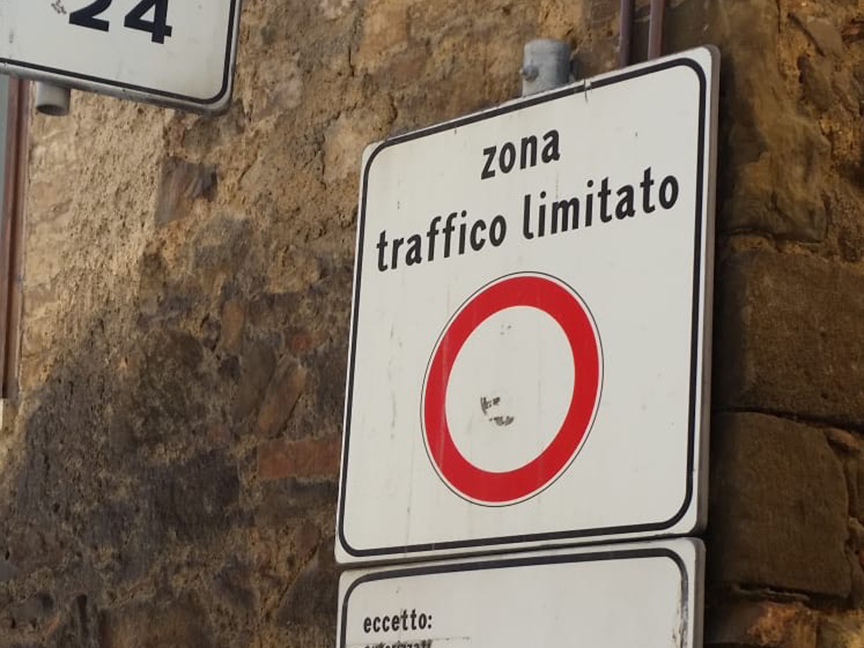
Above: a typical “zona traffico limitato” or “restricted traffic area” sign in Montalcino (photo by my good friend Laura Gray of Il Palazzone, producer of Brunello di Montalcino). In some of the bigger cities, the zones are demarcated by LED signs that read “ZTL” (acronym for “zona traffico limitato”).

Monday’s post on driving in Italy (“Italy driving tips: speeding tickets, tolls, international driver’s permit, Waze, DUIs, wi-fi, etc.”) generated a lot of engagement on social media. I’m glad that folks have found it useful and I appreciate all the feedback and input.

A friend from my La Jolla High School days, Adriana, left a great comment on the post with tips on city driving in Italy (she lives and teaches English in Bologna where she and her husband have raised their lovely family). It’s chock-full of good intel.

A lot of folks on social media also shared horror stories about receiving tickets after inadvertently entering a “zona traffico limitato” or “restricted traffic area” in a city center.

The “zona traffico limitato” or “ZTL” is a delimited area within an urban center where only residents and authorized drivers are allowed to travel by car. They are monitored by cameras that report offenders to authorities. The fines can be steep and are often compounded by rental car processing fees and late fees for those who don’t pay on time (depending on the city, the office issuing the ticket may or may not be lenient with foreigners who only receive the ticket after the deadline to pay has passed).

There’s a lot of useful information on the internets about the dreaded ZTL.

This post by Auto Europe (rental car agency) is one of the best and it includes excellent maps.

It came to my attention via another really useful post by Italy Beyond the Obvious.

I wasn’t surprised to learn that Siena claims to have been the first Italian city to implement a ZTL back in the 1960s.

The bottomline: don’t drive into city centers in Italy. Park in paid parking lot on the edge of the city (every city, including Siena and Florence have them) and then walk or take public transportation (a fat cab fare is always better than the cost and hassle of a ticket).

For my last night in Italy earlier this month, I had planned to meet my dissertation advisor, the Milanese poet Luigi Ballerini (more on that later), at his home in downtown Milan. I took my rental car back to the airport and then took a 30-minute-or-so train ride from the airport to the city center. No stress, no worries about parking, and I caught up on email on the train.

My advice is avoid city driving, especially when you visit the smaller urban centers, like Parma or Siena, for example. Take the train, a bus, or a taxi into to town. Removing that layer of stress makes the visit all the more enjoyable.

Thanks for all the great feedback, everyone! I’m so glad people have been finding the post useful.

In other news…

Wow, Philip Roth’s passing really hit me hard. It marks the end of an era in American letters.

He never wanted to be pigeonholed as a “Jewish” writer. But for many in my generation and the generation before mine, he gave American Jews a new vernacular to express our identity.

He was, first and foremost, an American. And he was also a model of the immigrant experience here and a role model for the American intellectual, socially and politically engaged without ever losing sight of literature’s greater purpose and human calling.

There have been so many great tributes published over the last 24 hours. But one of my favorites is this one by Roger Cohen for the New York Times.

“How [Roth] dazzled; how he delighted,” wrote Cohen today. “I often laughed out loud, not least at the speculation of Portnoy’s father on how he might overcome constipation: ‘I remember when they announced over the radio the explosion of the first atom bomb, he said aloud, “Maybe that would do the job.”‘ Laughter stood at the heart of Roth’s liberating gift.”

The passage says so much about my parents’ generation and it says so much about the world I grew up in. His humor taught us how to laugh at ourselves, even when the world seemed (and seems) to be crumbling around us.

Enjoy the Memorial Day long weekend, everyone! We’ll be playing music, drinking Bele Casel Prosecco Col Fondo, and raising a glass to Roth at our house if you care to join in… have a great weekend and a great summer. Thanks for being here.

Nature doesn’t refine sugar. But refined sugar goes into your sparkling wine.

Earlier this month, a group of leading Italian wine writers sat down to taste a flight of nine wines, spanning 10 years, with my friends Nico Danesi, Andrea Rudelli, and Giovanni Arcari. Beyond their own wines (Arcari e Danesi, SoloUva, and Vezzoli Giuseppe, a 2008-2018 retrospective), the three Franciacorta growers and producers also included current-release wines from three marquee Franciacorta estates, covered in foil, to be tasted blind that evening.

The idea behind the tasting and selection of wines was to highlight the differences between wines made using the classic method and wines made using what the three 40-something franciacortini call the SoloUva (SOH-loh-OO-vah) method or Just Grapes method.

The classic method is analogous to the Champagne method (the fundamental difference is that only wines grown and vinified in Champagne can be rightly called “Champagne method” or méthode champenoise wines).

A “base” wine or wines are produced as still wine or wines (non-sparkling). A sweetener and yeast are added to the wine (or blended wines) to provoke a second fermentation (the tirage). The wine is sealed in bottle. The CO2 resulting from the pressurized second fermentation gives the wine its fizziness. The wine is then allowed to age “on its lees” (i.e., the dead yeast, a solid that results from fermentation). At the appropriate time, the wine is “disgorged” of its solids. It’s topped off with a sweetener if desired (the so-called liqueur d’expédition or dosage). And the wine is resealed and labeled for release.

(The above description of the classic method is a simplified one. For one of the best overviews of classic method winemaking, see the introduction to Tom Stevenson’s World Encyclopedia of Champagne and Sparkling Wine or the entry for “sparkling wine” in the Oxford Companion to Wine.)

The difference between the classic method and the SoloUva method (developed by my friends) is that the classic method calls for refined sugar to be added for the tirage and dosage (topping off) while the SoloUva method calls for reserved grape must to be used as the agent for the second fermentation and the topping off of the wines.

Among the wines that Nico, Andrea, and Giovanni selected from their own cellar for the tasting, there was a dichotomy: two of their wines had been produced using the classic method; the three “blind” wines from other producers were also made using the classic method; and the remaining seven wines were made using the SoloUva method.

As they tasted through the 12 wines before them, the Italian writers immediately noted the blaring difference between the two categories: the classic method wines had distinctive aromas of “brioche,” “yeast” (a canonical descriptor, however misleading), “toast” etc.; the SoloUva method wines had “fresh” fruit aromas.

The discussion that followed (on picking times, phenolic ripeness, and different approaches to sparkling wine production) was as interesting as it was provocative. But it was plainly clear to all present that the oxidative style of classic method wines was starkly contrasted by the fresh and ripe fruit style of the SoloUva method wines.

Nico, Andrea, and Giovanni are not the first to employ reserved grape must as a sweetener in sparkling wine production. But they may be the first to propose such a method as a “purer” expression of their appellation.

Why add exogenous (as opposed to autogenous) cane sugar from Brazil when you can use grape sugar from the very same appellation? they asked their interlocutors.

When they call into question the wisdom of centuries of classic method wines from France, they may be veering from the enological into the ontological. But over the course of the gathering, Nico changed the nature of the conversation when he pointed out that refined sugar doesn’t occur in nature. Only humankind produces refined sugar, he noted, and refined sugar is partly to blame for many of contemporary society’s health challenges.

Nearly all sparkling wine is produced with the addition of refined sugar (and not just classic method wines; Charmat, Martinotti, and even some ancestral method wines are made using refined sugar). Wines labeled dosage zero, brut nature, and pas dosé are also made with the addition of refined sugar (some may be surprised to learn this).

Only history will reveal whether or not Nico, Andrea, and Giovanni’s wines will represent a new era of sparkling wine production. I like their wines a lot. But take my opinion with a grain of salt spoonful of sugar because I am biased by our friendship. What I can tell you for certain is that their wines don’t contain anything that nature didn’t give them.

All they need is grapes…

Here’s a song I wrote for them a few years ago (MP3).

Mother nature is yours and she is mine
And the tender grapes she grows on the vine
She gives us the earth, the sun, the sky
But it takes humankind to make the wine so fine

Two wineries from Soave that you’ll want to taste

In logology, it’s called “multiple discovery,” the notion that distinct cultures often produce similar and nearly simultaneous scientific discoveries unknowingly and independently of one another.

The phenomenon came to mind as I walked the halls of the third annual Vulcanei tasting in the Colli Euganei outside of Padua a week ago Sunday. Organized by the Colli Euganei Consortium, the tasting brings together hundreds of wines that have been raised in volcanic-rich subsoils: Campania (mostly Irpinia), Sicily (mostly Etna), Greece (mostly Santorini), and Veneto (Soave and Colli Euganei).

When I told some of my more-savvy-than-the-average-punter Italian colleagues that “volcanic wines” were all the rage in the U.S., they were as surprised as they were unmoved and unimpressed. It seems — at least to me — that the interest in these wines has emerged and developed on either side of the Atlantic free of international contamination (thus disappointing would-be diffusionists).

It was my first Vulcanei and I was blown away by the range and scope of the wines. And the massive Colli Euganei offering alone would have been worth the price of admission.

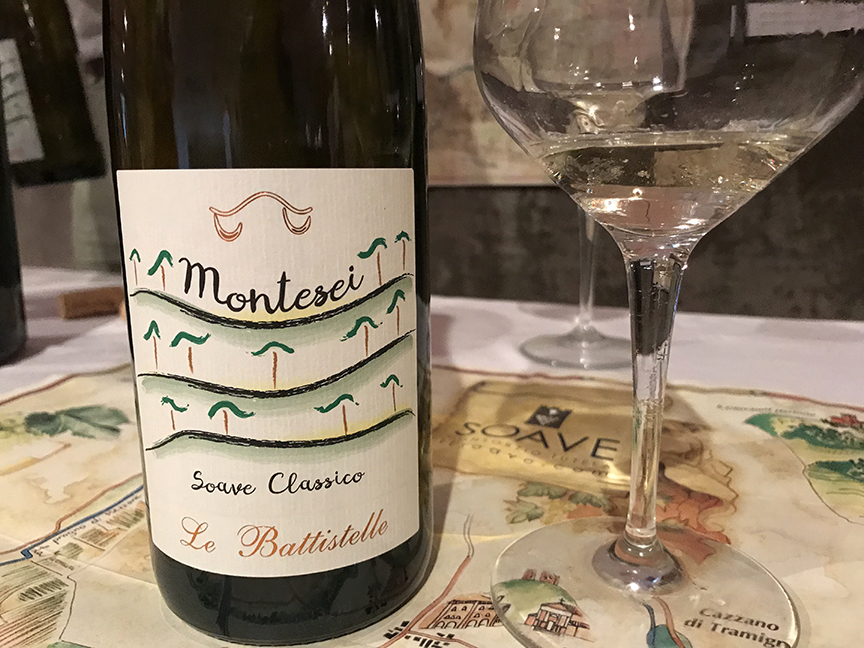
One of my biggest discoveries (however not multiple) was Le Battistelle (above).

What fantastic wines, with vibrant fruit and rich but not overpowering minerality! Organically farmed, family-raised, and with lovely hand-drawn labels, these wines have all the right stuff to appeal to the American market. I believe a few bottles have found their way to California but none of the mid-sized importers of natty and groovy have picked up on these gems. I hope one of them does soon.

When I pointed the wines out to a superbly experienced taster in our group of wine professionals, he noted how these wines taste like “real Soave” and not the many trumped up wines that the appellation seems to favor these days. I really loved every wine I tasted from Le Battistelle — wholesome and delicious.

Another one of my big Soave discoveries on this last trip to Italy was Filippi, an estate that has already generated buzz among the American enocognoscenti but still hasn’t landed with an importer here.

These gorgeous wines are focused, smart, and electric with aroma and flavor. I had the wonderful opportunity to taste with the winemaker at the Arcari + Danesi/SoloUva “Friends in Wine” event in Franciacorta a week ago Saturday (it was also a birthday celebration for my bromance Giovanni Arcari). Like many young growers in Soave, he’s taken over his family’s vineyards and has been making his own wine instead of selling the fruit to the cooperative. Similar to what’s happening in Langa, it’s a trend analogous to the “grower Champagne” movement from the late 1990s. And we’re all going to be the better for it.

I am really smitten when Filippi’s wines, from the entry tier to the flagship single vineyard bottling. I know it’s just a matter of time before they get snatched up by an American importer. I just hope it’s the right one. Great wines and great folks.

Oh and about that wild party in Franciacorta?

Here’s what results from a little “day drinking” (as we call it in Texas):