Breaking news: the organizers of the Chianti tasting (held yesterday in Houston) told me that Slow Wine has confirmed the dates of its January-February 2022 U.S. tour. (I’ll see you in Austin on January 27.)
A great read: please check out wine educator Mike Madaio’s superb post on the history and legacy of the wines of Chiantigiana, “Chianti: Why Are There Two DOCG Regions?”
Today’s post expands on my “Debunking Chianti myths, speaking Chianti truths” post, published yesterday.
 Above: Baron Bettino Ricasoli (center, on horseback) receives Victor Emmanuel II at Brolio Castle in Gaiole in Chianti (oil on canvas displayed in the Ricasoli museum at Brolio Castle; photo taken in January 2020).
My thesis that Baron Bettino Ricasoli didn’t intend his research on Sangiovese to be interpreted as a “recipe for Chianti” was (understandably) met with skepticism at the Chianti consortium tasting yesterday in Houston.
Luca Alves, the consortium’s longtime ambassador, gave an excellent talk on Chianti, its legacy, and its modern day hierarchies and designations. And he led a fantastic tasting of eight wines that showed Chianti’s wonderful diversity and depth.
But he didn’t buy my argument (in our pre-game, private chat). And it was no surprise: the myth and mythology that Ricasoli wrote a “recipe” or “formula” for Chianti is deeply engrained in the Chianti legend.
Many years ago, long before the texts in question had been republished (in 2019), I sought them out and with the help of the current generation baron, Francesco Ricasoli and his father Bettino, I was able to find them (see my translation of the most famous letter below).
Reflecting on the hypertext that the letters have spawned, I was reminded of what one of my undergrad professors at UCLA used to say: when you underline one line on a page, you might as well delete all the others.
In other words, if you don’t read the salient passage in context, you’re not getting the bigger picture. You’re only seeing the tree but not the forest.
The extensive epistolary correspondence between Ricasoli and professor Cesare Studiati at Pisa (1859-1876) documents in great detail a broad and variegated set of experiments that Ricasoli performed at Brolio Castle.
The primary focus and objective of his work was to create high-quality wines that could be shipped beyond Tuscany’s borders. As Luca rightly noted yesterday, Ricasoli would actually ship the bottles to different destinations and then have them shipped back to see how well they had fared.
(It’s important to keep in mind that in the era before our deeper understanding of yeast, bacteria, and the use of sulfur to stabilize wine, it was immensely challenging to ship wine. There is ample evidence of this in descriptions of wine stretching back to the Middle Ages. Today, we see a manifestation of this issue with unsulfured wines that are prone to spoil after shipping.)
The often cited letter (below) is without question a watershed moment for Chianti and Italian wine in general. But historically, its readers have focused solely on the last paragraph.
In my view, Ricasoli’s greatest achievement — and his greatest impact on Italian viticulture — was that he grubbed up the international grape varieties planted on his property and replanted his vast farm with indigenous grape varieties. Elsewhere he writes about his conclusion that Sangiovese marries best with Tuscan soil.
(Keep in mind that at the time, Gamay was the most widely planted variety in Tuscany. I know this will come as a surprise to many but over the course of my research, I’ve found more than one early 20th-century ampelographic survey that reports this. It makes perfect sense: growers at the time were concerned with quantity as opposed to quality. Similarly, sturdy hyper-productive Gamay was widely planted in Burgundy at the time.)
If there were a conative function to Ricasoli’s writings, it wasn’t that wines from Chianti should be blended as per his experiments. Rather, it was that growers should plant Sangiovese in the place of international and other grape varieties.
Would Clemente Biondi Santi have begun experimenting with Sangiovese had he not read Ricasoli’s studies? Remember that first Brunellos were produced toward the end of the 19th century, after Ricasoli had died.
The concept of the Chianti “recipe,” although inspired by Ricasoli only came into focus (as a cultural touchstone) long after Ricasoli’s passing (most likely during Fascism).
To my point, the so-called recipe is a deconstruction (in the critical sense) of the original. It’s what Jacques Derrida and Roland Barthes might have called a hypertext, in other words, a text generated by the readers of the original text — a reading no longer shaped solely by the original text.
Put in simpler terms, Ricasoli didn’t intend his observations to be interpreted as a “recipe,” per se. It was subsequent readers of his text who interpreted it as such.
As professor Cole would have said, the recipe shouldn’t eclipse the greater meaning and legacy of Ricasoli’s work. Distilling it into a few lines diminishes its influence on Italian viticulture — yesterday, today, and tomorrow.
*****
Bettino Ricasoli “the Iron Baron” to Cesare Studiati
September 26, 1872
As early as 1840, I began experimenting with every grape variety. I cultivated each one in significant quantities on my Brolio estate. Our goal was to test the quality and taste of the wines produced from each grape.
Following this comparative study, I restricted the number of grapes at Brolio and began growing Sangioveto, Canaiolo, and Malvasia almost exclusively. In 1867, I decided once again to make wine using these three grapes. I made a relatively large vat of each one and then I blended the three in another vat using exact proportions.
In March of last year, the experiment was finished and I was satisfied with the results. The wines were subsequently shipped.
Later I verified the results of the early experiments: the Sangioveto gave the wine its primary aroma (something I aim for in particular) and a certain vigor in taste; the Canaiolo gave it a sweetness that balanced the harshness of the former but did not take away from the aroma, even though it has an aroma of its own; the Malvasia, a grape that can be excluded for wines intended for aging, tends to dilute the resulting wine created by the former two, it increases the flavor but also makes the wine lighter and thus more suitable for daily consumption.

 There is no Italian wine more closely tied to the country’s culture and history than the wine we know today as Chianti.
  Myth: Tuscan ampelographer Giovan Vettorio Soderini was the first to sing the praises of Sangiovese in his 1590 treatise on grape farming in Europe.
  Fun fact: did you know that Machiavelli was a grower and producer of Chianti? After his exile from Florence, he retired to his farm in San Casciano where he produced and traded wine among other agricultural products.
  Many of us in the U.S. wine industry had hoped that January would see the return of Italian winemakers to the U.S.
  To the uninitiated, the cultural resonance of a street or road name may not be immediately apparent. But to many people who live, work, and socialize on those streets, those designations often carry meaning and memory that stretch back to a time before they were born.
  In 2017, he and his fellow Sons of Confederate Veterans (a neo-Confederate group of re-enactors and cosplay enthusiasts), completed construction of the monument. That’s when Tracie and I began protesting and working to raise an MLK billboard that overlooks the site.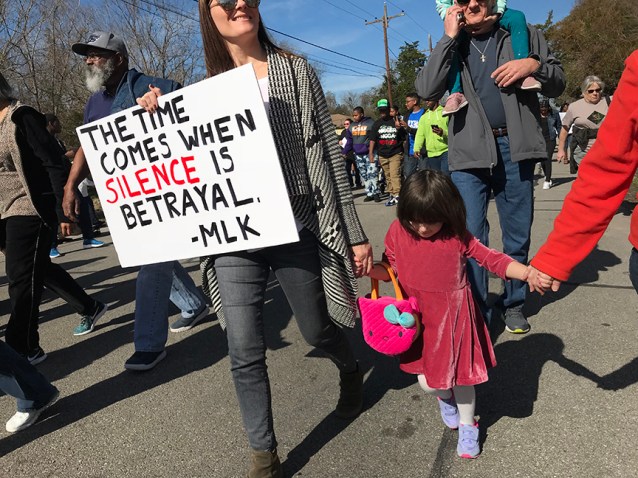
 Pinot Noir is grown across northern Italy and in a few notable spots in Tuscany.
 Please consider giving to
  There are certain nights when work doesn’t feel like, well… “work.”
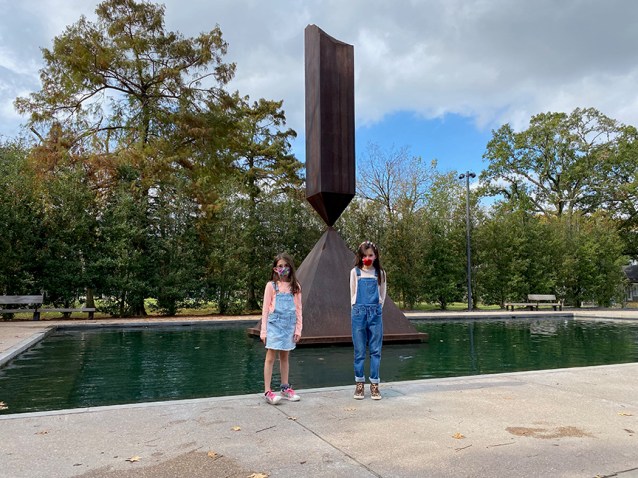 In 1969, the Houston-based art collectors and civil rights activists
 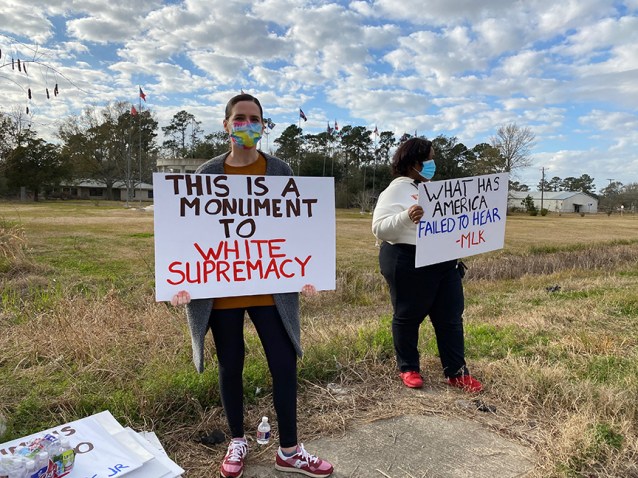 Given the history of racist violence in southeast Texas, where Tracie was born and where we have lived for the last nine years, it was devastating to learn that White Supremacists planned to build a neo-Confederate memorial along Interstate 10 in Orange, Texas where Tracie grew up and where we spend a lot of time with our children.
 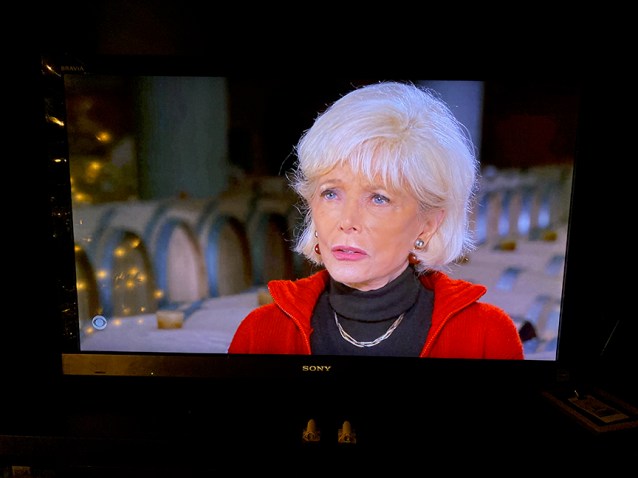 It was impressive to watch last night as 60 Minutes journalist Lesley Stahl dived into one of wine’s thorniest issues: the impact of climate change on grape growing.
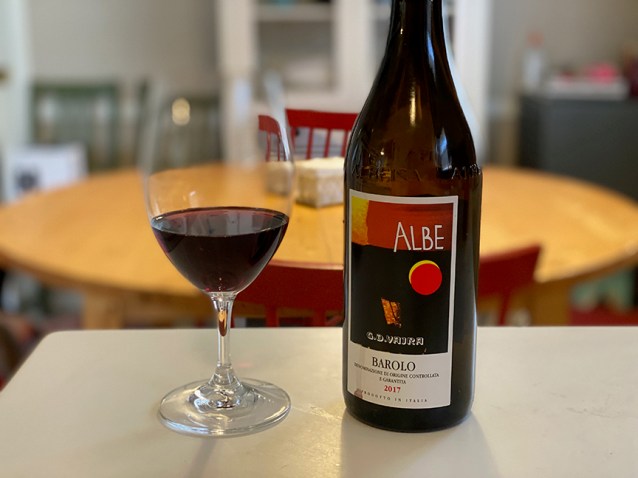
 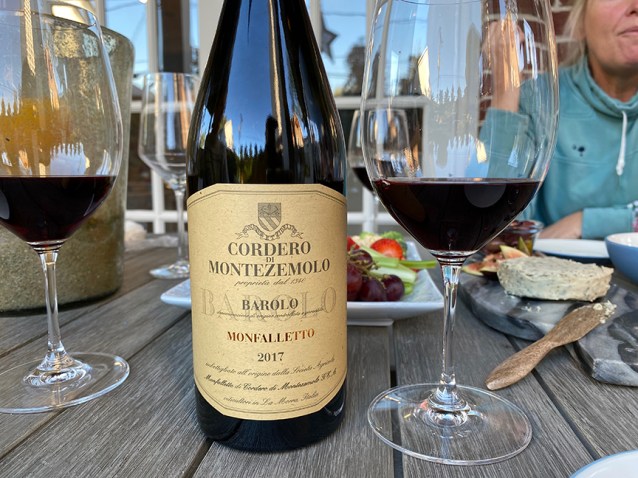 As it so happens, we opened Alberto’s 2017 Barolo Monfalletto during our (ongoing) Christmas break. Besides the 1998 Giacosa white label Barolo Rocche Falletto that a friend brought to our holiday party this year, the Monfalletto was one of the best wines we tasted this year. It was surprisingly approachable, with great freshness and drinkability, elegant and nuanced with wonderful balance between the acidity, alcohol, and tannin. We — Tracie, me, and another couple — loved it.
 For Christmas Eve, Tracie and I opened a bottle of the 2017 Produttori del Barbaresco, a classic “blended” Barbaresco, sourced from multiple vineyards in the historic cooperative’s family of parcels.
  Merry Christmas and happy new year from the Parzen family!
 Both girls are doing well, getting good grades at school and playing piano (both) and violin (Georgia) and cello (Lila Jane). Both girls are also in their school’s choir program.
 They both made the cut for the “performers” orchestra at their school this year.
 One holiday season highlight was their performance at the mayor’s tree lighting festival. It was their first taste of playing on a big stage, with lights and cameras etc. And the entire event was produced as a holiday show by the local ABC affiliate. It was amazing to watch the girls watch themselves on TV! They loved it! As did their parents.
 The biggest news of our year was that Tracie went back to work full time for the first time since Georgia was born in 2011. In early 2021, she obtained her realtor license and by April she had already landed at an old line Houston firm.
 My work picked up again early this year and it’s actually turning out to be a good year for me work-wise.
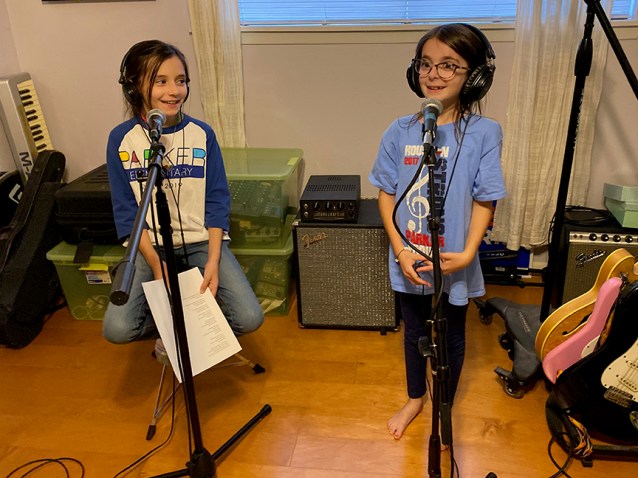 As we’ve spent more time at home over the past 12 months, the girls have become more interested in the recording arts. And they sing on a couple of tracks on our new album, “Falling in Love Again.”
 Do Bianchi