
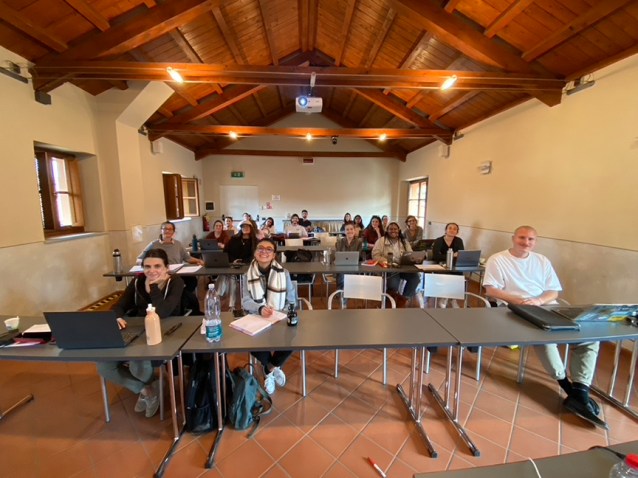
 Above: my graduate student class at the Slow Food University of Gastronomic Sciences in Piedmont, Italy, on the last day of our seminars earlier this month.
Last week, Slow Food U grad students attended my last four lectures/seminars for this academic year.
Like nearly every year the university has invited me to teach there (the first year was 2016), our class did a wine tasting where the students are asked to write a classic tasting note, including a 100-point scale score.
After a discussion of the invention and widescale diffusion of the now ubiquitous score and tasting note in the 1980s and 1990s, we turn each year to Eric Asimov’s wonderful book How to Love Wine where we read his chapter on the “Tyranny of the Tasting Note.”
In that essay, he writes: “At best, tasting notes are a waste of time. At worst, they are pernicious.”
He then goes on to compare tasting notes and accompanying scores for the same wine from three different wine writers, each writing for a high-profile masthead.
As you can imagine, each writer delivers wildly different tasting descriptors and widely divergent scores.
This year, as in years past, our class tasted a wine and was asked to write a tasting note and score the wine.
The results — it’s only natural — ranged broadly, as predicted.
But this year for the first time, I asked my students to write a second note for the wine.
For the first one, they were tasked with writing a classic note, à la Wine Advocate or Wine Spectator.
But for the second, I asked them to write about how the wine makes them feel. In other words, I asked them to describe not the wine but the emotion that the wine evoked in them.
The outcome was remarkable. Where their classic tasting notes were predictably divergent (even to the point that their descriptors were incongruous with one another), their “emotional” notes were nearly identical across the board.
Of those who offered to read them aloud (they were not required to share), the same theme emerged again and again: this wine makes me feel like calling up my friend and organizing a meal (the wine was a wonderful Barbera from Monferrato btw). A number of them even used the same word when they said it made them feel like they would like to “organize a picnic.”
One of the things that have always struck me about tasting wine in a social setting, whether in a large group like my class or one-on-one with a person you care about, is how when two or more tasters arrive at the quasi-identical sensation in a wine, it immediately becomes an “ah ha” moment where the lonely coil of human experience seems to be cast off by sharing a sort of sensory intimacy.
It’s like when my wife Tracie and I taste a wine and we both land on the same impression: Wouldn’t this be perfect for your King Ranch Chicken recipe? Yes, for sure! Let’s have that on Saturday night!
In 2019, Eric wrote published one of his most powerful pieces (imho) for the Times, “It’s Time to Rethink Wine Criticism.”
“It’s time to re-examine the nature of American wine criticism today… And it’s time to consider a better model that might be more useful to consumers, a system that would empower them to make their own choices rather than tether them endlessly to critics’ bottle-by-bottle reviews.”
I don’t have a solution for the wine trade’s ongoing criticism conundrum.
But our experiment last week brought to mind something that wine writer (and novelist) Jay McInerney once said to me over a bottle of wine we were sharing.
Tastings notes vexed him when writing for the Wall Street Journal, he shared. He would much rather write a poem for each wine he was asked to review. Writing poetry may be easier for Jay than most.
But while I don’t have an answer to the thorny question of a post-tasting note/score world, I do think that it lies on the horizon: what if we stop asking what a wine tastes like (an exercise that requires us to use a literally figure known as synaesthesia) and instead we ask ourselves what a wine makes a feel.
Especially in the light of the joy that my students felt when discovering that their “feelings” aligned, I believe this could be the path to a more useful critical theory of wine.
As unconventional and unscientific as it sounds, emotion — not technical information — is what really brings us all together around a glass or a bottle of wine. There’s no disputing that.
Otherwise, we wouldn’t still be here, ceaselessly poring over (and pouring over and over again) a wine that we like or dislike. Poetic chops not required. Just self-awareness and honesty.
Thanks again to my students and the admin staff at Slow Food U for a great experience and stay! Looking forward to next year.
 Just over the course of the last month, I’ve had the great fortune to interact with a half dozen wine professionals with whom I worked (and/or drank) during the late 1990s and early aughts in New York City.
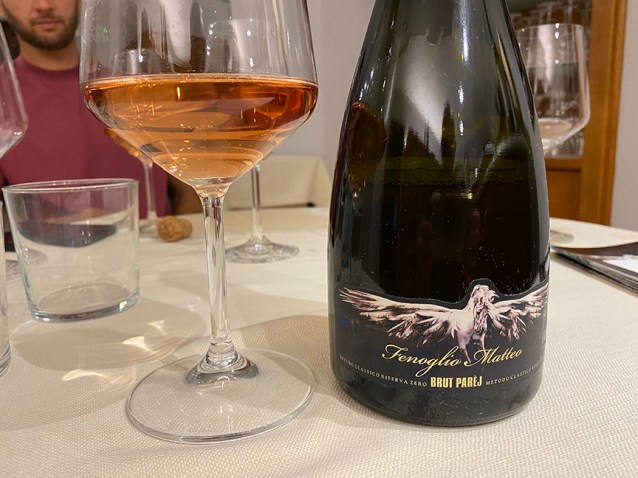 It’s not every day that you get an Instagram message from someone named Fenoglio.
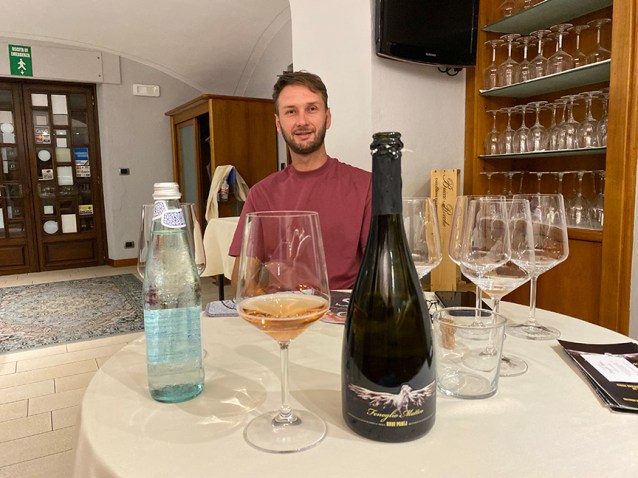
 It’s been a whirlwind.
 Happy birthday Tracie! The girls and I love you! Our doggies love you, too!
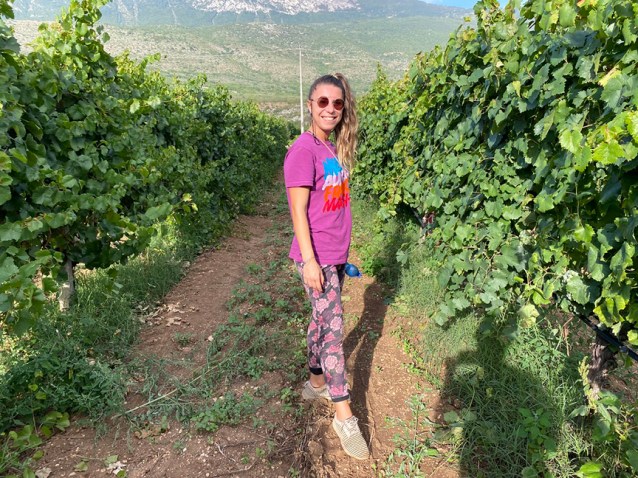 Above: brilliant, energetic, and super cool, Giulia Cataldi Madonna isn’t the winemaker that most people expect to find when they visit Abruzzo, one of Italy’s most undervalued wine regions. The work people like Giulia are doing there might just hold the key to the future of Italian viticulture.
 Above: Pecorino grapes at Cataldi Moadonna in Ofena commune were healthy and ready to pick despite the hot conditions. Ofena growers like Giulia have been dealing with extreme weather for generations. Their strategies offer clues into how Italian winemakers will need to face the challenges of climate change.
 Above: I’m going to get into trouble for saying this but Giulia told me that she agrees with me 100 percent when I say that Cerasuolo d’Abruzzo is not a rosé wine. It’s a red wine. More on that later.
 Next Thursday (10/13) in New York, I’ll be pouring and talking about “a wine for the worst kind of thieves”: Garganega (pictured in photo above, snapped a few weeks ago in Soave).
 It was the fall of 2007, nearly fifteen years ago this week, when I found myself on a park bench at the La Jolla Cove waiting to go to Yom Kippur services with my family at the same synagogue where I was a bar mitzvah some 27 years prior.
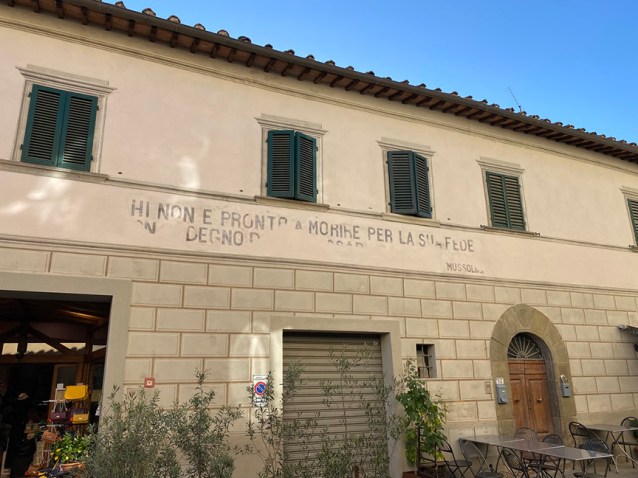 Above: “Chi non è pronto a morire per la sua fede non è degno di professarla — Mussolini” (“those not ready to die for their faith are not worthy of professing it”). No one has ever bothered to erase a Mussolinian aphorism from the main square in Gaiole in Chianti. Photo taken by me earlier this month.
 Shanah tovah (שנה טובה). Happy new year, everyone.

