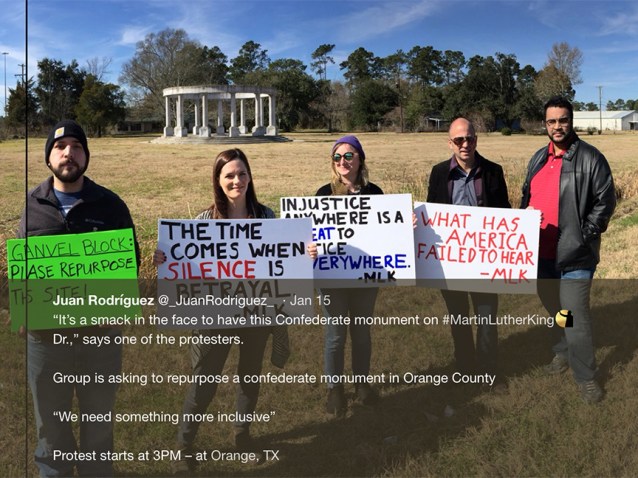
Confederate Memorial Protest TOMORROW: why I am speaking out and rising up

Tomorrow my wife Tracie and I will be protesting the Confederate Memorial of the Wind in Orange, Texas (Martin Luther King Dr. and Interstate 10) from 3 p.m. until sundown. (Please click here for protest details in case you would like join.)

We will be joined by members of Orange County Young Democrats and Southeast Texas Progressives. The last time we gathered at the site (on Martin Luther King, Jr. Day last month), we were also joined by passersby. We hope to have an even larger crowd tomorrow. I’ll have plenty of bottled water and extra signs for anyone who wants to join us.

Earlier this week, a friend of mine in Houston asked me why this particular Confederate monument concerns me so much. There are historic Confederate monuments in Houston, he pointed out. Why don’t I protest those? he asked.
Continue reading

Biondi Santi rebrands in U.S. with luxury importer Wilson Daniels

Top wine buyers from across Texas gathered yesterday in one of Houston’s most exclusive private dining rooms to taste new vintages from the iconic Biondi Santi winery. The estate’s new ambassador, Tancredi Biondi Santi (seated above, mid-table on the right, across from Master Sommelier Jack Mason), led the tasting.

The séance — organized by Biondi Santi’s new U.S. importer Wilson Daniels — would have been otherwise unremarkable if it weren’t for the fact that the wines haven’t been available in the state through legitimate channels for decades.

“The wines have mostly come in [to the U.S.] through the grey market,” said one of the Wilson Daniels sales managers present at the swank luncheon.

He was referring to the questionably legal practice of importing of high-end European wines without using the so-called “three-tier system.” Most fine wine arrives here through an importer who sells it to a distributor who, in turn, sells it to a retailer or restaurateur who ultimately sells it to the end user — hence the “three tiers.” Historically, trade operators have often skirted the system (and its sometime prohibitive costs) by shipping the wines directly to the U.S., sometimes through illegitimate channels (for example, by misleadingly labeling the boxes as products other than wine, one of the world’s most highly regulated commodities).

Since the late 1990s, the sole purveyor of Biondi Santi in the U.S. has been Italian Wine Merchants, a retail operation headquartered in New York and once co-owned by Joe Bastianich and Mario Batali. In 2015, the upscale wine shop and broker was still offering back vintages to clients willing to shell out up to $1,500 per bottle, according to Eric Asimov writing for the New York Times.

Following the 2013 passing of the family’s patriarch Franco Biondi Santi (Tancredi’s grandfather), many Italian wine trade observers speculated that the winery would abandon his unwavering devotion to traditional-style Brunello di Montalcino in favor of a more modern approach.

As Eric wrote in his 2015 piece, Biondi Santi is considered “perhaps the greatest of all Brunello producers, but one whose style was roundly assailed in the 1990s and the first decade of this century.”

All eyes were on Franco’s son (and Tancredi’s father) Jacopo. In the eyes of some pundits, he had already shifted the winery’s stylistic direction, even before his father’s death.

Yesterday, the young Tancredi told buyers that all the wines are aged in the traditional large Slavonian oak casks that his grandfather, and great-grandfather Tancredi (his namesake), used to raise them.

“Barriques are not allowed,” he said referring to the small French oak casks that many Brunello producers use today in order to appeal to American and northern European sensibilities.

In my view, it’s really exciting news that the wines will finally be available outside of New York. And it will also be interesting to follow the winery’s evolution under Jacopo and Tancredi. The younger Biondi Santi also talked openly about his desire to become the farm’s winemaker once his father steps down. He’s currently studying enology, he said.

I’ve had the great fortune to taste the wines on numerous occasions in Italy, including a lot of older vintages over the years. That’s not something a lot of American wine professionals can say. The fact of the matter is that few sommeliers in America have had any contact with these wines at all. But my concern today is that Wilson Daniels’ pricing will still keep these iconic wines out of reach for most young wine professionals. The 2011 reserve we tasted yesterday will cost more than $1,000 on a typical high-end wine list in the U.S.

Are the wines worth the high price tag? Most of us will never know.

Slow Wine and Taste of Italy in Houston March 5: register now to ensure availability

Texas food and wine lovers and restaurant and wine professionals: please register now for the Taste of Italy/Slow Wine Grand Tasting and seminars to be held on Monday, March 5, 2018 at the Hilton Post Oak (presented by the Italy-America Chamber of Commerce Texas, where I serve as a media consultant).

REGISTRATION LINKS FOLLOW BELOW.

Slow Wine (where I work as an editor for the guide) will be coming to Houston for the first time: at our morning seminar, I will be leading a tasting of 8 Piedmont wines selected from the guide’s prizes.

Next, BBQ writer Chris Reid, Italian wine legend Brian Larky, and I will be leading a tasting of Lambrusco paired with Texas BBQ. Top local smokers will be providing the food.

Finally in the afternoon, I’ll be leading a seminar on traditional balsamic vinegar with pairings by Chef Danny Trace from Osso & Kristalla and Potente.

And of course, the all-day Grand Tasting will feature both Slow Wine and Taste of Italy wineries and wines.

It’s a BIG BIG SHOW and the seminars are already almost sold out. Please register to make sure there’s a spot for you. And if you want a media pass and/or if you want to volunteer (which gives you access to the whole lasagna), please shoot me an email.

Hope to see you there! Thanks for your support and interest!

*****

GRAND TASTING
11 A.M. – 5 P.M. (Monday, March 5, 2018 at Hilton Post Oak)
OPEN TO TRADE, MEDIA, AND CONSUMERS.

CLICK HERE TO REGISTER FOR THE GRAND TASTING.

The event will feature more than 200 Italian food products and wines.
Continue reading

Happy anniversary Tracie my love, look at what we’ve done…

Happy anniversary, Tracie, my love!

Our anniversary date was actually Wednesday, January 31. But we are celebrating and treating ourselves tonight, Friday, with a babysitter and Japanese dinner, one of our favorites.

It was eight years ago, this week, that you and I were married. You’ve given me, through your love and partnership, the best years of my life — the richest and the most wonderful of my 50 years. As your husband, partner, and father to our daughters, I have experienced a depth of emotion and fulfillment that I never could have without your faith, solidarity, and affection.

I love you and know that I am blessed to have found you — through wine blogging, no less! With barely any money in my pocket and a rickety old used Volvo filled with some clothes and a couple of guitars, I set out from Los Angeles nearly 10 years ago and drove across the country to start a life with you. It was the smartest thing I ever did.

As I put together your anniversary YouTubication together this week, I remembered the videos and songs we would send each other when were first writing to each other in 2008. By the time I got to Texas at the end of the year, our hearts and minds were filled with hopes and dreams of what we could build together.

Eight years since we were married, look what we have done! Our daughters are happy and healthy, they are loved and they know that they are loved. We are building a financial future together, day by day. And along the way, we are teaching our children the importance of community and learning, compassion and awareness of the world around us.

But the thing that I am most thankful for is our ability to face even the greatest challenge together. Man, what a year 2017 was! We literally feared for our lives as water lapped up against our home in Houston. And we spoke out, loudly and with conviction, against the rising tolerance of intolerance. Over the last 12 months, we reached deep down into the bottom of our souls and found the strength and courage to face the unimaginable.

I never would have become the man I am without you, picci wicci. I never would have known the joy we have shared without your faith and love.

I love you. Happy anniversary.

Texas BBQ and Lambrusco: the ultimate wine pairing (WARNING CONTAINS BRISKET AND BALSAMIC PORN)

From the department of “nice work if you can get it”…

Above: the sacred and profane, a slice of juicy Texas smoked brisket topped with 12-year aged Traditional Balsamic Vinegar from Reggio Emilia (I’ll leave it up to the reader to decide which is the profane and which the sacred).
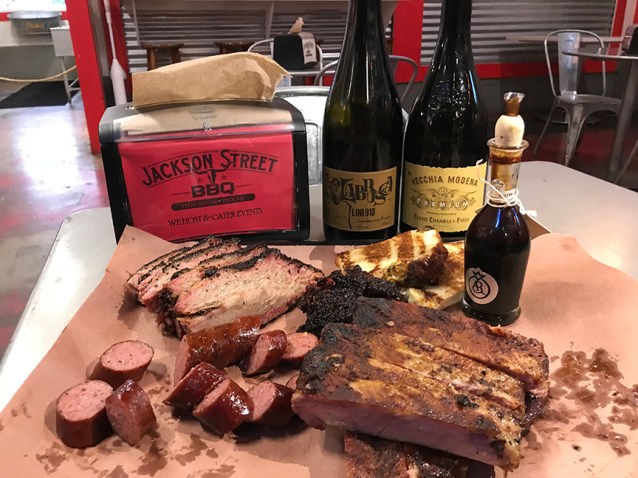
Yesterday afternoon, I connected with Houston Chronicle bbq columnist J.C. “Chris” Reid and Houston restaurant legend Bill Floyd at Bill’s Jackson St. BBQ in downtown for some Lambrusco and smoked meats pairing research.

I’ve always been a big believer that Lambrusco is not only the best wine to pair with Texas bbq but that it should also be adopted as the state’s official wine.

Refreshing, served cold, low in alcohol, with more tannic character than people realize, sweet with residual sugar even when people call it “dry,” Lambrusco mirrors in more way than one the sweet tea that is traditionally served with smoked meats in Texas.

Yes, beer is also a traditional pairing for bbq. But most beer doesn’t have the sweetness that can work so well with the smoky and often spicy character of the food.

When my wife Tracie and I first attended church “feeds” hosted by my father-in-law’s congregation in Orange, Texas on the Louisiana border, I tasted sweet tea with homemade bbq (no one in Orange goes “out” for bbq, btw). And that’s when I started to look to Lambrusco as the ideal match.

Above: on Monday, March 5 in Houston, J.C. “Chris” Reid and I will be leading a seminar on bbq and Lambrusco pairing at the Italy-America Chamber of Commerce Taste of Italy festival. Stay tuned for details on that.
The evolution of Texas bbq over the last 10 years is nothing short of incredible. When I first moved to Texas in 2008, the bbq revolution was just beginning to take shape. Today, you can find Texas bbq across the U.S. and even in Europe. And it’s not Kansas City, Carolina, or Memphis. It’s Texas bbq — religiously smoked, “low and slow” — that has proved to have such appeal across the world.

With its new international standing and profile, it’s only natural that we should start to look for the right wine to pair with this indigenous and truly unique gastronomic tradition.

On Monday, March 5 in Houston, Chris and I will be leading a seminar on bbq and Lambrusco pairing at the Italy-America Chamber of Commerce Taste of Italy festival. Jackson St. will be one of the smokers providing the food pairings together with another couple of Houston standbys.

And Texas brisket and traditional balsamic vinegar you ask? I’ll also be moderating a panel that day on classic and creative applications of the sticky icky and utterly delicious stuff.

It’s nice work if you can get it, ain’t it? Stay tuned for details and hope to see you March 5 in Houston at Taste of Italy!

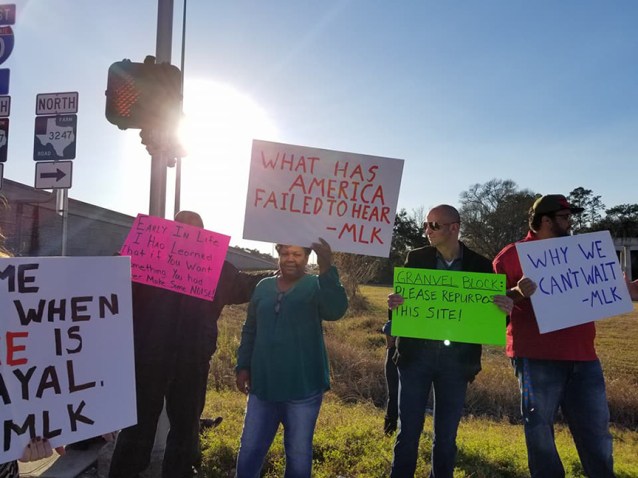
Confederate Memorial Protest Sat. Feb. 10 in Orange, Texas: please join us, please share…

Join us in PROTEST of the Confederate Memorial in Orange, Texas:

SATURDAY, FEBRUARY 10
location: Confederate Memorial of the Wind (Google map)
time: 3 p.m. until sundown

CLICK HERE TO JOIN THE REPURPOSE EMAIL NEWSLETTER to receive event details and updates.

Please visit the Repurpose blog.

Please like the Repurpose Facebook page.

ABOUT THE REPURPOSE MOVEMENT:

The Repurpose movement and blog were founded in December 2017: through protests and lobby efforts, we advocate for the repurposing of the Confederate Memorial in Orange, Texas.
Continue reading

The best Etna I’ve ever tasted and azolla, a fern to save the world…

Unless you’ve been living under a volcanic rock, you already know that wines from Sicily’s Mt. Etna have reshaped the Italian viticultural landscape. Nerello Mascalese, the active volcano’s favorite grape variety, has become so popular and so alluring in terms of its potential greatness that some of Italy’s most celebrated winemakers and wine trade players have set up shop there. The country’s most famous natural wine is made on Etna using Nerello. Some of its most coveted red wines are now made there using the same. And some of the top producers there are already hoping to capture a segment of the lucrative classic method market with sparkling wines made from Nerello.

As much as I’ve enjoyed Etna rosso — from the funky to the classic — it’s always been the white wines that have thrilled me the most. That’s partly owed to the fact that my wife and I drink mostly white wine at home. But it’s also thanks to the confluence of freshness and depth that white grape Carricante can achieve when handled by the right practitioners.

The variety’s greatness was on glorious display last week when I tasted Federico Curtaz’ Etna Bianco called “Gamma.” When I looked at the label, I thought to myself, “wow, that takes some real gumption to call a wine ‘Gamma,'” as in the “gamma factor” or “Lorentz Factor”: “the factor by which time, length, and relativistic mass change for an object while that object is moving” according to the Wiki.

But as soon as this wine came into contact with my tongue, I became a believer.

The fruit in the wine was like liquid electricity! Balanced citrus and elegant tropical fruit danced with elegant power in the blessed glass that had been fortunate enough to be filled with this wine.

It’s not a cheap date but it’s worth every last penny. What a wine!

Thank you to Anthony Baladamenti of Palermo Imports for turning me on to this.

Another memorable wine I tasted last week was the Beckham Sophia’s Pinot Noir from Oregon. Electric came to mind again when it came to the vibrant red fruit in this wine. Utterly delicious, with beautiful balance and classic style.
I was also intrigued to learn, thanks to the gent who tasted me on this wine, about the another organic winemaker’s use of azolla as a cover crop. The famed fern is probably what saved our planet from warming in prehistory. And today, it’s used across the farming sector for nitrogen fixation, the replenishment of nitrogen in soil, in this case by organic means.

Some today believe that azolla could be used to save the planet. And it’s been fascinating to read up on and learn more about the Azolla Event in the time before time.

In today’s troubled times, we could all use a more azolla in our diets.

Thanks to James Endicott of Vinocity Selections for turning me on to this excellent wine and hipping me to the azolla movement.

“Boycott Zonin wines” movement emboldened as details of financial misdeeds emerge

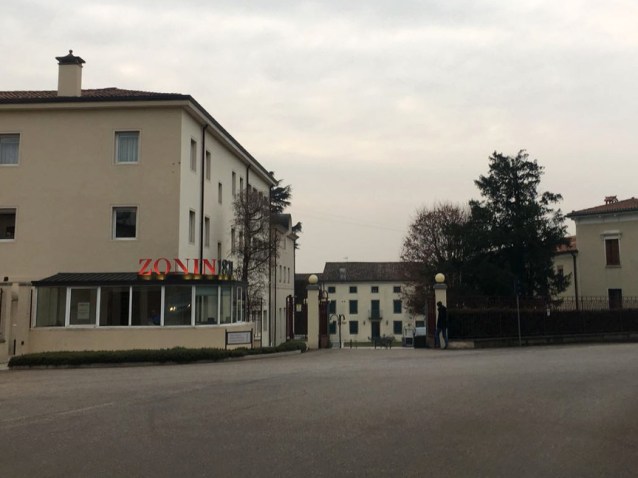
Above: the Zonin winery in Vicenza province, Italy. The Zonin winery group owns estates in Veneto, Piedmont, Tuscany, Sicily, and the U.S., among other properties.
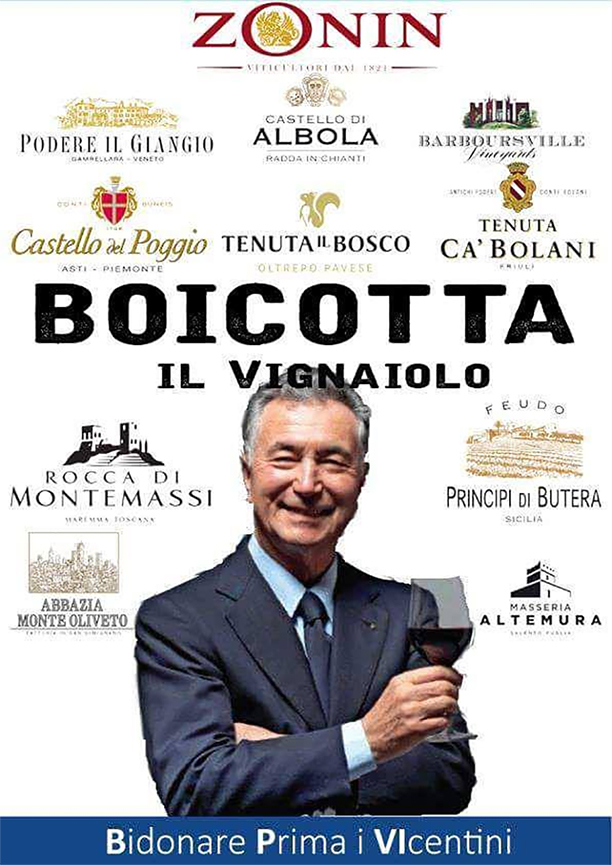
Italian wine mogul and banker Gianni Zonin made headlines in Italy last July when he was spotted shopping with his wife in Milan’s exclusive Via Montenapoleone commercial district. At the time, the 80-year-old ex-president of the failed Banca Popolare di Vicenza was under investigation for stock manipulation and obstruction of regulatory authorities.

When the investigators published their findings the following month, they reported that 118,000 clients lost their savings when the Banca Popolare di Vicenza collapsed.

The European Central Bank “euthanized” the Vicenza bank less than two weeks before the Zonins’ shopping spree (New York Times). Gianni Zonin had been its president from 1996 to 2015. (Read an English-language account of the initial probe by Reuters here.)

Zonin and his family made headlines again this week in the Italian media when it was reported that Italian authorities had seized a mere 346,000 euros from the ex-banker in the wake of the financial scandal.

“A drop in the sea,” was how Giulio Romani, Italian Trade Union Federation (First CISL), described it. “It barely corresponds to 34 percent of Zonin’s more than 1 million euro salary in 2015,” the last year he served as the bank’s president.

In another report published in the Italian media earlier this week, financial investigators reported that in order to protect his fortune, the winemaker transferred ownership of “‘nearly all of his property’ to one of his sons and his wife in two transactions on January 15 and May 13, 2016.”

According to Italian Magistrate Roberto Venditti, the judge who ordered the seizure, “the accused [Zonin] gave the majority of his financial assets to family members over the course of two years.”

The news of the seizure and Zonin’s financial dealings in the wake of the bank’s collapse have emboldened members of the Facebook page Noi che credevamo Nella Banca Popolare di Vicenza (We who believed in the Banca Popolare di Vicenza).

Above: “Boycott the grape grower,” a flier featuring winemaker and ex-banker Gianni Zonin, posted on the Noi che credevamo Nella Banca Popolare di Vicenza Facebook page. The caption at the bottom is a play on the bank’s acronym, BPVI. Translated it reads, “swindle Vicenza residents first.”

The Zonin winery group owns estates in Veneto, Piedmont, Tuscany, Sicily, and the U.S., among other properties. The family’s wines are widely available in North America, including its popular Prosecco, which retails for roughly $13 according to WineSearcher.com. With offices in Charlottesville (VA) and Miami, the family’s Zonin USA is one of the largest wine importers in the country.

See these Reuters profiles of bank clients whose savings were wiped out when the Banca Popolare di Vicenza collapsed on Zonin’s watch.

Want to go to Vinitaly? The Italy-America Chamber of Commerce has 10 sponsored trips available

A public service announcement…

If you work in the Italian wine business — whether as importer, distributor, restaurateur, or retailer — you already know that the industry’s annual trade fair in Verona, Vinitaly, represents one of the greatest opportunities to taste new releases and to interact with Italian winemakers and wine professionals from both sides of the Atlantic.

I’m pleased to share the news that the Italy-America Chamber of Commerce currently has 10 sponsored trips available for qualified wine and restaurant professionals.

The program is being administered by the Texas office of the chamber (where I serve as a consultant).

Before contacting their office in Houston, please be sure to register for the fair using this link.

(Make sure you select “Italy-America Chamber of Commerce Texas” as your point of contact to ensure that your application gets routed through the Houston office.)

Once registered, please contact the chamber’s deputy director for Texas, Maurizio Gamberucci, by clicking here.

The best news is that this year’s program will be focused on Vivit, the natural-organic-biodynamic pavilion at the fair.

If you’re a qualified buyer or restaurant worker (and servers qualify, btw), this is a great opportunity to get to Verona and the fair this year — for free.

I encourage you to apply and I hope to see you in Verona in April!

Bruno Giacosa, unrivaled “Nebbiolo whisperer,” dies at 88

The following excerpt comes from a 2012 lecture (lectio magistralis) delivered by Bruno Giacosa on the occasion of his honoris causa from the Slow Food University of Gastronomic Sciences in Pollenzo, Piedmont (translation mine).

    I was born in 1929 and one of my earliest memories is smelling the wine made by grandfather Carlo. That was also the year that my grandfather died and my father Mario took over his business. My grandfather Carlo had begun making and bottling wine at the end of the 1800s…
    He made classic Piedmontese wines, the same ones we know today: Mostly Dolcetto, then Barolo, Barbaresco, Nebbiolo, Barbera, Freisa, and Brachetto. Asti Spumante was the only white.
    Obviously, 1929 was also the year of the [stock market] crash. My father decided to stop bottling wine that year. Instead, he would buy grapes, which he would re-sell or vinify and sell as bulk wine. Back then, only a few wineries bottled wine under their own label. Most of them didn’t own there own vineyards. They would buy grapes from the so-called mediatori, brokers who served as intermediaries between grape growers and the businesses that made wine.
    I started working with my father when I was 16 years old, not long after World War II had come to an end. I would travel around the Langhe Hills with him, watching how he would buy and re-sell grapes; how he would distinguish the good fruit from the less favorable fruit; how he would remember which vineyards delivered the best results.
    At the time, there was also a grape market in Alba. My memory of the market isn’t a pretty one — a memory I share with the many farmers who would sell their grapes there. The brokers would wait until the very last moment to buy, forcing the grape growers to sell at whatever price the brokers wanted and sending them home with empty crates. It was a bit of a sad affair, especially when there wasn’t a great demand for grapes from the bottlers.
    We preferred instead to go directly to the farms, in part because we could choose which grapes to buy directly at the source. After we would buy our grapes, I would also help the growers make a little bit of wine. They would either sell it as bulk wine or they would sell to the very same bottlers who bought their fruit. You could make a little extra money by making your own wine. But it had to be really good. Otherwise, you might not be able to sell it…
    I was just a boy then. And so I didn’t drink wine. But I quickly developed a good nose. I figured out that you had to pay attention to the aromas that would emerge from the grapes when you bit into them during the harvest. Then you would taste the must during fermentation. And then you would taste the wine. This was all you needed to know. I learned to use my nose as a means for gauging whether the wine was clean or dirty. And you could also tell whether or not the wine would age well; whether or not it was nuanced enough; whether or not it would ever open up; or whether it was better to blend it with other parcels; whether or not I should keep it for another couple of years in my cellar before bottling it; or whether it was better to sell it right away to someone else.
    Obviously, I have tasted thousands of wines. But I can guarantee you that my nose has rarely been wrong. And this is the thing that I keep repeating to young people: Learn to use your olfactory. Many people today think that your sense of smell isn’t useful. But it’s with your nose that you understand the most important things about a wine.

Read the entire lecture (in Italian) here.

Today, the Slow Wine blog called Giacosa “Nebbiolo whisperer.” And that he was.

There’s not an Italian wine professional among our contemporaries who wouldn’t point to his wines as some of the most compelling she or he has ever tasted.

My wife Tracie and I had the great fortune to taste with Bruno at the winery in 2010 not long after we were married. He was a gentle, soft-spoken man whose work and career shaped a generation of winemakers and grape growers. And with his extraordinary wines, he also shaped a generation of wine lovers. He will surely be remembered as one of the last great champions of traditional-style Nebbiolo and one of the indisputable architects of Langa’s viticultural revolution and prosperity.

Brune sit tibi terra levis.

Thank you for all the incredible wines that you shared with us over the course of your lifetime.

Image via the Slow Wine Guide blog.