
 One of the issues that the greater community of Abruzzo growers has to address is that the wines are too good.
By that, I mean that some of the wines are so coveted that tradesfolk and laypeople tend to focus only on certain producers while eliding the rest.
It reminds me of something a famous U.C.L.A. communications professor said in class one day: when you highlight one line in your readings with a highlighting pen, it’s as if you’re erasing all the rest of the writing as inconsequential.
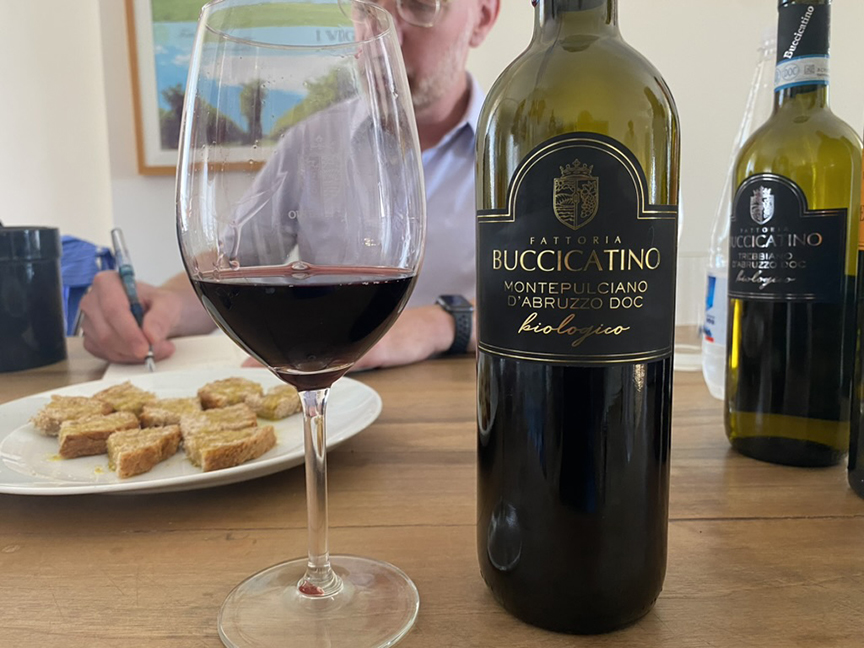
That nugget of wisdom came to mind when our dream team of American wine professionals stopped to taste at Buccicatino in Abruzzo’s Foro river valley, where the soils are rich in clay, the climate is arid, and there is a nearly constant breeze that runs from the sea through the valley.
The story is a familiar one in Abruzzo. In the 1990s, the family decided to stop selling its grapes to the cooperatives and make its own wine. Many years of sacrifice followed as they focused on quality and the often-outsized investment of resources and time that a wine brand requires. Today, more than two decades later, they have firmly established their brand in Italy and northern Europe.
And while the wines were great across the board, the labels that really stood out for me were the Montepulciano d’Abruzzo. These wines had that freshness that I look for in rich-style red wine. The wines’ acidity made them mouth-watering and wonderfully food friendly. I thought they were fantastic.
As we tasted, it occurred to me how well these wines would work in an emerging American market. By that I mean places beyond New York and California (and even Texas now) where, frankly, people are jaded by the mythologies that a lack of healthy marketing has created in Abruzzo.
As Nietzsche once wrote, the philologist’s mission is to look beyond the sacred texts.
For would-be importers of wines from Abruzzo — where arid climate, clay- and limestone-rich soils, and maritime influence create the ideal conditions for organic wine growing — I encourage you to look beyond the marquee names and discover the region’s seemingly unending viticultural treasures.
Buccicatino and the indomitable family behind the wines are worth seeking out.

