
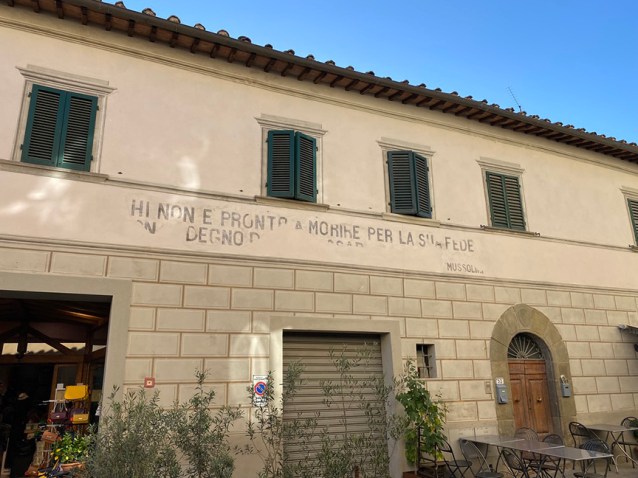
 Above: “Chi non è pronto a morire per la sua fede non è degno di professarla — Mussolini” (“those not ready to die for their faith are not worthy of professing it”). No one has ever bothered to erase a Mussolinian aphorism from the main square in Gaiole in Chianti. Photo taken by me earlier this month.
Italian politician Giorgia Meloni, whose party won the lion’s share of votes in elections on Sunday and who is expected to be elected as prime minister in coming weeks, is widely being called “Italy’s first post-fascist leader” and “Italy’s first hard-right leader.”
The epithet is owed in part to her anti-immigrant, anti-liberal (read anti-woke), and protectionist polices — spiked with a dash of conspiracy theory, Euroscepticism, and anti-globalism (sound familiar?).
The moniker is also owed to a symbol — an avatar if you will — that appears in iconography for her political party, Fratelli d’Italia (Brothers of Italy, a lyric borrowed from Italy’s 1847 national anthem): the Fiamma Tricolore or Tricolor flame that was adopted by the Movimento Sociale Italiano (Itaian Socialist Movement), the post-World War II incarnation of the fascist party. For all intents and purposes, her party is the current-day expression of that political platform, worldview, and aesthetic.
Never before today — almost 100 years to the day that Mussolini marched on Rome and seized power from the monarchy — has MSI fielded a prime minister.
For Italians born during the fascist era, the thought of a seated post-fascist government is practically, well, unthinkable. It’s as if Italy is finally having its Trump moment (many of my Italian university-era friends have called it that): the unthinkable has come to pass.
In the light of Italy’s election on Sunday, I’m not the only one who was reminded of Umberto Eco’s famous 1995 lecture at Columbia University, later published by the New York Review of Books, “Ur-Fascism” (and later translated into Italian as “Fascismo eterno” or “Eternal Fascism”). That essay is where he coined not only the term “Ur-Fascism” but also “fuzzy totalitarianism,” an expression that has taken on new and urgent meaning with Italy’s shift toward the hard right.
Here’s a link to read it in its entirety.
In the first part, he describes what it was like to grow up during fascism in Italy (he was born in 1932). It reads like the opening sequence of a Fellini movie, replete with comedy, redemption, and salvation.
In the second part, he offers “a list of features [14 of them] that are typical of what I would like to call Ur-Fascism, or Eternal Fascism. These features cannot be organized into a system; many of them contradict each other, and are also typical of other kinds of despotism or fanaticism. But it is enough that one of them be present to allow fascism to coagulate around it.”
Those bullet points have been frequently cited in the Trump era. But to read them in context, prefaced by his memories of growing up under fascism, gives the essay renewed meaning and relevance. I highly recommend it to you.
 Do Bianchi
How to Spot a Socialist (aka Fascist): Umberto Eco wrote the essay “Ur-Fascism” (Eternal Fascism) and he also wrote “How to Spot a Fascist.” In his essay, Eco purports to list 14 typical elements of fascism. Eco’s work was smashed by a critic in a book entitled “How to spot a socialist” (or the essay “Ur-Socialism”). It contains a list of 14 common features of Eco and every socialist:
1. He talks and writes a lot about “Fascism.” (e.g. “Ur-Fascism” and “How to Spot a Fascist”).
2. He doesn’t point out similarities between Socialism and Fascism, despite ubiquitous opportunities presented in his descriptions of “Fascism.”
3. In his “Fascism” comments, he never admits nor states that he is a Socialist.
4. He never admits anywhere that he is a Socialist.
5. He just goes on and on about how bad “Fascists” are.
6. When he writes about Mussolini, he seems ignorant that Mussolini was a long-time Socialist leader. Or is he just being intellectually dishonest?
7. He appears to be ignorant in his writings that Fascism was created by a Socialist (Mussolini).
8. He mentions “Nazis” an awful lot.
9. He seems ignorant that “Nazis” didn’t call themselves “Nazis.”
10. He seems ignorant that “Nazis” self-identified as “Socialists.” He mentions Mein Kampf and appears ignorant that “Nazi” is not within it; that “Fascist” is not within it as a self-identifier by Hitler; that “Socialism” and “Socialist” ARE in it throughout as self-identifiers; Eco has nothing to say.
11. He needs his readers to be ignorant about “Nazis” so that they will continue to pay money for his benighted comments on “Fascism.” Eco relies on his echo chamber of ignoramuses.
12. He seems embarrassed that he self-identifies the same as Hitler: SOCIALIST. So, he never says anything about that.
13. His ignorant tunnel vision prevented him from discovering that Hitler used the swastika to represent “S”-letter shapes for “Socialism” (the discovery by the libertarian historian Dr. Rex Curry).
14. Now that he knows about Dr. Curry’s discovery concerning the swastika, he will never mention it (nor any of the above) to his fans anywhere. He will never inform his readers. Ever. He will gladly go to his grave without ever saying anything about it. He prays every day that the widespread ignorance will never end.
Bonus common feature: Eco is hopelessly brainwashed by the absurd Left-Right political spectrum that is taught in government schools (socialist schools). He assumes that everyone else is brainwashed in the same way too. Curb Ur Socialism.