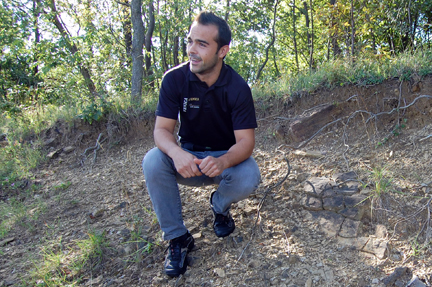
Above: Frank Cornelissen, who produces wine on Mt. Etna, is one of the signatories of the following open letter. On Saturday, Italian journalist and wine industry observer Jacopo Cossater noted on his personal blog that the editors of the Gambero Rosso has managed to do what no one could until now: they have united the often discordant field of Natural winemakers in Italy.
On Friday, the popular Italian-language wine blog Intravino published the following “open letter” undersigned by a confederation of “natural” winemakers in response to a series of negative (and some would say blindly and wildly pompous, misinformed, and misguided) editorials on Natural wine published by the Gambero Rosso in its January issue (click the link for my excerpted translation).
The author of the Intravino post, Jacopo Cossater, notes that the editors of the Gambero Rosso have no intention of publishing the rebuttal.
I have translated the letter in its entirety below.
*****
Open Letter to the Gambero Rosso
February 1, 2013
Dear Sirs,
We write to you in the name of hundreds of wineries — both affiliated with appellation associations and consortiums and indepedent — that produce natural wine. We were dismayed to read the editorial by Eleonora Guerini (“The Natural Obsession”) and the observations by Bettane and Desseauve (“Have We Got Natural Wine For You!”) published in the January issue of your magazine.
To be honest, we have the distinct impression that you are not really up to speed with what has been happening, for years now, in the wine world. Your tout court accusation that “natural” winemakers produce only defective, oxidized, stinky wines is absurd. Your magazine regularly reviews and often rewards wines produced by wineries widely accepted as members of the natural wine orbit.
The technical part of your argument is wholly indefensible. What are the “new, ‘natural,’ and innovative” methods utilized to stabilize natural wines? Extended lees aging (a practice used for centuries, from Mt. Etna to the Loire Valley)? In Bettane and Desseauve’s article, the authors state that with natural vinification, “all of their grape varieties and terroirs end up resembling one another because the nasty native yeasts with which they are made — yeasts that greedily cannibalize the good yeasts if the vinifier allows them to do so — are the same yeasts that you find all over the planet”! From the implicit thesis of this singular affirmation, it would follow that a “selection” of yeasts — or rather, a small part of the entire population of the yeasts themselves — generates a “variety” with greater effects. You’ll have to excuse the irony, but this would mean that we need to eliminate all the black keys from the piano (those which have been “altered”) in order to compose more complex musical pieces…
And let’s not talk about the vineyards, where — as you yourself write — the will to greatly limit or entirely exclude herbicides, pesticides, and fertilizers is a simple act of common sense.
We are the first to acknowledge that there is no wine that is completely and exclusively “natural” and that wine is a product of culture, the fruit of interaction between man and nature. Perhaps the term “artisanal” is better suited to our ideas: wine should be the fruit of choices made by those who work in the vineyards and those who transform the grapes into wine.
But we also believe that it is sensible, even fundamental, to discuss the greater or lesser “naturalness” of a given wine because the law allows winemakers to add a daunting number of substances — dozens and dozens — to wine must. If it were possible to list additives to wine labels (or even the substances that a given producer decides not to use), everyone would have all the tools necessary to effectively evaluate whether or not a wine is natural.
But guess what? This is not allowed. And no one ever mentions it.
And yet, the more substances that are added, the less the wine is spontaneous and digestible. This is what’s happening today: many wine drinkers and lovers — perhaps tired of the “obssession with the best wine there is” and the “obsession with the best vintage of the century” — shift away from the most manipulated wines and move instead toward more spontaneous products that don’t give you a headache, wines easier to digest and more food friendly.
Continue reading →














 Do Bianchi