
happy mother’s day


Earlier this morning, when I filed my Mother’s Day brunch recommendations for the Houston Press, I started thinking about what a special Mother’s Day this is for our family.
Tomorrow, in Orange, Texas, we’ll be celebrating Mother’s Day with four generations: memaw, who is 90 and is a greatgrandmother many times over now; Mrs. B (my mother-in-law and grandmother to four), and Tracie P, above with our nearly five-month old Georgia P.
Tracie is such a wonderful, sweet, gentle mother to our baby and I’d like to honor her today by talking about a “drinking problem”… No, not the one you’re thinking!
No, the drinking problem I’m referring to is how the pressures of consumerist hegemony and bourgeois society drive mothers away from breast-feeding.
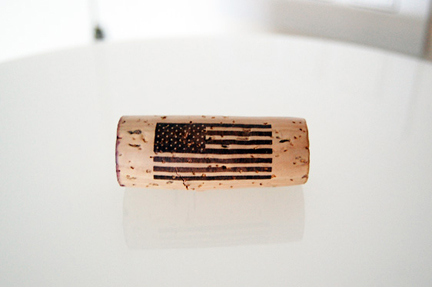
We the Wine Lovers of the United States, in Order to form a more perfect Meal, establish better Wine Pairings, insure enogastronomic Tranquility, provide for the common wine service, promote the quality of fine wine, and secure the Blessings of Vinous Liberty to ourselves and our Posterity, do ordain and establish this Wine Drinker’s Bill of Rights for the United States of America.
Click here to read my work-in-progress wine lover’s Bill of Rights post today for the Houston Press…
Preparations for Mother’s Day at our house got me thinking about one of the most famous Italian-American mothers, Lidia Bastianich. Here are some notes from a recent lunch hosted by her at the Bastianich summer home in Friuli for the Colli Orientali del Friuli blogger project.
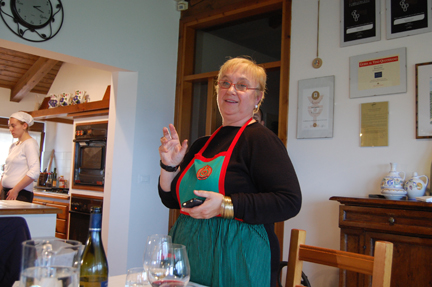
It’s difficult to overestimate the impact that Lidia Bastianich has had on gastronomic culture in the United States and on the renaissance of Italian cuisine throughout the world.
She is to our generation what Julia Child and James Beard were to my mother’s generation (my mother was a James Beard devotee, for the record).
And to her credit, she has never wavered from her devotion to regional Italian cuisine. Long before “peasant” food (what an awful and despicable term!), “rustico” cuisine, or even “Northern vs. Southern” Italian cooking ever appeared in the American gastronomic lexicon, Lidia championed regional culinary traditions from Italy, first in the Croatian neighborhood in Queens where she and her family got their start and then later at Felidia in Manhattan (a restaurant where I used to regularly take my mother during the decade that I lived in New York).
In 1998 — the year that Babbo opened and the year that “regional Italian” became bywords of food culture in America — Lidia launched her first cooking show, “Lidia’s Italian-American Kitchen” on PBS. To this day, Tracie P’s Saturday morning ritual is not complete without watching a DVR’d episode.
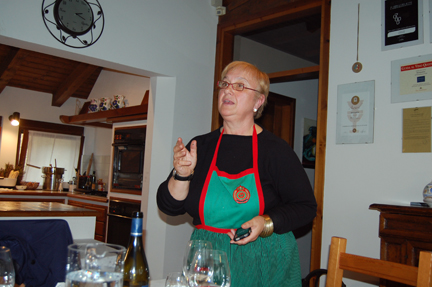
I asked Lidia to share her thoughts about the renaissance of Italian gastronomy and her role in Italy’s culinary conquest of the U.S. palate and hedonist imagination.
Her response, I must say, surprised and inspired me.
“When you look at the great beauty of Italy,” she said. “It’s easy to understand why the Italians are such creative people. From the [historic] Renaissance to this day, Italians have made so many contributions to the arts and culture. It was only natural that Italian cooking would do the same.”
“I don’t know if I’ve been an architect of the Italian culinary renaissance as you put it,” she added graciously. “But when I am surrounded by this beauty and the goodness of the ingredients I find here, I know that I am inspired by them.”
Lidia also told me that she has been asked to be the madrina (i.e., the grand marshal) of the first-ever “Biennial of Cuisine” in Venice. I wasn’t surprised by this news: her celebrity and her contributions to the dissemination of Italian cuisine and culture in the U.S. is not lost on Italians — at least, gauging from my Italian colleagues and counterparts.
“But it’s really Joe [Bastianich, her son] who’s become a celebrity here,” she told me. His appearances on “MasterChef Italia” (the number-one rated show in Italy this year, I was told by a journalist at our luncheon) have made him a megawatt star there.
“Just the other day, we were stopped by school children in Venice who wanted his autograph,” she said.
Whether or not her celebrity is or will be eclipsed by her son’s is irrelevant, really. After all, if it weren’t for Lidia, there would be no Joe, would there?
As a proud new father myself, I couldn’t resist the urge to share a photo of Georgia P with Lidia.
“Don’t take this the wrong way,” she said, “but she’s a prettier version of you.”
Words only a mother could utter.
Di mamme, ce n’è una sola… You only have one mother…
Here’s a link to some photos of what Lidia made us for lunch that day.
From the department of “ampelography and vinography as exegetic tools that help us to achieve a more profound understanding of the human experience and condition”…
Photos by Tracie P.
Every once in a while, you stumble upon a bottle of wine that expands your vinous horizons.
Once such bottle came into our lives the other day after wine seller Marcy Jiminez in Houston recommended it to me: the 2008 Laimburg Alto Adige/Südtirol Kalterersee Auslese Classico Superiore DOC Ölleiten (Kalterersee is German for [Lago di] Caldaro Scelto; “Ölleiten” refers to the fact that the vineyards lie adjacent to olive groves).
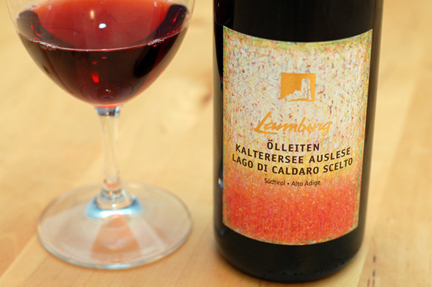
Here’s the link to the winery and link to the wine and fact sheet.
The wine was bright and fresh, with the zinging acidity and balance of technicolor (red berry and black cherry) fruit and earthiness that really turn us on. And even in a market like Texas, where we pay more for European wines than our counterparts in New York and California (thanks to higher alcohol tax, higher storage cost, and the big distributors’s choke-hold monopoly on the Texas legislature), this wine weighed in at only $23.
We love, love, loved it…
Especially after tasting a wine like this, it’s not hard to understand why Schiava was such a popular grape in another era.
As editors Calò et alia write in Vitigni d’Italia (Grape Varieties of Italy, Calderini, Bologna, 2006), Schiava (pronounced SKEE’AH-vah) “was one of the first grape varieties to be cited in the legal documents and treatises of the Middle Ages.” Its popularity was so great that “it represented the viticultural model for Slavic grape growing by antonomasia.”*
The name Schiava comes from the High German Schlaff, an ethnonym denoting “A person belonging by race to a large group of peoples inhabiting eastern Europe and comprising the Russians, Bulgarians, Serbo-Croats, Slovenes, Poles, Czechs, Slovaks, etc.” (Oxford English Dictionary). And it is related to the Italian schiavo (meaning slave, from the Latin sclavus) only in its morphology.
In other words, it was (and is) an ampelonym that, by synecdoche,** represented a cultural epoch in which Slavic culture dominated that part of the world.
When I attended Vinitaly earlier this year, I asked Florian Gojer of the Gojer winery to pronounce Lagrein for the Italian Grape Name & Appellation Pronunciation Project. When I asked him to pronounce Schiava, he insisted on using the German name, noting that in “Alto Adige, we use the German” Vernatsch.
My philological intuition points me to a relationship with Vernaccia but that inquiry will have to wait for another day. In the meantime, here’s Florian…
* antonomasia: “The use of a proper name to express a general idea, as in calling an orator a Cicero, a wise judge a Daniel” (Oxford English Dictionary).
** synecdoche: “A figure by which a more comprehensive term is used for a less comprehensive or vice versâ; as whole for part or part for whole, genus for species or species for genus, etc.” (Oxford English Dictionary).

These days, Parzen family honkytonking starts earlier in the evening day than it used to: yesterday we took Georgia P to two of our favorite spots for Sunday afternoon jams, Guero’s Taco Bar and Ginny’s Little Longhorn Saloon (our all-time fav).
That’s Ginny above in the photo holding little Georgia P. She came out back to meet Georgia for the first time.
“Mommy’s been coming here a looooong time,” said Tracie P, remembering when she first came to Ginny’s in 1999.

That’s Ginny’s daughter Sharon holding her.
The amazing Dale Watson wasn’t performing this last Sunday as usual but his band was there.
“Dale’s in Atlanta,” said Sharon. “He’s the understudy for John Mellencamp in a play in Atlanta.”
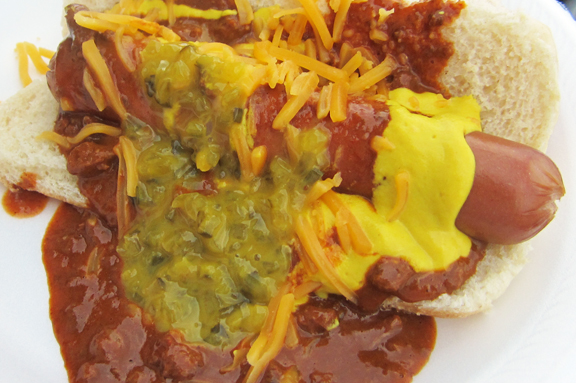
Of course, Daddy P couldn’t resist a Ginny’s dog. “The best dogs in the world,” as Dale would say.
Tracie P and I are so blessed. We’re going through that tough time that all new parents talk about: “sleep training.” It ain’t easy but her smile and laughter eclipse the fatigue and weariness of any sleepless night…
I’m adding a new category to the blog today: de arte copulandi vinorum…
Photos by Tracie P.
1 bulb fennel, washed and trimmed
2 cloves garlic, peeled
extra-virgin olive oil
kosher salt
1 cup white wine
1 cup chicken stock
2 porter house pork chops, about ½ inch thick
Slice the fennel vertically into rounds about ¼ inch thick.
In a wide sauté pan, heat 3 tbsp. olive oil over medium heat. When smoke begins to rise from the pan, add 1 clove garlic. When the garlic has begun to brown, add the fennel rounds, sprinkle with salt, and brown on both sides.
Deglaze with ½ cup white wine. When the alcohol has evaporated, add ½ cup chicken stock and simmer over low heat until the cooking liquids have reduced by half. Transfer the fennel to a mixing bowl, discard the garlic, filter the sauce using a fine strainer, and add the sauce to the bowl. Reserve.
Preheat oven to 200° F.
Gently season the pork chops with salt on both sides.
Add 3 tbsp. olive oil to the same pan used to braise the fennel and brown the remaining garlic clove over high heat. Add the pork chops and brown on both sides (n.b.: it’s important to brown the pork quickly over high heat; they don’t need to cook through).
Once browned on both sides, transfer the pork chops to an oven-ready dish and cover with aluminum foil; transfer to the pre-heated oven.
In the meantime, add the remaining wine to the pan over medium heat. When the alcohol has evaporated, add the remaining stock, the reserved fennel and its sauce, and reduce to desired consistency. Remove the fennel from the pan and reserve and then filter the sauce using a fine strainer (n.b.: in the time that it takes you to reduce the sauce, the pork chops will have cooked through).
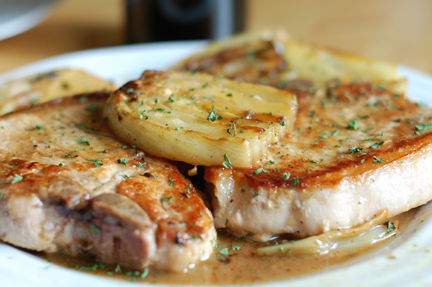
Arrange the pork chops on a serving dish and then top with the braised fennel and sauce.
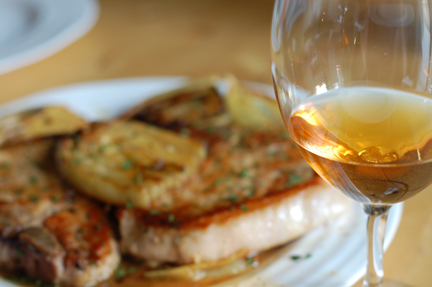
The tannin of the skin-contact, amphora-aged Vitovska was ideal with the fatty, juicy chops and its nutty fruit flavors the perfect complement to the sweetness and tang of the fennel.
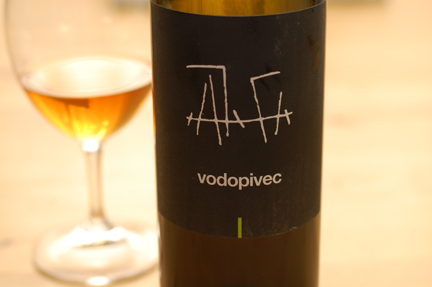
Buon weekend, yall!

Georgia P is growing and becoming more curious about the world around her.
Even in those 4:30 a.m. moments where she decides it’s time to wake up (she sleeps in a bassinet in our bedroom) and make a ruckus, the joy she brings us is endless…
I’m not sure that “Here Comes Mandy” is going to make it on to the next NN+ record, but it was a hit with one Texas toddler…
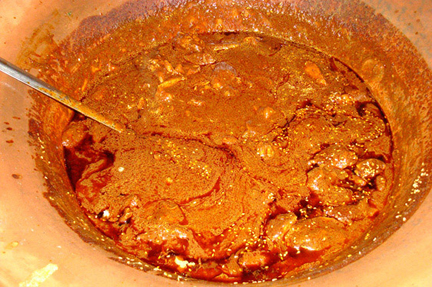
Here’s my post today for the Houston Press on the ars copulandi vinorum and the Holy Mole of Wine Pairings…
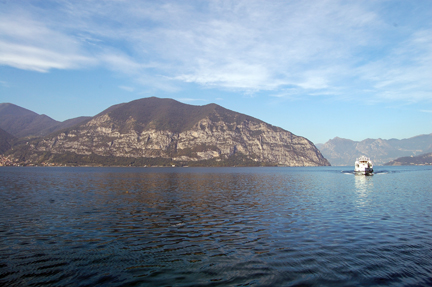
Above: The gorgeous Lago d’Iseo (Lake Iseo) provides maritime influence for the vineyards of Franciacorta. The beauty of Italy’s topography is immeasurable.
“No inflated numbers this time. No triumphalism. And not even any orgasms during a ‘Ring Around the Rosie,'” wrote my good friend, winemaker, and Franciacorta superhero Giovanni Arcari on his blog yesterday. “Nonetheless, it feels like a good moment to celebrate a success, even if that success was generated by a problem.”
Giovanni was referring to newly announced Franciacorta appellation regulations that will lower yields, raise the minimum vineyard age, and help to raise production standards throughout the appellation, where Champagne-method sparkling wines are produced.
By all accounts, Italy produces more sparkling wine than any other country: at latest count, “400 million bottles with Euro 1.7 billion in sales.”
Despite the generally bleak outlook for Italian winemakers, these figures have resulted in robust chest-beating, fist pumping, and a surplus in funds devoted to marketing (the “triumphalism” to which Giovanni refers).
But Franciacorta, an affluent appellation created in the 1960s and funded by Italian steel magnates, has suffered the economic crisis more acutely than any other sparkling wine producer: as Franco Ziliani reported on his sparkling wine blog earlier this year, prices for Franciacorta — a luxury product — have reached alarming lows, with wines being sold in Europe for as low as Euro 4.
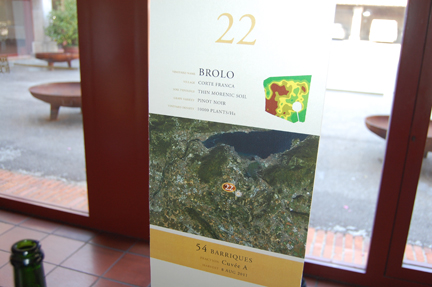
Above: One of the most interesting tastings I attended during the 2011 European Wine Bloggers Conference was a flight of nearly 30 Franciacorta crus at the Berlucchi winery. I think that many would be surprised at the diversity of growing sites in the appellation (but more on that in a future post).
The new appellation regulations were approved by an overwhelming majority (by Italian standards) of 80% of consortium members, reports Giovanni.
And the measures will deliver significant change in an appellation dominated by large commercial producers whose bottom line often trumps character and originality in the wines they bottle.
Of all the sparkling appellations in Italy, Franciacorta — there’s no doubt in my mind — has the potential to deliver truly great and original wines: even though very few of the top bottles make it to the U.S., I’ve tasted some stunning wines in Franciacorta, where fresh, clean, bright Pinot Noir and Chardonnay take on an intensely saline quality that pairs superbly with the fresh water cuisine of the Italian Lake District.
And the new appellation regulations, everyone seems to agree, are a step in the right direction. [We must] “improve to grow and grow to improve,” wrote Giovanni in the chiasmus of his title. And they are sure to do more than consortium president Maurizio Zanella’s recent appeal to the Italian media to stop using the term bollicine (tiny bubbles) when referring to Franciacorta.
Franciacorta and sparkling wines from Italy have been on my mind lately because I’ve been asked to speak on a panel devoted to the subject at the upcoming Viva Vino conference in Los Angeles.
The Holy Grail quest to produce sparkling wines has played an enormous role in shaping the history of Italian wine in general. And I’ll devote an upcoming post to my research.
In the meantime, if you want to get the discussion rolling, please share your thoughts in the comment section.
What is it, after all, that makes sparkling wine play such a powerful role in our vinous psyche?
 Do Bianchi