Barolo Villero by Brovia (New York Stories I; @saignee wish you were here)

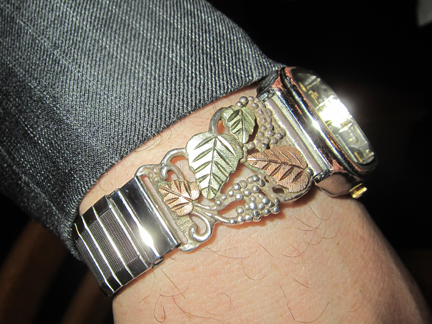
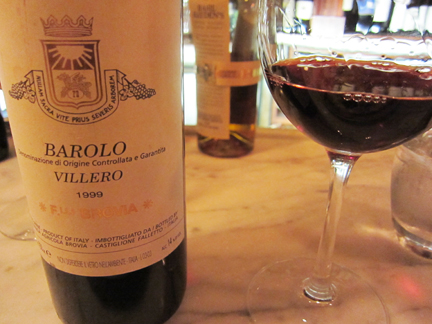
“My mother was disappointed that I didn’t become an architect,” said Victor Pinkston as he opened and poured me and my good friend Jeff a bottle of 1999 Barolo Villero by Brovia on Thursday night in Manhattan at Otto. “But then I showed her the watch that she gave me [above] when I was a kid and told her that ‘it was meant to be.'”

Victor’s done pretty well for himself: after five years as a company man in the Bastianich-Batali dynasty, he’s landed the job as wine buyer and head sommelier at the empire’s pizza joint.

And while he and I may disagree on the finer points of the modern vs. traditional dialectic, the dude definitely knows his shit.
When I lived in the City, Otto was one of my best-kept secrets: although not a fan of the university and tourist crowd that hangs there (Otto is, after all, “Molto Mario Light,” if such a thing can exist in the rational and sensual world), I knew I could always find some older Nebbiolo there at reasonable prices. Back in the day, I practically depleted an allocation of 1993 Barbaresco Nervo by Pertinace at $75 a pop (there are still some bottles left although at a higher price). And when I asked Victor what trick he had up his sleeve, he suggested no fewer than five labels from the 90s under $150, including an Oddero Barolo (classic) 1996 (wow!).

But it was the 1999 Barolo Villero by Brovia at $140 that spoke to me. (Remember this post by Saignée on our visit to Brovia a few years ago?)

I am no fetishizer of old wine and you’ll never hear me cry infanticide when a great one is opened before its time. But I must admit that this bottling was going through an extremely tight phase.

It was dense and deliciously chewy, with mushroom and earth dominating the fruit. But as Jeff and I slowly nursed this spectacular bottle, the berry fruit began to emerge, as did a delicate eucalyptus note, with the zinging acidity — the nervy backbone, as the Italians say — plucking on the strings of fruit and earth like Jimi Hendrix playing the first notes of “Little Wing.”
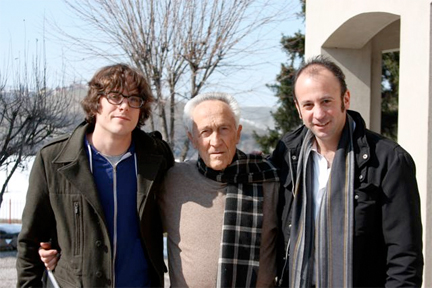
That’s me and Cory aka Saignée (left) with Giacinto Brovia back in March 2009 (photo by Brunellos Have More Fun). And here’s what Saignée had to say about our visit there.

Let’s just hope that Victor saves a bottle of this truly thrilling wine for us to taste next year.

Stay tuned for New York Stories II: Alice and I visit Maialino… or “two Jews walk into a Jew-owned bar named ‘suckling pig'”…

Cumin in my pants Brussels sprouts @Tertulia_NYC

Not a lot of time to post today… slammed with meetings in NYC…

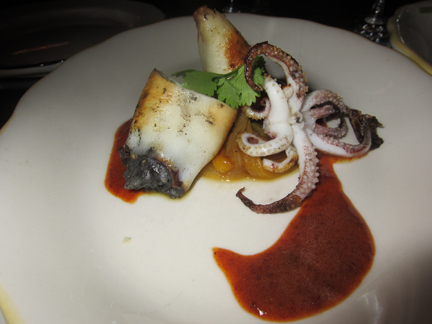
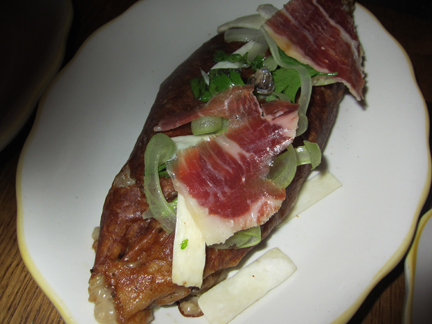
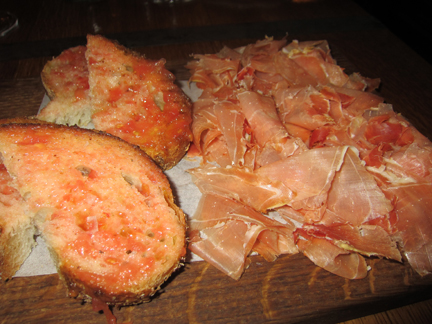
Here’s what I ate last night at Tertulia, an awesome new Spanish joint in Manhattan…

I didn’t get a picture of the FANTASTIC Brussels sprouts, roasted with a generous dash of cumim. They had me cumin in my…

Stay tuned for my notes on the 1999 Barolo Villero by Brovia that we drank later in the evening…

Heading to NYC…

Photo by Giovanni.

Heading this morning to New York City for meetings and some wine bar hopping… See you on the other side…

Cuttlefish risotto and the “last taboo” of Italian gastronomy @TonyVallone @AldoFiordelli

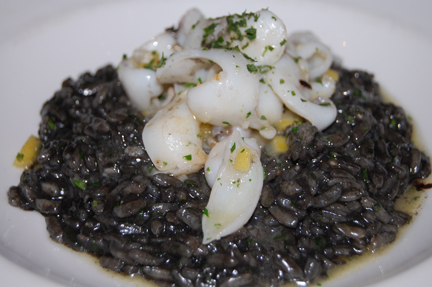
The Cuttlefish risotto at Ciao Bello in Houston the other night was so good that it nearly made me cry.

And it inspired a conversation about the “last taboo” of Italian gastronomy: the pairing of dairy and seafood.

I was at the restaurant doing a media dinner for my friend and client Tony Vallone, who shared the following anecdote about a luncheon in Naples a few years ago.

One of the guests, he said, an Italian-American, asked for grated Parimigiano Reggiano with his seafood pasta. The waiter politely responded that the restaurant didn’t serve cheese with seafood dishes. When the guest insisted, the waiter acquiesced, telling the patron that he would bring him the cheese. He disappeared, only to return after the gentleman had finished eating his pasta. “You see,” he said, “the dish didn’t need the cheese,” adding “in Italia si fa così,” this is how we do things in Italy.

The Italian taboo of mixing dairy and seafood stretches back to the Renaissance, when widely embraced Catholic customs required abstinence from dairy and meat on the numerous Lenten — di magro — days in the religious calendar. The bottom line: when seafood was consumed, dairy and meat were not. (I don’t have time to post about this today but this element of Renaissance cookery came to mind when I read Mark Bittman’s recent NY Times editorial on faux chicken; Renaissance cooks were obsessed with creating faux food, a gastronomic phenomenon that I called “culinary anamorphism” in a piece I wrote for Gastronomica some years ago.)

Of course, Tony’s cuttlefish risotto was made without the use of cheese (even though so many chefs in Italy and the U.S. discreetly fold some grated Parmigiano Reggiano into their seafood dishes). The secret to its creaminess? Tony had his chef caramelize and emulsify onions and then add them a few moments before the rice (Carnaroli) had cooked through. The viscous liquid gave the dish the all’onda texture that Tony likes in his risotto (whether sea- or landfood).

And it seems that we weren’t the only ones thinking about the “last taboo” of Italian gastronomy this week.

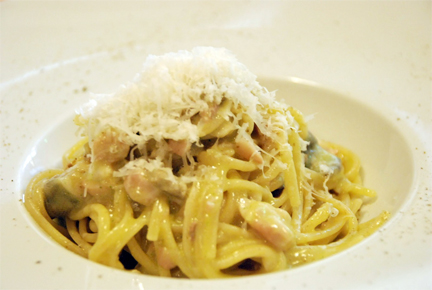
Today, Aldo Fiordelli, one of my favorite Italian-language food and wine bloggers and writers, posted this photo of “Linguine limone sgombro capperi essicati e parmigiano vacche rosse di Cristiano Tomei dell’Imbuto di Viareggio” (linguine tossed with lemon, mackerel, dried capers, and Red Cow Parmigiano Reggiano by Cristiano Tomei at the restaurant Imbuto in Viareggio).

Aldo notes that more and more Italian chefs are taking the bold step of using cheese in their seafood dishes, calling it their “last prejudice.”

Tony always says that for Italian cuisine to be authentic, it must also be creative. But I don’t think he would ever serve a dish like the one described by Aldo.

But hey, when in Viareggio, why not take a walk on the wildside?

We’re going to miss Lou on Vine

From the department of “Where do I begin? To tell the story of how great a love can be?”…

Above: Tracie P with Lou Amdur at a Kermit Lynch tasting back in May 2009 in San Francisco. Tracie and I had just been engaged.

It’s hard to explain the intrinsic role that Lou Amdur has played in our lives.

Lou and his Lou on Vine have been the backdrop for some of the most special moments of the last three years. It was the first place I took Tracie P (then B) when she visited me in California for the first time. It’s where I met Comrade Howard for the first time. It’s where Anthony and I would go nearly every week when I was living in Los Angeles. The first time I went there it was for a book reading by Alice.

Across the nation, from the New York Times to the Los Angeles Times, the wine world is reeling from the news that Lou is closing his amazing wine bar.

So many great wines tasted there. So many thrilling wine tales recounted. So many wine personages encountered.

But none greater than Lou, who could always — always! — surprise you with what he was pouring, a rare grape variety he was excited about, a biodynamic Pecorino that really turned him on…

I really liked this elegiac post by Cory (and recommend it). It reminded me of how Lou brought so many of us together — despite the vitriol that so often surfaces on the Natural wine scene.

He was our rabbi and Lou was his synagogue — a συναγωγή, a bringing together, etymologically speaking.

Where do I begin?
To tell the story of how great a love can be
The sweet love story that is older than the sea
The simple truth about the love he brings to me…

how sweet it is (to be loved by her)

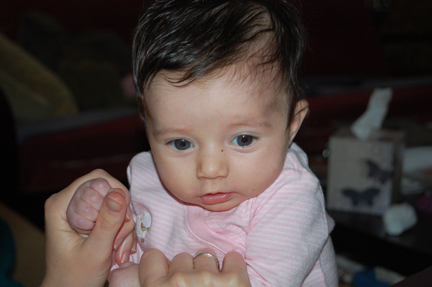
Lil’ Georgia P was three months old yesterday (thirteen weeks) and she’s not so little anymore!

She’s starting to sit up straight and to turn her head side to side. And man, she loves to talk! It’s just baby talk but she just goes on and on as if she’s carefully explaining something very important…

I’m on the road today in Houston. I never really knew what loneliness was until I had to be separated from my femminucce. But Tracie P takes lots of photos (like this one) and sends them to me throughout the day.

How sweet it is to be loved by her…

Gaglioppo, so many great wines making it to the U.S.

As thrilling as Etna is right now on the U.S. wine scene, the Southern Italian wine and grape that I am the most excited about are Cirò and Gaglioppo.

When I was in Los Angeles week before last to spend some time at Sotto, a New York-based importer tasted me on (as we say in the biz) the wines of Scala in Cirò (Calabria) — a winery I’d never heard of.

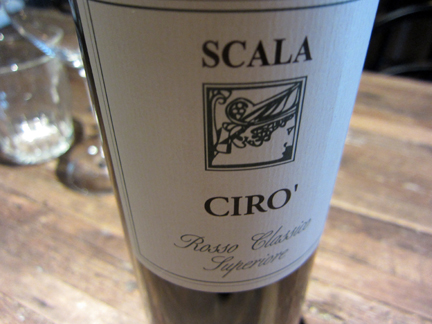
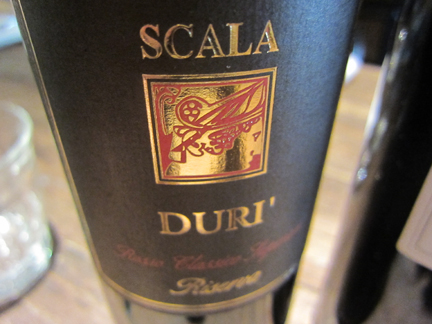
Both the Cirò Classico (above) and the Cirò Riserva (below) wowed me with their freshness, focus, and balance of earth, fruit, and acidity. Gorgeous, thrilling wines, imho…

Currently, Gaglioppo is relatively unknown in the U.S., despite the ever growing interest in indigenous grape varieties (I tasted a Piave Raboso the other night in San Antonio, btw!).

But tasting these wines, I begin to understand the high praise that writers of another era like Mario Soldati and Norman Douglas reserved for the caliber of winemaking there.

“The wine of Cirò,” wrote Douglas, “is purest nectar.”

I’m with Alfonso when he sings Mama, don’t let your (Gaglioppo) babies grow up to be Cabernets

“Do you have a corkage fee if we can’t live without our California wine?”

On the “wine” page over at Sotto in Los Angeles, where I curate the wine list, there’s a link that allows guests to email me their questions. They mostly write to ask if we allow corkage…

From: A.
Date: Mar 9, 2012 8:17 PM
To: Jeremy Parzen
Subject: Do you have beer?

Hi Jeremy,

We’re looking forward to our dinner at Sotto tomorrow evening, but I had two questions.

First, do you have any beers available?

Second, do you have a corkage fee if we can’t live without our California wine?

Thank you,

A.

From: Jeremy Parzen
Date: March 10, 2012 8:20 AM
To: A.
Subject: Re: Do you have beer?

Hi A., thanks so much for your interest in Sotto.

We do have beer available, yes.

And corkage is $25 per bottle with a 2 bottle max.

We also include Californian wine on our last — all by Natural winemakers (i.e., chemical-free farming, spontaneous fermentation via native yeast, and low sulfuring).

Here are a few great articles on the etiquette of corkage, one by Lettie Teague and another by a northern Californian connoisseur.

http://www.foodandwine.com/articles/corkage-for-dummies

http://forkandbottle.com/wine/corkage.htm

We have roughly 15-20 wines by the glass on any given day: your server will be happy to offer you a taste of any of them (and they are all available by the bottle).

I kindly ask you to consider that there is a reason why we have chosen the wines for our list: they pair exceedingly well with our chefs’ food. And they express our gastronomic aesthetic.

Please ask for the wine captain tonight. His name is Rory and he will be more than happy to find you a bottle that suits your taste and expectations.

And if truly you can find no wine from my selection of Southern Italian and Natural Californian, please feel free to take advantage of the corkage policy (although we hope that corkage will be reserved for unique, rare, and/or older vintages of special wines).

Thanks again and best wishes, Jeremy


Jeremy Parzen, Ph.D.
http://DoBianchi.com
http://twitter.com/DoBianchi
http://facebook.com/jparzen

she’s the one

From the department of “yes, last night while Tracie P ate her dinner, I sang my daughter A Chorus Line in its entirety and she LOVED it”…

One singular sensation
Every little step she takes.
One thrilling combination
Every move that she makes.
One smile and suddenly nobody else will do.
You know you’ll never be lonely with you know who.
One moment in her presence
And you can forget the rest.
For the girl is second best
To none,
Son.
Ooooh! Sigh! Give her your attention.
Do… I… really have to mention?
She’s the…
She’s the…
She’s the…
One!