Texas Frito Pie and Schiava brilliant pairing @stilesswitchbbq

texas frito pie

Houston, we have a problem…

The bbq at Stiles Switch in Austin (around the corner from our house) is just too damned good to resist.

And our daughter has become addicted to their chopped beef.

The folks at Stiles Switch use chopped beef and beans to finish their Frito pie: a pan-Southern dish typically made with Fritos topped with chili and shredded cheese (in Texas, it’s generally made with classic Texan “chili con carne,” which doesn’t claim beans as one of its ingredients).

When I chided the pit master this week about why Stiles Switch adds the designation “Texas” to its “Frito pie,” he noted that it’s “Texas” because of the fact that they use chopped beef (instead of chili).

Well, I’m not one to split hairs about such things… ;)

laimburg schiava

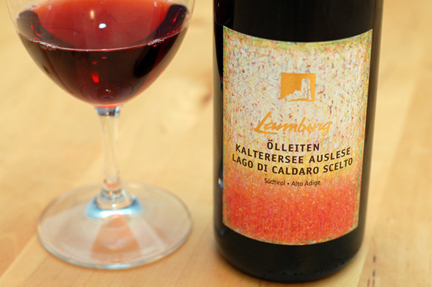
We paired the Texas Frito pie (yes, there are Fritos underneath that mess of beans, chopped beef, pickled jalapeños, and cheese) with bright, fresh, slightly chilled Schiava by Laimburg.

The wine is so focused and pure, so refreshing and its alcohol so well balanced by the brilliant fruit and acidity, that the next day, even Mrs. B aka “nanna” (who doesn’t care much for red wine) couldn’t stop talking about how good it was.

It’s such a great metric for the quality of wine, no? When you’re still talking about it the day after, it must have been outstanding.
don't mess with texas bbq

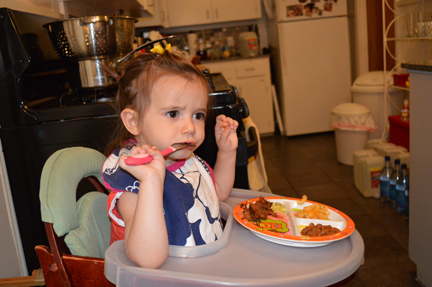
Don’t mess with Texas bbq! And don’t get between a girl and her chopped beef!

Frito pie would be a bit overwhelming for little Georgia P. But a heaping helping of Stiles Switch chopped beef with a side of mac and cheese was just right.

Buona domenica (happy Sunday), yall!
Pergola-trained Schiava that blew us away… @MasVinoPorFavor

From the department of “ampelography and vinography as exegetic tools that help us to achieve a more profound understanding of the human experience and condition”…

schiava

Photos by Tracie P.

Every once in a while, you stumble upon a bottle of wine that expands your vinous horizons.

Once such bottle came into our lives the other day after wine seller Marcy Jiminez in Houston recommended it to me: the 2008 Laimburg Alto Adige/Südtirol Kalterersee Auslese Classico Superiore DOC Ölleiten (Kalterersee is German for [Lago di] Caldaro Scelto; “Ölleiten” refers to the fact that the vineyards lie adjacent to olive groves).

Here’s the link to the winery and link to the wine and fact sheet.

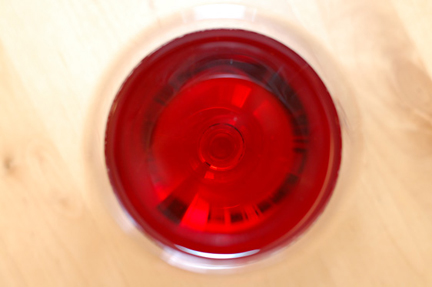
The wine was bright and fresh, with the zinging acidity and balance of technicolor (red berry and black cherry) fruit and earthiness that really turn us on. And even in a market like Texas, where we pay more for European wines than our counterparts in New York and California (thanks to higher alcohol tax, higher storage cost, and the big distributors’s choke-hold monopoly on the Texas legislature), this wine weighed in at only $23.

We love, love, loved it…

Especially after tasting a wine like this, it’s not hard to understand why Schiava was such a popular grape in another era.

As editors Calò et alia write in Vitigni d’Italia (Grape Varieties of Italy, Calderini, Bologna, 2006), Schiava (pronounced SKEE’AH-vah) “was one of the first grape varieties to be cited in the legal documents and treatises of the Middle Ages.” Its popularity was so great that “it represented the viticultural model for Slavic grape growing by antonomasia.”*

The name Schiava comes from the High German Schlaff, an ethnonym denoting “A person belonging by race to a large group of peoples inhabiting eastern Europe and comprising the Russians, Bulgarians, Serbo-Croats, Slovenes, Poles, Czechs, Slovaks, etc.” (Oxford English Dictionary). And it is related to the Italian schiavo (meaning slave, from the Latin sclavus) only in its morphology.

In other words, it was (and is) an ampelonym that, by synecdoche,** represented a cultural epoch in which Slavic culture dominated that part of the world.

When I attended Vinitaly earlier this year, I asked Florian Gojer of the Gojer winery to pronounce Lagrein for the Italian Grape Name & Appellation Pronunciation Project. When I asked him to pronounce Schiava, he insisted on using the German name, noting that in “Alto Adige, we use the German” Vernatsch.

My philological intuition points me to a relationship with Vernaccia but that inquiry will have to wait for another day. In the meantime, here’s Florian…

* antonomasia: “The use of a proper name to express a general idea, as in calling an orator a Cicero, a wise judge a Daniel” (Oxford English Dictionary).

** synecdoche: “A figure by which a more comprehensive term is used for a less comprehensive or vice versâ; as whole for part or part for whole, genus for species or species for genus, etc.” (Oxford English Dictionary).