The Fourth, San Diego style

Do they go… to some faraway archipelago?
Nah, they go to San Diego.

Mel Tormé
“California Suite” (1957)

Although an op-ed contributor in The New York Times pronounced the “American road trip dead” on Sunday, I know a lot of folks will still be hitting the highway this fourth of July weekend. In case you’re heading down San Diego way, here are some of the joints I’ve been hanging out at. (For details, click on the boldface for the website or if no website, I’ve included address and phone.)

Italian is spoken at Mamma Mia in Pacific Beach, where Francesco and Cinzia Mezzetti serve delicious handmade panzerotti and pizze (with perfectly seasoned, crispy crust). I love Cinzia’s flower power t-shirt.

The 2004 Produttori del Barbaresco Barbaresco (classico) is very reasonably priced at Mamma Mia. I head to Mamma Mia whenever I wish to indulge in my number-one guilty pleasure: pizza and Nebbiolo.

Mamma Mia
1932 Balboa Ave (where Balboa and Grand intersect)
San Diego, CA 92109
(858) 272-2702

Arturo offers me a traditional Spanish porron at Costa Brava in Pacific Beach. The porron — an expression of friendship and revelry — is used liberally at Costa Brava, where the Spanish food is authentic and tasty and the wine list (arguably the best Spanish list in San Diego) includes modern and traditional choices. Owner and Spanish wine fanatic Javier Gonzalez grows Tempranillo in a planter in the back (I’m not kidding). He also runs a great Spanish cheese and charcuterie next door. No place in San Diego is more friendly.

Dashing French Chef Olivier Bioteau at the Farmhouse in University Heights has one of San Diego’s deftest hands in the kitchen. The food is excellent and the francophile wine list, although not ambitious, has some interesting lots. I really like the farmhouse chic vibe but I’d love to see what Olivier could do in a four-star setting.

My friend Jon Erickson disgorges a bottle of 2000 Movia Puro Rosé at Jaynes Gastropub, my standby dining destination in Normal Heights (adjacent to University Heights) in San Diego. As Jon’s wine program continues to evolve, I can always find something I want to drink at Jaynes: most recently, Bertani Valpolicella and Caprari Lambrusco. Namesake Jayne Battle’s haute pub food always hits the spot.

Jay Porter’s Linkery in North Park, San Diego (a stone’s throw from Jaynes) recently moved around the corner and will reopen on July 10. Eat-locally and think-globally Jay is San Diego’s undisputed king of “organic,” “market fare,” “sustainable” cuisine and he’s also one of the city’s top food bloggers. If you’re looking for socially conscious and politically engaged fare, this is the place to go.

How to describe the Pearl? In self-described “vintage-modern” style, the owners of the Pearl took over a 1960s-era rundown motel near the U.S. Naval Base in Pt. Loma, San Diego, and turned it into a hipster, poolside hangout and restaurant and lounge. The food is a little affected at the Pearl (“Deconstructed Nachos” anyone?) and the wine list too modern for my palate but the scene can’t be beat. The night I was there, they were screening old episodes of Get Smart poolside.

The first time I walked into Wine Steals, also in Pt. Loma, I thought I’d been transported into a parallel universe: I found myself in classic San Diego down-and-dirty, get-your-drink-on bar where wine has usurped the supremacy of beer. Using a formula seemingly unique to San Diego, you purchase bottles at retail prices and then pay a small corkage (hence the name “Wine Steals”). The extensive wines-by-the-glass program features affordable, quaffing wine. Is wine the new beer? There’s another Wine Steals (the original) in Hilcrest and the Pt. Loma edition is located in the old (and now obsolete) second-world-war era Naval telephone hub.

In nearby Ocean Beach, The Third Corner Wine Shop and Bistro is my favorite San Diego “neighborhood” wine bar. Although it also caters to the Silver-Oak-guzzling wine-is-the-new-cocktail crowd, it offers real wine lovers like me a number of solid choices (like Joly, Produttori del Barbaresco, and Tempier, among others). The food is not great but the wine prices keep bringing me back: combining retail and on-premise sales (like Wine Steals), Third Corner lets you purchase bottles at retail prices and charges a small corkage to open them at your table. The owners just opened a new location in Encinitas, North County San Diego.

They still make a mean Mai Tai at Zenbu in La Jolla. Zenbu has lost some of its local charm as the owner, my high school buddy Matt Rimel has moved on to bigger projects, the prices are high, and the beach-bunny waitstaff could use a crash course in old-fashioned hospitality, but its raison d’être remains unchanged: locally sourced fresh fish prepared by “extreme sushi” chefs (live clams and prawns are often offered) with a California flair.

Gambero Rosso in San Diego (or What Would Happen if All Tuscans Became Super Tuscans?)

Above: Giovanni Folonari pours his new Super Tuscan, Campo al Mare (Bolgheri) at the Gambero Rosso Tour in San Diego, California.

Does the world really need another Super Tuscan? This question plagued me as I tasted through the wines on display at the Gambero Rosso “Top Italian Wine Roadshow” at the San Diego Wine and Culinary Center in downtown San Diego.

Otherwise useful as a directory of Italian wineries, the Gambero Rosso Guide to the Wines of Italy favors the big “lip-smacking,” luscious wines that seem do sell well in the United States. The three-glass scoring system used in the guide is yet another – however poetically veiled – points-based system, and while the same big-name wines seem to score well year after year in the guide, few small producers and even fewer lower-end wines make it up the ladder.

When I asked how the guide has grown in the 20+ years he’s served as editor-in-chief, Marco Sabellico told me, “the guide hasn’t grown because Italians are making more wines. The guide has grown because Italians are making more higher-end wines.”

It’s not really clear to me how the wines are chosen for the Gambero Rosso “Top Italian Wine Roadshow” (held this year in San Francisco, Los Angeles, and for the first time San Diego). Its “Three Glass” tasting features only those wines that have won the guide’s top award. For the roadshow, it seems that Marina Thompson PR might have something to do with the selection. Marina happens to be Gambero Rosso president Daniele Cernilli’s wife.

What lured me to the event this year was the fact that it was held for the first-time in San Diego, California.

Above: Tim Grace of Il Mulino di Grace, a Chianti Classico producer in the township of Panzano.

I was asked by many presenters to taste this or that “new” Super Tuscan.

Giovanni Folonari had me taste his Campo al Mare, made from Merlot, Cabernet, and Petit Verdot (no Sangiovese). The estate, he told me, lies between Sassicaia and Ornellaia. The wine was well made, not overly woody, and not too high in alcohol. But does the world need yet another Super Tuscan? Maybe it does and since I’m not a fan of Merlot and/or Cabernet Sauvignon in the first place, maybe I should just keep my mouth shut. Giovanni told me it will retail for about $35 and that’s good news, I guess. Maybe the world does need a new reasonably priced Super Tuscan.

I also tasted a Super Tuscan (Gratius) by Mulino di Grace (Panzano, Chianti Classico). The Grace family’s Chianti Classico is a blend of Sangiovese with smaller amounts of Merlot and Cabernet. I kinda liked its Chianti Classico, where the addition of small amounts of international grapes give the wine more color and forward fruit, thus making it more modern in style. But I really liked the Gratius, 100% Sangiovese, a wine that showed the balance of fruit, acidity, and gentler tannin, and the lightness in the mouth that you get with Tuscany’s Sangiovese. To my palate, the Gratius tasted the most like Chianti Classico of all the wines he was pouring (in fact, owner Tim Grace told me, the wine could have been classified as Chianti Classico DOCG).

Some believe that the term Super Tuscan was coined by Nicolas Belfrage and was first used in print in Life Beyond Lambrusco (1985), co-authored by Nicolas and Jancis Robinson. The early Super Tuscans were generally made with international grape varieties and the wines generally saw some time in new wood. Because the wines — most famously, Sassicaia and Tignanello — did not meet standards for any existing appellations at the time they were first released, they were officially classified as vini da tavola or table wines, even though they were marketed as high-end wines.

According to usage, a Super Tuscan is a Tuscan-made wine that 1) does not meet requirements set forth by local appellation laws (in many cases, this is due merely to the fact that a given wine uses grape varieties not allowed by the appellation); or 2) has been intentionally declassified by the producer (as in the case of Tim Grace’ wine). While barrique aging is often used for Super Tuscans, barrique is not a sine qua non.

One of the reasons why the term Super Tuscan helps winemakers to sell wines in the United States is the moniker itself: it just sounds good and it implies that the wines are somehow better, that they surpass the rest of the field. I certainly can’t blame Tim for declassifying his wine. Chianti is a confusing appellation for Americans and if declassification helps him to promote awareness of his wines, more power to him (and his wines are good and deserve attention).

But because the term Super Tuscan is now applied to wines made in Bolgheri (on the Tuscan coast), Chianti Classico, Chianti Rufina, Chianti Colli Fiorentini (and other subzones), Montalcino, Montecucco, Montepulciano… and the list goes on… it has became a de facto über-classification that eclipses the personality of those places and the character of the persons who make those wines.

Tuscans are a highly diverse group of people and their language, their food, their traditions, and their wines change from city to city, town to town, from village to village (and from principality to principality, we would have said in another age). Just ask a Florentine what s/he thinks of the Pisans and you’ll see what I mean (and I won’t repeat the colloquial adage nor the often quoted line from Dante here). I’ve traveled extensively in Tuscany and have spent many hours in its libraries, its trattorie, and wineries. I would certainly be disappointed if the Tuscans, like their wines, all became Super Tuscans.

Impossible Pairing: Sushi, Me, & NYC

Having grown up and come of age in southern California, I have had the opportunity to experience some of the best “sushi” and Japanese cuisine in the country. During the 1990s when I was a graduate student at U.C.L.A. (and when the sushi craze was rippling through the U.S.A., with its epicenter in Los Angeles), I was fortunate enough to dine at the now legendary Katsu (first in Los Feliz and then in Beverly Hills), opened by Katsu Michite who now works in Studio City at my fav LA sushi place, Tama Sushi (no website, unfortunately, see info below).* Then came Hirozen (in an unassuming strip-mall, still fantastic, a must), R23 (downtown, disappointing the last two times I visited), and one of the most beautiful restaurants I’ve ever eaten in, Thousand Cranes, which is supposedly returning to its former glory (the traditional Japanese breakfast there is worth a visit if you’re staying downtown).

Down in San Diego, where I grew up, Zenbu can be a lot of fun. So crowded and popular (and expensive) these days, it has its ups and downs but I still love their “aggressive” dishes like live prawns and giant clams (and by live, I mean literally). I also like the colorful cocktail menu inspired by local surf spots and surf lore. The lounge is very hip there and one of my best friends, Irwin, performs electronica there on some nights. The restaurant’s owned by another of my high-school friends, Matt Rimel, a huntsman and fisherman, whose fishing crew provides nearly all of the fish, working with eco-friendly and dolphin-safe fishing techniques.

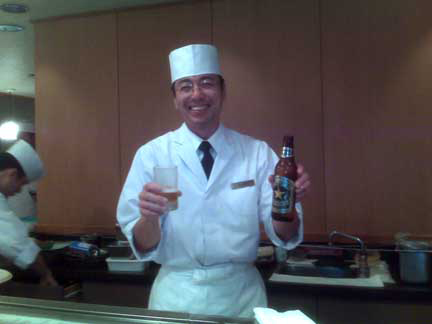
mano.jpg

Above: I felt like I was a tourist in my own city when I asked our sushi chef Mano, at Sushi Ann, NYC, to pose for a picture (with a beer we bought him in gratitude).

I had always found NYC sushi disappointing, even though I’d been treated to some of the finer and pricier venues in town. But now I have seen a new dawn on my NYC sushi horizon at the wonderful and very reasonably priced Sushi Ann.

The Odd Couple — that’s me (Felix) and Greg (Oscar) — dined there last night on the recommendation of friend and colleague, top NYC Italian restaurateur and wine maven, Nicola Marzovilla (who owns I Trulli and Centovini). We asked our chef to prepare whatever he liked — really, the way to go at the sushi bar — and we were delighted with each serving. The fish was fresh and he avoided the sushi stereotypes. One sashimi dish was tuna belly cubed (not sliced) and drowned in a miso reduction sauce (sinfully good). Mano, our chef, also liked to counterpose bitter and sweet, as he did in some rolls, which he served together, the one made with Japanese basil and pickled radish, the other with scallion.

basil.jpg

Above: Mano offered me a leaf of Japanese basil, sweeter than the western variety.

Most of the fish seemed to be flown in from Japan (Japanese Red Snapper, Japanese Mackerel, etc.) and tasted fresh (didn’t have that freeze-dried taste that find in so many of the Lower East Side sushi joints). The restaurant was very clean (important for sushi restaurants, in my opinion) and the waitstaff polite and attentive.

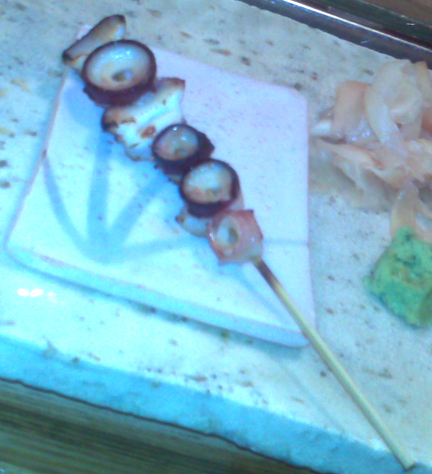
octopus.jpg

Above: skewered octopus tentacles, raw but seared with a torch.

One of my favorite dishes was the seared octopus tentacles, dressed with just a little bit of lemon juice.

Greg drank a cold, unfiltered sake (which was a little too sweet for my taste, although our waiter said it’s very popular in Japan) and I stuck to beer. I’m sure we could have spent a lot more had we indulged in a bottle of fine sake — the list was alluring but it wasn’t the night for that. Our bill was very reasonable for an excellent experience in a high-end midtown neighborhood (51st between Park and Madison).

After ten years in this town (I got here in 1997), I finally found a great sushi restaurant. Who knows? After the recent crazy changes in my life, maybe I should stick around after all.**

*Tama Sushi
11920 Ventura Blvd
Studio City, CA 91604
(818) 760-4585

**So all you newsy people, spread the news around,
You c’n listen to m’ story, listen to m’ song.
You c’n step on my name, you c’n try ‘n’ get me beat,
When I leave New York, I’ll be standin’ on my feet.
And it’s hard times in the city,
Livin’ down in New York town.

— Bob Dylan