
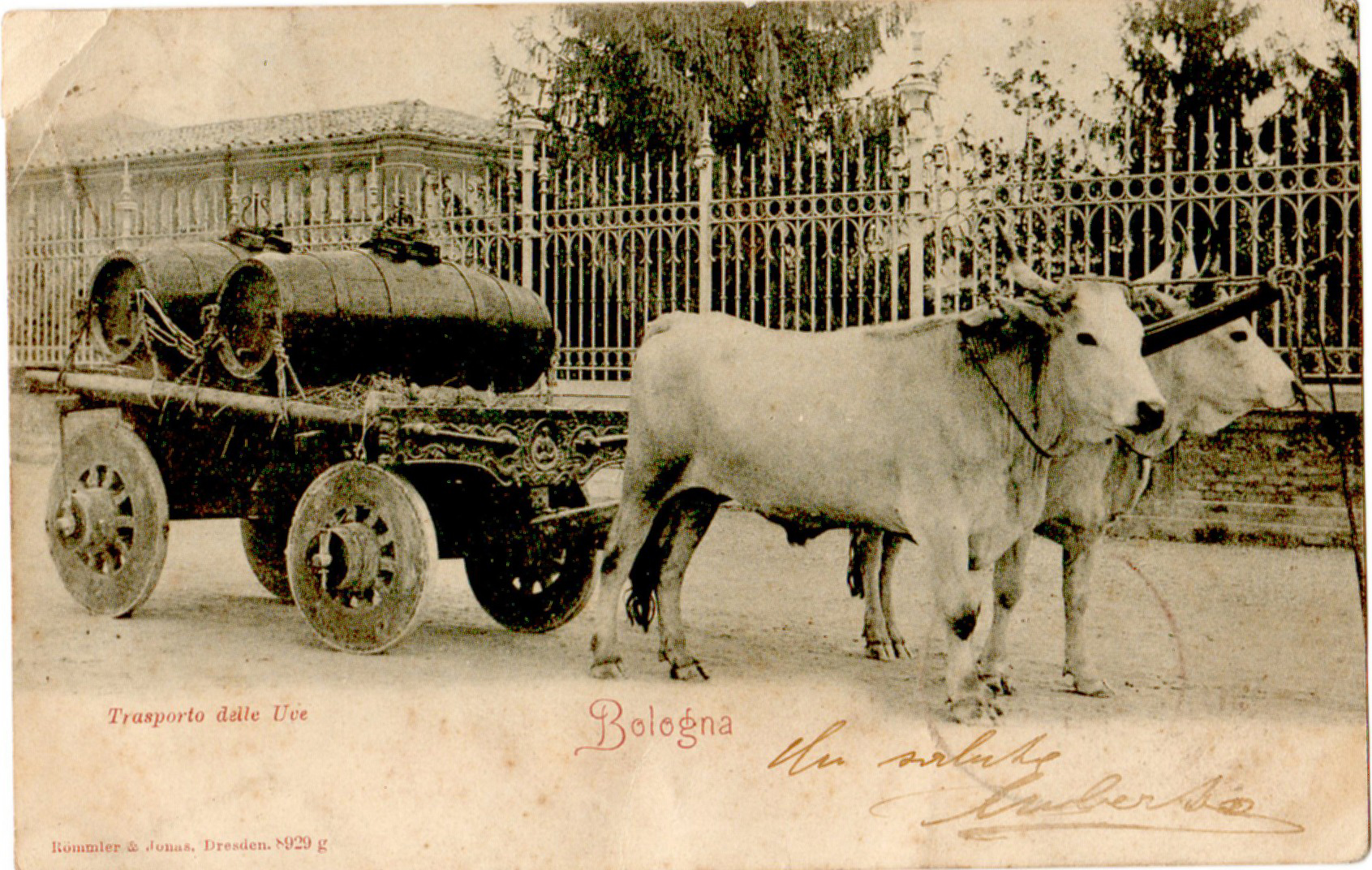
Above: Grape transport early 1900s (?), Bologna, signed “Greetings from Umberto.” It makes me wonder if fermentation has already begun in those casks. Click the image to see a hi-res version.
So much junk mail appears in my inbox these days, most of it from publicists who haven’t really taken the time to see what my blog is really about (BrooklynGuy gets his share, too, and he wrote this funny post about the phenomenon).
But every once in a while, I find myself on the user-end of a mass mailing that catches my eye.
Today, I received an email from a man I’ve never met, nor heard of, Carlo Cassinis, who writes:
- We have started a collection of postcards having the theme “agriculture and enology.”
Please find attached the last postcard we have received. We are asking you to look in your attics and cellars to unearth postcards like this.
We are sending this message to all of our friends with the hope that they will read it and pass it on to all of their friends and everyone in their address books.
As soon as we have enough interesting material, we will mount an exhibit in the cellars of the Vicara winery.
If you have any material like this, please send it to Carlo Cassinis V.lo S. Sebastiano 13 15020 Ponzano Monferrato (Al)
Thank you and looking forward to hearing from you.
Carlo Cassinis
Carlo didn’t include a link to his winery’s website but it wasn’t hard to find.
I like the postcard and the image made me think about how much the Italian wine industry has changed over the last century. I’m still reeling from the news of yet another adulteration scandal in Tuscany. As the Italian Wine Guy said to me today, we’ve been working so hard for so many years to promote Italian wine in this country because we love it so much. And then something like this happens and it seems as if we have to start all over again, sharing the true greatness of the wines of Italy.
The weather is cold here in Austin and it’s a melancholy Friday “deep in December” sitting at my desk…
Try to remember the kind of September
When life was slow and oh, so mellow.
Try to remember the kind of September
When grass was green and grain was yellow.
Try to remember the kind of September
When you were a tender and callow fellow.
Try to remember, and if you remember,
Then follow.
Follow, follow, follow, follow, follow,
Follow, follow, follow, follow.
Try to remember when life was so tender
That no one wept except the willow.
Try to remember when life was so tender
That dreams were kept beside your pillow.
Try to remember when life was so tender
That love was an ember about to billow.
Try to remember, and if you remember,
Then follow.
Follow, follow, follow, follow, follow,
Follow, follow, follow, follow.
Follow, follow, follow, follow, follow,
Follow, follow, follow, follow.
Follow, follow, follow, follow, follow,
Follow, follow, follow, follow.
Deep in December, it’s nice to remember,
Although you know the snow will follow.
Deep in December, it’s nice to remember,
Without a hurt the heart is hollow.
Deep in December, it’s nice to remember,
The fire of September that made us mellow.
Deep in December, our hearts should remember
And follow.
 Dear
Dear 


 Do Bianchi