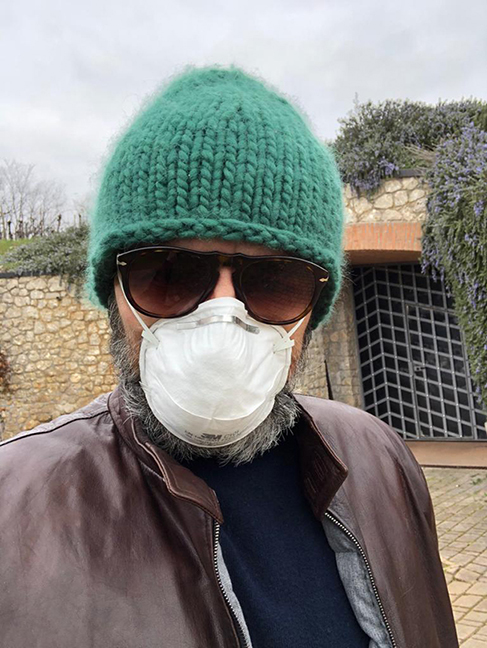
Taste Scarpa Barbera d’Asti with winemaker Silvio Trinchero and me at 10 a.m. CST

Today’s virtual tasting is going to feature Scarpa Barbera d’Asti and winemaker Silvio Trinchero.

Please join me live on Instagram @DoBianchi at 10 a.m. CST (Texas time) when Silvio and I will be discussing life in Piedmont during the health crisis as well open a bottle of 2015 Scarpa Barbera d’Asti CasaScarpa.

This is the second virtual tasting I’m leading with my clients and friends in the wine trade. I’ll be doing more next week.

Please join us! Evviva il vino italiano!

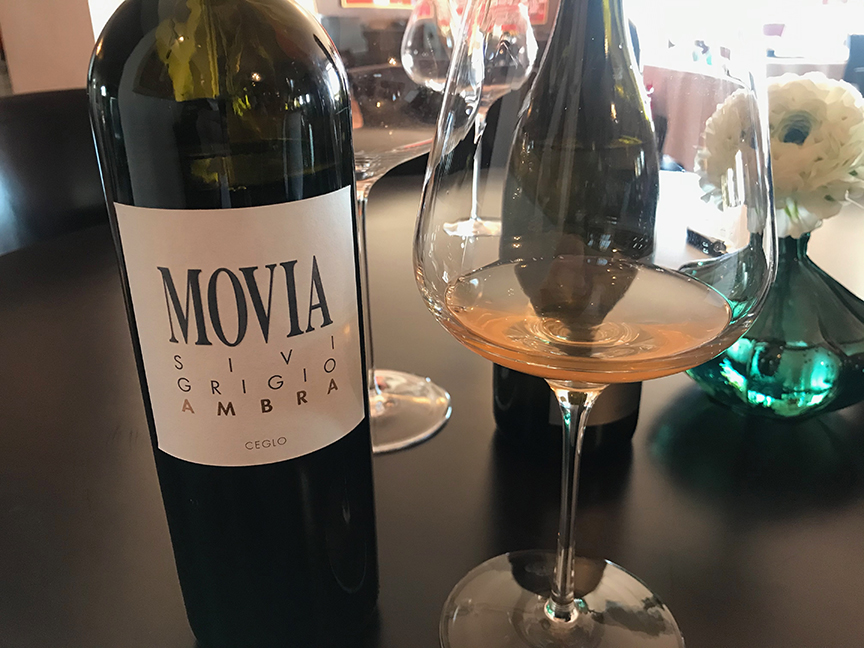
Taste Movia with Aleš Kristančič and me today at 11 a.m. CST @EthicaWines

At 11 a.m. CST today, I’ll be doing an live story with Aleš Kristančič of Movia on the @EthicaWines Instagram.

It’s the first of a series of virtual tastings that I’m leading with them. I hope you can join us.

Aleš and his family are great friends of mine and when I visited them in January of this year, we had a blast remembering when they brought my band Nous Non Plus to play a concert at the winery back in 2008 when we had a hit song in Slovenia (no joke!).

Please join us at 11 a.m. and please look out for more Ethica Wines tastings I’ll be doing.

See you shortly! We’ll be tasting four wines, including the Pinot Grigio Ambra.

Dispatch from Brescia: “I don’t think I’ve ever seen such a concentration of suffering.”

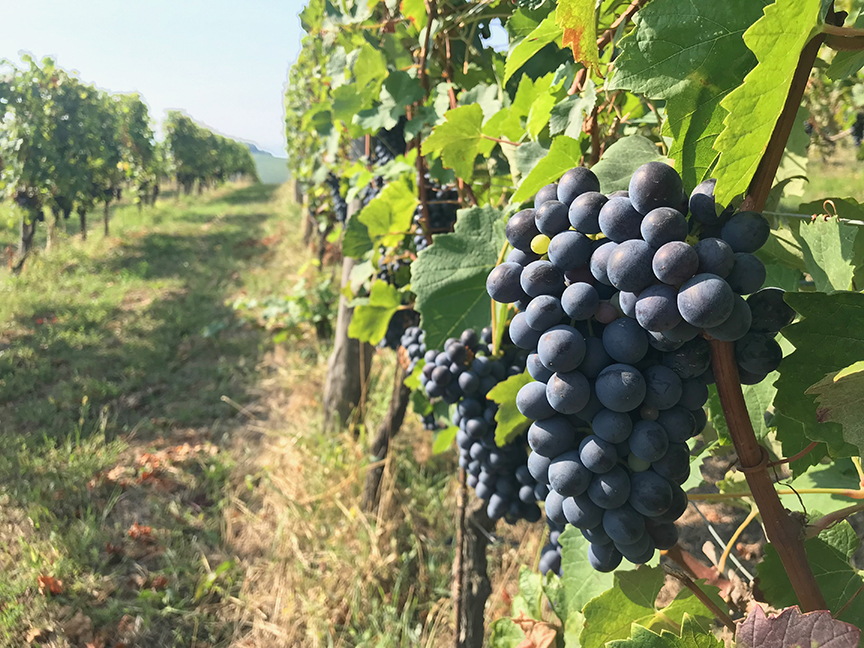
Above: a vineyard in Brescia province, a photo taken nearly a year ago to the day.

In what’s become a daily ritual, there’s a late afternoon-late night call to Italy when a couple of middle-aged wine professionals — one an American in Houston, the other an Italian in Brescia province — catch up on the ongoing health crisis in their respective cities.

Yesterday’s call was grimmer than most.

“I see the number of cases has actually begun to fall in Italy today,” said the American, noting that there was a drop, however small, in the number of new cases and victims with respect to the previous day’s reporting.

“But not in Brescia,” replied the Italian.

His words were echoed in a story this morning on the front page of the New York Times website: “Dip in Italy’s Cases Does Not Come Fast Enough for Swamped Hospitals.”

“In Brescia,” write the paper’s editors in a caption for the lead image, “hospitals have been reporting hundreds of new cases a day.” The photo that appears at the beginning of the article was taken in the intensive care unit of the Spedali Civili hospital in Brescia.

While the numbers are beginning to level off, just barely, in the rest of Italy, the situation in Brescia and neighboring Bergamo province is getting worse. Bergamo and the Italian region of Lombardy where Bergamo and Brescia are located are the epicenter of the ongoing health crisis.

“I don’t think I’ve ever seen such a concentration of suffering so intense,” says
Dr. Intissar Sleiman in a video the man from Brescia shared with his American friend during their chat. She’s a Brescia medical professional on the front lines of the Covid-19 pandemic in Italy.

“We’re not used to losing so many people in such a short period of time,” she says as she holds back her tears.

The video left the American wine professional with tears streaming down his face. Just a few months ago, he was there in Brescia province visiting his Italian friend. He was supposed to be in Italy this week. How he wishes he could embrace his friend in Brescia right now! Magari!

The wine professional from Brescia and his partners are donating proceeds from the sale of one of their wines to a fund that supports the struggling Brescia hospital system.

Walter Speller wrote about it for JancisRobinson.com this week.

G-d bless Brescia. G-d bless us all.

Letter from Italy: “I’m proud to be an Italian” by Paolo Cantele.

According to a report published just minutes ago by the Associated Press, “Italy, a country of 60 million, registered 2,978 deaths Wednesday after another 475 people died. Given that Italy has been averaging more than 350 deaths a day since March 15, it’s likely to overtake China’s 3,249 dead — in a country of 1.4 billion — when Thursday’s figures are released at day’s end.”

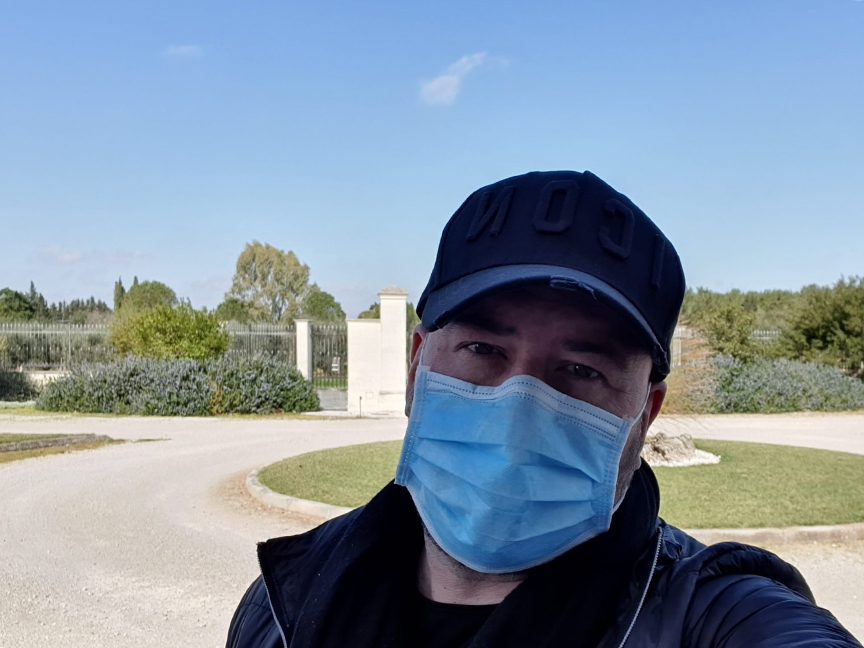
Above: Paolo Cantele, one of my best friends in the world and my client of many years, standing in front of his family’s winery in Guagnano in Lecce province. He calls me “Jar,” my nickname since I was a teenager.

Dear Jar,

It took me a little time to write you because, to be perfectly honest, I wasn’t in the right mood for it.

Writing is supposed to be therapeutic. It’s meant to help you overcome you’re the fears and doubts that grip your brain even as your mind, despite its efforts to remain cool and collected, continues to focus on that damned list of infected and dead.
Continue reading

Letter from Italy: “We will be reborn” by Angela Mion.

Angela Mion is a wine writer and sommelier who lives in Este in the Euganean Hills outside of Padua. She posts regularly for the popular Italian wine blog Intravino.

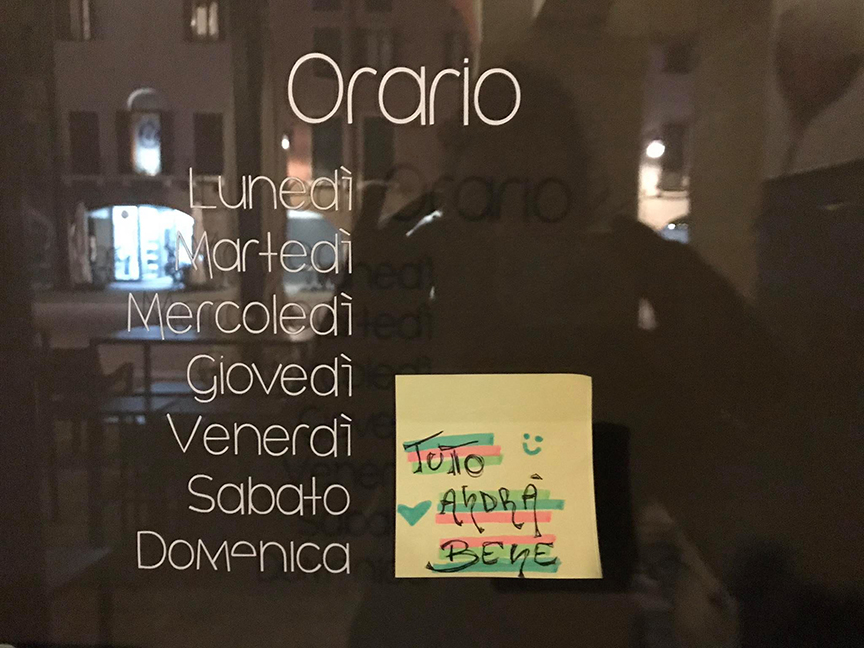
Above: in the place of weekly hours, a handwritten note in a restaurant in Este reads “everything will be okay” (photo by Angela Mion).

Close but faraway.

Italy doesn’t know what day it is today as it looks out onto the world from its windowsill, whether from home or the hospital.

We have never felt so equal. We are all being chased by the same invisible enemy that’s upending all of our lives.

An economy, probably in need of a rewrite, now seems a post-war economy.
Continue reading

Letter from Italy: “We’ve been through two wars. We’re still here and we’re not giving up now” by Andrea Gori.

Sommelier and wine writer Andrea Gori is the current generation of a Florence restaurant legacy: Trattoria da Burde, one of the Renaissance city’s most beloved dining spots. “We’re hanging in there,” he wrote me when I asked him to write a post for the blog. “Italians are fantastic team players.” Earlier this week, in its ongoing effort to curb the spread of Covid-19, the Italian government ordered all restaurants, bars, and cafés to shutter.

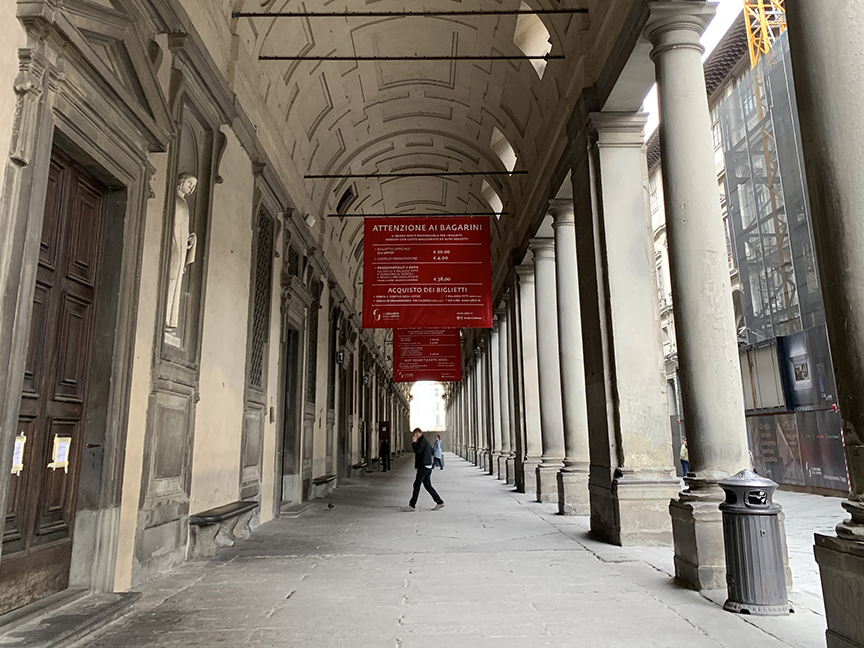
Above: There are no lines this week at the famous Uffizi museum in Florence (photo by Elena Farinelli). All public gatherings have been banned in Italy until April 3.

Does 16 days seem like a long time to you? Or a short time? Just 16 days ago, we were counting our covers, ordering wine and meat, we were planning wine dinners. Covid-19 was already here and things had already slowed down as if a spell had been cast over the outskirts of the city where our restaurant is located. Things were slowing down for us but in downtown Florence, the tourist apocalypse had already taken shape three weeks ago. The initial reaction was one of pride enabled by the inability to accept that the entire world had turned its back on us — all at once.
Continue reading

Letter from Italy: “Hopeful a better human race will emerge (and ‘Nutella Biscuits’)” by Giovanni Arcari.

Yesterday, in its ongoing efforts to curb the spread of the novel coronavirus, the Italian government issued a decree closing all businesses except supermarkets, pharmacies, and health care. The entire country has been under lockdown, with a near total ban on movement, since Tuesday. I’ve asked a number of my friends and colleagues there to share their experiences, feelings, hopes, and fears. Today, I’ve translated a letter from my best friend Giovanni Arcari, a winemaker in Brescia province.

Dear Jeremy,

Here in Brescia, the situation is intense. The hospitals are about to fall apart and the number of infections continues to rise. This is all attributable only to ourselves. We believe we know everything and we have become egotistical beyond measure, so much so that we are convinced that no one can be as intelligent as us. Today, we are facing the unknown and it’s beginning to permeate our consciousness aggressively. It’s something that only unexpected death can manage to create.
Continue reading

Letter from Italy: “Not prayers but bottles” by Raffaella Guidi Federzoni.

A guest post today from one of my best friends in the Italian wine business, Raffaella Guidi Federzoni, who’s hunkered down with her family in Montalcino.

Above: unaware of the health crisis that surrounds them and threatens their stewards, the vines in Italy continue to grow (photo by Raffaella Guidi Federzoni).

Americans love Italians? Yes, they do. They love us very much, even too much sometimes, because we are funny, we know how to cook and how to live. They love us and forgive us for our shortcomings.
Continue reading

In unprecedented move, Italy expands coronavirus lockdown nationwide.

Yesterday in a televised address to the country, Italian premier Giuseppe Conte announced the implementation of nationwide restrictions on movement throughout Italy and its islands. The new “zone protetta” (“protected zone”) expands the “zona rossa” (“red zone”) lockdown that was put into place across a broad swath of northern Italy early Sunday morning.

Read the New York Times coverage here.

As of today, Italians are being advised not to leave their homes and are only allowed to travel between cities and towns if they are in possession of a signed declaration that their movement is absolutely necessary for work or health reasons or “extenuating circumstances.”

The government has assured citizens that goods will continue to circulate despite the lockdown. There are widespread reports of supermarkets being overwhelmed by shoppers concerned that shortages of essential items are inevitable.

It’s not clear what the short-term impact on the Italian wine trade will be. All the major Italian wine trade fairs, generally held during this time of year, have already been cancelled or postponed. Most Italian winemakers had already cancelled international travel plans before the nationwide lockdown took effect.

“Dear friends and customers,” wrote one Italian winery in an e-blast to its clients today, “we inform you that the cellar will be closed for visits and tastings until April 3. In the meantime, keep drinking [our wine] at home, and if you don’t have enough, contact us, we will do our best to help you.”

Nothing like this has happened in Italy since the Second World War.

I had been planning to travel to Italy next week but when I logged into my airline account manager this morning, I discovered that my flights to and from Milan had been cancelled by the carrier.

My Italian friends and colleagues, at least those with whom I’ve traded messages since the announcement of the new restrictions, agree that the new restrictions are necessary. One friend in Milan told me that people are getting restless and that some are planning to travel regardless of the new lockdown. It’s not clear how authorities will enforce the restrictions or how severe the penalties will be for those who travel without authorization.

“We all have to sacrifice something for the good of Italy,” said Conte in his address.

Right now, our hearts and prayers go out to all of our Italian sisters and brothers, especially those with elderly relatives. Italians, know that we stand with you. G-d bless Italy and all of us.

Photo by Rosita Dorigo.

Coronavirus: northern Italy implements severe travel restrictions as Italian wine professionals face “discrimination” in U.S.

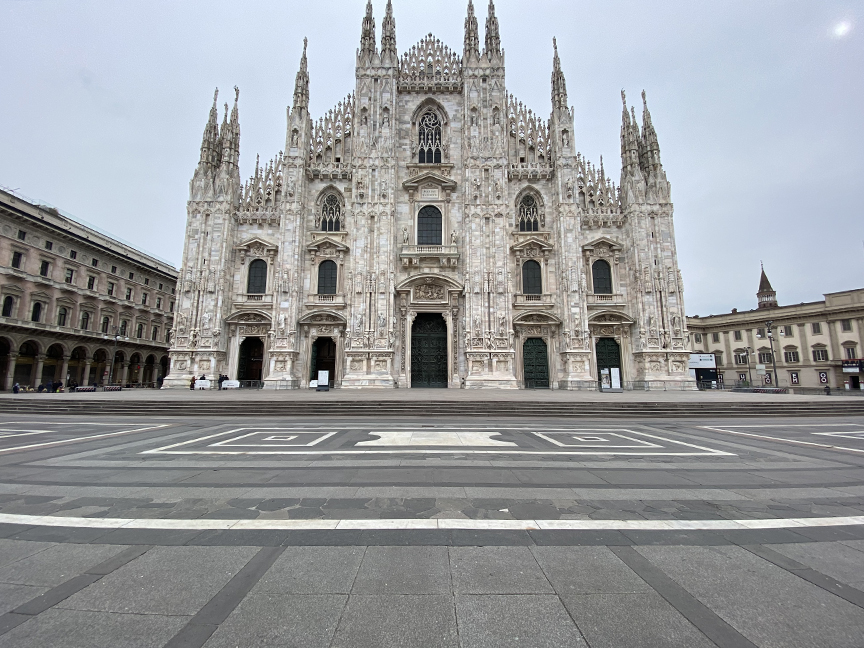
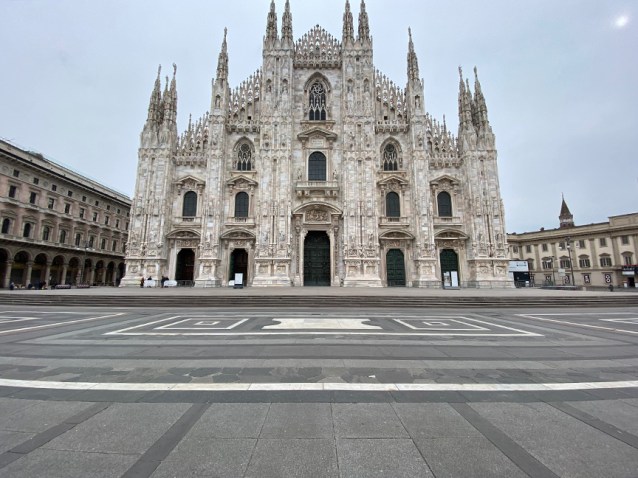
Above: Milan’s iconic cathedral on Monday morning around 10 a.m. On a normal day, this piazza would be full of commuters and shoppers (photo by Giovanni Contrada).

Early Sunday morning, in its ongoing efforts to stop the spread of the novel coronavirus, the Italian government announced severe restrictions for movement across a broad swath of northern Italy, affecting roughly 16 million people.

Later in the day, the U.S. embassy in Rome issued the following statement:

    On March 8, 2020, the Government of Italy signed a decree that requires individuals to avoid movement to and from and within certain areas unless one can demonstrate an essential work-related reason or other necessity such as an emergency health-related reason. It remains unclear what mechanisms the Italian government foresees to enforce the provisions of the decree.
    These areas include Lombardy region; the provinces of Padova, Treviso, and Venice in Veneto region; the provinces of Alessandria, Asti, Novara, Verbano Cusio Ossola, and Vercelli in Piemonte region; the provinces of Modena, Parma, Piacenza, Reggio nell’Emilia, and Rimini in Emilia Romagna region; and the province of Pesaro-Urbino bordering the Republic of San Marino in Marche region.
    The decree is in force through April 3 and also details restrictions for the rest of Italy, such as certain large gatherings, school closures at various levels, and the closing of civil and religious ceremonies, gyms and swimming pools, theaters. museums and cultural centers. Public transportation including trains and airlines continues, but travelers should check with carriers for any schedule updates.

Above: Milan’s canal district, known as the Navigli, deserted on Monday morning (photo by Giovanni Contrada).

According to the latest update published by the Italian health ministry (6 p.m. local time, March 8), there have been 7,375 reported cases of persons infected with the virus in the country, with 6,387 persons currently testing positive. 622 persons have recovered after being infected. 3,557 persons with symptoms are currently hospitalized, 650 are in intensive care, and 2,180 are in home isolation. As of last night, 366 had died as a result of the virus (although this number is still being verified by authorities).

There is still widespread confusion as to how the northern lockdown will be implemented and who will be allowed to enter and leave the restricted zones.

Milan’s central train station was overwhelmed on Sunday as thousands of southern Italians hoped to leave the city before restrictions went into effect.

None of my Italy-based colleagues I spoke to today know exactly how strictly their movement will be monitored in coming days or how the new measures will be enforced.

According to mainstream media reports, the Milan airports are still open although Alitalia has cancelled all flights to and from Malpensa (the city’s international hub). At least one masthead reported that Alitalia is still flying in and out of Linate, the city’s smaller airport.

As the number of infections continues to grow, there seems to be no indication of when the crisis will begin to subside.
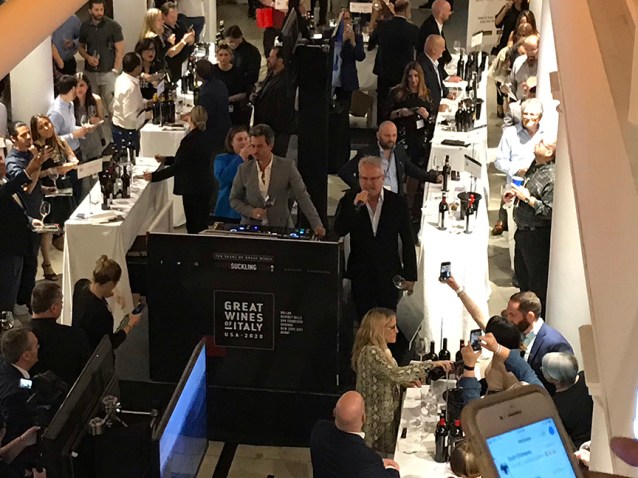
Above: leading Italian wine critic James Suckling (center, right) presented his Great Wines of Italy event Friday in Miami. Many, including me, applauded him as a hero of Italian wine for his efforts this week in the face of the growing health crisis.

In the meantime, here in the U.S., traveling Italian wine professionals were turned away last week when the Manhattan venue hosting the James Suckling Great Wines of Italy tasting refused to allow them on the premises.

In an Instagram video that has since gone viral within the Italian wine community, San Diego-based Italian wine professional Laura Donadoni described her dismay when she learned of what she termed “discrimination” toward her fellow Italians in New York and at other tastings across the U.S. this week.

Thankfully, Suckling was able to secure a new venue for the event and did not have to reschedule.

On Friday, I attended the last stop of the Great Wines of Italy tour in Miami where the event went off without a hitch, although many attendees told me that there were fewer people than last year. Over the weekend, a few wine enthusiasts told me privately that they decided not to attend the event for fear of contracting the virus (although they all insisted that they were avoiding “public gatherings” and not Italians per se).