Last night I ate my fork.

Braving the sweltering heat and collective grouchiness that pervade NYC streets this time of year, I had a quick bite and beer last night after work with a colleague at what instantly became my new favorite burger joint, Stand, on East 12 St.

Miniburgers, onion rings, fries, potato salad and house-cured pickles and beets on the side, microbrews (man, that beer tasted good after a long hot week in Manhattan!), and a colorful cocktail list. Didn’t get to peruse the wines but was told that they are selected by natural-wine aesthete and NYC wine über-hipster Byron Bates, wine director at Bette. Each table at Stand also sports a plastic jar of Bertman’s Original Ball Park Mustard, imported expressly from Cleveland, OH.

But what completely blew me away was the bio-degradable packaging the restaurant uses for its take-out. The straws were made from corn, the sandwich boxes from sugar, and the utensils fashioned from potatoes. I put the fork in my mouth and started to chew. While the fork was more than firm enough, I could feel it give way to the pressure of my teeth when I bit down. “It probably doesn’t taste so good,” said manager and co-owner Ray Pirkle, “but if you drop it in hot water, it turns into a noodle.”

For the Benjamin Braddocks out there contemplating a career in reduce-your-carbon-footprint take-out packaging… I want to say one word to you. Just one word: potatoes.

In other news, I really liked Dr. Vino’s recent post on billionaires.

Sharing a meal with a favorite writer.

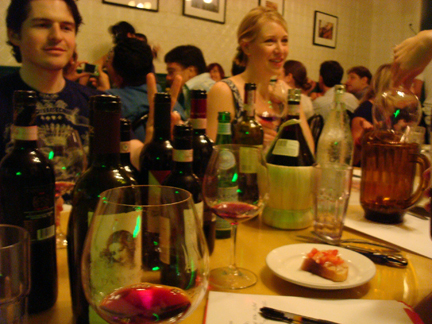
Last night found me at Centovini where I was lucky enough to dine with one of my favorite wine writers, Lawrence Osborne, whose excellent 2004 book on wine and taste, The Accidental Connoisseur, offers what is arguably the best explanation of why international tastes for wine are shifting toward the American “modern” palate (which seems to favor extracted, high-alcohol content, “jammy,” fruit-driven wines).

We were also joined by his friend, the truly lovely Elizabeth Spiers, who charmed the table with anecdotes from her career as a gossip-blogger-writer-fashionista. She also offered insight into the career of her friend and colleague Perez Hilton, who had been featured in last week’s NY Times Style Section.

I can’t reveal what we tasted because Lawrence is writing a piece on the flight we shared for one of his regular columns.

While I often attend tastings with noted wine writers, occasionally I get to taste as both professional and fan: I read Lawrence’ book when it came out and was immediately impressed by his quasi-Gramscian approach to the globalization of wine and the — to borrow a Gramscian phrase — cultural hegemony of the modern American palate for wine.*

I was pleased to discover that Lawrence shared an experience as graduate students in Italian (he at Harvard) and that we both enjoy the filmography of Antonioni, to whom we raised a merry glass. Reflecting on the obituary in the NY Times of that morning, we both noted that critics and scholars often forget the abundant humor in Antonioni’s films.

… a truly memorable evening in this city that I’ve come to love.

*N.B.: While I don’t endorse Wikipedia (and often see it as a promulgator of factoids, urban legends, and in some cases outright falsehoods), I liked the entry on Gramsci.

Antonioni’s Ellipse and Eclipse

Wednesday is the only day of the week that I don’t read the front page of the Times first since Wednesday is the Dining section day.

When I finally got around to unfolding the front page, I felt my heart sink as I read the news of Antonioni’s passing. In my first year post-BA, I studied Antonioni’s films in Padua with film critic and Professor Giorgio Tinazzi. I’ve read Seymour Chatman’s book on Antonioni, The Surface of the World, over and over. And I did meet Antonioni once at UCLA in the 1990s. Pier Maria Pasinetti, Antonioni’s brother-in-law and a collaborator on Le signore senza camelie, was one of my professors at UCLA where I took his 19th Century Italian Lit class (and on many occasions he spoke about his relationship, personal and professional, with the master director). Antonioni was among my favorite subjects to teach when I taught Italian Cinema at UCLA as a grad student.

As we witness Antonioni’s eclispse, I can’t help but think of L’eclisse (or “The Eclispse”), the third installment of the 1960s Trilogy. Many don’t remember that the title — like so many things Antonioni — was intended as a wonderful paronomasia: the Italian eclisse means both “eclipse” and “ellipse” (from the Latin ellipsis in turn from the Greek elleipsis, from the root leipo or lipo, “to be or to go missing”). Today, I’d like to think that Antonioni’s life and work have not been eclipsed but rather that he has given us yet another ellipse that makes us think about the spaces and surfaces of the meaning of our lives.

In the Name of Franco-American Relations

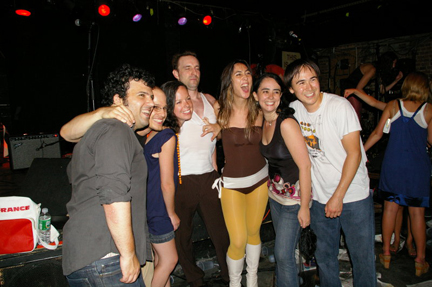
Nous Non Plus ended its Summer 2007 France tour on Saturday night playing to a packed house at the Flèche d’Or, one of my all-time favorite clubs (great sound system, nice people, and a really great vibe).

Seems that the band is inadvertently helping to assuage Franco-American relations and to bolster the “ego national.” For Francophone readers out there, check out this preview that was published in Paris Obs magazine (I’m the band’s “sommelier”):

Rock
Nous Non Plus

On l’a vu avec les Pipettes tout au long de l’année dernière, le pastiche ( ou remise à niveau pour les jeunes générations ) sixties a la cote. Mais quoi de plus flatteur, a priori, pour l’ego national que de voir qu’à New York un journaliste, un champion d’Air Guitar, un sommelier, un professeur de science politique, tous américains, et une artiste française, ont lancé un groupe parodiant, en français et en anglais, Dutronc, Hardy et autres yéyés franchouillards ? Il est même plutôt étonnant de voir dans un club branché de Brooklyn un « Jean-Luc Retard » et une « Céline Dijon » ( leurs pseudonymes-blagues ) chanter avec un accent approximatif des histoires de « Fille atomique » devant un public médusé. Mais quel intérêt pour un public parisien peut bien présenter ce « Grand Guignol bilingue » ? A vrai dire, voir l’héritage musical des yéyés revisité à coups de riffs garage, d’électro et d’autodérision, c’est assez jubilatoire. La mondialisation amusante.

Les vendredi 20 et samedi 21 juillet à 20 h. La Flèche d’Or , 102 bis, rue de Bagnolet ( 20 e ) ; 01-44-64-01-02. M ° Gambetta.

Timothée Barrière
Paris Obs

A Mishap Eclipsed by a Tuna Fish Sandwich and De Vinis Illustribus

The day could have started better: woke up early after a late night at the Flèche d’Or and headed out to Microbe Studios, a recording studio in St. Cloud (in the western suburbs of Paris, about 30 minutes toward Versailles) only to find that the young engineer was nowhere to be found. I decided to eat lunch while waiting and went up the street (in this upper middle-class neighborhood) to the neighborhood bar/brasserie (where a lot of people play Loto). I asked for a thon and crudités sandwich and was rewarded with an indulgent combination of rich flavors: besides tuna in olive oil, lettuce, tomato, and a generous slathering of mayonnaise, the kitchen had poached an egg (and then they must have shocked it in an ice bath because the white was firm but chilled, while the yolk was tepid and wonderfuly runny), sliced, and distributed it evenly along the long roll.

It almost made up for the morning’s mishap (the engineer never showed and I had to lug my gear back to Paris via light rail with a few changes… oh well… a lost morning but great sandwich).

CAFÉ-TABAC
LE BEAU SITE
• Bar • Brasserie • Tabac • Presse
• Loto • RATP
Ouvert du lundi au vendredi
de 7h à 20h.
Le samedi de 8h à 20h.
140, boulevard de la République, St. Cloud
Fax et tél. : 01 47 71 05 23

A good place to visit if you enjoy Loto and gaming.

De Vinis Illustribus – a truly superb wine shop

vinisillustribus.jpg

I went back to the 6th where the band is staying (at Céline Dijon’s parents’ house on the Left Bank), freshened up, and headed up to the Panthéon to visit a fantastic wine store specialized in old wine, De Vinis Illustribus, recommended to me by my friend Frank Butler.

The owner Lionel and his colleague Ghislaine were exceedingly gracious and I chatted at length with both of them about their shop, perceptions about old wine, and the changing landscape of winemaking today. Ghislaine gave me a tour of the cave where she showed me bottles of 1893 and 1921 Château d’Yquem, among many other remarkable lots. “When the sediment in old bottles of Sauternes is light in color,” Ghislaine explained, “you know the wine will not be oxidized, even if the wine has begun to turn brown.” It was fascinating to see the original capsules on these bottles: they didn’t stretch down as far as modern-day capsules and so you could read the information on the corks. This proves extremely useful when the labels have been damaged or destroyed by (desired) humidity in the cellar.

Bordeaux figures predominantly in their library but the Burgundy selection was also impressive. Lionel remarked that many of his clients are moving toward Burgundy from Bordeaux as they find that Bordeaux winemaking practices are changing.

Truly remarkable shop and lovely people.

Yesterday, François Hardonne (David Griffin, keyboard and trumpet player in Nous Non Plus) and I walked all the way to the Tour d’Eiffel from the Quai des Grands Augustins where we are staying. We visited the hardly remarkable and easily forgettable Musée du Vin, which is more of an events space and cheesy tourist trap than a museum.

tastevins.jpg

Above: The collection of old tastevins at the truly forgettable Musée du Vin near the Tour d’Eiffel.

The collection of pre-revolutionary vine tenders’ tools was interesting, as were some of the pieces among the old stemware and bottles. Overall, the museum was a not entirely unexpected disappointment but it was nice to take such a long walk through Paris.

old_bottles.jpg

A snapshot of the Tour d’Eiffel as I walked from the studio to the light rail station in St. Cloud:

view_from_stcloude1.jpg

In The New York Times

Played with Nous Non Plus last night at the Paris Paris, a disco on the Avenue de l’opéra that features bands a few nights a week. Needless to say we performed our “(I Want to Spend a Night in) Paris,” a song about Paris Hilton, at the Paris Paris in Paris.

Paronomasia aside, I awoke this morning to read about Lini Lambrusco (wines that I love) and see myself quoted in Eric Asimov’s weekly wine column in The New York Times.

Catering at Francofolies

jar_driving.jpg

We drove this morning from Vosne-Romanée to La Rochelle, a journey that took us back up toward Paris on the A6, then over to Orléans, and then on the A10 to Tours and down to La Rochelle (not far from Bordeaux).

cross_country.jpg

The trip took us through the “heartland” of French agriculture and then through the Loire Valley, where we could see signs for (but could not stop at) Chinon, Saumur, etc.

Just outside of Tours we stopped for gas at a rest stop and by chance we happened upon the other members of Nous Non Plus.

We were met in La Rochelle by our handlers Pierre and Pascal from Scène et Public, our agent for France and Europe, who had booked us at the Francofolies festival. After a long day of traveling, everyone was hungry and Pascal was raving about the catering tent behind the mainstage. We checked into our hotel and made our way through La Rochelle, which was in full party mode, with musicians (buskers and festival performers) everywhere.

When we arrived at the tent, even the French among us (including Patrick Woodcock of Mellow, Céline Dijon’s boyfriend) agreed that the spread was the best “catering” they had ever seen at a music festival: summer salads, freshly shucked oysters, fish loaf (which I loved), couscous, saffron rice, a cheese board… amazing… (N.B.: the French use the American word “catering” which they pronounce KAH-tehr-eeng.)

catering.jpg

I was happy to eat a meal lighter than my typical Burgundian repast!

rose_rochelle.jpg

It was also nice to drink something a little less demanding on the palate, like the Provençal rosé they served.

I had a great time talking about wine with Pierre and Pascal. Nearly everyone I meet here knows and appreciates wine, although Pascal is not a fan of Italian wine. The French seem to know only Sicilian wine (and occasionally they’ll tell you that they like Lambrusco).

everyone_chewing2.jpg

Above, from left, Céline Dijon (Verena Wiesendanger), Bonnie Day (Emily Welsch), François (our sound guy), Pascal (our handler), François Hardonne (David Griffin), Prof. Harry Covert (Greg Wawro).

Halfway through dinner, a huge storm exploded over La Rochelle and everyone poured into the main tent to escape the rain. The tent was transformed into a fantastic party (you can imagine). At a certain point, an African group started up a contagious rhythm by banging empty wine bottles on the tables and the whole tent broke out in song led by the group’s lead singer… A smoke-filled tent of happy happy people, their bellies full of wine.

Despite the rain, the festival went on, and I caught the tail-end of the closing set by ex-tennis star Yannick Noah, who closed the penultimate night of the festival on the main stage. Man, that guy can work a crowd…

A Wine Older than Me: Spanna Colline Novaresi VdT 1958 Vallana

Opening fifty-year-old wine with fellow forty-year-old and friend Jeff Grocott at Morandi.

Spanna VdT 1958 Vallana

A few weeks ago, good friend and fellow child-of-the-Summer-of-Love Jeff Grocott proposed that we drink a bottle of old Spanna by Piedmontese (Novarese) producer Vallana to celebrate the near completion of our nearly four decades on the planet. Jeff, a page-one editor at the Wall Street Journal, wrote a number of wine features and tasting notes when he was an editor at the WSJ Weekend Section. You have to subsribe to the WSJ online edition in order to browse/search old articles but you can find some of Jeff’s articles on the web. His story on wine storage, which appeared in syndication, is one of the most popular and it offers some interesting and solid insights into the myths/truths of cellaring. Jeff and I met a few years ago when I was doing media relations for a NYC wine merchant and have since opened and enjoyed many bottles together, including a Barolo Riserva (Red Label) 1990 Giacosa that my friend and colleague Jim Hutchinson generously poured for us in his apartment last winter (served with a Coda alla Vaccinara that Jim had cooked all day in his crock pot).

Jeff, who lives in the village with his wife Barbara, had spied the Spanna 1958 Vallana at the relatively new Morandi on Waverly at Charles St.

We were both reluctant to open such an old bottle at a place like Morandi: similar to the ever-popular Da Silvano, Morandi is a glamorous, star-studded (see our celebrity encounter below), pseudo-trattoria New York City cafeteria — not exactly the place you think of when it comes to old wine. The bottle was reasonably priced but what was its provenance? how had it been stored? what kind of wine service would we find at a bustling downtown “feed-em-and-turn-the-table” eatery on a hot July evening?

While the food at Morandi was unremarkable (typical greasy but well-dressed downtown Italian), the wine list offered some interesting Nebbiolo options, including a Barbaresco 1988 Produttori del Barbaresco magnum at a good price. I was also impressed by the Ligurian whites on the list and a few labels from Basilicata, unusual for a restaurant where wine-savvy diners are unlikely to be found.

Jeff Grocott and Rosario "Roy" Marino

Above: sommelier Rosario “Roy” Marino (right) tasted with me and Jeff (left).

As it turns out, where were greeted by Rosario “Roy” Marino, a Salerno native, who gave us a great table in the back, had set the bottle upright (at Jeff’s request) the night before, and produced excellent Burgundy-style crystal glasses and a crystal decanter for our table (before opening the Vallana, we ordered a glass of Donnas Rouge from Val d’Aosta, which Roy poured in the restaurant’s standard glass stemware).

Novara is a lower-lying, wine-producing zone found to the east of the Langhe Hills (Piedmont) were the more famous Barolo and Barbaresco appellations are produced. The Spanna DOC was created in 1969. In order for the bottle to be labeled “Spanna” (Spanna is the Novarese name for Nebbiolo), it must contain at least 85% Spanna (Nebbiolo). This wine was made before the DOC existed and thus was labeled vino da tavola (table wine; see label detail below).

Judging from the newish cork and clean label, the Spanna Vino da Tavola 1958 Vallana had been recently rebottled (and probably topped off with a little bit of new wine, as is the custom among many Piedmontese producers who keep reserves of older wine in their cellars).

Spanna has often been cited by wine experts (including the great Shelly Wasserman) as one of Italy’s greatest aging wines. Many people think only of Barolo (and Barbaresco) as cellar-worthy Nebbiolo. In fact, Nebbiolo grown in the Langhe was not labeled as Barolo until Ratti’s legendary 1971 bottling, while Spanna, Gattinara, Grumello etc. had already achieved fame as long-lived wines in the 1960s (for those who read Italian, I found this informative and moving account of drinking a bottle of 1964 Spanna discovered in the mud by rescuers in the aftermath of the 1969 flood in Novara).

I believe that Spanna’s longevity can be attributed — at least in part — to the addition of smaller amounts of less tannic, more acidic grape varieties. Vespolina and Bonarda other grapes are allowed in the appellation. Many have pointed to Antonio Vallana’s blending skills as the secret behind his remarkable wines.

The wine was fantastic: after the initial stink dissipated (not uncommon in wines this old), the nose opened up beautifully and the wine had gorgeous fruit, nice acidity, and perfectly softened tannins. The 1958 harvest is considered one of the great twentieth-century vintages for Piedmont and this nearly-fifty-year-old wine was powerfully elegant but retained some of the rustic character that you find in the naturally and traditionally made wines from Novara. We enjoyed it thoroughly.

As we were paying and preparing to leave, a party of three was seated next to us. Jeff discretely told me, “turn around and look who is sitting next to you.” Little did I know but the Edge was rubbing elbows with me. Wow… He was dining with two young women (I imagine one was his daughter). I wonder what they drank. I’m sure that Roy took very good care of them.

Vallana Lable Closeup

Old Spanish at Il Buco

Centovini_Spuntino

Above: the Spuntino Reggiano at Centovini (photo by Winnie).

Last night began with a Spuntino Reggiano at Centovini with my colleague Winnie. The Spuntino Reggiano (a “snack in the Reggio Emilia style”) is a dish inspired by a visit I made with our colleague Jim Hutchinson to Correggio where we discovered the Lambrusco of Vini Lini. The snack consists of grilled mortadella wedges (which were awesome) and erbazzone (called “torta di verdura” here), a Swiss chard and Parmigiano-Reggiano pie which benefitted from chef Patti Jackson’s amazingly light and tasty pie crust. We paired — of course — with a glass of Lambrusco Labrusca Rosso 2006 from Lini. The fresh wine tasted great after a way-too-hot day in NYC.

From Centovini, I walked over to Il Buco where I met my good friends Mitzi and Flip.

Flip is one of the world’s greatest luthiers (not kidding… see below): he and I met through our mutual friends, the band Hello Stranger, with whom Nous Non Plus has done a lot of shows in NYC as well as touring.

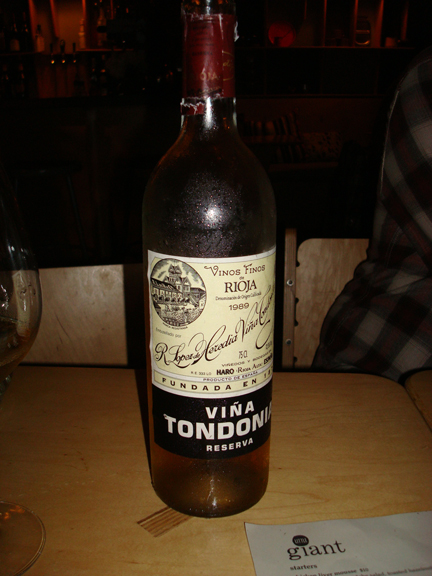
Despite her concern that the wine would be too oxidized for our palates, our waiter brought us a bottle of Rosado 1995 by Lopez de Heredia. I can understand her reluctance: old rosé from Spain is not everyone’s cup of tea and does not have the fruit forward mouth and nose that blush lovers expect. I do find it strange however — and this happens a lot — that waiters and sommeliers tell people the wine is “oxidized.” I know what “oxidized” means and I like oxidization in certain wines (when it is intended by the winemaker). But I can’t imagine that the term means much to unititiated wine drinkers. Couldn’t she have said something like “the wine won’t have the fruit that you might expect from a rosé”?

Rosado_at_il_Buco

I love Lopez de Heredia and drink and buy the wines when I can find them. The 12-year-old rosado was bright and full of life, had structure, and a rich nose. It went well with the octopus and potatoes — a favorite dish there.

The wine director at Il Buco, Roberto Paris, and I have been friends many years and he always surprises me with the bottles he opens for me. He had given us my favorite table, where we had a great view of Sandra Bernhard‘s table (I’m a fan and couldn’t help to do a little star-gazing). We were thinking about doing the 1987 Rioja from Lopez de Heredia but Roberto promised he had something special that he knew we would love.

Heredad_Corinda_at_il_Buco

He disappeared and came back a few minutes later with a wine that “no one orders because they don’t know it”: Heredad Corinda Gran Reserva Rioja 1970 (embotellado por Bodegas Herbasa) — yes, 1970!!!. Flip and I particularly enjoyed the nose of this wine and in the mouth, it was rich but so light. Roberto’s wine knowledge is fantastic and we were all blown away by the wine, paired with some goat’s and cow’s milk cheese and prosciutto.

By the end of the night, the conversation had turned to Flip’s work and the many famous guitars he’s worked on over the years. I had been waiting to ask him about Paul McCartney’s 1963 Hofner bass, “the most famous guitar in the world,” as Flip put it. He worked on it some years ago.

“They flew it out to NY on the Concord,” he said. “It had it’s own seat on the plane and its own bodyguard,” who, evidently, remained in the guitar’s presence the whole time Flip worked on it. Flip also recommended seeing Will Lee’s Fab Faux Beatles cover band, which, he said, plays amazing versions of tracks from the White Album.