Say it ain’t so: reporter claims that Banfi’s 03 Brunello contains grapes other than Sangiovese

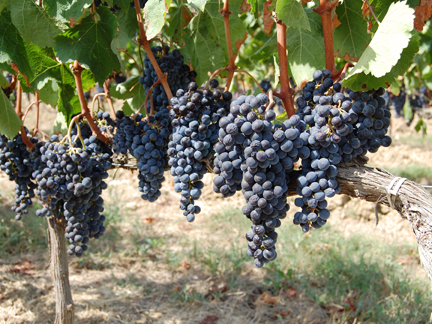
Above: “no hunting allowed.” Photo courtesy VinoalVino.

Ne nuntium necare. I’m really sorry to report that, according to at least one Italian news service, Banfi’s 03 Brunello contains grapes other than Sangiovese. Read our post at VinoWire and for those of you who speak Italian, read Franco’s post.

I’m in Montalcino as I write this and I am speechless. Non ho parole. This sucks.

Italy day 2: desperately seeking Sangiovese

Above: in my book, penne should be rigate di rigore (obligatorily ridged as opposed to smooth). Otherwise, the pasta doesn’t absorb the sauce properly. Yesterday at Il Poggione in Sant’Angelo in Colle (Montalcino), we were served penne from Gragnano dressed with a rich ragù.

Yesterday, My Life Italian wrote a post about that “epiphany” wine where it all got started. Wine, she wrote, is a “stained-glass window to the world, a way to touch another culture… a way to travel that is much more visceral than vicarious.” The post got me thinking about my own “epiphany” wine.

Above: lunch began with classic Tuscan antipasti — prosciutto toscano, salame, chicken liver and spleen crostini, and a slice of saltless Tuscan bread drizzled with extra-virgin olive oil.

It was nearly twenty years ago that I first came to Montalcino, to stay in my friend and composer Michael Convertino’s apartment in Bagno Vignoni, a small village in the south of the township, where a Roman hot springs bath still dominates the main piazza. I became friends with Riccardo Marcucci and his brothers Leonardo and Andrea. Riccardo ran the wine program at his family’s hotel and he took it upon himself to teach me about Tuscany’s grand winemaking traditions. It sounds unbelievable now but every night we opened bottles of Sassicaia, Solaia, Ornellaia, Tignanello, Pergole Torte, and every other Bordeaux-inspired wine under the Tuscan sun. The year was 1989, the Super Tuscan craze had not yet begun in the U.S., and the wines didn’t command the prices they do today.

Above: next came stewed wild boar and beans. Not very photogenic but delicious.

But my “stained-glass window” wine was the wine their father Augusto used to make. 100% Sangiovese vinified in a natural style (natural yeasts and no temperature control) and aged in large old oak casks. I’ll never forget the night (it was 1994 by then) that my then band was invited to dine at Augusto’s home on the hill above the village. We ate fried wild boar liver (from road-kill boar that Augusto had collected and frozen), drank Sangiovese, smoked and told jokes late into the night. Augusto couldn’t understand a word we were saying but he laughed and clowned with us all through the evening. We played a show the next night in the town piazza.

Above: the stars of lunch were a 1997 Brunello di Montalcino Riserva and an 18-month pecorino. What a fantastic pairing. We tasted the ’97 side-by-side with the 2003. Both vintages were warmer than usual in Montalcino. The 2003 is still very tight and will need many years in bottle to come around. The ’97 was showing beautifully. It will be great to come back to the ’03 in 5-10 years or so.

The same way a junkie seeks forever to recreate that same first high… I’ve been looking for the flavors and aromas of Augusto’s Sangiovese since that day.

Epilogue: in May, Eric le Rouge and I had a chance to taste Il Poggione going back to the 1970s. I’ll do a post on our tasting when I get back Stateside.

Italy day 1: Trattoria Il Pozzo, one of my all-time favs

Above: twilight in the Val d’Orcia (Orcia River Valley) is stunning. The sun was setting as my friend Ben and I arrived yesterday evening.

Whenever I come to Montalcino, Trattoria Il Pozzo in Sant’Angelo in Colle is at the top of my list. It’s one of the few classic trattorie that has remained unchanged since I first came here nearly twenty years ago. The cuisine is traditional Val d’Orcia fare, no frills and no fuss. And while the arista di maiale (the roast rack of pork loin) is excellent at Il Pozzo, one of the highlights of any trip to Montalcino is always the restaurant’s fiorentina, the Tuscan porterhouse (made from gigantic Chianina cows slaughtered young).

My dinner at Il Pozzo always begins with an assortment of crostini: chicken liver and spleen, tomato, and caramelized onions.

Pinci or pici are traditional hand-rolled long noodles, made with just flour, salt, and water. I like mine with ragù.

Ben had his with mushrooms. Also very good…

We had our choice of steaks: I would have liked to order the large one with the tenderloin, but in my book it’s the striploin that counts (more flavorful) and I didn’t want to overdo it on my first night in Montalcino.

Now that’s one MEAN PIECE OF STEAK!!! I’ve been to Il Pozzo with winemakers in the past and the ladies who own and run it are always cool about bringing your own wine. But last night we just did a simple old-school, food-friendly “locally produced” Sangiovese.

Trattoria Il Pozzo
Piazza del pozzo, 2
Sant’Angelo in Colle
53024 – Montalcino (SI) Italia
Tel. 0577.844015
closed Tuesdays

****

I am currently blogging from Le Logge, a classic Montalcino mainstay, and the ONLY place I can find to get online in this town!

I can’t find a listing on Google for Le Logge (man, this place is old school, but how cool is that, that they have free wifi? Some German girl at an enoteca down the road overheard me asking about internet and hipped me to it. There’s no sign or anything.).

So I’m just reading the address from the street: 1 Via Giacomo Matteotti.

That’s 2005 Canalicchio di Sopra in my glass. I think that Canalicchio may have declassified some of its Brunello in 05 (a warm vintage) and this wine is drinking really well right now.

Bees in Berlin

Above: Céline Dijon (Verena Wiesendanger) and Bonnie Day (Emily Welsch) had so much fun dancing the night before in Frankfurt an der Oder that they had to recreate their dance moves the next morning on the train back to Berlin.

Sunday, Nous Non Plus took the train back to Berlin where I spent the afternoon and evening with my childhood friend Noah Isenberg, who’s on sabbatical in Berlin this year (he’s a professor of German), his wife Melanie Rehak, and their gregarious son Jules. The four of us had a leisurely stroll in their neighborhood in Berlin, Prenzlauer Berg, ate a sandwich and drank a Radeburger, and hung out at their favorite playground, or spielplatz as Jules likes to say.

Above: there are so many bees in Berlin at the end of the summer that shopkeepers have no choice but let them have the run of the place.

Noah’s guide to Weimar cinema is to be released later this year and Melanie has just completed a book on a favorite restaurant of hers in Brooklyn (the name of which I cannot reveal! to be published by Houghton Mifflin Harcourt).

After Jules was put to bed, we stayed up late, talking and talking and sipping a nice, very food-friendly Zweigelt, which weighed in at 13% alcohol and paired well with a much-needed, simple and wholesome repast of roast chicken, potatoes, and cauliflower.

Today, I leave for Montalcino… stay tuned…

Above: Radeburger and a cheese sandwich really hit the spot on a lazy summer afternoon in Berlin.

Above: people are really into vintage scooters in Berlin.

Above: Jules really loves this über-cool pirate ship in his favorite spielplatz.

Dany le rouge

Nous Non Plus had a rocking time last night at the Bridging the Gaps Green Party party in Frankfurt an der Oder. But the real star of the evening was Daniel Cohn-Bendit (above, dancing), Dany le rouge (Danny “the Red”), one of the leaders of the student protests in May 1968 in France and the co-president of the European Greens–European Free Alliance in the European Parliament. He had just delivered the key-note talk, where he spoke about the crisis in Georgia and the Greens’ role in moving forward.

The party was fantastic, we did three encores, and then we danced away into the night with lots of new Green friends. Nous Non Plus has played a lot of crazy shows in our time but never had we seen a conga line in the audience. What a great crowd and what a great time. That air kiss above? The recipient knows who she is ;-).

Lunch in Poland

Above: Nous Non Plus was reunited yesterday afternoon at the train station in Berlin and headed down to Frankfurt an der Oder to check into our hotel and sound check for our show tonight.

After sound check in Frankfurt an der Oder and a good night sleep (much needed), we walked across the bridge to Słubice, Poland. What a thrill for me to return to the country where most of my great-grandparents and a lot of great aunts and uncles were born (of course, that was another time and they all left because their lives were pretty hard, pretty much all of them before the Russian Revolution). My last name, Parzen (which comes to me through my grandmother’s second marriage, not through kinship), was the name of a shtetl outside Warsaw.

We found an awesome little smoke-filled place in the heart of the local market (the bazar) called Smakosz. Kielbasa, schnitzel, and skewers of roast pork cubes alternated with lard and onions, and a variety of pickled cabbage salads. Seems we found the best place in the market because it was packed. If you ever make it to Słubice, definitely check it out. The food was fantastic and the beer cold.

Above: the facade at Smakosz. The girl behind the counter told me they have another location in town.

Above: chanterelle mushrooms are in season and many vendors had them for sale.

Above: the ladies in the butcher shop had a laugh when I asked if I could photograph the sausage.

Above: a view from the Oder river that divides Słubice and Frankfurt.

Above: Jean-Luc Retard aka Dan Crane aka Bjorn Turoque really enjoyed his lunch in Poland. Dan’s nickname in the band is “Snackboy Junior” or just “Snack” because of his propensity to snack. He arrived in Germany from Finland where he had MC’d the International Air Guitar Championships (I’m not kidding).

Holy tomato

My flight for Berlin leaves shortly but I couldn’t take off without posting on my dinner last night with my buddy David Schachter at Il Grano in West Los Angeles. During the summer, Chef Salvatore Marino (from Naples) does an all heirloom tomato menu using fruit he grows in his yard in Hancock Park (Los Angeles). David and I did six small-plate dishes featuring the sweet solanaceae. Highlights were chef Salvatore’s tomato risotto with candied lemon peel and his “PBT”, a prosciutto, burrata, and tomato sandwich served on toasted white bread. The crudo was also excellent and the sepia-ink grissini were pretty darn sexy.

Chef Salvatore rightly calls his menu the “sagra del pomodoro” or tomato festival.

Salvatore’s playful take on the BLT, his PBT.

David brought 2004 Silex and I brought La Chablisienne 2004 Chablis Premier Cru. Both wines paired well with the acidity and sweetness in the many different types of tomatoes we tasted.

The sagra del pomodoro continues for a few more weeks at Il Grano. Definitely worth checking out.

Il Grano
11359 Santa Monica Blvd
between Purdue and Corinth
Los Angeles, CA 90025
(310) 477-7886

Montalcino: the next step? Angelo Gaja weighs in.

Above: that’s my good friend Robin Stark (center right) tasting with legendary Piedmontese winemaker Angelo Gaja on one of her wine-themed bike trips in Piedmont. Our mutual friend Terry Hughes over at Mondosapore likes to call me Zelig but Robin makes me look like Forrest Gump!

Legendary winemaker Angelo Gaja made news today when he published an open letter calling for changes in Brunello appellation regulations that would allow for the use of grapes other than Sangiovese. I have translated an excerpt at VinoWire.

As I get ready for my trip to Germany and Montalcino, I wish I had time to translate the entire letter, which is already creating waves in the blogosphere. But I’ve been busy working on the production of our record, getting ready for my trip (see below), and taking some time out to stop and smell the roses (yellow roses, in this case).

Angelo Gaja is one of the most charismatic and interesting figures in the world of Italian wine — and the world of wine period. I’ve met and tasted with him on a few occasions, including once at the winery. The Gaja winery is a unique experience, an objet d’art in and unto itself, where modern sculpture and architecture live side-by-side with the wine. Years ago, Gaja caused a controversy when he proposed that the Barolo and Barbaresco appellations be changed to allow for the use of international grape varieties. And after he was unsuccessful in his bid to revise the appellations, he declassified his site-designated wines. No one knows exactly what he puts in them but they are among Italy’s most collected — if not the most collected. A long-time proponent of barriqued Nebbiolo, Gaja makes wines that even the most fervent detractors of new oak aging will gladly drink. I’ve tasted Gaja back to 1971 and have to say that his wines are simply exquisite. He also produces high-end wines in Montalcino and Bolgheri.

Here’s a interesting passage that I translated but didn’t include in the post at VinoWire.

    In the 1960s, there were less than 60 hectares of vineyards planted to Sangiovese earmarked for the production of Brunello di Montalcino. There were roughly twenty producers, and no more than 150,000 bottles were produced [every year]. In the same period, there were 500 hecatres planted to Nebbiolo in Barolo, 115 producers/bottlers, and 3,000,000 bottles of Barolo produced annually. While Barolo did not have a leading figure, Brunello di Montalcino already had Biondi Santi: its founding father, an artisan who over time had raised the flag of quality high and he had also raised the price of his aristocratic, rare, and precious Brunello, available only to the few who could afford it.

    And then came Banfi…

He doesn’t take issue with Banfi but he reveals how the expansion of Sangiovese vineyards, spearheaded by Banfi, led to many “large” producers (as he puts it) planting Sangiovese in growing site that don’t have the right soil and climate conditions to grow superior Sangiovese. This phenomenon, he says, is what led to the current controversy there. It’s important to note that Banfi’s expansion and extremely successful marketing of Brunello made the appellation a house-hold name in the U.S. I remember the first time I saw a bottle of Brunello at the supermarket in La Jolla in the early 1990s: it was Banfi.

I wish I had time to translate the entire letter but you can read it in Italian here.

Germany, get ready for Nous Non Plus

Above: Nous Non Plus’ new release “Ménagerie” will be available on Aeronaut Records sometime in November. Stay tuned…

I haven’t even finished posting about my April trip to Europe and here I am about to depart for Germany, where I’ll be performing with NNP (that’s short for Nous Non Plus) at Viadrina University (near Berlin) on Saturday night. We’re doing a show as part of the Green Party’s “Green European Summer 2008 Bridging the Gaps” festival (scroll down to Saturday August 30 for show info). If you happen to be in or around Berlin on Saturday, please come on down (the show is free and you can always email me to let me know you’re coming since I’ll have my blackberry with me).

On Monday, September 1, I head down to Montalcino where I’ll be tasting and talking to winemakers, trying to find out what’s happening “on the ground,” so to speak.

So please stay tuned!

Reports of August 15 hail in Montalcino confirmed

At least one grower has confirmed reports of an August 15 hail storm in Montalcino. I’m sad to report that the 2008 harvest was damaged (up to 35%, according to the post) but I am glad to see that someone in Montalcino is bringing much-needed transparency to the appellation. Franco was the first to post about the storm, which occurred last Friday, and until now, no one had stepped forward to confirm or deny the report.