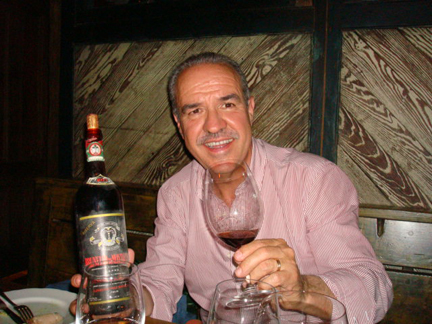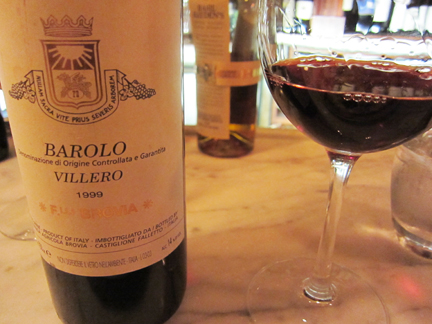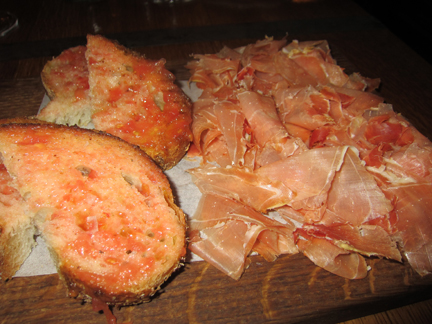
Photo by Giovanni.
Heading this morning to New York City for meetings and some wine bar hopping… See you on the other side…

Photo by Giovanni.
Heading this morning to New York City for meetings and some wine bar hopping… See you on the other side…

The Cuttlefish risotto at Ciao Bello in Houston the other night was so good that it nearly made me cry.
And it inspired a conversation about the “last taboo” of Italian gastronomy: the pairing of dairy and seafood.
I was at the restaurant doing a media dinner for my friend and client Tony Vallone, who shared the following anecdote about a luncheon in Naples a few years ago.
One of the guests, he said, an Italian-American, asked for grated Parimigiano Reggiano with his seafood pasta. The waiter politely responded that the restaurant didn’t serve cheese with seafood dishes. When the guest insisted, the waiter acquiesced, telling the patron that he would bring him the cheese. He disappeared, only to return after the gentleman had finished eating his pasta. “You see,” he said, “the dish didn’t need the cheese,” adding “in Italia si fa così,” this is how we do things in Italy.
The Italian taboo of mixing dairy and seafood stretches back to the Renaissance, when widely embraced Catholic customs required abstinence from dairy and meat on the numerous Lenten — di magro — days in the religious calendar. The bottom line: when seafood was consumed, dairy and meat were not. (I don’t have time to post about this today but this element of Renaissance cookery came to mind when I read Mark Bittman’s recent NY Times editorial on faux chicken; Renaissance cooks were obsessed with creating faux food, a gastronomic phenomenon that I called “culinary anamorphism” in a piece I wrote for Gastronomica some years ago.)
Of course, Tony’s cuttlefish risotto was made without the use of cheese (even though so many chefs in Italy and the U.S. discreetly fold some grated Parmigiano Reggiano into their seafood dishes). The secret to its creaminess? Tony had his chef caramelize and emulsify onions and then add them a few moments before the rice (Carnaroli) had cooked through. The viscous liquid gave the dish the all’onda texture that Tony likes in his risotto (whether sea- or landfood).

And it seems that we weren’t the only ones thinking about the “last taboo” of Italian gastronomy this week.
Today, Aldo Fiordelli, one of my favorite Italian-language food and wine bloggers and writers, posted this photo of “Linguine limone sgombro capperi essicati e parmigiano vacche rosse di Cristiano Tomei dell’Imbuto di Viareggio” (linguine tossed with lemon, mackerel, dried capers, and Red Cow Parmigiano Reggiano by Cristiano Tomei at the restaurant Imbuto in Viareggio).
Aldo notes that more and more Italian chefs are taking the bold step of using cheese in their seafood dishes, calling it their “last prejudice.”
Tony always says that for Italian cuisine to be authentic, it must also be creative. But I don’t think he would ever serve a dish like the one described by Aldo.
But hey, when in Viareggio, why not take a walk on the wildside?
From the department of “Where do I begin? To tell the story of how great a love can be?”…

Above: Tracie P with Lou Amdur at a Kermit Lynch tasting back in May 2009 in San Francisco. Tracie and I had just been engaged.
It’s hard to explain the intrinsic role that Lou Amdur has played in our lives.
Lou and his Lou on Vine have been the backdrop for some of the most special moments of the last three years. It was the first place I took Tracie P (then B) when she visited me in California for the first time. It’s where I met Comrade Howard for the first time. It’s where Anthony and I would go nearly every week when I was living in Los Angeles. The first time I went there it was for a book reading by Alice.
Across the nation, from the New York Times to the Los Angeles Times, the wine world is reeling from the news that Lou is closing his amazing wine bar.
So many great wines tasted there. So many thrilling wine tales recounted. So many wine personages encountered.
But none greater than Lou, who could always — always! — surprise you with what he was pouring, a rare grape variety he was excited about, a biodynamic Pecorino that really turned him on…
I really liked this elegiac post by Cory (and recommend it). It reminded me of how Lou brought so many of us together — despite the vitriol that so often surfaces on the Natural wine scene.
He was our rabbi and Lou was his synagogue — a συναγωγή, a bringing together, etymologically speaking.

Where do I begin?
To tell the story of how great a love can be
The sweet love story that is older than the sea
The simple truth about the love he brings to me…

Lil’ Georgia P was three months old yesterday (thirteen weeks) and she’s not so little anymore!
She’s starting to sit up straight and to turn her head side to side. And man, she loves to talk! It’s just baby talk but she just goes on and on as if she’s carefully explaining something very important…
I’m on the road today in Houston. I never really knew what loneliness was until I had to be separated from my femminucce. But Tracie P takes lots of photos (like this one) and sends them to me throughout the day.
How sweet it is to be loved by her…

As thrilling as Etna is right now on the U.S. wine scene, the Southern Italian wine and grape that I am the most excited about are Cirò and Gaglioppo.
When I was in Los Angeles week before last to spend some time at Sotto, a New York-based importer tasted me on (as we say in the biz) the wines of Scala in Cirò (Calabria) — a winery I’d never heard of.
Both the Cirò Classico (above) and the Cirò Riserva (below) wowed me with their freshness, focus, and balance of earth, fruit, and acidity. Gorgeous, thrilling wines, imho…
Currently, Gaglioppo is relatively unknown in the U.S., despite the ever growing interest in indigenous grape varieties (I tasted a Piave Raboso the other night in San Antonio, btw!).
But tasting these wines, I begin to understand the high praise that writers of another era like Mario Soldati and Norman Douglas reserved for the caliber of winemaking there.
“The wine of Cirò,” wrote Douglas, “is purest nectar.”
I’m with Alfonso when he sings Mama, don’t let your (Gaglioppo) babies grow up to be Cabernets…

On the “wine” page over at Sotto in Los Angeles, where I curate the wine list, there’s a link that allows guests to email me their questions. They mostly write to ask if we allow corkage…

From: A.
Date: Mar 9, 2012 8:17 PM
To: Jeremy Parzen
Subject: Do you have beer?
Hi Jeremy,
We’re looking forward to our dinner at Sotto tomorrow evening, but I had two questions.
First, do you have any beers available?
Second, do you have a corkage fee if we can’t live without our California wine?
Thank you,
A.
From: Jeremy Parzen
Date: March 10, 2012 8:20 AM
To: A.
Subject: Re: Do you have beer?
Hi A., thanks so much for your interest in Sotto.
We do have beer available, yes.
And corkage is $25 per bottle with a 2 bottle max.
We also include Californian wine on our last — all by Natural winemakers (i.e., chemical-free farming, spontaneous fermentation via native yeast, and low sulfuring).
Here are a few great articles on the etiquette of corkage, one by Lettie Teague and another by a northern Californian connoisseur.
http://www.foodandwine.com/articles/corkage-for-dummies
http://forkandbottle.com/wine/corkage.htm
We have roughly 15-20 wines by the glass on any given day: your server will be happy to offer you a taste of any of them (and they are all available by the bottle).
I kindly ask you to consider that there is a reason why we have chosen the wines for our list: they pair exceedingly well with our chefs’ food. And they express our gastronomic aesthetic.
Please ask for the wine captain tonight. His name is Rory and he will be more than happy to find you a bottle that suits your taste and expectations.
And if truly you can find no wine from my selection of Southern Italian and Natural Californian, please feel free to take advantage of the corkage policy (although we hope that corkage will be reserved for unique, rare, and/or older vintages of special wines).
Thanks again and best wishes, Jeremy
—
Jeremy Parzen, Ph.D.
http://DoBianchi.com
http://twitter.com/DoBianchi
http://facebook.com/jparzen
From the department of “yes, last night while Tracie P ate her dinner, I sang my daughter A Chorus Line in its entirety and she LOVED it”…

One singular sensation
Every little step she takes.
One thrilling combination
Every move that she makes.
One smile and suddenly nobody else will do.
You know you’ll never be lonely with you know who.
One moment in her presence
And you can forget the rest.
For the girl is second best
To none,
Son.
Ooooh! Sigh! Give her your attention.
Do… I… really have to mention?
She’s the…
She’s the…
She’s the…
One!


Corkage and racism… These aren’t two words you’d expect to find in a binomial expression. But they are the words that flashed like burning embers in my mind the other night at Sotto in Los Angeles when two couples (right out of Real Housewives of Beverly Hills, facelifts, fake tans, shiny teeth and all) sat down and plopped a magnum of a wine that rhymes with joke (you know what I’m talking about), a Brunello I’ve never heard of, and a pack of Marlboro Lights on the table (no joke).
Before I get to explaining my thought process, let’s begin by revealing how offensive it is when restaurant goers do not follow the etiquette of proper corkage.
Lettie Teague wrote this excellent corkage guide a few years ago. And I also really like this guide by Jack Everitt on his site Fork and Bottle.
When it comes to corkage, there are three things that everyone seems to agree on: 1) find out what the corkage policy is before you visit the restaurant; 2) bring something truly special and ideally rare (not something readily available) and offer the sommelier a taste; and 3) order a bottle comparable in value from the list (and leave a generous tip for your server who’s check is reduced as a result of the corkage).
The couples that came the other night already knew that we have a two-bottle limit. They thought that they could get around this by bringing a magnum (two bottles in one) and a 750ml. (It reminded me of a story about an undertaker who got a ticket for using the carpool lane with just him and a cadaver in the van.) It was as if they were saying (and in fact, they were shouting at the top of their lungs): we love the food (and the A-list celebrities) here but we think the wine list sucks and we can’t drink your crappy wine…
And here’s the part where their attitude became racist in my view.

Our wine captain informed them that the magnum counted as their two bottles of wine and so they were forced to order something from our list. Otherwise, how could they get their drink on between smoke breaks?
A server brought them the list and I approached the table and asked the hair-plugged gentleman who seemed to be in charge of alcohol consumption, very politely, “may I answer any questions about the wine list for you, sir?”
He looked up at me and said dismissively, “no, I think we’ve got that covered.”
He ordered a glass (yes, just a glass!) of Lioco 2009 Indica (Carignan and Grenache blend from Mendocino by one of my favorite Californian winemakers, Kevin Kelley).
It was then that I realized that his fear of “the Other” — in this case, southern Italian wine — overwhelmed any ounce of civility that his parents may have imparted to him during child rearing.* (In case you’re not familiar with the concept behind our wine program at Sotto, it’s devoted to southern Italian wine, with a short list of Natural wines from California.)
On the one hand, here was this slick angeleno, with his trophy wife and his Santa Rita Pinot Noir. On the other hand, our wine list must have conjured every southern Italian stereotype in the western canon.
Granted, our list is esoteric by any measure. Even Italian wine professionals will tell me that they don’t recognize many of the wines I have sourced for the list.
But his gesture was a sweeping dismissal: it was abundantly clear to me that in his view, there was no wine from southern Italy that he could possibly drink.
And that, my friends, is racism in flagrante delicto.
When you work in a restaurant, you have to de-sensitize yourself to rudeness. It’s part of the deal. But this is where I draw the line…
Thanks for reading and please treat your servers and sommeliers well!
* Hegel was among the first to introduce the idea of the other as constituent in self-consciousness. He wrote of pre-selfconscious Man: “Each consciousness pursues the death of the other”, meaning that in seeing a separateness between you and another, a feeling of alienation is created, which you try to resolve by synthesis. The resolution is depicted in Hegel’s famous parable of the master-slave dialectic. (Wikipedia)

Photo via Grub Street.
Beyond writing about wines under $25, my mission as wine writer at the Houston Press is to offer coverage of fine wine in Houston and Texas.
So what could be better than an interview with my friend Ray Isle, Houston native, who’s on his way to Texas next month for the Austin Food & Wine Festival?
You can read the interview here.
And here are his thoughts on Italian wine (topic of one his seminars) that didn’t make it into the Houston Press post:
Ray is such a cool guy… I’ve promised him a night of honkytonking while he’s out here. Ginny’s Little Long Horn Saloon, anyone?

“Frank Cornelissen came from Belgium to Etna,” wrote Eric the Red in a recent New York Times piece, “where he makes extreme wines unlike almost any others on earth, which people tend to love or hate.”
Cornelissen’s supremely polarizing wines are a wine director’s worst nightmare. Because they are entirely unsulfured, there is extreme bottle variation in any allocation and secondary fermentation (and the resulting spritz) is more common than not. Because they are unfiltered and unfined, the wines are cloudy and have all kinds of nasty looking bits floating around in them. And the volatile acidity in the wines — there’s no way around this — can make them smell like shit when you first open them.
So why did I put them on my list at Sotto in Los Angeles (where I’ve been curating the carta dei vini since the restaurant opened on March 5, 2011)? And why did the general manager, Dina Pepito, agree to let me, against her better judgment?

It’s a lot easier to serve Cornelissen’s wines at home, where you have all the time in the world to let them rest upright and let their sediment fall to the bottom. When we’ve served them in our home, we made sure to give them ample time to repose and we’ve drunk them over the course of an entire evening, following along as the wine changed from first glass to last.
When I worked the floor at Sotto on Saturday night, there were ninety people on the waiting list trying to get in. It’s one of the hottest A-list tables in LA right now. And in all that hustle and bustle (between the CAA dick-waggers and the Chardonnay-drinking housewives of Beverly Hills), a sturdy Gaglioppo works great while a delicate Etna blend tends to be unsettled by the roaring din of the rich and famous.
And even though the allocation we managed to get certainly doesn’t meet the criteria for “fine wine,” we store the bottles with our verticals of Taurasi, Cirò, and Graticciaia because the wines need to be handled with the same gentle tenderness.
When the wines became available to us thanks to Amy Atwood Selections, I put them on the list because I wanted to offer our guests Natural winemaking in its most extreme expression. From the Natural wine police to the consumerist hegemony of wine punditry in the U.S. today, everyone agrees that 1) these are impeccably Natural wines; and 2) they represent, to borrow an expression from Roland Barthes, “wine degree zero.” These are wines to which literally nothing has been added. Nothing, zero, zippo… (If you don’t know the wines, read this profile by Matt Kramer in the Wine Spectator, of all places!)
And of course, I wanted our wine list to reflect the renaissance of winemaking that’s taking shape on the northern slopes of Mt. Etna.
I sold a couple of bottles of the wine over the last weekend (when I was visiting for staff training and to “work the floor”).
One was to a table of wine geeks who had read a preview of the list in one of LA’s sea of food blogs. It was amazing to watch their eyes light as the stink blew off and they slowly nursed the wine. “I’ve never tasted anything like this,” said one. “The wine is slightly sparkling,” noted another.
I sold another bottle to super glam Eastern European lady (Hungary?) who sported a Farrah Fawcett hairdo and who was in town to visit her daughter, who was dining with her.
“I cannot drink wines with sulfites,” she told me. “I break out if I drink wine with sulfites. I can only drink natural wine,” she added, clearly unaware of what the volatile term natural can mean to wine professionals these days.
“As it just so happens,” I said, “I have a wine to which, I am 100% sure, no sulfites have been added.” (We actually have a couple on the list.) And I opened the Contadino (the same as in the photos above).
She wasn’t entirely thrilled by the wine but she didn’t send it back. She was normally a “Merlot drinker,” she told me. And in one of the most bizarre moves I’ve ever seen, she ordered coffee after dinner but kept nursing the wine with her coffee. (Disgusting, right?)
I don’t think the wine made much of an impression on her. But I’m assuming, since she didn’t call to complain, that she didn’t break out the next day.
And in our small little way, we made the world a little safer for Italian wine…
Stay tuned for my next post about my recent visit to Sotto: “The Racism of Corkage.”