Want to go to Vinitaly? The Italy-America Chamber of Commerce has 10 sponsored trips available

A public service announcement…

If you work in the Italian wine business — whether as importer, distributor, restaurateur, or retailer — you already know that the industry’s annual trade fair in Verona, Vinitaly, represents one of the greatest opportunities to taste new releases and to interact with Italian winemakers and wine professionals from both sides of the Atlantic.

I’m pleased to share the news that the Italy-America Chamber of Commerce currently has 10 sponsored trips available for qualified wine and restaurant professionals.

The program is being administered by the Texas office of the chamber (where I serve as a consultant).

Before contacting their office in Houston, please be sure to register for the fair using this link.

(Make sure you select “Italy-America Chamber of Commerce Texas” as your point of contact to ensure that your application gets routed through the Houston office.)

Once registered, please contact the chamber’s deputy director for Texas, Maurizio Gamberucci, by clicking here.

The best news is that this year’s program will be focused on Vivit, the natural-organic-biodynamic pavilion at the fair.

If you’re a qualified buyer or restaurant worker (and servers qualify, btw), this is a great opportunity to get to Verona and the fair this year — for free.

I encourage you to apply and I hope to see you in Verona in April!

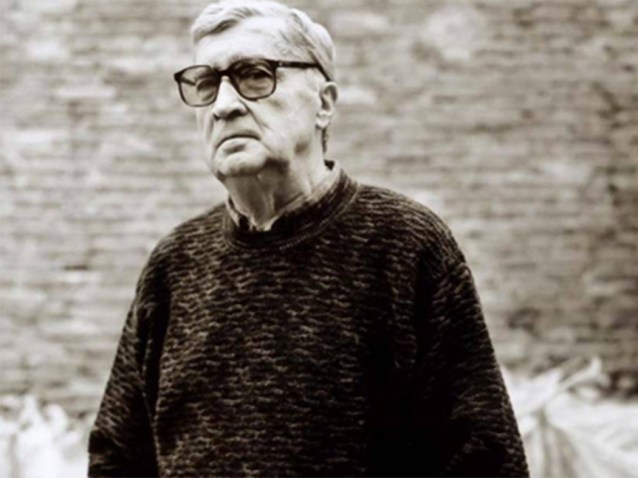
Bruno Giacosa, unrivaled “Nebbiolo whisperer,” dies at 88

The following excerpt comes from a 2012 lecture (lectio magistralis) delivered by Bruno Giacosa on the occasion of his honoris causa from the Slow Food University of Gastronomic Sciences in Pollenzo, Piedmont (translation mine).
    I was born in 1929 and one of my earliest memories is smelling the wine made by grandfather Carlo. That was also the year that my grandfather died and my father Mario took over his business. My grandfather Carlo had begun making and bottling wine at the end of the 1800s…
    He made classic Piedmontese wines, the same ones we know today: Mostly Dolcetto, then Barolo, Barbaresco, Nebbiolo, Barbera, Freisa, and Brachetto. Asti Spumante was the only white.
    Obviously, 1929 was also the year of the [stock market] crash. My father decided to stop bottling wine that year. Instead, he would buy grapes, which he would re-sell or vinify and sell as bulk wine. Back then, only a few wineries bottled wine under their own label. Most of them didn’t own there own vineyards. They would buy grapes from the so-called mediatori, brokers who served as intermediaries between grape growers and the businesses that made wine.
    I started working with my father when I was 16 years old, not long after World War II had come to an end. I would travel around the Langhe Hills with him, watching how he would buy and re-sell grapes; how he would distinguish the good fruit from the less favorable fruit; how he would remember which vineyards delivered the best results.
    At the time, there was also a grape market in Alba. My memory of the market isn’t a pretty one — a memory I share with the many farmers who would sell their grapes there. The brokers would wait until the very last moment to buy, forcing the grape growers to sell at whatever price the brokers wanted and sending them home with empty crates. It was a bit of a sad affair, especially when there wasn’t a great demand for grapes from the bottlers.
    We preferred instead to go directly to the farms, in part because we could choose which grapes to buy directly at the source. After we would buy our grapes, I would also help the growers make a little bit of wine. They would either sell it as bulk wine or they would sell to the very same bottlers who bought their fruit. You could make a little extra money by making your own wine. But it had to be really good. Otherwise, you might not be able to sell it…
    I was just a boy then. And so I didn’t drink wine. But I quickly developed a good nose. I figured out that you had to pay attention to the aromas that would emerge from the grapes when you bit into them during the harvest. Then you would taste the must during fermentation. And then you would taste the wine. This was all you needed to know. I learned to use my nose as a means for gauging whether the wine was clean or dirty. And you could also tell whether or not the wine would age well; whether or not it was nuanced enough; whether or not it would ever open up; or whether it was better to blend it with other parcels; whether or not I should keep it for another couple of years in my cellar before bottling it; or whether it was better to sell it right away to someone else.
    Obviously, I have tasted thousands of wines. But I can guarantee you that my nose has rarely been wrong. And this is the thing that I keep repeating to young people: Learn to use your olfactory. Many people today think that your sense of smell isn’t useful. But it’s with your nose that you understand the most important things about a wine.

Read the entire lecture (in Italian) here.

Today, the Slow Wine blog called Giacosa “Nebbiolo whisperer.” And that he was.

There’s not an Italian wine professional among our contemporaries who wouldn’t point to his wines as some of the most compelling she or he has ever tasted.

My wife Tracie and I had the great fortune to taste with Bruno at the winery in 2010 not long after we were married. He was a gentle, soft-spoken man whose work and career shaped a generation of winemakers and grape growers. And with his extraordinary wines, he also shaped a generation of wine lovers. He will surely be remembered as one of the last great champions of traditional-style Nebbiolo and one of the indisputable architects of Langa’s viticultural revolution and prosperity.

Brune sit tibi terra levis.

Thank you for all the incredible wines that you shared with us over the course of your lifetime.

Image via the Slow Wine Guide blog.

The best Zinfandel I tasted in 2017…

From the department of “my other son, the wine writer”…

It’s not the first time that my fingers glide across my computer keyboard and deliver the following mea culpa to the screen: “California wine, I was wrong about you. And I’m sorry.”

My role as the coordinating editor of the 2018 Slow Wine Guide to the Wines of California has been an eye-opening and humbling experience for me (you can read our winery profiles for the 2018 guide, soon to be published in print, as they come online — free access — on the Slow Wine guide blog).

When Slow Wine editor-in-chief Giancarlo Gariglio first contacted me about joining the project, I asked him, “are you sure you have the right man?”

When he pressed on, I wondered out loud, “will we even find enough wineries to fill the pages of the guide?”

But I finally succumbed to his insistence, despite my skepticism and reluctance.

Man, was I wrong!

In early June I began visiting wineries in southern and northern California, tasting and talking with grape growers and wine makers. In late June, I joined my fellow editors — Giancarlo, senior editors Elaine Brown and David Lynch, and field editor
Elisabeth Fiorello-Sievers — for a tasting of more than 200 wines we had requested.

Over the summer, we traded notes, I wrote and I edited our contributors’ profiles, and we decided on the top wines and wineries that would be awarded the guide prizes.

I was simply blown away by how much great wine we tasted. And I was also impressed by how many wineries in California employ sustainable farming practices. In many cases, I learned, the sustainable legacy stretched back at least one or even two generations.

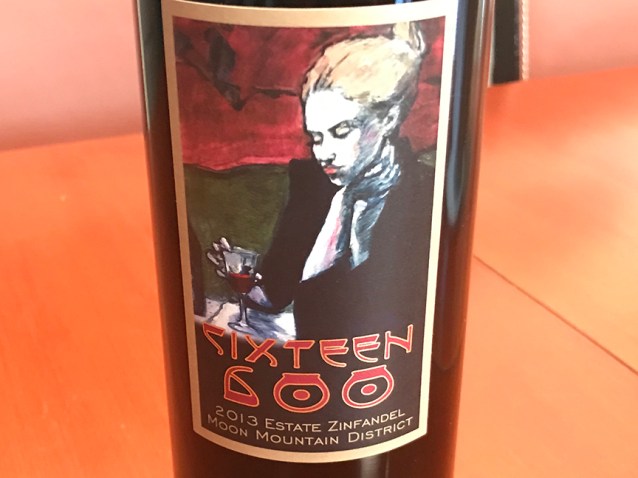
Although it didn’t win awards in this year’s guide, one of my favorite wines was the 2013 Moon Mountain Zinfandel by Winery Sixteen 600, made with fruit grown by biodynamic pioneer Phil Coturri. Named after the family’s address “on the mountain” (one of Sonoma’s most famous and storied houses, with ties — and tie dyes — to the Grateful Dead), the winery and tasting room is managed by one of Phil’s sons, Sam (whom you might recognize from yesterday’s post).

Not only was this lithe and fresh yet meaty wine utterly delicious, with buoyant red fruit and tasty minerality, but it reminded me of the Louis Martini Zinfandel from the 1970s that Darrell Corti (the renowned Sacramento retailer) once poured for me in his home.

When I shared that red thread with Sam, he smiled broadly and revealed that the cuttings for this wine actually came from the same vineyard where Louis Martini farmed its wines back in the day — before the overwrought, highly alcoholic and concentrated style of Zinfandel emerged as the new hegemony in the 1980s.

For years, the Coturri family has advocated for the Moon Mountain District and I believe Phil had a hand in lobbying for and creating the Moon Mountain AVA (in 2013). Not a lot of California wine lovers are aware of this newish appellation. But I believe it’s one of California’s most exciting wine growing regions, where more and more marquee-name wineries are looking to source higher-altitude, volcanic-soil fruit.

The Winery Sixteen 600 2013 Moon Mountain Zinfandel isn’t cheap. But it’s one of the purest and most elegant expressions of California’s antonomastic grapes. I loved it and highly recommend it.

Check out the 2018 Slow Wine Guide to the Wines of California here. Thanks for reading and buon weekend a tutti… have a great weekend, everyone!

Killer trees and a long road to recovery in California wine country (Slow Wine California Guide now online)

Beyond the myriad hand-painted posters thanking first responders for their efforts during the October wildfires, there weren’t a lot of signs that Sonoma wine country had been devastated by a natural disaster when I visited last month.
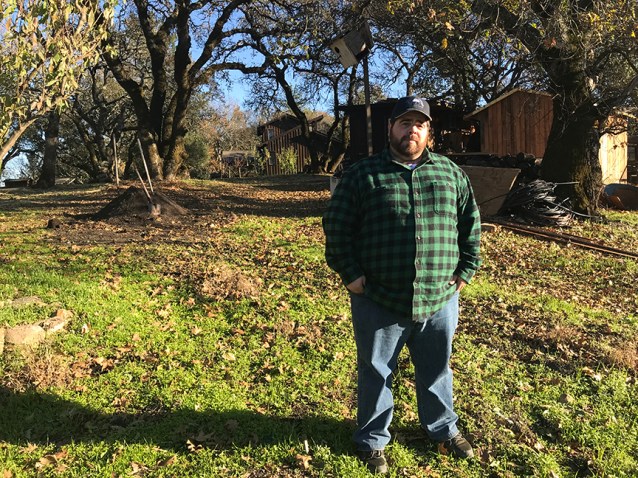
But when winemaker Sam Coturri invited me to jump into one of his company’s off-road trucks and we headed “up the mountain,” it didn’t take long for us to come upon blackened areas and “killer trees,” like the one above.

State recovery crews, he told me, remove some of the most dangerous burned-out trees. But many property owners are left to clear out the precarious “snags” as they are known in wildfire terminology. The government team marks them for you. But you have to remove them yourself.

Burned out trees and acre upon acre marred by damaged fences and cattle guards were just some of the issues that Sam was dealing with the day we visited in early December.

“Fuel… all I see is fuel, all around us,” he kept saying as we toured his family’s property and the farm where he grew up. He pointed to the dry brush that could instantaneously turn into kindling. The Coturris nearly lost their estate and beloved home in the October fires.
Word of the southern California wildfires had just begun to hit social media as he and I met up that morning. And it was abundantly clear that he, his colleagues, and his family were freaked out by the news they were receiving via text and private messages.

“Up here they call the Santa Ana winds the Diablo Winds,” he explained, referring to the notoriously hot dry air that arrives from the east this time of year.

The weather conditions that day were eerily similar to the day the Tubbs Fire first broke out.

At a certain point, Sam’s wife called him while we were in the car together. You could hear the fear in her trembling voice as Sam helped to soothe her nerves with loving words.

It’s going to be a long road to recovery for the California wine trade — financially and emotionally. As Sam pointed out that day, winemakers won’t know whether or not their 2017 vintage will be affected by smoke taint for many months to come. They have to let the wine age before they can properly test it.

There are also many other challenges they are facing, including a drop in tourist dollars and a housing shortage, just to name a few.

I’ll be catching up with Sam for updates to post here in coming weeks.

In the meantime, please check out the Slow Wine Guide blog where we have begun to post producer profiles nearly every day (many of the profiles online have been written by Elaine Brown, David Lynch, or myself). Some of the featured wineries will be joining us for the Slow Wine U.S. Tour in late February and early March.

There’s no better way to help in their recovery than by buying and drinking California wine.

No, we won’t get the f— out of here! Scenes from MLK march and Confederate monument protest

Yesterday at 3:00 p.m. sharp, I stood at the corner of Martin Luther King, Jr. Drive and U.S. Interstate 10 with two black women in Orange, Texas. We were the first to gather at a protest of the recently erected Confederate monument there. We were the only ones who had arrived at that point.
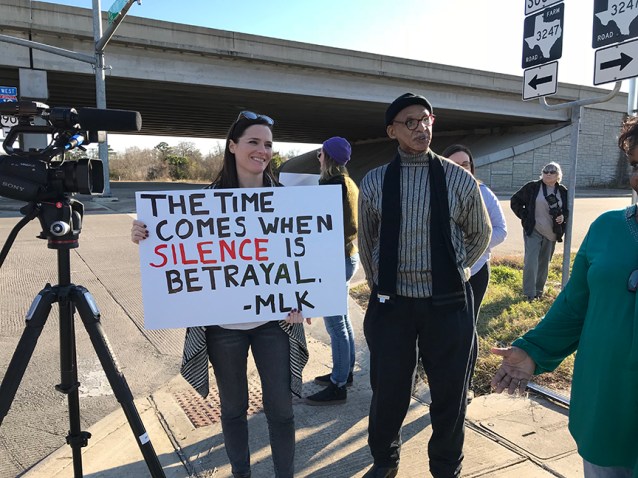
A pick-up truck with two men in it pulled up to the light and rolled down the passenger’s window. The driver, a large white man with light facial hair and a baseball cap, motioned for me to approach the truck. He then asked me what we were doing there.

“We are protesting the Confederate monument,” I replied. “We feel it is offensive to the community. We would like for the site to be re-purposed.”

“Get the f— out of here,” he yelled at me menacingly. “Get the f— out of here,” he shouted again, raising his voice even louder with an extremely aggressive tone.

He rolled up the window as he stomped on the gas and sped away.

“You could count the number of negative responses to our protest on one hand,” said one of the event’s organizers, Louis Ackerman, president and co-founder of Southeast Texas Progressives.
It’s true: during the two hours we were there yesterday, the overwhelming number of people who drove by gave us the thumbs-up or waved in solidarity.

But that man’s reaction and face continue to sear in my mind.

That’s my wife Tracie in the photo directly above. Reverend Franklin Gans, president of the local chapter of the NAACP, is standing next to her. She went to high school in Orange with his daughter. He and Tracie’s father, Reverend Randy Branch, worked together for years at the Dupont oil refinery there.

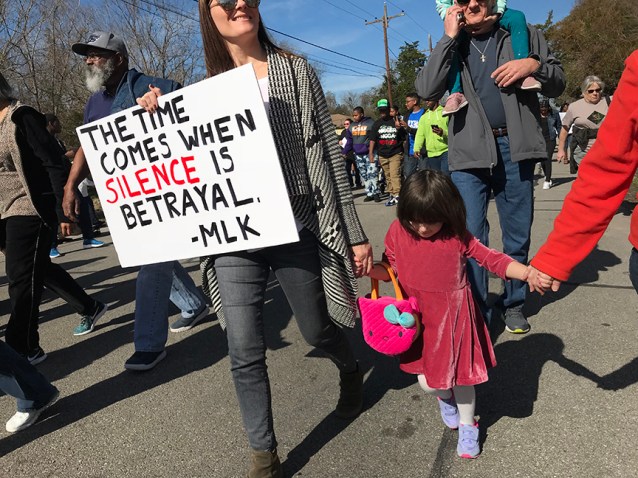
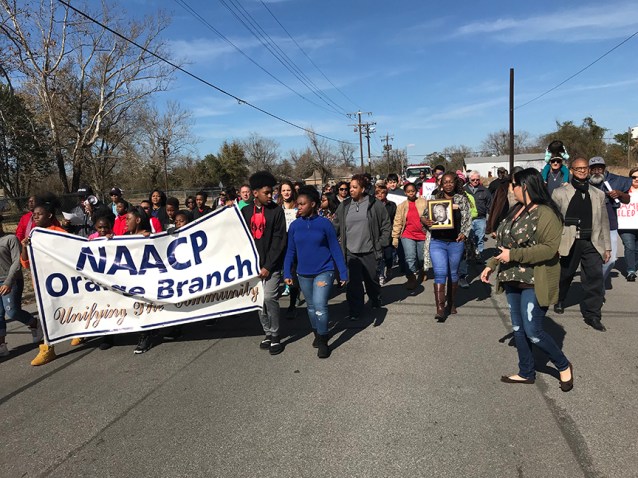
Earlier in the day, our family had joined the NAACP for its annual Martin Luther King, Jr. Day march. Randy and Jane, my mother-in-law, joined us, as did aunt Ida and uncle Tim. And of course, our daughters Georgia and Lila Jane marched with us as well (we didn’t take them to the protest that afternoon, for obvious reasons).

The local ABC affiliate did a story on our protest. Please check it out here. Linda, who is featured in the segment, was one of the women standing with me on the corner when the man in the truck rolled down his window.

Our numbers are growing and we are not going to stop until we get that site re-purposed. Stay tuned for details and please message me if you want to help or join us in our campaign. Our next protest will take place in a few weeks.

And please read this excellent column published yesterday by Evangelical Christian and conservative essayist Michael Gerson, a former speech writer for President George W. Bush and a longtime Republican.

“Racism is not a single issue among many to be weighed equally with tax or trade policy,” he wrote on Martin Luther King, Jr. Day. “Trump is at war with the central ideal of the Republic — a vision of strength through inclusion and equality that makes our country special and exceptional. The president is wrong — repeatedly and offensively wrong — on the centerpiece question of our history: Are there gradations in the image of God? The only acceptable, only American answer is ‘no.'”

The only American answer is “no, we won’t get the f— out.”

Thanks for reading and thanks for your support and solidarity. Stay tuned.

“We must see racism for what it is.” —Martin Luther King, Jr.

“There comes a time when the cup of endurance runs over…”
—Martin Luther King, Jr.

As Tracie and I were readying our signs for the NAACP Martin Luther King, Jr. Day March today in Orange, Texas where she grew up, I re-read the civil rights leader’s landmark speech “The Other America.”

The title alone, pregnant with meaning both historical and topical, was enough to make me leap from my chair.

And the following passage resonated like a kettledrum in America’s current cacophony of political discourse:

    There must be a recognition on the part of everybody in this nation that America is still a racist country. Now however unpleasant that sounds, it is the truth. And we will never solve the problem of racism until there is a recognition of the fact that racism still stands at the center of so much of our nation and we must see racism for what it is. It is the nymph of an inferior people. It is the notion that one group has all of the knowledge, all of the insights, all of the purity, all of the work, all of the dignity. And another group is worthless, on a lower level of humanity, inferior. To put it in philosophical language, racism is not based on some empirical generalization which, after some studies, would come to conclusion that these people are behind because of environmental conditions. Racism is based on an ontological affirmation. It is the notion that the very being of a people is inferior.

50 years have passed since King was murdered at age 39. And today we will march to honor him and his legacy.

I highly recommend this New York Times article, published yesterday, on black Americans’ “frustration and disappointment about the direction of the country.”

I also encourage you to visit and browse the Stanford University Martin Luther King, Jr. Research and Education Institute website. If you can’t march in solidarity today, please take time out to read one of his speeches.

Happy Martin Luther King Day! May G-d bless America, may G-d bless us all.

Image via the National Park Service Flickr (Creative Commons).

MLK MARCH and Confederate monument PROTEST Monday in Orange, Texas: please join us!

Please join Tracie and me on Monday, January 15 for the NAACP Martin Luther King, Jr. Day March in Orange, Texas.
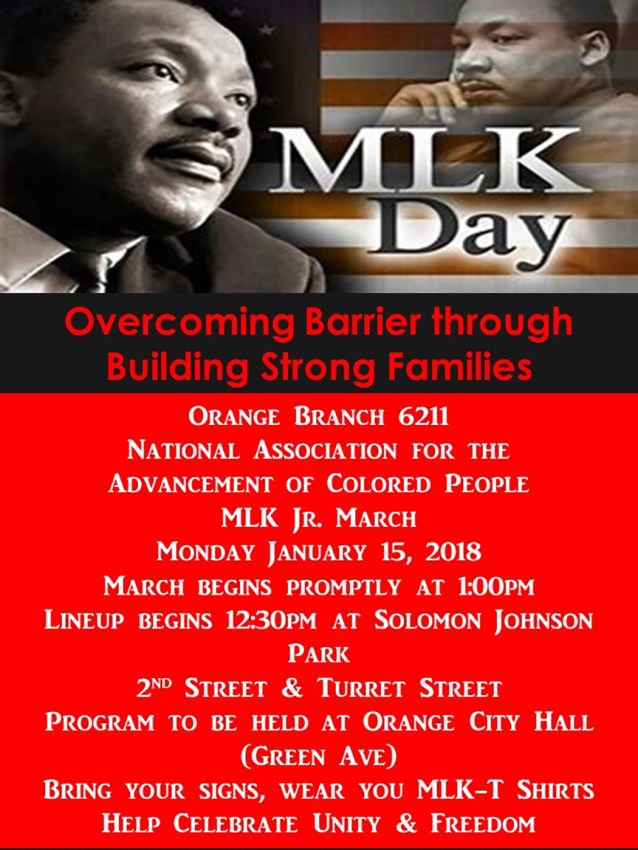
We will be meeting at Solomon Johnson Park at the corner of 2nd St. and Turrett Ave. at 12:30 p.m. for line-up. March will begin at 1:00 p.m.

Following the March, Tracie and I will be organizing a protest at the Confederate memorial at the intersection of Martin Luther King, Jr. Dr. and Interstate-10 (northwest corner). We are tentatively planning to meet at 3 p.m. and will stay there until sunset.

Here’s my email address if you need more info and/or want to coordinate a ride to Orange for the march and protest.

Yesterday evening the president of Southeast Texas Progressives Louis Ackerman and I met with the local chapter of the NAACP in Orange. Among the action items on our agenda, we discussed our family’s ongoing efforts to repurpose the Confederate memorial being built in Orange by the Sons of Confederate Veterans Texas Division. I’m happy to report that its board gave us its blessing in continuing our fight.

I’ve been researching the origins of the monument and I’ve discovered that the story behind the site is much more complicated than meets the eye. I’ll be writing about the memorial in coming weeks as more pieces in the puzzle come into focus. Please stay tuned: I’m confident that many readers will be surprised by what I’ve found.

The bottom line: despite what many have written and what many believe, ORANGE RESIDENTS DO NOT WANT THIS MONUMENT AND THEY WANT IT REPURPOSED. That’s all I can reveal at the moment…

PLEASE JOIN THE PARZEN FAMILY AT THE MARCH ON MONDAY AND PLEASE MEET US AT THE MONUMENT SITE AFTERWARDS FOR OUR PROTEST. WE ARE ENCOURAGING PROTESTERS TO USE QUOTES FROM MLK FOR THEIR SIGNS. WE WILL BRING EXTRA SIGNS FOR MARCHERS AND PROTESTERS. PLEASE SEE THE NAACP FLIER BELOW. HAPPY MARTIN LUTHER KING DAY!

Top image via Wikipedia Creative Commons. Lower image courtesy of the NAACP Orange Branch 6211.

Bruno De Conciliis: “Wine and may the dance begin,” a poem (translation mine)

Wine is a game, a serious game, a joyful game,
a heroic game, an erotic game, wine is skittish, it’s
joyful, it’s sad, it’s solitary, it’s a sea, it’s a road,
it’s a destination, it’s silence, it’s entropy.

Breathe.

White wine is green, yellow, gold, sometimes orange,
red is ruby, purple, violet, sometimes black.

Wine is instinct, science, pure creativity, painting, music,
Johann Sebastian Bach and Mozart, John
Coltrane and Jimi Hendrix; how is it possible
to drink a baroque wine listening to Purple Haze?

Wine, an intense pleasure, a happy thought, sometimes
requires, sometimes suggests, an undisputed star
or distant tapestry that takes a backseat to conversation
or food, the little pleasures to share with a
friend or a lustful torrent that enchants the viewer,
wine is a friend to humankind and it can be its
worst enemy, wine is happiness, simple sharing or opulence,
comfort in solitude, glue of friendship, wine’s solitary
pleasure creates deep friendships or becomes the
energy of a clique born from happenstance.

Wine is study, knowledge, an immovable journey,
curiosity and sloth, overwhelming passion,
a cruel struggle, a sincere friend who knows the way
you need to go or invents one where there is none.

Memories that lead us to tenderness or move us to laugh,
to smile, to enjoy, enemy of regret and blame, maternal bosom
where you can nurse until becoming aware.

Wine is born from deep within the land, from people
who are bound to it by an umbilical cord
that hasn’t been voluntarily severed, from the uniqueness
of that land, from the specific variety,
from the culture and knowledge of those people, that people.

Wine is the experience of that land, that culture,
the history of a village.

Wine and may the dance begin.

Bruno De Conciliis
(translated from the Italian by Jeremy Parzen)

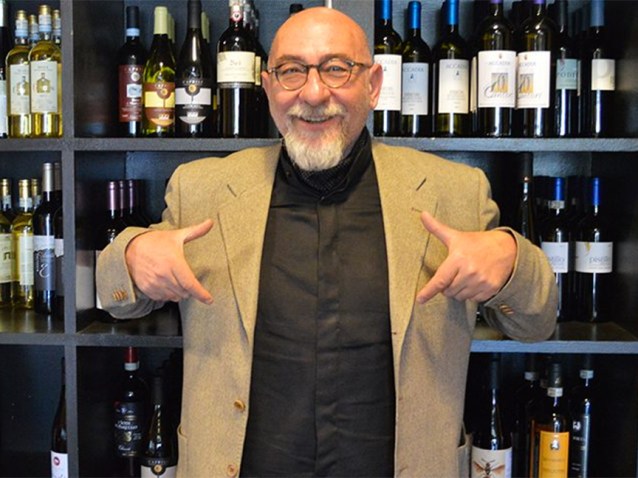
Bruno (below) and I will be leading a tasting of his wines at Sotto in Los Angeles on Thursday, January 25. Please join us. He’s one of the most fascinating grape growers and winemakers I’ve ever had the chance to taste with. And his wines are among the most compelling I’ve ever drawn to my lips. Stay tuned for details.

Protesting racist iconography in Southeast Texas: a recent effort and upcoming MLK march in Orange (TX)

Image courtesy of Southeast Texas Progressives.

On Wednesday of last week, my wife Tracie and I stood for two hours on the corner of Interstate 10 and Martin Luther King, Jr. Dr. in Orange, Texas in protest of the Confederate memorial being built there by the Sons of Confederate Veterans Texas Division.

We organized the gathering together with Southeast Texas Progressives, an advocacy and activist group created by its founders so that they and we could have “a place to express our shared ideals and political views without fear of being insulted or mocked.”

Here’s the Facebook group. Feel free to join and/or PM and I’ll invite you to join.

Here’s the Facebook page. Please like us and share in solidarity.

Our four-person protest was covered by both the Beaumont Enterprise and the Orange Leader. (Beaumont, Orange, and Port Arthur form what is known as the Golden Triangle in Southeast Texas.)

To get an incomplete picture of how our activism was received online, I encourage you to read the comment thread on the Enterprise site.
Continue reading