Coolest bar in Franciacorta, Andata e Ritorno (Provaglio d’Iseo)

giovanni arcari

After I put the girls to bed at the hotel in Erbusco (Franciacorta) last night, Giovanni (above) took me to the coolest pub in Franciacorta, Andata e Ritorno Stazione di Provaglio d’Iseo, a functioning regionale train station (see video below, shot right outside the pub). Great selection of local, artisanal beers, super cool crowd, and awesome metal and classic rock playlist.

andata e ritorno

The place has the feel of train station circa 1965 (andata e ritorno means round trip in Italian).

piadina

Piadina with prosciutto, mozzarella, and salsa rosa.

claudio bertazzoli

I really dug owner Claudio Bertazzoli’s playlist of virtuoso metal: Satriani, Steve Vai, Pantera… This dude knows his shit and digs the shredding!

Soldera & Brunello consortium spar

soldera montalcino consortium

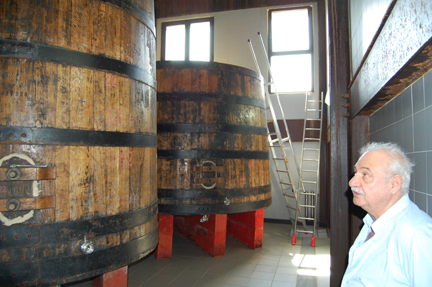
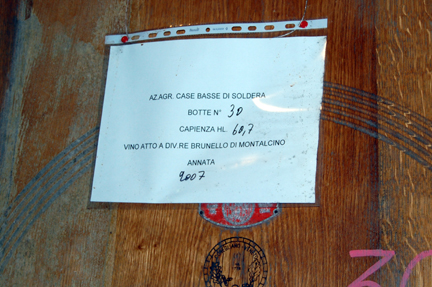
Above: Gianfranco Soldera with his fermentation casks (I took this photo in 2008). Every time I’ve visited and tasted with him, he’s spoken of the importance of fermenting in wood, “a breathing” vessel, he said repeatedly.

Adding yet another unsavory wrinkle to the sad tale of the now infamous act of vandalism (or “sabotage,” as the Italian media has called it) that took place in December 2012 at the Case Basse winery in Montalcino (more than 60,000 liters of wine destroyed), the estate’s winemaker Gianfranco Soldera and Brunello consortium vicepresident Donatella Cinelli Colombini publicly traded barbs yesterday.

In an interview entitled “Why I am leaving the consortium,” posted online yesterday by the Italian daily Corriere della Sera, Soldera told editor Luciano Ferraro that the consortium had “wanted to donate wine to me. I was supposed to bottle it as if it were mine, without knowing where it came from. [This was] an unacceptable and offensive proposal, a swindling of the consumer. I asked them [instead] to finance studies in Montalcino. But nothing came of it.”

In a post on her family’s winery’s website entitled “What on earth is Soldera saying?”, Colombini swiftly returned the volley.

“The meanest thing,” she wrote yesterday, “is the accusation that the consortium ‘proposed a swindling [of the consumer].’ How could it be that the producers give him a gift [by donating] a part of their production to help him in a difficult moment, thus creating a ‘solidarity Brunello,’ and he responds in this manner? Isn’t he ashamed of himself?”

In a press release issued by the winery on Friday of last week, Soldera announced — without explanation — that he was leaving the consortium.

He also revealed that he was able to recover a considerable quantity of wine “at the time of the damage.” The winery will resume sales, he wrote (after news of the vandalism spread in December 2012, prices for his wine skyrocketed and he stopped selling and shipping wine from his estate).

Bartolo Mascarello imported by Rare Wine Co. GREAT NEWS!

barolo town bartolo mascarello

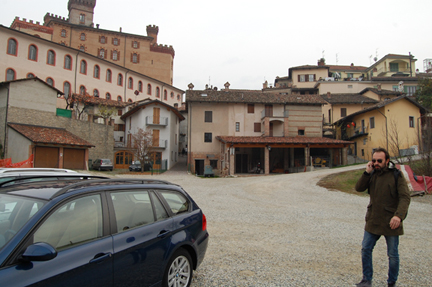
Above: In November of last year, Giovanni and I visited the village of Barolo and had lunch with Maria Teresa Mascarello, Bartolo Mascarello’s daughter and winemaker at Cantina Bartolo Mascarello.

Doug Polaner actually tweeted about this about a month ago but it’s now official: Rare Wine Co. in Sonoma has become Bartolo Mascarello’s U.S. importer. (I’m a trade wine buyer in California and so I receive price lists and today, I received a pre-offer for B. Mascarello.)

This is SUCH great news.

Historically, Bartolo Mascarello was imported by a wine trade dinosaur, who, by employing a form of racketeering, withheld the wine from scores and scores of honest buyers. You couldn’t just buy Bartolo Mascarello from him: you had to buy other lots that he selected himself. And in many cases, he blacklisted buyers. As a result, it became nearly impossible to obtain the wine in certain markets. Sadly, it would take me more than two hands to count the number of leading wine professionals in Texas who have never tasted these iconic bottlings.

The unmentionable importer was also notorious for trying to get journalists not to talk to winemakers he represented.

One of our country’s highest-profile wine writers recently wrote me that she was “one (of the many) constantly confounded by” him.

When I ate lunch at Maria Teresa Mascarello’s house in November, she still hadn’t decided who the new importer was going to be and I’m thrilled to learn that it will be Rare Wine Co., a liberal, forward-thinking company that treats its clients respectfully and caringly.

And I’m overjoyed that the wine – however expensive — will be readily available to the current generation of Italian wine lovers in our country.

This is great news.

Here’s a thread of my most recent posts on Bartolo Mascarello.

And that’s Maria Teresa below, posing for my camera in her home and “speaking” Barolo.

Piè franco, origins of the designation (more fascinating than expected @finewinegeek)

pie franco meaning

One of the Italian wine bloggers I admire most, Ken Vastola, wrote me this morning asking about the meaning and origins of the Italian expression piè franco.

The designation can be confusing, especially to the non-Italophone among us.

Here’s what he wrote to me:

    I have read in my places that Franco in “Pie Franco” means French. Thus implying European root stock. But Keith Levenberg wrote to me “a correction to the pages for the Pie Franco, “Franco” actually doesn’t mean “French” as is usually assumed — it means “free,” so, free feet as distinguished from feet that got cut off and tied up, I guess.”

    Can you clarify this for me? I know linguistic and Italian in particular is your specialty. I thought Franco was Piemontese, not Italian.

Piè franco is used in Italian wine parlance to denote ungrafted rootstock and is often employed to designate wines made from ungrafted, pre-phylloxera vines, like the Cappellano Barolo Piè Franco. It is akin, although not derived from, the French franc de pied.

The word franco means free or independent in Italian (not French). Lexicographers point to the Franks, third-century Germanic invaders of the Italic peninsula, as its etymology. They were “free,” unrestricted by Roman law.

By the time of the Renaissance, the term campo franco (free field) denoted an open field where a duel could be held.

By the end of the seventeenth century, the term lingua franca (free language or tongue) denoted a means of communication between speakers who did not share a common language.

Here’s where it gets interesting…

Piè appears for the first time in Italian in the fifteenth century, as a truncated form of piede (foot). One of the earliest instances is found in humanist poet Politian (Poliziano, who was from Montepulciano, btw). The wonderfully maleable Italian language is ideal for poets and prosodists: syllables can seamlessly be elided and vowels can mellifluously be fused in the name of versification (my dissertation was devoted to Italian Renaissance prosody).

The expression piè franco (literally, free footed or free standing) begins to appear in the eighteenth century, the age of the Italian enlightenment (Parini, for example) meaning with unclouded thought. It’s borrowed from religious parlance, where it meant free willed.

Camminare a piè franco meant to walk with a free gait, as in the English expression to go one’s own gait, in other words, to pursue one’s own course (OED). (It’s interesting to note that Manzoni changed piè franco to passo libero or free passage in his 1840 edition of The Betrothed. But that’s a longer conversation!)

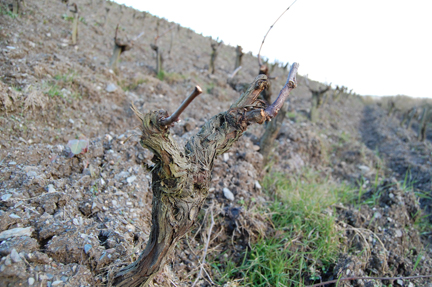
By the mid-nineteenth century, agronomists had begun to employ the term to denote free-standing trees. Many note how lower planting density in orchards can produce higher quality fruit. (The Bindoccis wrote about this recently on their blog in regard to olive grooves.)

Only later, toward the end of the century, does its usage as ungrafted begin to appear and by the end of the century, we see the first instances where it is used to apply to vines.

This makes perfect sense because the evolution of the meaning mirrors the emergence of the phylloxera plague of the 1800s.

So there! Thanks, Ken, for setting me down this path and nudging me to walk with my own gait!

The subtitle of my blog is: “Negotiating the Epistemologic Implications of Oenophilia.”

This little philological romp is just the type of thing that gets me going: using wine as a lens to see and better understand the world around us.

Thanks for reading.

Wherefore art thou Romeo? Ask @RomeDigest (& a fav Chianti)

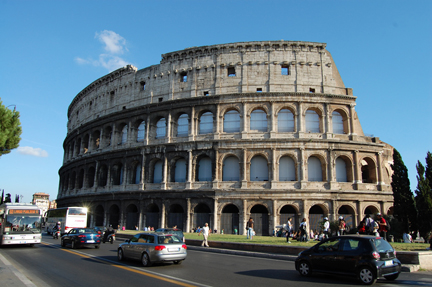
colosseum

One of the questions I get asked more than any other is where should I/we eat and drink in Rome?

Of course, I have my favorite haunts (from my year studying at the Vatican library as a Fulbright scholar) and my many visits in the years since.

But as the Romans used to say, ubi maior, minor cessat: there’s a new resource for dining, drinking, and touring in Rome and it’s called The Rome Digest.

For some years now, I’ve been pointing romei to the inimitable Katie Parla and her ParlaFood. And when I go to Rome, she’s the person I try to have dinner with!

She’s now teamed up with some of the top Anglophone food and wine professionals in the Eternal City to bring us the digest, which I highly recommend.

Btw, a romeo (pl. romei) is a pilgrim heading to the city on the Tiber. (And this peregrinatory word is pronounced roh-MEH-oh.)

Check out their new site. They rock.

In other news…

selvapiana best chianti

When I cozied up to Tracie P on the coach last night after we put Georgia P to bed, she asked: “What wine are you drinking? It smells like Chianti!”

I had popped a bottle of 2010 Chianti Rufina by all-time fav Selvapiana. So right on, with great acidity and fresh red fruit and gentle earthiness, and just the right amount of tannin to tame a piquant aged pecorino. I love LOVE this wine.

Did I say that I love this wine?

Thanks for reading… may you drink well this weekend! Buon weekend, yall…

Soldera update: 4-year prison term for vandal, 6 requested by prosecutor

brunello scandal soldera

Above: One of the casks of Soldera’s wine that was destroyed by a vandal in December 2012.

The news that the Soldera vandal has been sentenced to four years in prison arrives via Franco Ziliani’s blog, Vino al Vino, today.

(The sentence was originally reported by MontalcinoNews.com.)

According to the report, judge Monica Gaggelli gave the vandal, Andrea Di Gisi, two years less than requested by the prosecutor.

Natural wine… don’t ask, don’t tell (@DonkeyandGoat dinner @VinoVinoWine)

best natural wine california

Above: Tracey Brandt of Donkey and Goat (Berkeley, California) was in Austin last night for a dinner at Vino Vino.

You might say that, second only to Produttori del Barbaresco, Donkey and Goat is the “official Parzen family wine.”

We drink it regularly at home (Stone Crusher in fridge? Check!), my parents-in-law Rev. and Mrs. B drink it regularly (hey, Rev. B, did you drink that Helluva Pinot Noir without me?), and it’s been a by-the-glass favorite on our list at Sotto in Los Angeles (where I co-curate the carta dei vini with @CaptainWine) since the restaurant’s inception more than two years ago.

Tracie P and I are thrilled that the wines are finally (legally) available here in Texas and these days we buy them regularly at the Austin Wine Merchant and the Houston Wine Merchant (two of the dwindling number of independent retail operations in our state).

I was geeked to sit down, taste, and chat last night with Donkey and Goat’s better half, Tracey Brandt (above) at the best little wine bar in Austin, Vino Vino, where owner (my client and friend) Jeff Courington had organized a dinner in her honor.

Last year, when I sat down with her husband Jared at Sotto, he told me: “I don’t like labels and I don’t consider myself a Natural winemaker… I think of it more as ‘unmanipulative’ winemaking. But that’s not as fun to say.”

roast beef texas austin

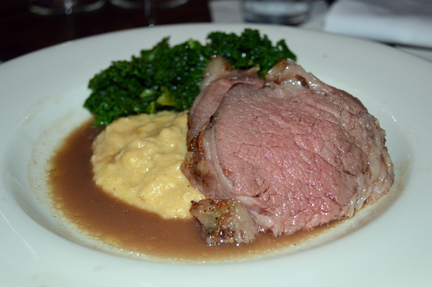
Above: Vino Vino chef Jesse Marco’s rib roast with polenta and kale was as delicious as it looked.

In our conversation over dinner last night, Tracey noted that “we were already making wine in this style before we had even heard the term Natural wine.”

Does she call her wine “Natural”? I asked.

“Here’s what I say to people,” she told me, “our wines are often referred to as ‘Natural’ wines.”

She said that she first hear the term when she and Jared presented at VinNatur in Italy in 2008. By that time, they were already into their fourth vintage.

There are three basic tenets of their winemaking philosophy, she said:

“First, the wine should be food-friendly. Second, the wine should be ‘honest’; it should taste like the place where it was grown. And [lastly] the wine should taste like the varietal. In other words, if it says Pinot [Noir] on the label, it should taste like Pinot.”

There’s been such a fuss about the use and misuse of the term Natural over the course of the last eighteen or so months.

Does it really matter what the winemakers, wine pundits, or wine lovers call it?

My thought is… don’t ask, don’t tell… just drink it (if you like it)…