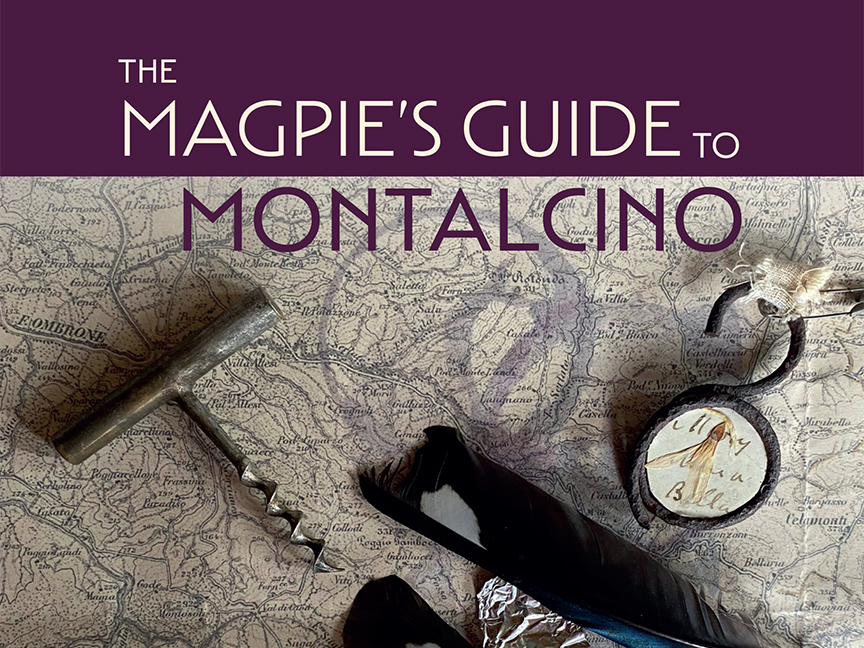
A new book and a new language for Montalcino: The Magpie’s Guide.

The first the thing that came to mind as I scrolled the pages of The Magpie’s Guide to Montalcino (Constellations 2024) was Natalia Ginzburg’s autobiography Lessico famigliare — Family Sayings, as it has been translated into English.

A more slavish of the title could be our family’s [secret] language, in other words, the intimate code that a family uses for internal communication and affection. Like the nicknames I have for my daughters or the pseudo-idiolectal terms we use for foods, dogs, restaurants, experiences, etc., and anything that makes our family unalike from any other.

Laura Gray’s new book on Montalcino and its idiosyncrasies offers a sort of ABCs — that great Britannic genre — a legend by which the legendary city and wine capital may be decoded and interpreted.

Her almanackic writing broadly reflects her unique experience in the city of the holm oak. Laura — disclosure: a close friend of ours — is perfectly bilingual and has lived in Sangiovese city for the better part of her life. She’s also a wine industry insider. She ran one of Brunello’s most high-profile wineries for many years.

But what’s most remarkable about this new book is its dissection of Montalcino’s idiosyncratic lexicon. Words there often have meanings that stand at least a few degrees apart from the constitution of peninsular Italian.

Take her entry for Prato, where the Italian word for meadow takes on a special toponymic value in the context of the Montalcino-verse.

Or her entry for “VIP” where she shares some of the impossible celebrity that makes its way to this erstwhile Tuscan backwater. It reminds me of the time that I sat down for a serendipitous chat with the great Italian publisher Valentino Bompiani who just happened to be vacationing there.

Space doesn’t allow me to share the scores among 300 entries that had me grinning and often falling out of my seat with laughter and wonder. Even the most jaded wine professionals will find her more technical entries fascinating because of the insights they reveal.

Montalcino is a genuine singularity, I would even say, a hyperobject that fascinates and often enchants us. The Magpie’s Guide offers a new syntax to drink in the magical mystery of that timeless city on the hill.

A bottle from a special vintage and vineyard reminds me of why I love wine and how I love Tracie.

The 2008 harvest is a very special vintage for me and Tracie.

We had followed each other’s blogs for more than a year and there had been a few emails.

But it was during the summer of 2008 that I first traveled to the state capital to meet her in person. And by the end of the year, I had rented an apartment and moved to the Live Music Capital of the World.

The rest is… well, you know the rest… Let’s just say it turned out to be a good move.

In 2013, when we had been married for nearly three years, Georgia had been born, and Lila Jane was on the way, we decided to invest in our wine cellar with a purchase of crus from Produttori del Barbaresco — from the 2008 vintage.

We’ve kept the wines in a locker in San Diego where we visit often. We generally open them during the summer or in January when we travel to California. Pulling the corks with friends makes them all the more special.

But at least once a year, I smuggle a few bottles back to Texas (don’t tell the TABC!).

Last week, to celebrate Kamala’s nomination (YES!!!), we opened the Barbaresco Rio Sordo 2008.

The cru is even more meaningful to us because we slept on the crest above Rio Sordo on our honeymoon in 2010, at Giovanna Rizzolio’s place, Cascina delle Rose.

The wine was still young in the bottle with restless energy expressed through brilliant red and berry fruit. The integration and cohesiveness in this wine were extraordinary and we agreed that our investment had paid off.

What a great wine and what a great experience and memory to drink it with the love of my life. Our renewed hope in the Democratic party only made the feeling more sweet.

The fall is almost here and I’m looking forward to all the crazy projects I have lined up for the season. Thanks for being here and letting me share this. Stay tuned and VOTE KAMALA!

A visit to Abruzzo’s new paradigm for success: Francesco Cirelli’s anforaia.

Visiting the Francesco Cirelli winery with our dream team group of sommeliers last month was like a homecoming for me.

Francesco’s wines first came to my attention many Vinitalys ago when a mutual friend took me to taste with him.

At his stand, a clique of über-hipster winemakers awaited. They were there for the vibrant wines, the salami and bread, and the super cool conversation that seemed to take ethereal shape around him.

The next year, his amphora-aged wines were stars on my list at Sotto in Los Angeles where people enjoyed them as much as Tracie and I dug them at home.

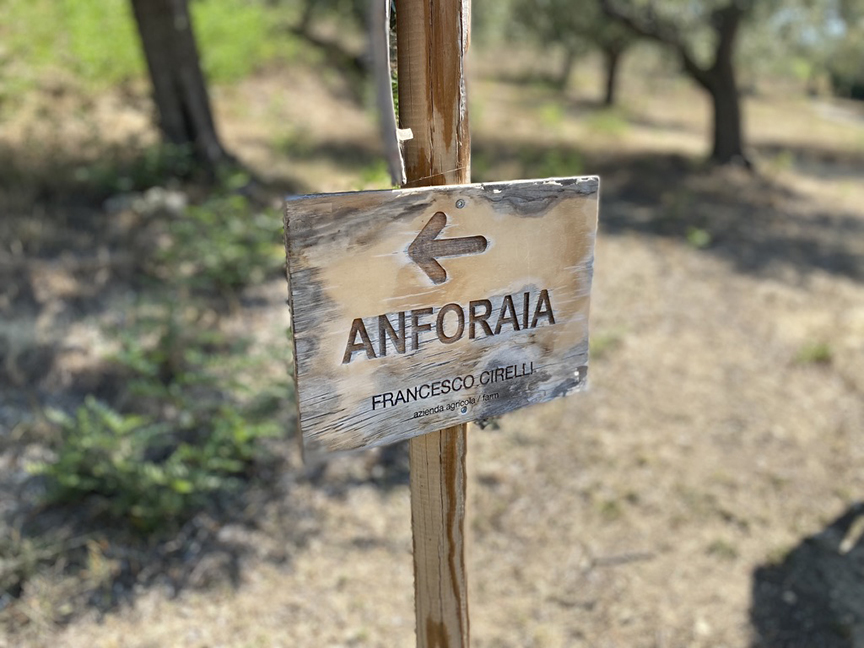
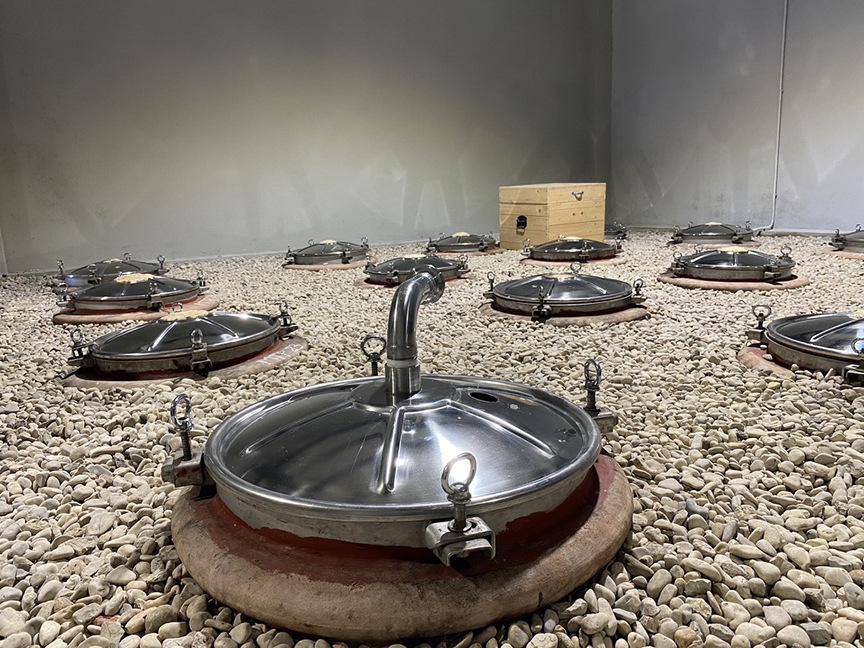
That’s a sign, above, that leads you to his “amphora room” (anforaia is a compound word formed by the Italian anfora meaning amphora and the suffix -aia, which comes from the Latin area; just like a sassicaia is a place full of stones, from sassi, and a lupaia is a den of wolves, anforaia is a place where you will find amphorae).

Many years ago now, when Francesco planted his grapes along the side of a valley not known for viticulture, his neighbors must have thought him crazy. But he already had a solid business plan in his pocket and a vision in his mind.

Even before the new wave of new and old Abruzzo growers reshaped the way we think about these wines, Francesco’s wines were a breakout success in a region that most American wine professionals knew for just a handful of mainstay estates.

He accomplished this by making great wines, of course, wines that appealed to a youthful sensibility. But perhaps more importantly, he created a new “vibe” and model for the Abruzzo wine business: cool user-friendly packaging, screw top bottles, a glamping destination (yes, you can glamp there!), aggressive pricing, and an ecumenical attitude toward his customers.

I couldn’t have been more proud to lead our group to one of our favorite wineries, producer of the amphora-aged Cerasuolo that Tracie and I drink on special occasions.

To Francesco and all the wine pros (Justin and Nathan!) who have believed in and shared his vision, I share a thanks for giving us a new paradigm for great Abruzzo wines.

For great wines in Abruzzo, look (also) beyond the marquee names.

One of the issues that the greater community of Abruzzo growers has to address is that the wines are too good.

By that, I mean that some of the wines are so coveted that tradesfolk and laypeople tend to focus only on certain producers while eliding the rest.

It reminds me of something a famous U.C.L.A. communications professor said in class one day: when you highlight one line in your readings with a highlighting pen, it’s as if you’re erasing all the rest of the writing as inconsequential.

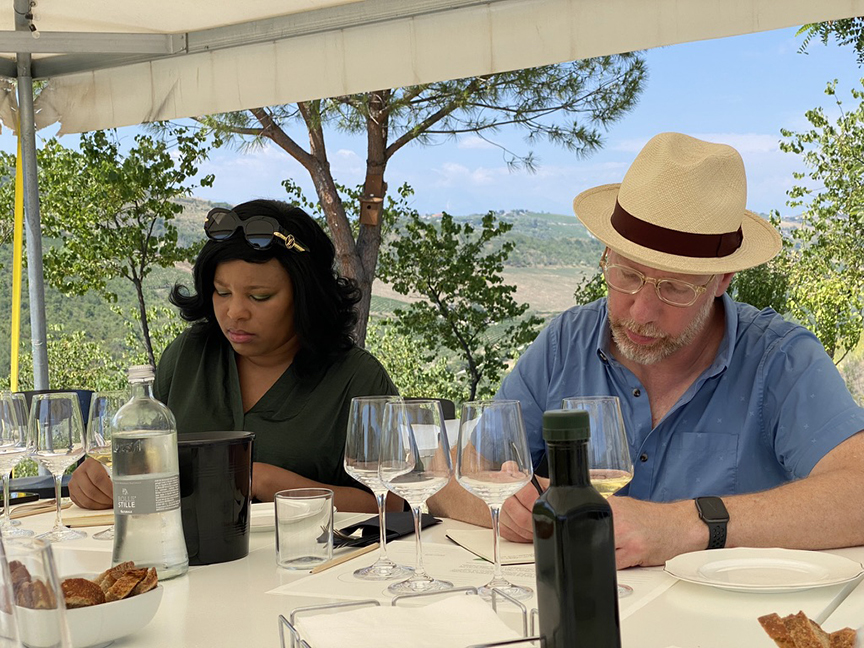
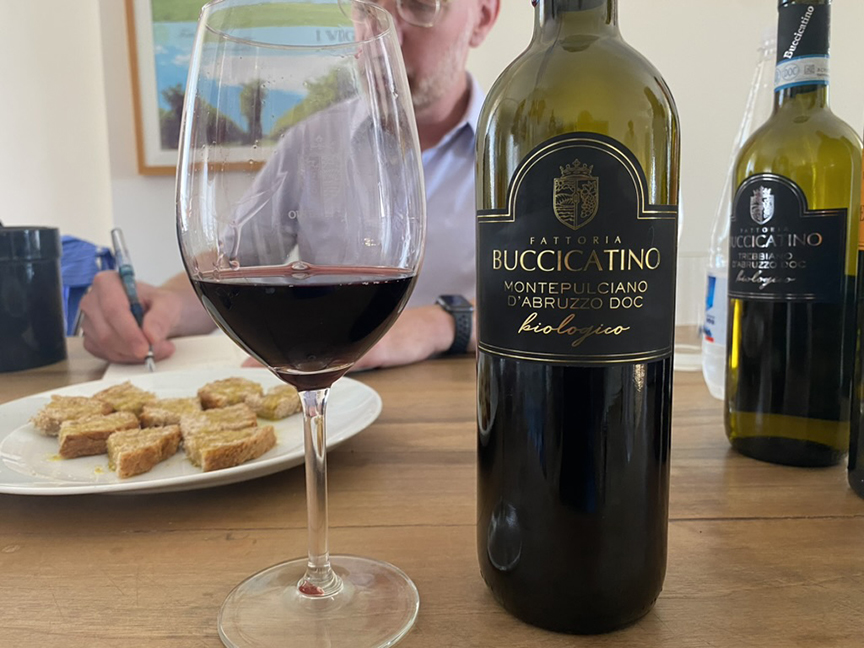
That nugget of wisdom came to mind when our dream team of American wine professionals stopped to taste at Buccicatino in Abruzzo’s Foro river valley, where the soils are rich in clay, the climate is arid, and there is a nearly constant breeze that runs from the sea through the valley.

The story is a familiar one in Abruzzo. In the 1990s, the family decided to stop selling its grapes to the cooperatives and make its own wine. Many years of sacrifice followed as they focused on quality and the often-outsized investment of resources and time that a wine brand requires. Today, more than two decades later, they have firmly established their brand in Italy and northern Europe.

And while the wines were great across the board, the labels that really stood out for me were the Montepulciano d’Abruzzo. These wines had that freshness that I look for in rich-style red wine. The wines’ acidity made them mouth-watering and wonderfully food friendly. I thought they were fantastic.

As we tasted, it occurred to me how well these wines would work in an emerging American market. By that I mean places beyond New York and California (and even Texas now) where, frankly, people are jaded by the mythologies that a lack of healthy marketing has created in Abruzzo.

As Nietzsche once wrote, the philologist’s mission is to look beyond the sacred texts.

For would-be importers of wines from Abruzzo — where arid climate, clay- and limestone-rich soils, and maritime influence create the ideal conditions for organic wine growing — I encourage you to look beyond the marquee names and discover the region’s seemingly unending viticultural treasures.

Buccicatino and the indomitable family behind the wines are worth seeking out.

Gianni Masciarelli gives us words to live by: “the quest for quality.”

One of the things that strikes you when you visit the Masciarelli winery is the undeniable presence of its visionary founder Gianni Masciarelli, who died unexpectedly and prematurely in the summer of 2008.

I visited the property for a second time last month with a dream team of wine professionals and I’m sure they would all agree that it was as if you could feel his physical presence. In some cases, there are artifacts that you discover as you tour the winery. One is his “thinking room,” a wonderful studio — a den, as we used to say in the 1970s — where he could retire to rest and reflect.

There are many such artifacts and I leave it to you to find them when you visit.

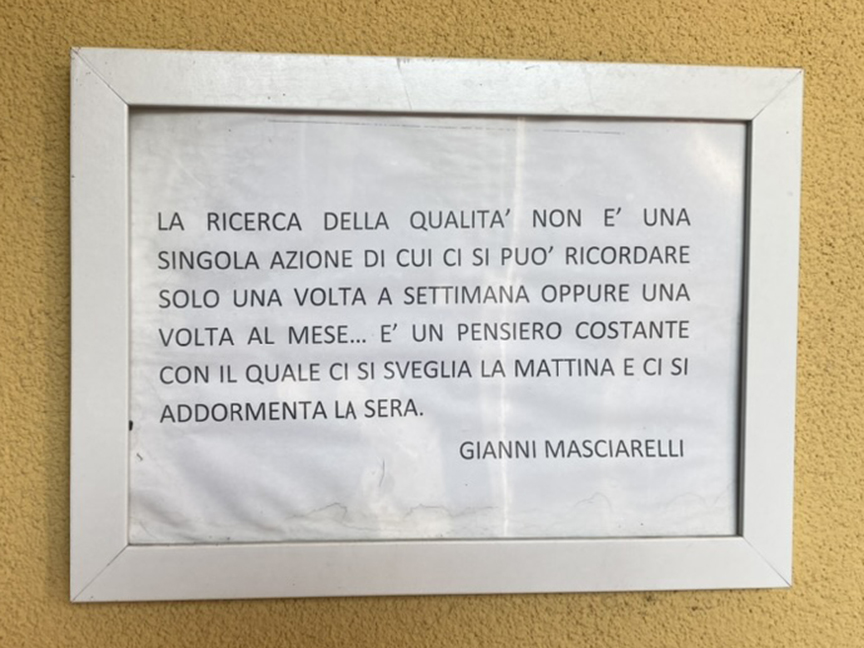
But one that really stuck with me was the sign above, posted on a wall in connecting two parts of the facility:

The quest for quality is not a single action that you remember to do just once a week or once a month… It is a constant thought with which you wake up in the morning and you go to bed at night.

Gianni Masciarelli

As we gear up for fall and the work and travel it will bring, I can’t think of a better maxim to tuck under my pillow every night, an aphorism to read every day when I get out of bed.

I’ve written about the wines here before. They are astounding. The Villa Gemma white is one of my best wines tasted from this year. Seek them out, taste, drink, and pair them. They are delicious but they will also give you a glimpse into the heart, soul, sweat, blood, and tears that made this winery so great.

Gianni’s daughter Miriam recounted the story of a university professor who told Gianni, the child of a proletariat family, that he would never amount to much. He dropped out of college that same day, she said, and never looked back. Perhaps it was then that he adopted his adage: the quest for quality is not a single action.

Miriam, thank you again, for the wonderful anecdotes, the tour, the wines, and a wonderful dinner hosted at your family’s Castello di Semivicoli.

And thank you to the consortium of Abruzzo growers, who have allowed me to join them in their own quest for excellence by having me contirbute to their mission.

Big news from Abruzzo: new rules on Cerasuolo color codify its chromatic identity.

At the first tasting on the first day of our dream team trip to Abruzzo earlier this month, leading U.S. wine educator James Tidwell asked me to share my impressions of the essence of Montepulciano, the grape variety.

The first thing that popped in my mind was color. Montepulciano is a fascinating grape, including its versatility and the breadth of wines it can produce. But it all starts with color.

James and our team will surely agree that there is no wine that the Abruzzese hold more dear than Cerasuolo d’Abruzzo — a wine defined by its color. Nearly every producer we tasted with told us that Cerasuolo d’Abruzzo is “our” wine, the wine of the farmer, the wine of the young and old, the wine of the ruling class, the wine of the proletariat, the wine that pairs best with their “mountains meet the sea” gastronomy, the wine that genuinely reflects the hues of the Abruzzese people.

There are a number of methods used to give Cerasuolo its signature cherry color (cerasuolo means “cherry” in archaic Italian). But most simply press their richly colored Montepulciano and macerate it briefly or not at all. The wine in the photo above, by one of my favorites, Contesa, is indicative of what a classic Cerasuolo looks like.

In recent years, certain producers have found ways to lighten the color in an effort get on the “Provençe” bandwagon. Frequently, the Abruzzo growers consortium has sent me pale, pink-hued wines that are labeled as “Cerasuolo” for my seminars and tastings.

But that’s all about to change: consortium partners have now agreed on a protocol that will require a chromatic rating between six and 10 on a 10-point scale. In other words, in order to be labeled as such, Cerasuolo will have to have a depth of color similar to that in the photo.

The news was communicated to me a voce by consortium president Alessandro Nicodemi. It’s not clear to me what method will be used to evaluate color. I’ll follow up on that here.

When we tasted with Pierpaolo Pasetti of Contesa, he echoed what nearly every producer told us: they agree wholeheartedly with the new rules for chromaticity. Contesa btw is one of the region’s most dynamic wineries, producers of some of my favorite wines. And the young Pierpaolo is a leading voice of his generation.

“T’aspetto a Vasto”: southern Abruzzo reveals its treasures in Fontefico and Jasci e Marchesani.

What can I say? I fell in love with Vasto on this last trip to Abruzzo. I hadn’t spent much time in this commune where the beaches are still undiscovered by foreign tourists and where the wild vegetation and biodiversity are as exciting as are the people who grow and make wine not far from the Molise border.

Nicola Altieri’s wines at Fontefico are fantastic. Organically farmed, spontaneously fermented, and 100 percent delicious and food friendly. The creative, youthful packaging is also consumer-friendly and just downright fun.

After our tasting a few weeks ago, I scratched my head wondering aloud why progressive U.S. importers are not bending over backward to get these wines to north America. I loved them.

But I also loved the whole vibe of their estate, where they have rooms for visitors (we didn’t stay) and an extraordinary “zero kilometer” restaurant where Nicola’s mom cooks up a storm. That’s peperoncino over white flower chicory — yes, the rare white flower chicory! — and crunchy maize.

And man, the flavor of the tomato sauce and the pasta itself… wow… this dish, so simple, floored me. I’m sorry I don’t have any photos of the wines. They are worth seeking out.

Earlier in the day, we had tasted at Jasci e Marchesani, another hit in my book.

The Jasci family is a pioneer of organic farming in Abruzzo. Early on, before the term “organic” even existed as we know it today, they had recognized the potential harm of synthetic pesticides, herbicides, and fungicides.

Abruzzo is arid and well-ventilated thanks to the maritime influence, ideal for organic farming. The Jasci showed their neighbors a path forward at a time when chemical-driven farming was encouraged among small growers like them.

I really loved their two Cerasuolo but the Trebbiano was another favorite of mine, one of the estate’s flagships. Shout out to our tasting guide Luana and her command of English (made my job easy!). You should have seen the locals lining up to buy their monthly supply. This place was another wonderful discovery for me.

And dulcis in fundo, that’s the view from the Hotel Villa Maria in Francavilla where we stayed during our trip. And below you’ll find a YouTube for the famous song, “T’aspetto a Vasto” (“I’ll wait for you in Vasto”), including shots of the gorgeous pristine beaches.

Chiusa Grande’s wonderful stone-fermented Trebbiano expands our palates — and our minds.

One of the most exciting and original wines our dream team tasted while on tour in Abruzzo earlier this month was the In Petra Trebbiano d’Abruzzo by grower and winemaker Franco D’Eusanio.

I had visited the famous Roman-era stone vinification vats in the village of Pietranico, high up in the heart of Casauria, one of the Pescara river valley’s top subzones. And that experience made it all the more exciting to taste a Trebbiano that had been vinified in stone vats similar to the historic ones.

Everyone in our group agreed that Franco’s In Petra Trebbiano was superb (“in petra” is Latin for “in stone”): rich gold in color from limited skin contact and slightly oxidative, this wine was all mineral and dried stone fruit, one of the most expressive examples of Trebbiano we tasted all week.

It was fascinating to hear Franco describe the winemaking process and how the stone acts as a natural temperature control.

So many projects like this end up producing mediocre wines at best or forgettable and even undrinkable wines at worst. It would seem that the romance of history sometimes eclipses quality. But not in this case. The caliber of Franco’s wine made it all the more compelling to taste.

It should surprise anyone: not only is Franco a widely respected winemaker in Abruzzo, he’s also the region’s resident philosopher — or should I say “vinosopher.”

He’s developed a nuanced “sensorial experience” at his Chiusa Grande estate where he invites guests to “feel” wine through color and music. He has devised an elaborate system whereby images, lights, sounds, and the evocation of emotions open the layperson’s mind to a broader and richer understanding of wine and its cultural and human value.

For the average wine lover, Franco’s “sensorial experience” is worth checking out, especially at dusk as the contours of the Gran Sasso in the distance are silhouetted by the setting sun. But even for the expert taster, the trip is worth it for the excellent wines. Our group also loved his pét nats and his Cerasuolo was a favorite of mine.

Stay tuned for more from Abruzzo this week and next.

The best porchetta sandwich I’ve ever had and a July 31 dinner in LA where I’ll present a flight of Roman wines.

It was along a drive from Ciampino (just outside of Rome) through the Castelli Romani hills on my way to Latina to visit the site where Cincinnatus chose agriculture over power and inspired one of the founders of the U.S…

During the journey, I stumbled upon a holy grail — or should I say, holy tail — that I had been searching for since a taste more than three decades ago in Rome: the best porchetta sandwich ever.

I’m still not sure what inspired me to stop at a roadside shack — one of among countless others — adorned with a simple sign that reads “porchetta.” If you glared at it closely through the bright sunlight that beat down on the volcanic landscape, you could make out the words “da Rea,” a nod to the owner Salvatore Rea — “Porchetta by Rea” — whom I later learned is a legendary figure in the world of Porchetta di Ariccia, the holy of the holies when it comes to the slow-roasted suckling pig panino, with the meat’s distinctive crispy crust.

I wanted to taste porchetta in its purest form, nestled gently between a halved bun.

After hearing other lunch-goers order their sandwiches dressed with a diversity of pickled vegetables, I felt a slight pang of covetousness. But I justified my spartan choice in the name of science. After all, I need to taste the meat unadulterated in order to assess its true flavor, texture, and quality.

Porchetta, the sandwich shop, has no website that I can find. There are two different Google pages for the venue. I recommend using this one. The reference on the sign to “8.7 kilometers,” I believe, is a now obsolete address system: “8.7 kilometers down Nettunense Road.” The current address is Via Nettunense, 58.

Later that day, I found myself in the heart of Lazio wine country, treading through the volcanic soils that make this part of Italy so famous for grape growing and other agriculture, including the livestock that gives us porchetta.

What did I find?

You’ll have to come to my July 31 “Ancient Rome” dinner at Rossoblu in LA to find out. Here’s the link to register.

I hope to see you there. And in coming weeks, I’ll share notes from my winery visits. What an incredible trip through that part of the country. I highly recommend it and be sure to stop at “Porchetta” in Cecchina, a hamlet of Albano Laziale village, high in the hills above the Italian capital.

Thanks for being here and see you next week.

Abruzzo wine trip dream team: James Tidwell and co. show me how it’s done right!

It was an absolute pleasure to travel to my beloved Abruzzo last week with a wine trip dream team: Alisha Blackwell-Calvert (far left), James Tidwell (second from left), Tiffany Bobbs (far right), and Christy Frank (second from right).

That’s legacy grower and winemaker Giulia Cataldi Madonna (center) standing between me and James. We met with Giulia at her family’s winery outside Ofena village in the Abruzzo mountains not far from L’Aquila on Saturday morning, the last visit of our spectacular trip.

This group came together after I did an Abruzzo seminar last year at TexSom, the annual wine conference founded by James more than a decade ago. He was impressed, he told me, with the caliber of wines in a Pecorino flight that we served to a group of 60 or so TexSom volunteers. Would it be possible to travel to the region together with a group of top sommeliers? he asked me.

Nearly a year later, we made it happen.

James recommended six persons for our team Abruzzo. A few folks couldn’t make it for one reason or another. But the three above were game.

It filled me with pride to sojourn with such a high-level group of sommeliers, each a world-class taster.

I’ve never been on a trip — ever — where each fellow traveler comported themselves with such professionalism, technical ability, and warm humanity. At nearly every visit, growers and winemakers commented to me that they had never experienced such a top-notch group.

And the level of dialog — in both directions — was astounding.

We had some amazing visits, including Valentini. Yes, Valentini!

I have many notes and tales to share. But today, I’d just like to share my deepest thanks with each in our group. This was no mere junket trip. It was a genuine learning experience for everyone involved, including the producers and especially me.

Warm shouts out and thanks also to consortium communications director Davide Acerra and his team member Sabina Rosso for believing in this campaign and for the superb execution.

I love doing what I do for a living but this gig was one of those very special ones. Stay tuned for notes from my trip. Thanks for being here.