White Zin, Chardonnay, and Pinot Noir

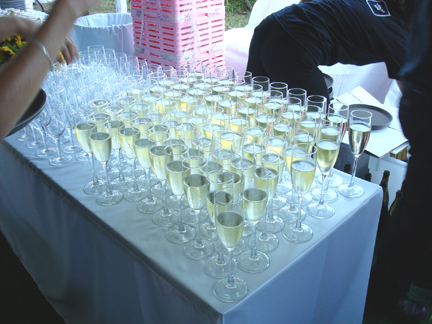
flutes.jpg

Southhampton, Long Island was the destination yesterday. A few colleagues and I went out to the Hamptons to pour wine at a glitzy fundraiser: megawatt celebrities and trophy wives, blue blazers and loafers, khaki pants and flowery prints, perfectly sculpted bodies and botoxed lips, painted smiles and Hamptons drips, but no White Zin, Chardonnay, or Pinot Noir.

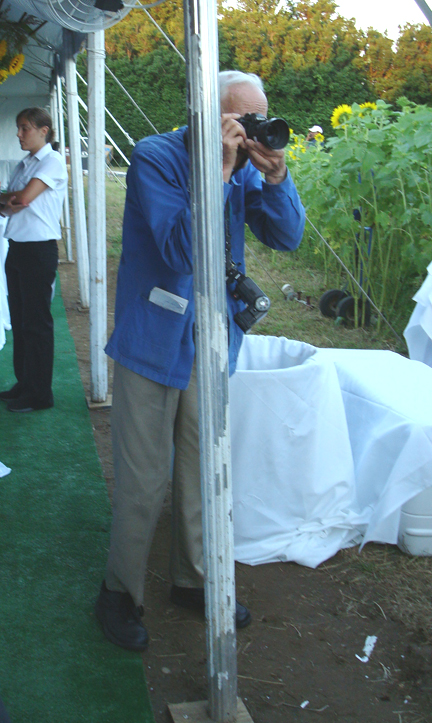
Jane Fonda was in attendance, as was Sarah Jones, who gave a wonderful performance (her impressions/accents are amazing!) but didn’t get many laughs when she quipped that she was from Queens, “the other tip of Long Island.” My personal celeb moment was a siting of The New York Times photographer Bill Cunningham who furtively flitted through the crowd (see pic below).

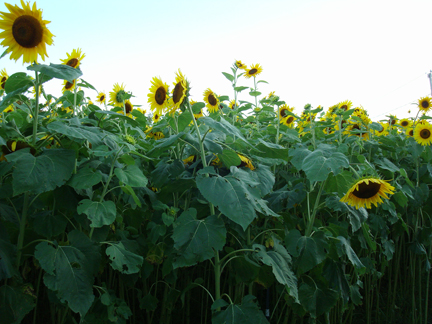
sunflowers.jpg

Above: a beautiful sunflower field surrounded the party tent.

An age-old proverb: You can lead a horse to vino but you can’t make her drink.

Although there were a few guests who expressed some interest in the wines, we were bombarded by a litany — a Jeremiad, really — of “Chardonnay? Pinot Grigio? Merlot? Pinot Noir?” and the occasional “White Zin?” In all fairness to this palateless crowd, I heard no one ask for a “Cab.” I guess — to borrow a Hamptonsesque phrase — “Pinot Noir is the new Cab.”

Forgive them for they know not what they do. Of course, my colleagues and I were not pouring any of the above hegemonic, consumerist choices. We were pouring wines which must have seemed terribly esoteric and unpronounceable to the 350+ partygoers: Erbaluce, Malvasia, Montepulciano, and Pelaverga (just try explaining this last one to a white-haired martini-quaffing gent!). These days, people seem programmed to expedite the wine line process by asking for something familiar, something sanctioned and endorsed by their peers, something safe and reliable in situations where appearances are everything and substance refers not to character but to intoxication.

billcunningham.jpg

Above: New York Times social-pages photographer Bill Cunningham flitted furtively through the crowd… He’s cool.

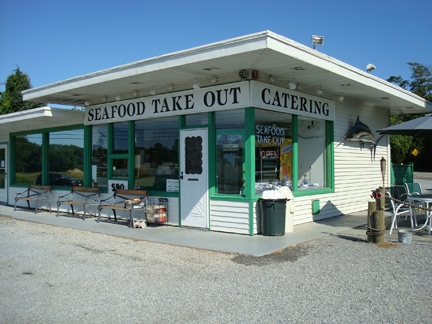
captainwho.jpg

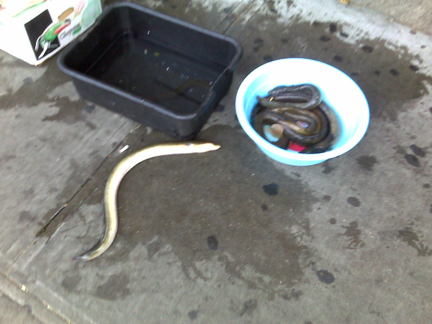
Above: We ate lunch at this fish shack (Captain Who’s?), picturesque but the food was just okay.

In other news, I am so bummed that The New York Times has changed paper size. Even the Old Gray Lady herself wrote that this money-saving move would lead to “fewer words” in the paper. Conan O’Brien said it best — quoted in the Times — when he observed:

The New York Times reduced the size of their newspaper; they cut the paper’s width by an inch and a half. The move was announced with the headline, ‘‘Big Changes at The New York Tim.’’

It’s official: Bollinger Sponsors Nous Non Plus…

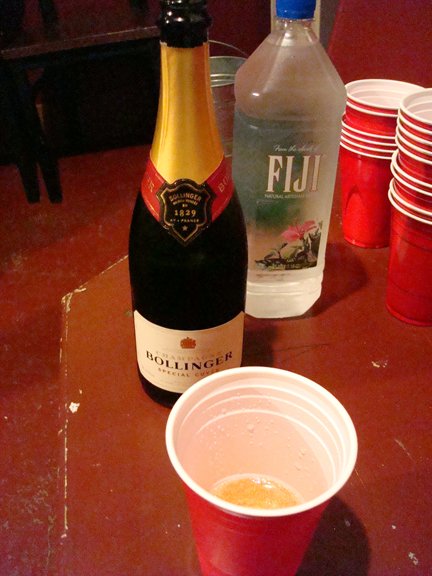
bollinger.jpg

Above: in the greenroom at Mercury Lounge, I discovered — to my surprise — that Bollinger tastes good in a plastic cup.

Sexy chanteuse Céline Dijon was upstaged at Nous Non Plus’ Mercury Lounge show last night by a bottle of our favorite champagne Bollinger. About halfway into our set, bassist and chanteur Jean-Luc Retard called for a small celebration of our recent French tour with a bottle of Bollinger Special Cuvée.

I have always been a huge fan of Bollinger and the new Nous Non Plus disk will feature a song that we’ve written about our favorite Champagne (out in Spring 08?). For my birthday this year, the band gave me a bottle of Grande Année 1999.

Good stemware is hard to find in rock clubs and so plastic beer cups served as a substitute for crystal flutes last night. At first I was disappointed to see how the fizziness exploded and lost its concentration in the wide-mouthed drinking vessels. But I was pleasantly surprised when the wine reached my lips and the aroma hit my nose: the expanded diameter of the plastic chalice seemed to intensify the classically yeasty notes of the wine.

My current day gig working as marketing director for the restaurant group that owns and manages Centovini Restaurant and Bar in SoHo has brought me into contact on numerous occasions with SoHo interior design guru Murray Moss, owner of the eponymous store, the restaurant’s designer and one of the partners, and undeniably one of the nicest taste-makers I have met in my time in NYC. On those rare nights where I have had the chance to sit down with him over dinner at the restaurant (usually in the company of a writer or two), the conversation has often turned to a discussion of the merits of aesthetically pleasing stemware over “technical” stemware. Murray often challenges conventional wine-wine glass pairings and many of the wines at Centovini are served in stemware that transgresses standards complacently embraced by the wine industry.

My experience last night made me question the wisdom of the obligatory flute and think that Murray is right to lament the absence of the coupe à champagne, simply called a “coupe” in English (some believe that the coupe was modeled after Marie Antoinette’s breasts, a apocryphal legend that is surely false but fun to consider nonetheless).

Click here for a Newsweek article featuring Murray subtitled “It’s not about the glass is half full or half empty—it’s about the glass itself” (you have to click on the image of Murray to get the article to load).

Maybe it was the steamy August night, maybe the hot stage lights at Mercury Lounge… but, man, the Bollinger tasted great in those plastic cups.

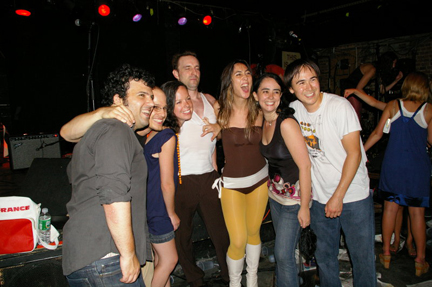
celine_prof.jpg

Above: Prof. Harry Covert (Greg Wawro, center left) and Céline Dijon (Verena Wiesendanger, center right) pose with fans after our show last night at Mercury Lounge (photo by Gary Wexler).

Last night I ate my fork.

Braving the sweltering heat and collective grouchiness that pervade NYC streets this time of year, I had a quick bite and beer last night after work with a colleague at what instantly became my new favorite burger joint, Stand, on East 12 St.

Miniburgers, onion rings, fries, potato salad and house-cured pickles and beets on the side, microbrews (man, that beer tasted good after a long hot week in Manhattan!), and a colorful cocktail list. Didn’t get to peruse the wines but was told that they are selected by natural-wine aesthete and NYC wine über-hipster Byron Bates, wine director at Bette. Each table at Stand also sports a plastic jar of Bertman’s Original Ball Park Mustard, imported expressly from Cleveland, OH.

But what completely blew me away was the bio-degradable packaging the restaurant uses for its take-out. The straws were made from corn, the sandwich boxes from sugar, and the utensils fashioned from potatoes. I put the fork in my mouth and started to chew. While the fork was more than firm enough, I could feel it give way to the pressure of my teeth when I bit down. “It probably doesn’t taste so good,” said manager and co-owner Ray Pirkle, “but if you drop it in hot water, it turns into a noodle.”

For the Benjamin Braddocks out there contemplating a career in reduce-your-carbon-footprint take-out packaging… I want to say one word to you. Just one word: potatoes.

In other news, I really liked Dr. Vino’s recent post on billionaires.

Sharing a meal with a favorite writer.

Last night found me at Centovini where I was lucky enough to dine with one of my favorite wine writers, Lawrence Osborne, whose excellent 2004 book on wine and taste, The Accidental Connoisseur, offers what is arguably the best explanation of why international tastes for wine are shifting toward the American “modern” palate (which seems to favor extracted, high-alcohol content, “jammy,” fruit-driven wines).

We were also joined by his friend, the truly lovely Elizabeth Spiers, who charmed the table with anecdotes from her career as a gossip-blogger-writer-fashionista. She also offered insight into the career of her friend and colleague Perez Hilton, who had been featured in last week’s NY Times Style Section.

I can’t reveal what we tasted because Lawrence is writing a piece on the flight we shared for one of his regular columns.

While I often attend tastings with noted wine writers, occasionally I get to taste as both professional and fan: I read Lawrence’ book when it came out and was immediately impressed by his quasi-Gramscian approach to the globalization of wine and the — to borrow a Gramscian phrase — cultural hegemony of the modern American palate for wine.*

I was pleased to discover that Lawrence shared an experience as graduate students in Italian (he at Harvard) and that we both enjoy the filmography of Antonioni, to whom we raised a merry glass. Reflecting on the obituary in the NY Times of that morning, we both noted that critics and scholars often forget the abundant humor in Antonioni’s films.

… a truly memorable evening in this city that I’ve come to love.

*N.B.: While I don’t endorse Wikipedia (and often see it as a promulgator of factoids, urban legends, and in some cases outright falsehoods), I liked the entry on Gramsci.

In The New York Times

Played with Nous Non Plus last night at the Paris Paris, a disco on the Avenue de l’opéra that features bands a few nights a week. Needless to say we performed our “(I Want to Spend a Night in) Paris,” a song about Paris Hilton, at the Paris Paris in Paris.

Paronomasia aside, I awoke this morning to read about Lini Lambrusco (wines that I love) and see myself quoted in Eric Asimov’s weekly wine column in The New York Times.

A Wine Older than Me: Spanna Colline Novaresi VdT 1958 Vallana

Opening fifty-year-old wine with fellow forty-year-old and friend Jeff Grocott at Morandi.

Spanna VdT 1958 Vallana

A few weeks ago, good friend and fellow child-of-the-Summer-of-Love Jeff Grocott proposed that we drink a bottle of old Spanna by Piedmontese (Novarese) producer Vallana to celebrate the near completion of our nearly four decades on the planet. Jeff, a page-one editor at the Wall Street Journal, wrote a number of wine features and tasting notes when he was an editor at the WSJ Weekend Section. You have to subsribe to the WSJ online edition in order to browse/search old articles but you can find some of Jeff’s articles on the web. His story on wine storage, which appeared in syndication, is one of the most popular and it offers some interesting and solid insights into the myths/truths of cellaring. Jeff and I met a few years ago when I was doing media relations for a NYC wine merchant and have since opened and enjoyed many bottles together, including a Barolo Riserva (Red Label) 1990 Giacosa that my friend and colleague Jim Hutchinson generously poured for us in his apartment last winter (served with a Coda alla Vaccinara that Jim had cooked all day in his crock pot).

Jeff, who lives in the village with his wife Barbara, had spied the Spanna 1958 Vallana at the relatively new Morandi on Waverly at Charles St.

We were both reluctant to open such an old bottle at a place like Morandi: similar to the ever-popular Da Silvano, Morandi is a glamorous, star-studded (see our celebrity encounter below), pseudo-trattoria New York City cafeteria — not exactly the place you think of when it comes to old wine. The bottle was reasonably priced but what was its provenance? how had it been stored? what kind of wine service would we find at a bustling downtown “feed-em-and-turn-the-table” eatery on a hot July evening?

While the food at Morandi was unremarkable (typical greasy but well-dressed downtown Italian), the wine list offered some interesting Nebbiolo options, including a Barbaresco 1988 Produttori del Barbaresco magnum at a good price. I was also impressed by the Ligurian whites on the list and a few labels from Basilicata, unusual for a restaurant where wine-savvy diners are unlikely to be found.

Jeff Grocott and Rosario "Roy" Marino

Above: sommelier Rosario “Roy” Marino (right) tasted with me and Jeff (left).

As it turns out, where were greeted by Rosario “Roy” Marino, a Salerno native, who gave us a great table in the back, had set the bottle upright (at Jeff’s request) the night before, and produced excellent Burgundy-style crystal glasses and a crystal decanter for our table (before opening the Vallana, we ordered a glass of Donnas Rouge from Val d’Aosta, which Roy poured in the restaurant’s standard glass stemware).

Novara is a lower-lying, wine-producing zone found to the east of the Langhe Hills (Piedmont) were the more famous Barolo and Barbaresco appellations are produced. The Spanna DOC was created in 1969. In order for the bottle to be labeled “Spanna” (Spanna is the Novarese name for Nebbiolo), it must contain at least 85% Spanna (Nebbiolo). This wine was made before the DOC existed and thus was labeled vino da tavola (table wine; see label detail below).

Judging from the newish cork and clean label, the Spanna Vino da Tavola 1958 Vallana had been recently rebottled (and probably topped off with a little bit of new wine, as is the custom among many Piedmontese producers who keep reserves of older wine in their cellars).

Spanna has often been cited by wine experts (including the great Shelly Wasserman) as one of Italy’s greatest aging wines. Many people think only of Barolo (and Barbaresco) as cellar-worthy Nebbiolo. In fact, Nebbiolo grown in the Langhe was not labeled as Barolo until Ratti’s legendary 1971 bottling, while Spanna, Gattinara, Grumello etc. had already achieved fame as long-lived wines in the 1960s (for those who read Italian, I found this informative and moving account of drinking a bottle of 1964 Spanna discovered in the mud by rescuers in the aftermath of the 1969 flood in Novara).

I believe that Spanna’s longevity can be attributed — at least in part — to the addition of smaller amounts of less tannic, more acidic grape varieties. Vespolina and Bonarda other grapes are allowed in the appellation. Many have pointed to Antonio Vallana’s blending skills as the secret behind his remarkable wines.

The wine was fantastic: after the initial stink dissipated (not uncommon in wines this old), the nose opened up beautifully and the wine had gorgeous fruit, nice acidity, and perfectly softened tannins. The 1958 harvest is considered one of the great twentieth-century vintages for Piedmont and this nearly-fifty-year-old wine was powerfully elegant but retained some of the rustic character that you find in the naturally and traditionally made wines from Novara. We enjoyed it thoroughly.

As we were paying and preparing to leave, a party of three was seated next to us. Jeff discretely told me, “turn around and look who is sitting next to you.” Little did I know but the Edge was rubbing elbows with me. Wow… He was dining with two young women (I imagine one was his daughter). I wonder what they drank. I’m sure that Roy took very good care of them.

Vallana Lable Closeup

Tasting with Richard Parsons at Porter House

Dining with the rich and powerful in NYC.

Last night I attended a dinner for roughly 40 persons in a private room at Porter House in the Time Warner Center at Columbus circle. Time Warner CEO Richard Parsons sat at the head table and guests tasted 9 bottlings of his Brunello di Montalcino Il Palazzone. Richard’s wife Laura Parsons and Washington insider Vernon Jordan also attended, not to mention the sommeliers, wine directors, and general managers of a number of top NYC restaurants (Babbo, Esca, Felidia, San Domenico, Four Seasons among others). I had been invited by my friend Amanda de Leon, who is president of Il Palazzone. Richard Parsons and his wife dine regularly at I Trulli and he and Ron Lauder often lunch at Centovini (two of the businesses for which I do marketing).

One of the most fascinating elements — to my mind at least — about working in the New York City restaurant scene is how the allure of fine dining and the aphrodiasic of money and power bring together some of the most unlikely bedfellows. On the one hand, between Vernon Jordan and Richard Parsons, I broke bread with two of the country’s most powerful dealmakers and Washington insiders. I exchanged pleasantries with Mr. Jordan who sat with Amanda and chatted briefly with Mr. Parsons about I Trulli. I can’t imagine any other context where I would come into contact with such luminary figures. On the other hand, after working as a writer/copywriter in New York for the last ten years, I have seen some of the more unsavory sides of the city’s restaurateurs and wine merchants. Working in the wine and restaurant business in NYC is kind of like being in the mafia: the overblown egos and the intense competition create a sort of kill-or-be-killed working environment. Politicians and powerbrokers like to eat well and perhaps more than anything else, like to feel like they are restaurant insiders. Restaurateurs like to feel like they have access to power. Having seen some of those restaurateurs and wine merchants up close, I find them strange bedfellows.

But what really blew my mind about the dinner was how Il Palazzone’s enolgoist, Paolo Vagaggini, stood up and told the party — first in broken English and then in Italian — that the Palazzone winery “respects and reflects the tradition of Brunello and makes a very traditional wine.” In fact, the wines are very modern in style: very fruit driven and concentrated, oaky and high in alcohol. What tradition is he talking about? The one launched by Wine Spectator’s James Suckling and the inimitable Robert Parker in the early 1990s? Forget Mondovino, we need Michael Moore!

Although they’re not wines I would drink at home, they are very well made modern-style wines. The 2001 Riserva will drink well in a few years and both the 1998 Brunello and 1998 Brunello Riserva showed well.

The food at Porter House was mediocre and the 1995 Brunello Riserva, which I had tasted a number of times over the last few years, seemed shot (at least the bottle poured at my table). But the evening’s glamour — borne out of the odd marriage of monied power and restaurant power brokers — made for a memorable evening nonetheless.

Stepping out into the street after the dinner, I was happy to return to the warm June night air and the smells and sounds of the Upper West Side. Those dinners remind me of Fellini’s 1950s movies where the characters fill the emptiness of their lives with meaningless conversation. Last night the welcomed Broadway street scene was the little girl who Marcello meets at the end of La dolce vita. It reminded me that there is a “sweetness” to life in NYC… where dinners like that happen every night and no one even notices. Broadway and the Upper West Side just keep doing their thing — they don’t care about overly oaked Brunello, badly cooked steak, and unsavory restaurateurs who cuddle up to the rich and powerful.