Italian Lessons

Above: the upstairs bar at Accademia di [sic] Vino. “Talk to my agent before you take another one,” snapped the bartender after I snapped this pic. “Don’t quit your day job,” I thought to myself.

It is my steadfast conviction that food and wine professionals have a responsibility to divulge and disseminate correct information. Just as practitioners of medicine take the Hippocratic oath, practitioners of the culinary arts enter into a social contract with restaurant-goers, a Gastereic vow, if you will, whereby they swear to tell the truth and nothing but the truth (to borrow from Brillat-Savarin’s tenth muse, Gasterea).*

And while none of us are perfect and we all make mistakes (myself included), egregious transgressions of this unspoken pact are committed freely on a nearly daily basis by insouciant restaurant owners, chefs, sommeliers, maîtres d’hotel, and waiters.

The Accademia di [sic] Vino in Manhattan seems to bill itself as a would-be “Italian Wine Academy” (at least that’s what I’ve read in The New York Times. I can’t seem to find the academy’s website). Evidently, they offer wine classes and seminars there and the space itself is dressed as a classroom: the walls of this beautiful restaurant are adorned with wine-related images and their Italian translations and there are chalkboards in the bar and the dining rooms with explanations of the Italian appellation laws etc.

There’s only one problem (two, actually): the name of the restaurant. In Italian you don’t write/say “accademia di vino.” You correctly write/say “accademia del vino.”

And it gets worse. Last night, when I sat down for a glass of wine with a colleague in the downstairs bar, I was handed a wine list that read: “vini a bicchiere.” I hate to be a stickler but… in Italian you correctly write/say “vini al bicchiere” (“wines by the glass”).**

It reminds me of a joke from the 1999 parodic mafia movie, Mickey Blue Eyes, where Hugh Grant’s character points out to his fiancée that her father’s restaurant is called “The La Trattoria,” or “The the trattoria.”

Although our hosts were exceedingly gracious (and the overwhelmingly gorgeous space was jam-packed with patrons), I’m sorry to report that the diced prosciutto on our grilled, “seasonal” pumpkin pizza was so hard I thought I was biting into stone.

The wines-by-the-glass list offered a wide range of price points and I had a glass of Inzolia by Valle dell’Acate and my friend a glass of Pinot Bianco by Hofstätter and the pours were generous, I must say.

The Accademia had been on my list of new places to try for a while. But when I got off the 6 train at Hunter College and walked down to 3rd Ave. and 64th St., I just couldn’t believe my eyes when my gaze fell upon the restaurant’s marquee: ACCADEMIA DI VINO.

Ask me “what’s in a name?” and I will tell you that a “Rose is a rose is a rose is a rose.”***

But “Accademia di Vino”? Give me a break.

Notes:

* Brillat-Savarin’s “tenth muse,” Gasterea, first appeared in 1825 with the publication of his Physiologie du Goût, ou Méditations de Gastronomie Transcendante (The Physiology of Taste; Meditations on Transcendental Gastronomy):

“Gasterea is the Tenth Muse; the delights of taste are her domain.

The whole world would be hers if she wishes to claim it; for the world is nothing without life, and all that lives takes nourishment.

Her chief delight is to linger on hillsides where the vine grows, or the fragrant orange-tree in groves where the truffle comes to perfection, and in regions abounding in game and fruit.

When she deigns to show herself, she appears in the guise of a young girl; round her waist is a flame-coloured girdle; her hair is black, her eyes sky-blue, and her figure full of grace; as beautiful as Venus, she is also extremely pretty.

She rarely shows herself to mortals.”

Brillat-Savarin, Jean-Anthelme, The Physiology of Taste, translated by Anne Drayton, Harmondsworth, Middlesex, England, Penguin, 1994 (1970), p. 287.

** del and al are articulated prepositions, di + il and a + il, respectively. The usage of articulated prepositions is always tough for students of Italian (I remember well from my days teaching Italian language at UCLA). In many cases, usage is idiomatic. In the instances cited above, however, the definite article is necessary because the terms vino and bicchiere refer to wine and stemware as general concepts.

*** Gertrude Stein, Sacred Emily, 1913.

Nelle botti piccole: good wine in small barrels?

nytimes_pour.jpg

Since Thursday, when Eric Asimov mentioned my blog in his, I’ve received countless emails and some interesting comments, including the following from winemaker and wine educator Eric Lecours, who wrote me from Burgundy (where he is working with Étienne Grivot at Domaine Grivot):

The catastrophe is in two wines in Italy: Brunello di M[ontalcino in Tuscany] and Barbera in Piemonte. With Brunello the trend seems irreversible, huge, fat and sweet. The Barbera though is heart-breaking. Probably the most versatile grape on the planet, the quality versions are drowned in oak. It reminds me of California SB [Sauvignon Blanc], anything above $10 a bottle has to be rich and oaked. Good for Sancerre I guess.

To paraphrase Neal Rosenthal: it’s worse than maquillage; you can take that off. Once you put this stuff on, you can never take it off. It touches the very soul.

Clearly, the question of new oak and Italy plays on the heartstrings of many. As much as I pine for the wines I tasted in the late 1980s and early 90s, before the use of barrique became so widespread in Italy, I was thrilled to see that there is a growing movement of wine lovers, enthusiasts, and winemakers (like Eric) who share my view that new oak masks the varietal characteristics of Italian grapes. I hope that Italian winemakers will take note.

Reflecting on the modern vs. traditional and new oak vs. botti dialectic, I remembered the Italian proverb nelle botti piccole sta il vino buono, literally, “there’s good wine in small barrels,” or figuratively, “good things come in small packages.”

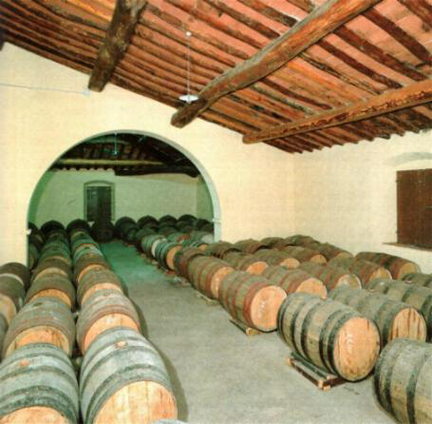
The saying refers not to small, new French oak barrels (barriques) but rather to the Italian caratello or carrato, a small and sometimes elongated barrel used to store wine (possibly from the Latin carrus or “cart”; others believe the term derived from the Greek keration, a diminutive of kèras, or “horn,” because of the barrel’s shape). As early as the sixteenth century, small barrels were used in Italy to make sweet wines like Vin Santo and Sagrantino (the latter was not made as a dry wine until the 1970s) and there is evidence that small barrels were also used during the 1500s in a winemaking technique now called the governo method, whereby a small amount of sweet, dried-grape wine is added to dry wine (and in some cases, a second fermentation takes place).

caratelli.jpg

Above: caratelli used to make Vin Santo.

Perhaps a more appropriate translation of the proverb would read: “coveted, sweet wine comes in small barrels.”

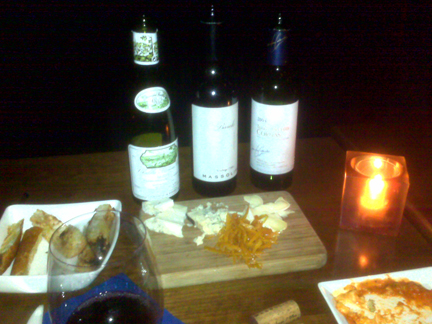
A propos wine in small packages, last night found me at Park Blue in midtown, a wine bar that specializes in half bottles, with roughly 150 different labels in its cellar (Per Se is the only restaurant in NYC, the owner told me, that has more half bottles on its list). Even though half bottles are not good for aging wine, they can be fun: especially at a place like Park Blue, with so many to choose from, the lower price point allows you to enjoy different wines in one sitting.

Among other wines, I was eager to try the 2001 Barolo by Massolino. I had never seen a Massolino Barolo in 375ml format and had yet to taste that vintage. I have tasted the 1996 and 97 on numerous occasions and I’ve always felt that Massolino was an excellent wine at an excellent price, a classic expression of the appellation. The wine was much “hotter” (higher in alcohol content) than the wines I had tasted previously and it didn’t taste as earthy as I remember for previous vintages.* It would appear that Massolino has abandoned its traditional style. On the other hand, Antonio Galloni just gave its flagship wine, the Barolo Rionda, a glowing review in The Wine Advocate, a publication that favors “modern” style wines. Am I wrong to begrudge Massolino when the winery seems to have achieved a new level of success with its current winemaking style? To borrow a phrase from François Villon, I miss the wines of yesteryear (as per my note below, I intend to retaste the wine and post new tasting notes).

Click here to read about my tasting with Franco Massolino.

park_blue.jpg

Above: half bottles at Park Blue.

The service at Park Blue was uneven but our server did know the wine list very well. The small plates were just okay but the cheese selection was great. The atmosphere there (music, lighting, and seating) is very relaxing and I’m glad to have discovered a wine bar, with an interesting list, that stays open late in midtown.

In other news, my good friend Charlie George and his family were evacuated from their home in Rancho Santa Fe, California (not far from where I grew up). They’re all safe but, at the moment, he doesn’t know if his house survived the fire. I’m keeping my fingers crossed for him.

I see your hair is burning.
Hills are filled with fire.
If they say I never loved you
You know they are a liar.

— Jim Morrison

*When I tasted the wine, I perceived notes of new oak but when I inquired, the importer assured me that winemaker Franco Massolino does not age this wine (from Serralunga) in new oak. I’m going to make a point of tasting again (this time in 750ml format) and will post new tasting notes. It’s possible that the wine was tainted by some bacteria in the botti in which it was aged. In any event, I will retaste the wine and post a new tasting note.

The Lice of Wine Writing Redux

For propriety’s sake, this post must begin with an errata corrige: my recent post on my dinner with Leslie Sbrocco included an erroneous literary attribution (to Eugenio Montale). In fact, it was twentieth-century Italian novelist Carlo Emilio Gadda who wrote: “Pronouns! They’re the lice of thought. When a thought has lice, it scratches, like everyone who has lice…. and they get in the fingernails, then… you find pronouns, the personal pronouns.”

“Ah! the world of ideas! What a fine world! Ah! this, I, I…,” says Gadda’s autobiographical character Gonzalo in Acquainted with Grief, “among the almond blossoms… then among the pears […] I, I… the foulest of all pronouns!”*
gadda.jpg

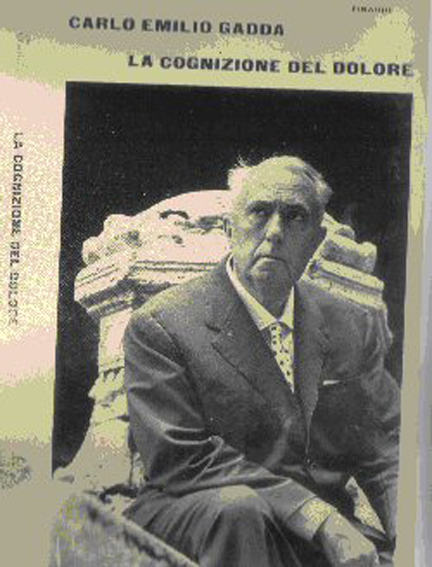
Above: Carlo Emilio Gadda, the great twentienth-century Italian novelist. We’ve all been “Acquainted with Grief,” haven’t we?

Over the weekend, in speaking with journalist and wine writer Peter Hellman about all of the upcoming tastings and wine events in NYC, we shared our dismay at the state of wine writing today and what I like to call the “lice of wine writing”: tastings notes so impossibly subjective, so beleaguered by the presence of the “I,” that they are bereft of meaning.

An avid reader of wine writing, Peter pointed out the absurdity in a recent promotional email where two very famous wine publications were quoted about the same wine:

Parker: “The 2003 Cornas La Louvee is a blockbuster. Glorious aromas of flowers, blackberries, roasted meats, espresso roast, and white chocolate flow from this full-bodied, concentrated, modern-styled, impressively-endowed, full-throttle Cornas. Drink it now and over the next 15+ years. 93pts”

Wine Spectator: “Tight and structured, with lots of iron and mineral notes framing the black cherry, plum, briar, tar and olive paste flavors. Long finish sports mouthwatering acidity. Very impressive for Cornas in 2003. Best from 2007 through 2015. 800 cases made. 92pts”

As Peter pointed out rightly, the tasting notes in the two passages are “mutually exclusive.” As I’ve asked many times before, how can a wine really taste like so many different things? And, come on, “mouthwatering acidity”? What the hell does that mean?

He also directed me to the website of Château Palmer where a similar discongruous hypertext emerges. Of all the I-can-taste-and-write-more-descriptors-than-you descriptions that I found there, the only one that showed some sanity was the wise Jancis Robinson, who, it seems to me, always takes a much more objective approach to wine writing and tasting notes, a style much more real and accessible to both the expert and the lay person:

Very, very deep crimson. Very intense and nervy – impressive on the nose – but more obviously big and fruity than the more delicate Ch Margaux… Slightly charred and smoky. Round and fresh and very beguiling. Real lift and only the slightest hint of inkiness on the finish. Bravo! Very fine tannins – very suave and polished with good density while still being Margaux. Very sweet. Hints of modern idiom but very gentle. Super silky texture. Sinewy – but polished sinews!

Hers is a more poetical approach and she avoids the subjective virtuosismo of the Parkers, Wine Spectators, and Tanzers, who just can’t resist the “I taste this, I taste that” one-upmanship** (as Peter pointed out, Tanzer is probably the only person in the world who knows what “Vermont granite” tastes like… Next time I go to Vermont, I’ll be sure to eat some).

When will wine writers come to their senses (pun intended) and realize that these overblown descriptors are the lice of wine writing???!!!

When I read “blackberries, roasted meats, espresso roast, and white chocolate” and “black cherry, plum, briar, tar and olive paste,” I scratch my head and like Gadda’s Gonzalo, I find lice in my fingernails — the lice of wine writing.

*Gadda, Carlo Emilio, Acquainted with Grief (original title: La cognizione del dolore), translated from the Italian by William Weaver, Braziller, New York, 1969, p. 86.

For the original Italian, see: ibid., La cognizione del dolore, Einaudi, Torino, 1970 (1963), p. 123.

In the passage, Gonzalo (Gadda) tells his doctor that he doesn’t need anyone but himself for a diagnosis of his ills, anyone but his “I.” Then, all of a sudden, a thought bursts from his mouth:

“Ah! the world of ideas! What a fine world! Ah! this, I, I… among the almond blossoms… then among the pears […] I, I… the foulest of all pronouns!”

The doctor smiled at this outburst; he didn’t understand. Still he seized the chance to direct into more serene channels their words, if not the man’s humor and thoughts.

“And why, for God’s sake? [the doctor asks Gonzalo] What have they done wrong, pronouns? When a person thinks something or other, he still has to say, “‘I think…'”

“Pronouns! [Gonzalo answers] They’re the lice of thought. When a thought has lice, it scratches, like everyone who has lice…. and they get in the fingernails, then… you find pronouns, the personal pronouns.”

**I write anti-chauvanistically “one-upmanship” and not “one-up-personship” because I believe that women have finer noses and palates in wine tasting and that they dispense with the ever-present male bravado that accompanies wine enthusiasm and connoisseurship.

Foodies vs. Winies?

My friend and colleague Winnie helps me to understand the “foodie vs. winie” dialectic.

I was recently inspired to create my Do Bianchi blog by my friend and colleague Winnie. She works with me in the marketing department for the company that runs Vino, I Trulli, and Centovini. She is also the editor of the Slowfood newsletter, The Snail. She’s one of the best food writers that I know.

Browsing her blog, I came across a link to an Epicurious/Gourmet Mag blogger that Winnie particularly admires, Francis Lam. I was intrigued by his take on “foodies vs. winies” and wanted to address some of the issues he raises. See quotes from his post and my reflections.

…food geeks are insufferable, but wine geeks are TOTALLY insufferable, and most people try to limit their insufferability. Once, at dinner with a real winie (if I’m forced to answer to “foodie”, it’s only fair to call them “winies”, right?) I took a bite of peas and exclaimed, “Oh my God. . . that tastes so much like pea!” Kind of annoying, sure. But then my winie friend took a bite and said, “Yeah. . . it tastes like pea skins.”

Wine geeks are insufferable (and I would argue that food geeks are equally insufferable, especially when they consider talking about food more important than eating well, but then again I guess that’s why all of us are in this business. “Foodie” and “winie” (a neologism? or is this what they call us all the time?) are reductive terms. We all need to approach food and wine within the context of who and where we are and whenever style supercedes substance, we all might as well just stop eating and drinking all together.

…have you read any wine tasting notes lately? Yeah, I don’t blame you. Last time I picked up a wine magazine, I realized that I can’t really blame my pea-skin loving friend. Hey, I understand how hard it is to talk about what something tastes like–we really don’t have much of a vocabulary for it.

I can’t say how much I agree: wine tasting notes are the “lice” of the wine world (as Montale once said of pronouns in poetry). Wine tasting notes are such a turnoff to so many people. Wine should taste like wine and the sad thing is that people overlook the fact that you need to start your knowledge by learning what different grapes and appellations taste like. You have to learn what Merlot tastes like before you can begin to describe the differences between Merlot grown in different places and vinified using different methods.

…I’ll say this at the risk of losing all my credibility in the gastronomic world: WINE IS NOT AS IMPORTANT AS FOOD. It’s just not.

As much as I agree with the central theme of his post, I have to say that a statement like this is just ridiculous and it’s irresponsible for someone like Francis to publish an “absolute” like this (in all caps?). This is a great example of what’s wrong with the blogosphere. Wine and food are equally important: uninformed bloggers like Francis are not aware of the fact that wine (like beer, also an important source of nutrients) were essential to human existence unti the post-second-world-war era when consumerism and the hegemony of American puritanism transformed wine into a purely “luxury” item.

Despite what oenophiles will tell you, wine is not central to food. To wit: all of the food cultures that have developed without wine: Hello, Muslim world! Hello, Asia! Hello, Mexico!

Again, why does he have to write in such extreme colors? And, again, he is misinformed: just think of the great fourteenth-century Persian poet Hafiz and the many verses he devoted to the mystical pleasures of wine. Muslim culture developed without any wine? Yeah, right.

…it’s a real problem that the idea of “knowing” wine means that you’ve memorized grapes and vintages, or that you know to look for the grapefruit, chalk, and sea salt in your glass of Pouilly-Fumé. These things might matter, but the bigger question, I think, is not how to get people to name the 13 varietals in Chateauneuf-du-Pape, but how to get people excited about trying something new, something good.

I felt compelled to write this post because what Francis is saying is fundamentally right (at least in my mind). Knowing wine, as he writes, is being excited about “something new, something good.” I tell people all the time: don’t listen to the would-be poets who taste “star anise” in their wine (when’s the last time they put star anise in their mouths?). All you need to know about wine is whether you like it or not. Drink what you like and don’t let anyone tell you different!

…that’s what I might say if I were going to be thoughtful about this.

Good thing Francis has decided not to be thoughtful.

Do Bianchi

Do Bianchi: The origin of the name.

My pseudonym Do Bianchi (Venetian for “two glasses of white wine”) came about when I was writing anonymously for The Magazine of La Cucina Italiana back when I first started working in NYC in the late 1990s. The editor and I wrote 90% of the content and so we each assumed a few noms de plume (my other pen name was Giovanni Malpaghini, borrowed from Petrarch’s calligrapher).

Do Bianchi was inspired by the pseudonym of one of my favorite authors, Samuel Clemens. In the early part of his life, when he lived and worked as a journalist in San Francisco, saloon-goers could often be overheard calling out “mark twain!” In other words: “mark me down for two glasses of whisky.” In the latter part of his life, evidently embarrassed by the origin, he invented a series of less savory explanations.

Trying to come up with my own pseudonym, I remembered the line you often here in Venetian osterie: “do bianchi!” (doh BEE’AHN-kee), “give me two ombre (or small glasses) of white wine!”

The Venetian term ombra means a small pour of wine to be consumed standing at the counter of a bar. The word’s origin is attributed to a wine carriage that appeared in the shadow (ombra in Italian and Venetian, umbra in Latin) of the campanile or bell tower of Piazza San Marco (St. Mark’s Square in Venice, see image above).

As the shadow moved, the wine seller would follow (in order to keep his wines and his patrons cool). One would say: ci vediamo all’ombra (xe vedemo al’ombra) or “I’ll meet you at the shadow.” By metonym, the term came to mean a glass of wine.