My new favorite word: oenomancy

oenomancy n. [< OENO- comb. form + -MANCY comb. form; compare French {oe}nomancie (1752)] divination by means of wine. (via OED)

More Italian winery designation notes and a clarification from Banfi

declassified sagrantino

Above: I tasted Paolo Bea’s 2006 declassified Sagrantino the other night in Houston. Winemaker Giampiero Bea was not allowed to label the wine as “Sagrantino,” he told me, because the tasting committee said that the wine “lacked color” and had undergone “slight oxidation.” It was fantastic. Giampiero’s labels are among the most information and most difficult to understand for someone who doesn’t speak and/or read Italian.

This morning, I added the following terms to the May 5 post
A note on Italian winery designations: azienda, cascina, fattoria, podere, et cetera
. I thank everyone for the generous support and I hope people will continue to make suggestions/comments/clarifications etc. (special thanks to one of my favorite wine writers, Mitch Frank, for reminding me, via Facebook, about ca’ and casa!).

cantina, literally cellar or cool place to store perishable goods and by extension tavern (probably from the Italian canto meaning angle or corner from the Greek kampthos, bend or angle).

The word cantina has a wide variety of applications in Italy (often used for restaurants and food stores, as well as wineries) and can be found across Italy to denote wine cellar.

casa, literally, a building, house, or habitation (from the Latin casa, a small house, cottage, hut, cabin, shed).

The term casa is used throughout Italy as a winery designation and is often abbreviated as ca’, as in Ca’ del Bosco (it is important to note that it’s often erroneously abbreviated as [using the accent grave diacritic], when in fact the inverted comma [‘] denotes the elision of the final two letters, often derived from a dialectal locution). A casa vinicola (pronounced KAH-sah vee-NEE-koh-lah) is a winery/négociant.

vignaiolo (plural vignaioli), vine tender or grape grower (derived from the Italian vigna, meaning vine, from the Latin vinea, vineyard [from the Latin vinum, wine]).

Pronounced VEEN-y’eye-OH-loh (plural VEEN-y’eye-OH-lee), vignaiolo is used to denote a winery that uses estate-grown fruit in the production of its wines.

I’d also like to draw attention to a important clarification made, in the comment thread, by Fred and Ken Vastola.

An azienda agricola (ah-zee-EHN-dah ah-GREE-koh-lah) is a farming estate, where grapes may or may not be grown for wine production. An azienda vinicola is a winery (or wine business) where grapes are purchased from other farms for wine production. An azienda vinicola (ah-zee-EHN-dah vee-NEE-koh-lah) can also denote a business where wine is purchased and then bottled. As such, the latter designation can be used for a wide range of business models, from the artisanal to the purely commercial.

In other news…

As the world anxiously awaits the results of today’s election of the new advisory committee for the Brunello producers association, a spokesperson from Banfi wrote me yesterday asking me to make this clarification at VinoWire.

More wine and cinema, Italian and Italian (and thoughts on ya’ll vs. y’all)

san dona del piave

Click here or on the image to view a short documentary (infomercial) about wines produced in the Veneto, made in 1969.

A lot of folks commented and/or retweeted my post from the day before yesterday, on Wine in Fellini’s La Dolce Vita. Thanks to all for the link love! :-)

This morning, I poked around in the Archivio Luce website (the Istituto Luce was founded by the fascists to create propaganda films, LUnione Cinematografica Educativa or The Educational Cinematic Union) and found this clip from 1969 about the “ichthyic wines,” i.e., the seafood wines of the Veneto.

The short film (essentially an infomercial for the Canella winery in San Donà del Piave) is interesting for a lot of reasons. Tocai, Verduzzo, Merlot, and Cabernet from the Veneto (Tocai and Verduzzo to pair with seafood, Merlot and Cabernet with roast meats and game), are top exports to the gourmets of the world, says the narrator. But the thing I find the most fascinating is the music and the chipper style and feel of the film — reminiscent, however distantly, of the feel of Fellini’s La Dolce Vita.

Watch the clip and let me know your impressions.

In other news…

Thanks to all the folks who retweeted yesterday’s post! :-)

lunar

I wanted to post another picture of Tracie B’s peepaw and meemaw (above) since Tracie B pointed out to me that peepaw wasn’t smiling in yesterday’s photo (it was the only one I could find with a glass of orange wine in it).

He just turned 90 and well, you don’t ask a lady her age, but the two of them are pretty amazing: peepaw may not be as spry as he once was but they both get out to all the family functions (meemaw drives) and they enjoy all the festivities, food, fixings, and the wines, too…

Honestly, there are not a lot of options for fine wine in Orange, Texas, and Texas retailers do not ship within the state. It is legal for out-of-state retailers to ship here but few have jumped through the hoops that allow them to do so. If Lunar made it to Orange, Texas, on the Lousiana border, it was ’cause Tracie B and me brought it! :-)

Thanks for reading!

In other other news…

In recent months, I’ve received a lot of comments (even some ugly ones) about my usage of the expression ya’ll. I addressed some of the linguistic issues and implications in this often heated debate in a comment thread the other day and would like to repost it here for all to consider. Thanks for reading!

“My thoughts on the (often heated) ya’ll vs. y’all debate.”

@TWG and IWG the ya’ll vs. y’all question has become contentious at times! There’s no doubt in my mind that the “more correct” inflection is “y’all” since nearly everyone agrees that the expression is a contraction of “you all”. I also believe it is the more correct inflection because it is the more common: orthography and the “correctness” of language are determined by usage and frequency. There are more occurrences of “y’all” than there are of “ya’ll” and so “y’all” wins as the “most correct.”

Having said that, a little research reveals that the earliest inflection is “yall”, written without the inverted comma denoting the elision (btw, an entire chapter of my doctoral thesis is devoted to the history of the inverted comma and its early usage to denote elision in the transcription of poetry in incunabula in 15th-century Venice tipography — no shit!). It appears in transcriptions of early 20th-century African-American (read “black”) parlance. So, technically, the most correct form is “yall”.

Having said that, “ya’ll” is an accepted form and I’m not sure why it evokes so much ire among observers. I, for one, will continue to use “ya’ll” because I like the way it mirrors the dialectal pronunciation of the vowel cluster, where the greater aperture of the “a” seems to take precedence in the enunciation of the contraction and elision.

Language is by its very nature a balance between idiolect (a language spoke by one person) and dialect (a regionally inflected and mutually comprehensible corruption of a standardized linguistic code).

In other words, “ya’ll” feels just right to me and I know that everyone understands it. So, as they say, if it ain’t broke? ;-)

Clearly, I’ve spent some time thinking about this.

Champagne, Xerox, and Kleenex

antonomasia [ahn-TAH-noh-MAY-zee’ah], the use of a proper name to express a general idea, as in calling an orator a Cicero, a wise judge a Daniel (OED, online edition).

Above: An unforgettable bottle of 1996 Billecart-Salmon that I shared last year with Jayne and Jon at Spago in Beverly Hills. We weren’t celebrating anything. But we were being treated by a famous winemaker.

In this week’s semiotic treatment of Champagne, we neglected to address one of the most fascinating semiotic implications of the lemma Champagne (at least, one of the most fascinating to me).

The term Champagne is a wonderful example of the literary figure antonomasia, from the Greek ἀντί (anti, meaning instead or against) and ὄνομα (onoma, meaning name), whereby a proper name is used to denote a general idea, in this case, sparkling wine.

Above: A bottle of Bollinger that we popped to celebrate pulling the first mix from Nous Non Plus’s 2009 release Ménagerie. The track? “Bollinger” (click to listen)! A song about our favorite Champagne and official band beverage. (We are a “French” band, after all, n’est pas?)

Other examples that immediately come to mind: Xerox and Kleenex. Both are proper names, in fact, brand names, yet both have come to denote generic items, namely, photocopies and tissue paper.

Let’s face it: even though we wine professionals and enthusiasts strictly use the term (toponym and proper name) Champagne to denote sparkling wines sourced from the place and appellation, Champagne, 99% of the intelligent lifeforms in the world interpret it as any sparkling wine. In his 1953 editio princeps of With a Jug of Wine, for example, food and wine writer Morrison Wood casually and regularly makes reference to California champagne.

Above: A bottle of Initial by Anselme Selosse that Alfonso opened for me and Tracie B last year to celebrate my move to Texas. Perhaps more than any other, Selosse is the most coveted and illustrious brand of Champagne in the U.S. It’s not cheap but it’s worth every penny. Check out this great post, from earlier this year, by McDuff.

Just this weekend, I was reminded of this fact when Melvin C and I visited a Walmart in Orange, Texas in search of some Prosecco for Tracie B, and I was greeted by a “stack” (as we say in the biz) of André California Champagne (“the best selling brand of sparkling wine in the U.S.,” according to the Wiki).

Whatever you plan to drink tonight for your New Year’s celebration, Tracie B and I wish you and yours a happy, healthy, and serene 2010. Thanks for all the support and love in 2009!

Breaking news: this just in from Italy

Thanks are due to reader Elaine from Italy who identified the champagne-method Nerello Mascaelese by Murgo (Sicily).

Also just in from Italy…

According to the Agenzia Giornalistica Italia, when all is said and done, Italians will have spent Euro 2.7 billion on sausage (cotechino and zampone) and Italian sparkling wine (spumante). “Salmon, oysters, and caviar” were no match for the famed boiled sausages of Modena (both delicious, btw). Nor did Champagne, with a “a 66% drop in sales,” rival its Italian counterparts.

On that part, according to a press release issued by the Prosecco di Valdobbiadene e Conegliano Producers Association, Italian agriculture minister Luca Zaia sent 60 “3-liter Jeroboams” of Prosecco to the staff of the “national radio and television stations.”

An early celebration of his upcoming governorship of the Veneto, no doubt.

Happy new year, everyone, everywhere!

Champagne by any other name…

From the semiotics department…

champagne

Above: A few weeks ago, Tracie B and I attended a “Champagne Party” in south Austin hosted by wine collectors.

Champagne is a place (a province of eastern France).

Champagne is an adjective, “something exhilarating, excellent” (“It was of the two Lytteltons, Alfred and Edward, that the phrase ‘the champagne of cricket’, was first used,” 1928, OED online edition). Champagne is a color.

Champagne is also a compound attributive adjective: you can have “champagne” tastes; you can be a “champagne” socialist (I, for one, certainly am one, although I prefer Brunello socialist); you can even have a “champagne” cocktail.

Champagne is also a wine — a sparkling wine made in the region of Champagne, twice-fermented in bottle.

champagne

Above: It was like a scene from Man Bites Dog when fellow Austinite blogger Alcoholian and I faced off with our cameras at the Champagne party. Meta-blogging at its best!

Champagne perhaps more than any other wine (with Bordeaux a distant second) evokes an ethos, a zeitgeist, an aura, a sentiment, a sensation, a sensual experience…

On any given day, you will find at least three bottles of wine in my refrigerator: a bottle of Prosecco, a bottle of Moscato d’Asti, and a bottle of Champagne. The Prosecco for celebration and/or a great pairing for a small plates dinner (cicchetti). The Moscato d’Asti, with its low alcohol and bright fruit flavors and residual sugar, a great brunch wine, a great a-friend-just-dropped-in wine, a great wine to pair with fresh fruit. But the Champagne? When it comes to a truly special occasion, I wish for no other wine to grace the palate of my beautiful Tracie B than Champagne. Is there any other wine where refinement and elegance meet power and structure as in Champagne? Is it just the ethos behind the wine that inspires this reverence in me?

Today, I’ll leave the technical discussion of Champagne to Eric and BrooklynGuy (I highly recommend both posts, the one on some great grower-producers, the other on varietal expression in Champagne).

I’ll just invite you to consider the word… say it aloud, roll it around your mouth… think of the imagery and ethos it evokes… Champagne… the very word titillates the senses, no? Champagne by any other name just wouldn’t be the same, would it?

Tracie B and I will be opening a Champagne on New Year’s Eve this year but we haven’t decided which one. What’s your “best Champagne” pick?

More tomorrow…

In other news… There is a G-d!

pastrami

Yesterday, Tracie B and I stopped in Houston on our way back to Austin from Orange, Texas and had lunch at Kenny and Ziggy’s Delicatessen. The day I decided to leave New York City, I had resigned myself to never eating great smoked fish and pastrami again (at least, not on a daily basis). But, man, let me tell you: the pastrami at Kenny and Ziggy’s ranks right up there with Barney Greengrass and Katz’s.

I never thought I’d utter the words, “there IS great deli outside of New York.”

Who knew?

Che bigolo! A sexy pairing with Pierre Péters

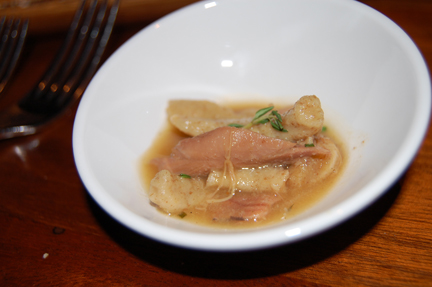
Above: Not exactly traditional but delicious. Buckwheat bigoli with guinea hen last night at Trio in Austin.

My Italian friends will get the joke from last night. When Tracie B and I saw that Trio chef Todd Duplechan was offering buckwheat bigoli on his menu at Trio, I couldn’t resist the pun: I turned and asked sommelier Mark Sayre, “do you think that Todd will let me taste his bigolo?”

Here’s what “Trevisan humanist” Bepo Maffioli had to say about bigoli in his landmark Cucina Veneziana (1982):

    “Brown” bigoli — the buckwheat long noodles of Bassano and Treviso — went through a dark period because Italian law requires that only durum wheat flour be used to make pasta. As a result, bigoli were considered an adulterated product. But then, sentence was passed, and they were found to be a traditional product and thus were permissible for consumption. Since the time of the “vigils,” bigoli a puro oio, in other words, dressed with just extra-virgin olive oil, has been one of the most common dishes for abstinence and fast days. Christmas Eve, Ash Wednesday, and Good Friday have always been holidays for bigoli in salsa (literally, bigoli in sauce) in nearly every city of the Veneto. This dish was almost always made by pairing bigoli and salt-cured sardines but the ingredients could change depending on the city and province and sometimes even the township.

[His thoughts on “adulteration” and culinary law (playful in this case) might seem ironic in the light of the pasta price fixing scandal that surfaced this week in Italy and the Chianti adulteration controversy that first raised its ugly head last week. Ne nuntium necare!]

Like the Tuscan pinci or pici, the Veneto word bigoli is a generic term that denotes long, round artisanal noodles. Most believe it comes from baco or worm. Many Veneto cookery authors use it interchangeably with spaghetti, which simply means little strings (from spago or string). In English, the term spaghetti evokes a particular shape of long noodle. But in Italian, it is a generic term that can be used in certain contexts to denote a wide variety of long, round noodles. The expression bigoli in salsa, literally bigoli in sauce, is used elastically to denote the traditional Venetian dish bigoli with sardines or anchovies as well as other preparations.

For obvious reasons, bigolo, when singular, is a euphemism for the male sex.

Todd served his buckwheat bigoli with guinea hen. They were shorter than traditional bigoli but delicious nonetheless.

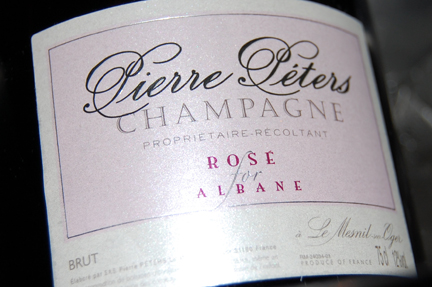
Above: Pierre Péters rosé at Trio. I had never tasted this superb wine before. What a fantastic, exquisite expression of Champagne! There is so much great wine in the world. Anyone who’s really into wine will tell you, the more I learn, the more I realize how little I know.

Our friends April and Craig Collins graciously and generously treated us to a bottle of Pierre Péters rosé to celebrate the holiday season. What an amazing wine! Ubi major minor cessat: for notes on the producer and the wines, I’ll point you to the experts here and here.

As we sipped this delicious and gorgeous pink wine (full of luscious fruit balanced by stern minerality), I couldn’t help but think to myself about how some of my wine blogging colleagues warned me (fruitlessly) that I wouldn’t find good wine to drink in Texas. Well, I’m here to tell ya, they got them some pretty darn good wine down here in this fine state!

Above: Master sommelier candidate Craig Collins and his lovely wife April are the leading man and lady of the Austin wine scene.

Thanks again, April and Craig, for turning us on to (and treating us to) such an amazing wine!

The ultimate (authentic) wine pairing for pizza

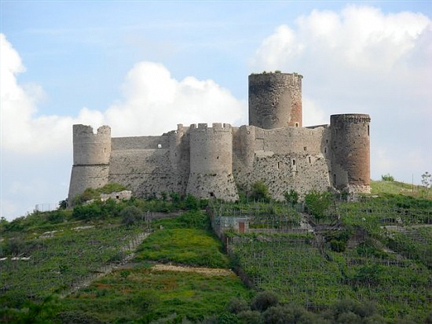
Above: It’s easy to understand why they can make fresh, clean wines in the Commune of Lettere (Naples), where vines are tended atop the peaks of the Lattari mountain chain.

It’s another busy day over here at Do Bianchi Editorial and I really shouldn’t be posting. But when a lovely lady sends me an etymological quaestio, the chivalrous in me trumps my otherwise unflagging work ethic (hah!).

Over at My Life Italian, Tracie B has produced a truly wonderful and thoroughly delightful post on a wine we shared just over a week ago in New York: a sparkling red blend of indigenous grape varieties from the township of Lettere (province of Naples). You’ll have to click through to read about this wine and why it — together with Gragnano — is one of Neapolitans’s favorite pairings for pizza.

But as far as toponomastic matters are concerned, I poked around the web and found an answer to her query as to the origins of the name Lettere.

The most likely etymon I found was that Lettere is a corruption of Lattari (pronounced laht-TAH-ree, if I’m not mistaken), the name of the mountain chain where the township is located. The beautiful (and fruitful) mountains take their name, most believe, from the Latin mons lactarius, literally the suckling mountain (from the Latin lac meaning milk) because the mountain chain was known in antiquity as an excellent site for sheep to pasture.

Tracie B and I will be heading to central and northern Italy in early 2010 but we are hoping to head south next fall. We’ll be sure to take a print out of this listing of pizzerie in Lettere (click on “Dove Alloggiare e Mangiare”)!

And in the meantime, I’ll reiterate Tracie B’s advice: head to Kesté Pizza e Vino in New York and order some Lettere (or Gragnano) with your pizza!

Getting tiggy with it in the ATX

From the “just for fun” department…

On Friday night, Tracie B’s birthday celebration weekend began with a glass of 1987 López de Heredia Tondonia — one of the best wines I’ve tasted in a long while. Our good friend Mark Sayre at Trio at the Four Seasons always has something crazy and stinky for us to drink when we hang out at Austin’s best-kept-secret happy hour (half-priced wines by the glass, happy hour snacks menu, and free valet parking).

I’ve become somewhat obsessed with chef Todd Duplechan’s fried pork belly. He makes a confit of pork belly and then fries it: when he serves it, the fat in the middle is warm and gelatinous and the outside is crispy and savory. You know the story I always tell about the Rabbi and the ham sandwich he “can live without”? Well, I can’t live without Todd’s fried pork belly. He garnishes with a relish made from seasonal vegetables, in this case pickled watermelon radish and okra.

Later that evening, we met up with some friends at the High Ball (no website but does have a Facebook fan page), Austin’s newest (and only) bowling alley cum Karaoke bar cum mixology and designer beer menu. Tracie B had the “Heirloom”: roseberry fizz, citrus infused vodka, elderflower, rosemary, muddled blackberries. The High Ball hasn’t even had its official, hard opening and it is already packed nightly, Austin’s newest hipster hangout and a lot of fun with its art deco, Bettie Page ambiance and clientele.

Thanks to everyone for coming out to my Italian wine seminars at the Austin Wine Merchant. Last night was Tuscany (that’s our new friend Mary Gordon, front row center). Highlights were 2006 Chianti Classico by Fèlsina (such a great value), 2001 Brunello di Montalcino by Il Poggione (this vintage is just getting better and better, always a fav), 2004 Vino Nobile di Montepulciano by Villa Sant’Anna (old-school Vino Nobile that I thoroughly dig), and 2005 Tignanello (not exactly my speed but always a go-to trophy wine). Coincidentally, Laura Rangoni posted an interview with the “father of Tignanello” Renzo Cotarella on her blog yesterday. “Barrique is like a mini-skirt,” he told her, “not every woman can wear one.” I couldn’t have said it better myself!

Yo, Renzo, get tiggy with it! Thanks for reading.

Nah nah nah nah nah… Get tiggy with it…

CMO reforms and how they relate to Italy

Tracie B and I recently opened a bottle of 2004 Sagrantino by Paolo Bea (a DOCG) that we had picked up at The Austin Wine Merchant. The wine was super tannic yet also had a wonderful “lightness of being.” We could not stop talking about it. So good… Photos by Tracie B.

In the wake of yesterday’s post on why the Italian DOC/G does and does not matter, I received a lot of positive and inquisitive feedback. So minister Luca Zaia and the Prosecco wars will have to wait until tomorrow.

First of all, some Googling this morning (prepping for my Tuscany seminar tonight at The Austin Wine Merchant) led me to this site, Agraria.org, which does seem to have a nearly complete list of DOCGs (although the new Matelica DOCG is not listed, it does include some of the most recently added DOCGs like the Moscato di Scanzo and Prosecco Asolo and Prosecco Conegliano Valdobbiadene).

Secondly, in case you haven’t been following the European Commission’s efforts to “streamline” and “simplify” European Union markets, here’s a link to some background info.

The bottom line: in 2006 the European Commission “proposed to the Council and the European Parliament to adopt one single Common Market Organisation for all agricultural products. This project, ‘the Single CMO’ is another important step in the process of simplification, which is priority of the Commission.”

As part of this process, beginning with the current vintage, EU member states’s wines will be required to be labeled with the one of the following classifications: Protected Designation of Origin (PDO) or Protected Geographical Indication (PGI). In Italian, the acronyms are as follows: DOP (Denominazione d’Origine Protetta) and IGP (Indicazione Geografica Protetta).

The following links will take you to some back ground info: here and here.

Here’s a link to E-Bacchus, a searchable database of all the currently registered PDOs and PGIs. There are currently 412 records in the PDO database (Italian DOCs and DOCGs) and 120 records in the PGI database (Italian IGTs).

And here’s a English Wiki entry on Protected Geographical Status.

In case you missed it, Franco wrote (and I translated) this editorial on the mad rush that preceded August 1, 2009 deadline for the creation of new DOCs and DOCGs.

On Saturday night, we ordered 2007 Langhe Nebbiolo by Produttori del Barbaresco (a DOC) at Il Sogno in San Antonio (no website). It’s one of our favorite wines and Il Sogno offers it at a fantastic on-premise price, a great value. We’re planning to serve this wine at our wedding! :-)

In my view, the CMO reforms are a good thing (for a number of reasons) and were “agreed by Italy” (as you say in diplomatic-speak): existing DOCs and DOCGs will be allowed on labeling (despite some alarmist reactions unfortunately based on sloppy blogging and reporting).

There are a number of reforms that have been implemented in Italy and Franco and I have reported on some of them at VinoWire. These include grubbing up, distillation, and use of grape must reforms, all aimed at streamlining the system and rewarding producers in member states for eliminating waste and observing environmentally friendly farming and vinification practices.

The new labeling, in my view, will help to simplify the appellation system, thus aiding those of us who buy and sell Italian wines.

From what I have read, there are other reforms as well (some of them unfortunately allowing undesirable commercial practices, like the use of oak chips).

But the most significant reform, in regard to Italy, in my view, is that at some point — and it’s not clear when — Italian winemakers will be able to use varietal labeling when producing international varieties. In other words, a wine like Planeta Merlot putatively could be labeled “Sicilian Merlot” or a Merlot from Tuscany hypothetically could be labeled “Montalcino Merlot.” Varietal labeling will not be allowed for indigenous varieties like Sangiovese or Aglianico.

Essentially, from what I understand, it will allow Italian producers to label their wines the way Californians and Australians do and consequently it will allow them to compete more aggressively in international markets.

While I’m not sure I want to drink Sicilian or Montalcino Merlot (and again, I need to stress, it’s not entirely clear how the labeling reforms will be implemented), it will free Italian producers from the yoke of currently strict labeling regulations. If someone wanted to produce a Montalcino Merlot and label it as such, that would be her or his business — literally.

Like the story of the Rabbi and the Ham Sandwich, I don’t need to drink Merlot from Montalcino. But if someone else wants to, that’s fine with me.

Vin Santo: an overlooked “orange” wine? (and a more likely explanation of its name)

vin santo

Above: Ale posted photos of grapes (Trebbiano and Malvasia) being laid out to dry on reed mats for the Vin Santo that he and his father are making this year.

Scanning my Google Reader feed this morning, I came across these posts by my friend Ale in Sant’Angelo in Colle. He and his father grow Sangiovese and make Brunello di Montalcino for one of the oldest — and one of my favorite — producers in the appellation, Il Poggione.

vin santo

Above: The mats are then hung in the vinsantaia, an attic used especially for the drying of the grapes. Windows on either side of the space allow for ventilation that helps to limit humidity during drying.

Reading his descriptions of harvesting and drying grapes for the production of Vin Santo, it occurred to me that Vin Santo is an “orange” wine. There is no canonical definition of “orange wine,” even though a new “orange wine” movement has clearly emerged among European winemakers, mainstream wine writers, fringe wine bloggers (like me), enthusiasts, and lovers. Vin Santo is generally not made using skin contact during fermentation (one of the fundamental techniques employed in the production of orange wine). But there is no denying that Vin Santo is orange in color.

The rich orange color of Vin Santo is created by the drying of the grapes and by intentional oxidation of the wine.

vin santo

Above: Specially sized caratelli (literally, “small casks”) are used for aging. Many believe that the size of the barrels is one of the keys to the unique flavors and aromas of Vin Santo.

The earliest documented printed reference to Vin Santo is found in Giovanni Cosimo Villifranchi’s Oenologia Toscana (1773). In 1605, Sir Robert Dallington mentions a wine called Zibibbo, which was “dried for Lent” and could possibly be a reference to Vin Santo (see his entire description of grape growing and winemaking in Tuscany here).

Many claim that the name Vin Santo (literally, “holy wine”) was coined in the 15th century when Greek humanist Basilios Bessarion tasted the wine and compared it to the wines of Xantos (see also this entry on Bessarion in the New Advent Catholic Encyclopedia). Supporters of the theory maintain that he liked it so much, he exclaimed “Xantos!” and those present understood him to say “Santo!” But I doubt this is the case.

I’ve heard some say that the name is inspired by the fact that Vin Santo can go through a second fermentation in the spring when temperatures rise in the vinsantaia. Like Christ, the wine “rises again.” I doubt this is the case but Dallington’s reference to Lent leads me to believe that dried grape wines were associated directly or indirectly with Easter in his time.

In 1773, Villifranchi writes: “The name that is given by us today to this ‘Vino di Santo’ is believed by some to be owed to Ancoret saints* and the Monks of Soria [Spain] who originally made wine in this manner.” He adds that “others believe that this name derives from the fact that the grapes are typically pressed during the period of the Christmas holidays.”

Whether you call Vin Santo an orange wine or not, it would seem to pass muster with the natural wine dogmatists. Using a “mother” yeast to start fermentation is a sine qua non of Vin Santo production: after pressing, sediment is scraped from a cask from a previous vintage and then added to the newly pressed juice to initiate fermentation. That’s how they’ve been making Vin Santo for centuries (or at least since Villifranchi first described methods of vinification employed in his day).

The only difference is that in Italy, they don’t call it “natural wine.” They just call it wine.

Look for more on Sir Robert in upcoming posts and check out this cool video posted by Ale on his blog today:

* “The recluses of the East in the early Christian centuries” (OED).