High design sformato, a last meal in Italy & a book by a friend

italian casserole

For my last 2012 meal in Italy, I was the guest of one of my best friends from my university days there, Stefano (you may remember him from my post on his Milanese “urban botanical” project which he has now aggregated on Pinterest).

Stefano is a member of Milan’s intelligentsia and is well connected in the city’s design, fashion, and publishing cliques. He had invited interior designer Gavino Falchi to join us. Gavino graciously offered to bring dinner with him for our Sunday evening repast.
best sformato recipe

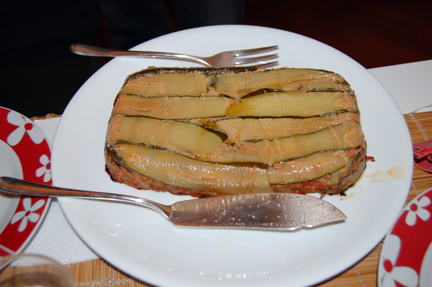
The pièce de résistance of Gavino’s menu was this sformato, accompanied by vintage Luigi Caccia Dominioni silver serving utensils (when he arrived, Gavino was wearing an overcoat from Ugo Mulas’ personal wardrobe, given to him by Ugo’s widow).

A sformato is an Italian casserole, generally made with grated Parmigiano Reggiano, beaten eggs, and various ingredients that have been cooked in a bain-marie and then turned out from the casserole pan or mold (hence the term sformato, meaning literally “turned out from a mold,” a designation which only began to appear in Italian gastronomic literature in the first decades of the twentieth-century, even though such casseroles were already popular in Italian cooking by the second half of the nineteenth century; the timpani in Cavalcanti’s 1837 Cucina teorica-pratica are a precursor to the twentieth-century sformato).

I imagine that the term sformato didn’t become popular until cooking molds were widely produced  and available in Italy in the country’s era of industrialization.

Gavino had made his with the classic base, using zucchine as the “pasta” and adding finely ground pork to the batter. It was as delicious as it was beautiful.
turkey roll italian

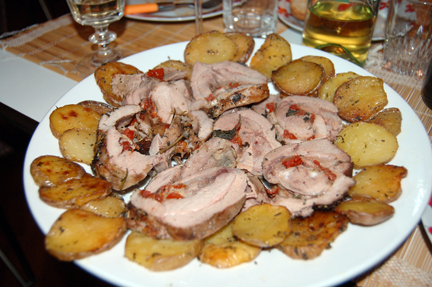
He also made this excellent rolled and stuffed wild turkey breast with roast potatoes, a dish that you often find in northern Italian homes on Sundays (Gavino is Sardinian by birth, Milanese by osmosis).

charles scicoloneMy good friend Michele Scicolone doesn’t include any recipes for sformati in her just released recipe book, The Mediterranean Slow Cooker, although many of the entries resemble or evoke the sformato model (the book is the lastest in a series that she has published with Houghton Mifflin Harcourt; her Italian Slow Cooker does include a number of sformato recipes).

Tracie P and I just received our copy of the book (which came out last week) and we’re geeked to dive in (we’re big slow cookers here in the Parzen household).

If you’re not familiar with Michele’s work, she’s one of the top Italian cookery book authors working in the field today and she’s one of the best cooks I’ve ever met. The thing I love about her recipes is their precision: Michele grew up in an era of food publishing when recipes were tested over and over and over again. As an editor for Ladies Home Journal, she told me, every recipe had to be executed no fewer than three times before it made it into the magazine.

She also happens to be married to one of my Italian wine mentors, the inimitable Charles Scicolone, an Obi-Wan Kenobi of an Italian wine universe that has been dominated, sadly, by the “dark side” of the force in recent decades.

They’re some of my best friends in New York and I’m looking forward to seeing them when I travel there later this month.

Stay tuned!

Anti-racist pizza & a studly view of Proseccoland (required reading) cc @Bele_Casel

racist pizza

This “kebab” pizza, prepared by pizzaiolo and restaurateur Alberto Barban of Pizzeria La Torre in Caerano di San Marco (province of Treviso) almost made it into my “best meals of 2012” series.

However delicious, this pizza just couldn’t compete with the many memorables meals of the year.

But it was unforgettable nonetheless: in a part of Italy where xenophobia and separatism sometimes trump human dignity and common sense, the notion of a pizza topped with kebab stands defiantly in the face of often unbridled racism.

Remember: in at least one Italian city, kebab (and kebab purveyors) has been banned from a historic city center. And in many urban areas, kebab and other Middle Eastern street food has been subject to de facto marginalization (you’ll find no kebab stands in the village of Caerano). While young Italians enjoy kebab as much as young people anywhere do in the West (Paris, London, New York, Los Angeles…), the dish has become synecdoche for the north Africans and Arabs who reside in Europe.

When Georgia P, Tracie P, and I stayed in Caerano di San Marco last September, we ate at the pizzeria on three different occasions. And after becoming friendly with Alberto, I asked him to make me his favorite pizza.

We didn’t speak of its underlying social commentary. But I couldn’t help reflect and remark on the fact that it makes perfect gastronomic sense: after all, pizza’s origins fall somewhere in a shared Mediterranean culinary legacy that includes pita and myriad expressions of flatbread.

Chapeau bas, Alberto!

The pizzeria was recommend to us by our friend and client Luca Ferraro, Prosecco producer in Asolo (a short drive from Caerano).

On Luca’s blog today, we posted amazing photos of his mountain bike ascent to a pre-Alpine pass.

italy alps mountain bike

The images are impressive as they are picturesque. But, beyond the studly ascent, I can’t think of a better way to illustrate the unique combination of topography, altitude, and marittime influence that define Proseccoland.

I highly recommend the post to anyone trying to wrap her/his mind around what makes Prosecco, Proseccoland, and the Veneto so special (at least to me).

Buona lettura, yall…

Best Meals 2012: w/ Frank Cornelissen @SottoLA

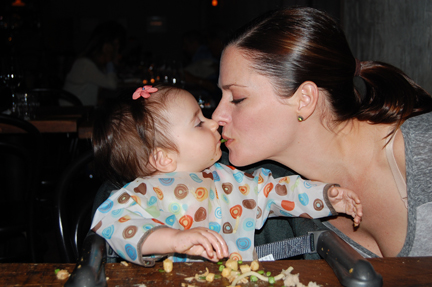
We’ve had so much fun sharing new foods with Georgia P and taking her to eat at our favorite restaurants this year. She visited Sotto (above) in Los Angeles twice in 2012. She ate meatballs, long noodle pastas, burrata, and discovered ragù, one of her favorite dishes of the year.

Sotto was also host to one of my most memorable dinners of the year, an event we hosted for winemaker Frank Cornellisen (btw, Levi, I posted some of my notes from the dinner here).

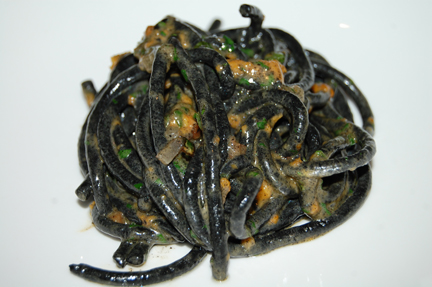
The squid-ink noodles tossed in uni (below) was my favorite dish for the year, for its purity of flavor and for its inspiration (via classic Sicilian cuisine).

I’ll never forget when Frank took a first bite of the food that night.

“This is the restaurant for my wines,” he said.

Best Meals 2012: Sotto (Los Angeles, November).

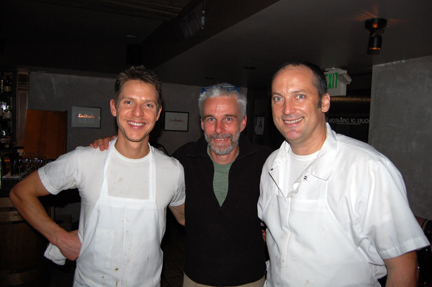
We had a truly epic dinner at Sotto last night with Frank Cornelissen (above with chef Zach Pollack, left, and chef Steve Samson, right).

Even though I’ve followed the wines for years, I’d never met Frank, who was visiting the U.S. for the first time with his wines (he had visited before he started making wine many years ago).

With all the mystery and aura that seems to surround him, I wasn’t sure what to expect. But I discovered that he’s a super cool dude, very approachable and just fun to talk to.

We spoke at length about what he calls the “zoo of Natural wine.”

“Natural wine hasn’t been defined and so we really can’t call wine Natural,” he said, noting that he doesn’t care for the term.

I was thoroughly impressed by his concept of “high definition” wines and I admired the respectful tone with which he spoke of his neighbors on Etna.

He speaks impeccable Italian, btw.

Levi always gets mad at me for doing this but I’m so slammed today (while on the road in southern California) that I’ll have to post my complete notes, including Lou’s thoughts, when I have a moment to catch my breath…

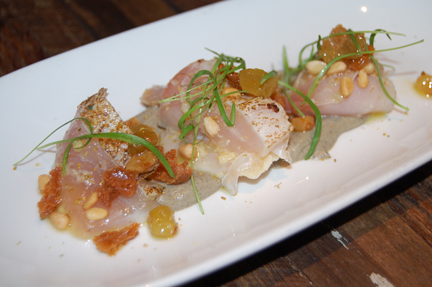
In the meantime, the seared tuna with raisins, pinenuts, and bread crumbs was INSANE (first food photo). And the squid ink spaghetti with uni was possible my top dish for 2012… amazing… And wow, what a thrill to finally get to taste the (declassified) Magma.

Levi, I promise to post all my notes asap!

Stay tuned…

Best meals 2012: Bacino Grande TY @PaoloCantele

Our first trip to Italy this year with Georgia P was so different than any other either Tracie P or I had ever made. Before our piccolina came along, dinner in Italy was the main meal of the day. But, as our friend Billy (Italophile father to a beautiful toddler) predicted, the mezzogiorno seating became the primary repast of our daily routine.

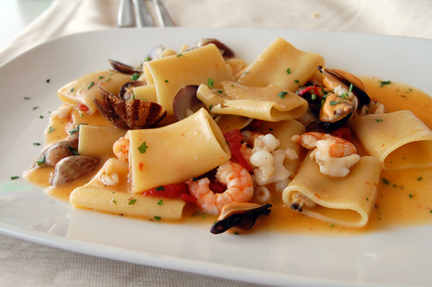
Lunch at the Ionian with our little bundle of joy was simply one of the most magical experiences of our lives. And the food was terrific: Georgia P couldn’t get enough of the paccheri.

Best Meals 2012: Bacino Grande (Porto Cesareo, Lecce, September).

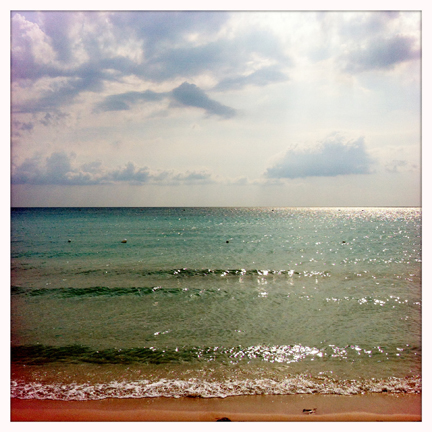
On Paolo’s recommendation, we headed to Porto Cesareo for lunch today. We wanted beach chairs, umbrella, and a restaurant right on the sea and he pointed us to the west coast of the Salento peninsula to Bacino Grande.

The paccheri ai frutti di mare were one of the best things we’ve eaten on the entire trip. The key to a dish like this is for the jus of the seafood to be absorbed by the pasta. The sauce had just the right consistency and texture and gave the pasta a wonderful savory character, with just a touch of sweetness from the tomato. Superb…

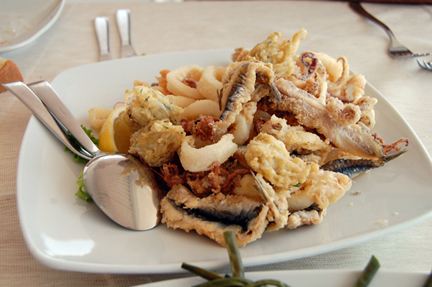
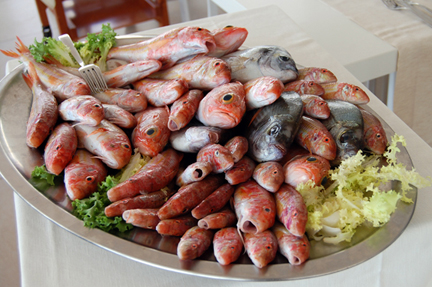
The frittura di paranza: a paranza is a wooden fisherman’s boat used for coastal fishing. This dish is akin to a “captain’s platter” fry. This, also, was over the top good.

It doesn’t really get any fresher than this. I really loved the place, even though the staff was a little bit grouchy.

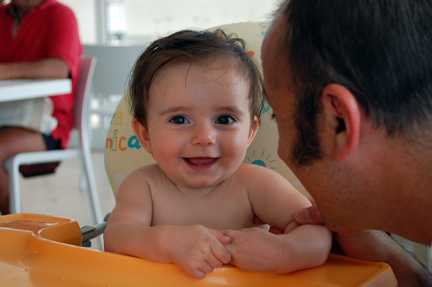
Georgia P LOVED the paccheri and she had a blast dipping her toes into the warm water of the Ionian. I love how Italians rejoice when you bring a baby into a restaurant and no one ever gives you a dirty look. We are having SO MUCH fun on this trip… She is our joy…

Best Meals 2012: Tony’s with @TerraUomoCielo

Tracie P and I have had so much fun sharing new foods with Georgia P this year. Leafing through posts on favorite meals this year, I am reminded of my friend Melanie Rehak’s wonderful book Eating for Beginners, where she chronicles her young son’s food awakenings along with her own.

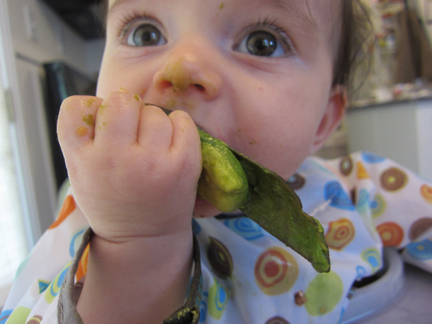
The above photo of Georgia P, where she’s eating avocados for the first time, was taken around the same time that I visited one of my favorite restaurants in the world, Tony’s in Houston, owned by my friend and client Tony Vallone. The occasion was bromance Giovanni’s first visit to Texas.

Best Meals 2012: Tony’s (Houston, June).

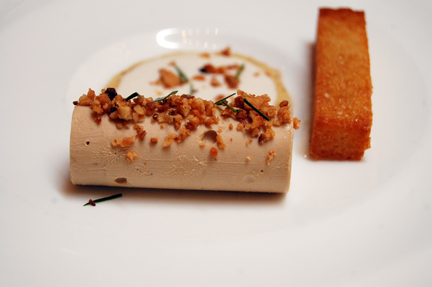
Above: Tony’s foie gras au torchon is one of his signatures and one of the dishes where simplicity and purity of flavor is offset by detail in the presentation.

How could Giovanni’s visit to Texas be complete without a meal at Tony’s in Houston?

Tony is my client (I curate his website and his media relations) but he’s also become one of my best friends in Texas and he is the architect and author of some of the most stunning meals I’ve ever had. Yesterday, Giovanni and I drove to Houston to meet Cousin Marty for lunch and a confabulatio that centered around… yes, of course… food and wine

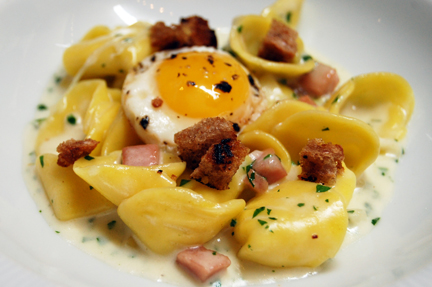
Above: Orecchiette with seared mortadella cubes and runny quail egg.

The secret to the rich yellow color of his pasta, said Tony, is locally sourced, organically farmed eggs. “But it’s also the fact that I use only flour and mineral water imported from Italy,” he added. Some would argue that sparkling mineral water is key to super pasta like this. But Tony insists that still water (acqua naturale) is a sine qua non.

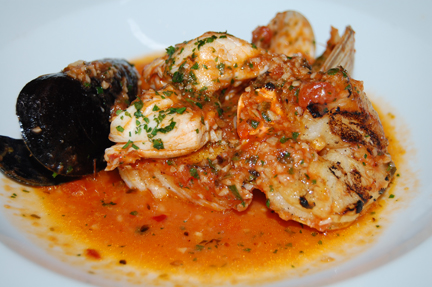
Above: Halbut and seafood medley “al Mare Chiaro,” named after the neighborhood in Naples.

Tony’s is the only place in Texas where we eat fine seafood (a category we reserve otherwise for our trips to California). This dish was simply stunning in its simplicity and presentation (and my camera didn’t do it justice, frankly).

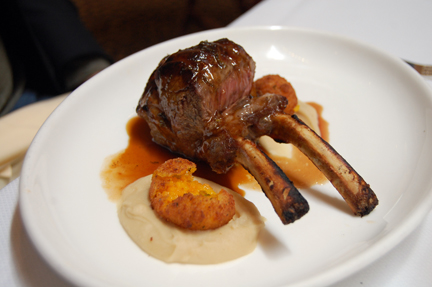
Above: Lamb chops.

Tony likes to tease me, calling me the chiodo (the nail) because I’m so careful about what and how much I eat. Lamb chops would have been a bit much for me for a Tuesday lunch but Giovanni dove in with gusto.

Above: General Manager and wine director Scott Sulma’s selection was right on.

And the wine? A tall order considering the fact that one of Italy’s top winemakers was seated at our table. And let’s face it, my general disdain for the Californian style is well known to my colleagues at Tony’s. But it also seemed right to have Giovanni taste something from my home state. GM Scott’s selection, Palmaz Vineyards 2007 Cabernet Sauvignon, delivered acidity, earth and gorgeous dark fruit, and balanced alcohol and wood. It was superb with the Bucatini all’Amatriciana that I had as my second course, playing beautifully against the savory guanciale in the dish. Chapeau bas, Scott!

Above: Nobody does it better than Tony.

I can’t conceal my pride in sharing the Tony’s experience with my good friend Giovanni, who made the trans-Atlantic crossing to see, hear, taste, and feel what life is like in Texas, California, and America.

Above: Two of my favorite fressers.

Thanks, again, Tony for yet another fantastic meal and an unforgettable experience. Ti ringrazio di cuore…

Best Meals 2012: Scarbolo’s Frasca

Our 2012 delivered more than a fair share of opulent meals. But looking back on our annus gastronomicus, the most memorable repasts — more often than not — stand out in my mind for the purity of their ingredients and the marvel of discovery, like Georgia P’s first encounter with burrata and ripe peaches (above) or this meal at one of my favorite restaurants in the world, Scarbolo’s Frasca…

Best Meals 2012: Valter Scarbolo’s Frasca (Lauzacco, province of Udine, April).

Valter Scarbolo makes wines in Grave and so there was no way for me to include him in the Colli Orientali del Friuli 2012 blogger project itinerary. But there was no way that I was coming to Friuli without spending an evening with him at his amazing Frasca. I’ll have to recount our conversation on Pinot Grigio and his 1995 trip — his first — to the U.S. in another post when I have more time. In the meantime, here’s what we ate…

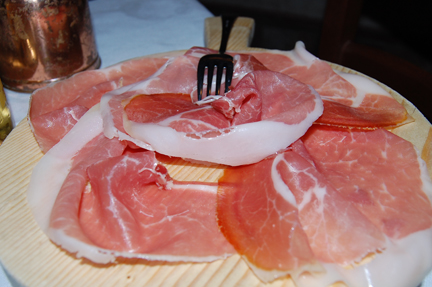
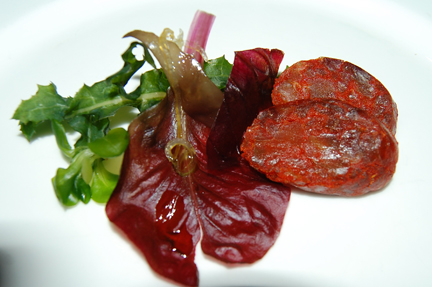
As James Bond would say, “if it’s Prosciutto d’Osvaldo, you must have been expecting me.”

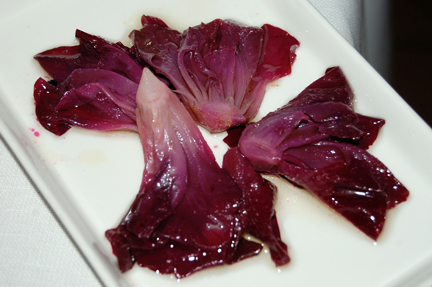
Rosa di Gorizia (Rose of Gorizia), a radicchio cultivar unique to Gorizia that resembles a rose.

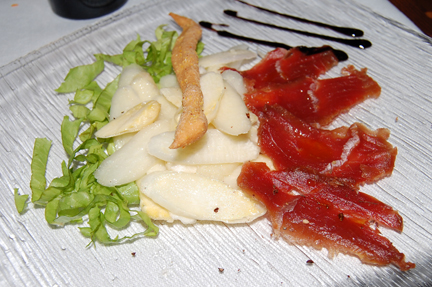
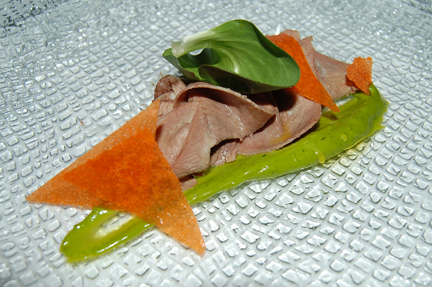
White asparagus is in season. Valter served it raw, thinly sliced, dressed with extra-virgin olive oil and accompanied by delicately marinated goose breast. “It had to be extremely fresh,” he said, “to serve it raw like this.”

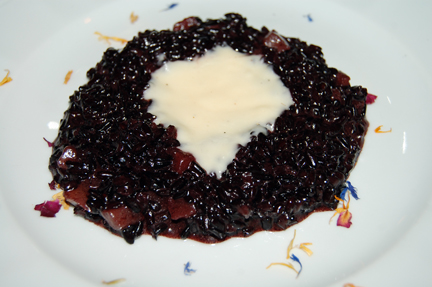
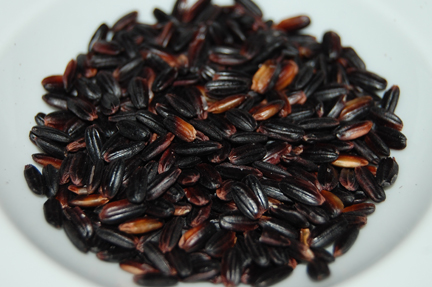
Riso nero Venere (black Venus rice) is a hybrid of Asian and Italian cultivars and, besides being delicious, is purported to have health-enhancing properties. Valter makes his with formadi frant, the truly unique, piquant cheese made from discarded and otherwise imperfect cheese — an ingredient that appears repeatedly in his cooking.

I asked Valter to show me the rice uncooked.

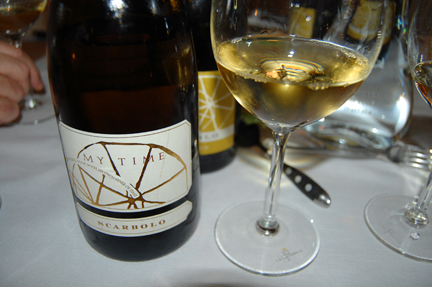
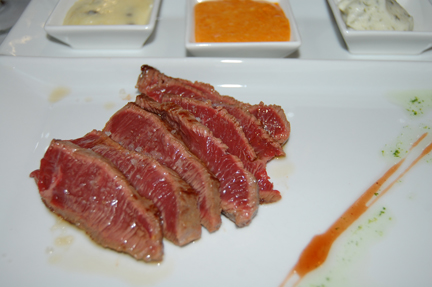
His My Time is always a treat to look forward to. The 2009 was unctuous and richer than previous vintages I’d tasted. And while it will undoubtedly become more elegant with some bottle age, its more muscular expression paired well with blood-rare pan-roasted and thinly sliced Prussian rumpsteak served with herbed formadi frant and montasio cheeses.

I’m posting this from the Colli Orientali del Friuli where the COF2012 trip has just begun… Stay tuned!

Best meals 2012: Le Logge (Siena), first visit

homemade pizza orange texas

Looking back on the best meals of 2012 (a mnemonic indulgence to which I treat myself every year between the Christmas holiday and New Year’s Eve), I can’t help but think about how the standouts were marked as much by the people with whom I shared them as much as the foods we ate and the wines we drank. Isn’t that what it’s all about?

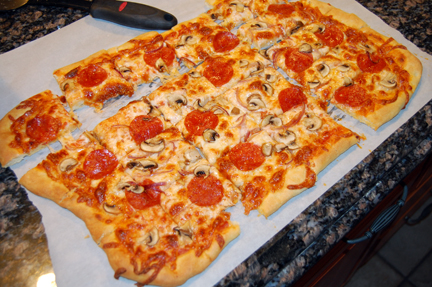
That’s Georgia P, above, eating her first pizza (homemade, by Tracie P, of course), a few nights before Christmas. Whether Parisi eggs and birth-year Barolo or mushroom and peperoni pizza, 2012 delivered some of the most memorable meals of my lifetime. Buona lettura e buon appetito!
Best Meals 2012: Osteria Le Logge (Siena, March).

Alfonso and I met up in Siena yesterday afternoon and joined good friends Laura and Francesco at Laura’s restaurant Osteria Le Logge for dinner.

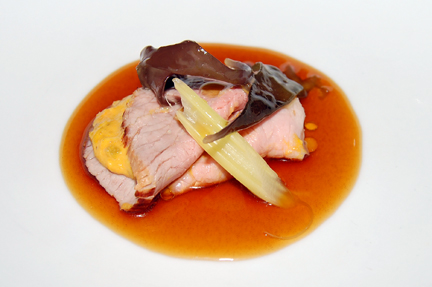
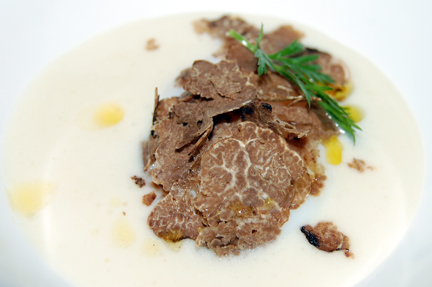
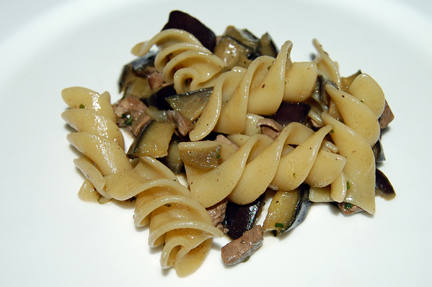
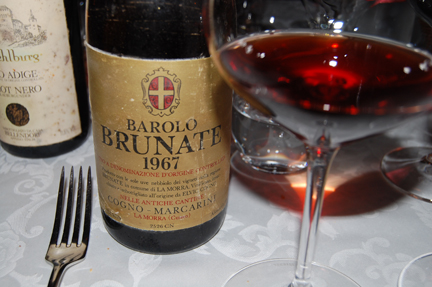
As I prepare to head up to Friuli today, there’s not enough time to post properly on the brilliant meal and stunning flight of wines. But here’s a “taste” of the “intellectual provocation”… THANK YOU, again, dear friends, Laura and Francesco, for opening your hearts to two weary Americans traveling along the wine trail in Italy…

Atlantic croaker sausage with mineral-water-macerated lettuces sous-vide

veal tongue Carpaccio in salsa verde

vitello tonnato with seaweed and ポン酢醤油 (ponzu jōyu)

Parisi egg with potato foam and marzolino truffles

fusilli with chicken livers and eggplant

Marcarini 1967 Barolo Brunate

Lake fish & Franciacorta at the “dispensary”

best fish restaurant italy

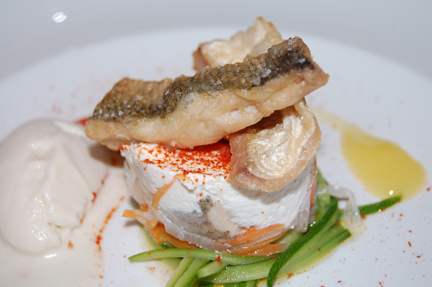
Marinated coregone (Coregonus lavaretus, European white fish) served with an “ice cream marinade.”

When you really get down to the thick and thin of it, “there’s really nothing unique about the terroir of Franciacorta,” as one prominent producer told me when I was visiting there over the Thanksgiving weekend.

With its marittime influence (thanks to Lake Iseo) and its alternance of morainic (glacial-era) and calcareous subsoils, it is indeed an ideal place to grow acidity- and minearl-driven Pinot Nero and Chardonnay. But in fact, those conditions can be found in many spots of the pre-Alps.

italian perch

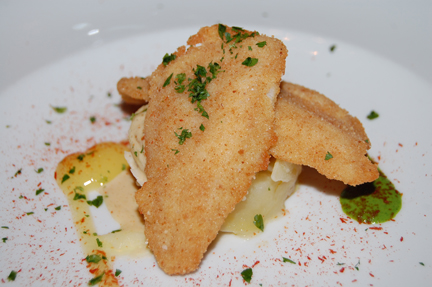
Gently fried perch (Perca fluviatilis) served over a potato “millefoglie.”

The tradition of sparkling wine there is owed to a small group of wealthy, industrialist landowners who began making classic-method wines in the 1960s (Franco Ziliani of the Guido Berlucchi winery was the first).

In my view, the thing that really sets Franciacorta apart as a producer of fine bubbles is the local, fresh-water cuisine there.

European white fish

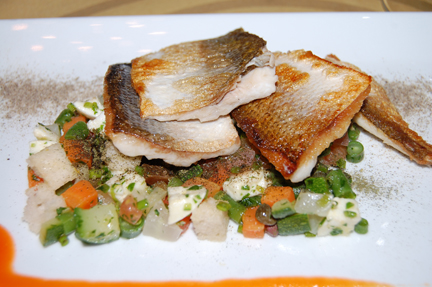
Vittorio called this superb however simple dish “bread and salt” coregone fillets.

And there is no one who can rival the fresh-water fish mastery of chef Vittorio Fusari at his amazing Dispensa Pani e Vini (“Bread and Wine Dispensary”) in the village of Torbiato di Adro (in the province of Brescia).

The restaurant is a temple to locally sourced lake fish and sparkling wine (including many French labels).

Especially when Franciacorta is made in a mineral-dominant style, the pairing can be sublime.

barone pizzini brut nature franciacorta

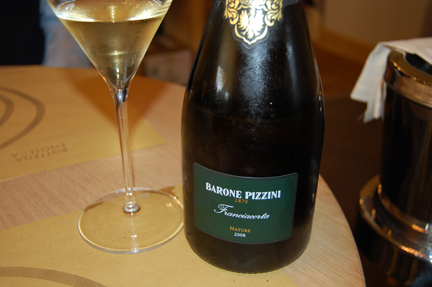
We paired with Barone-Pizzini Franciacorta Nature. In my notes I wrote: incredible balance, very nuanced nose, some tropical fruit, some red fruit, extreme freshness in the mouth, great balance here.

I had the great fortune of being treated to lunch at the “dispensary” by colleague Silvano Brescianini of the Barone Pizzini winery during my recent and very short trip to Italy.

I love the intelligence and elegance of Vittorio’s cooking (I ate there once before, in 2008, with Franco and Giovanni).

And he expresses his devotion to local fisherman through the eloquence of his menu.

I can’t recommend his restaurant highly enough. This meal alone would have made the trip worthwhile…

Pizza dough recipe by Tracie P

To borrow a phrase from my good friend Charles Sicolone (whose wife, Michele Scicolone, happens to be one of the best cooks in New York City and one of our nation’s leading cookbook authors), I am truly blessed: my wife, Tracie P, is an amazing home chef. Last night, at Mrs. & Rev. B’s house in Orange, Texas, she made us all pizza for dinner. Here’s her recipe.

best pizza recipe

Tracie P notes that “the great thing about this recipe is the short rising time and [the fact that] you can also freeze the dough” to use later with great results.

Be sure to have your toppings ready beforehand so that you can quickly top the dough after heating the pizza stones.

Makes 2 large pizzas or 4 small. These quantities can also be used to make 4-6 calzoni.

1½ cup water, about 100°
1 package baker’s yeast
4 cups unbleached all-purpose flour, plus extra for flouring
1½ tsp. kosher salt
1 tbsp. extra-virgin olive oil

Heat your oven with the pizza stone to 500° for an hour. If you don’t have a pizza stone, use a pan and simply preheat the oven without the pan.

In a mixing bowl, dissolve the yeast in the water, stirring with a spoon. Let it sit until it becomes foamy.

Combine the flour and salt in a food processor and, then, with the blade running, slowly add the water in a thin, even stream and then add the olive oil. Pulse until the dough comes together.

Turn the dough out onto a lightly floured pastry board and knead for approx. 2-3 minutes until the dough becomes smooth and less tacky.

At this point, you can freeze the dough balls that you don’t want to use. Just put the unrisen dough into a plastic freezer bag. When you want to use it, take it out in the morning and place it in an oiled bowl and place it on the counter. It’ll be ready and risen by the afternoon.

Grease 2 medium-sized mixing bowls with olive oil. For 2 large pizzas, divide the dough into 2 balls and transfer to the mixing bowls. (Divide into 4 for 4 smaller and slightly thinner pizzas.) Cover each with a dish towel and then set aside until the dough has risen, doubling in size (about 45 minutes).

Remove the stones from the oven, distribute the dough on the stones and top quickly (using whatever toppings you like).

Bake the at 500° F. for 7-10 minutes or until the crust becomes golden brown.

We paired last night with a salty Santorini Thalassitis by Gaia. Utterly delicious…

beautiful baby texas

Georgia P’s had a great time visiting with her nanna and pawpaw while her daddy was in Italy and on the road here in Texas. But now it’s time to head back to the River City (that’s Austin, for all you folks who ain’t never been to Texas)…

Buon weekend, yall!

The stars came out for Piero Selvaggio’s 40th at Valentino

best italian los angeles

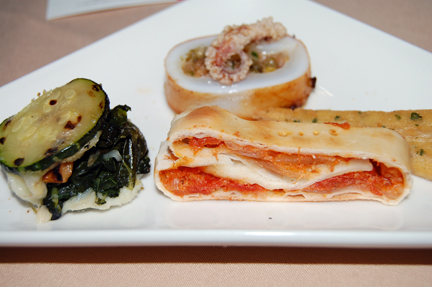
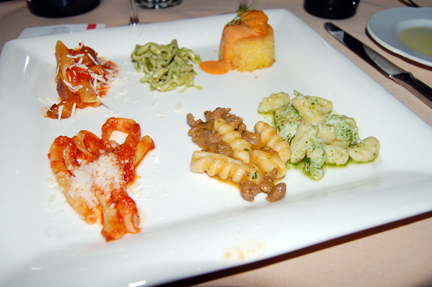
Above: When Piero Selvaggio finally sat down to dinner last night at my table, he couldn’t wait to dig into the schiacciata alla siciliana (front, center), one of the forty dishes his chefs and guest chefs created to celebrate his fortieth anniversary last night. “This is one of the dishes of my childhood,” he said.

What a thrill for me to be asked to speak last night at the fortieth anniversary celebration of Piero Selvaggio’s landmark restaurant Valentino in Los Angeles!

I first met Piero long before I ever dreamed of writing about Italian wine and food.

One of the top benefactors of the Italian department at U.C.L.A. was a close friend of Piero’s. When I was a graduate student there in the 1990s, I had the great fortune to dine in his restaurants thanks to his generosity to the department and his support of Italian cultural events.

Above: Piero is from Sicily and his executive chef Nicola Chessa is from Sardinia. The enogastronomic theme of the evening was wines and cuisine from their resepctive regions.

I’ve followed Piero’s career ever since. He’s one of the earliest pioneers of regional Italian cuisine in the U.S. and he was among the first to open a fine-dining establishment devoted exclusively to Italian cooking.

darrell corti

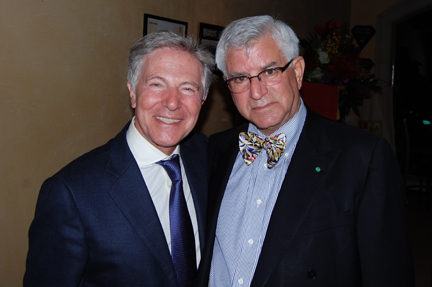
Above: Piero, left, with Darrell Corti, my friend and inspiration for my own career in the scholarship of Italian wine.

Of course, the other thrill was the chance to catch up and taste with the Darrell Corti, one of the great wine and food personalities of our generation.

Darrell was the event’s keynote speaker and it was great to watch as he and Piero, along with the many wine and food professionals in attendance, reminisced and reflected on how Americans’ perceptions and appreciation of Italian gastronomy has changed over the arc of their lives.

In my world, they are giants — generous of spirit and ever ready to share their trésor of knowledge with the curious and enthusiastic (like me).

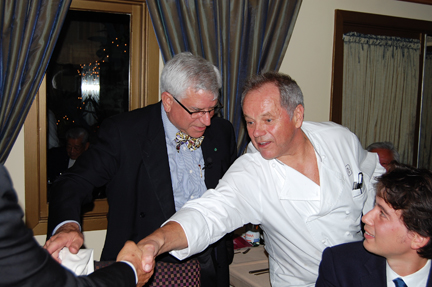
Above: Woflgang Puck was just of the many LA food celebrities who stopped by to pay homage to Piero. He arrived late in the evening and Piero promptly presented him with a doggy bag.

Chef Steve Samson, co-owner of Sotto (where I curate the wine list), began working with Piero in the 1990s and he ultimately became the executive chef at the flagship Valentino before launching his own restaurant. (Steve and I met in 1987 on our junior year abroad in Italy and have remained close friends ever since; he’s a daddy now, too!)

Piero had asked him to prepare some of the dishes and he had asked me to speak about Natural wines from Sicily (Cornelissen) and Sardinia (Dettori).

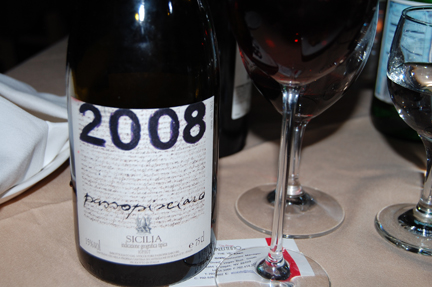
Above: There was a lot of great wine poured last night but my top wine of the evening was the 2008 Etna by Passopisciaro. What a stunning wine!

At the end of the night, when it came time for hugs and goodbyes, I thanked Piero again for asking me to be part of such an extraordinary event. And I thanked him for his generosity. I couldn’t help but think to myself how Piero — one of just handful of Italian wine and food pioneers in our country — literally made my career possible.

For that, I can’t thank him enough.