
 It’s been a whirlwind.
On Wednesday night, for the first time since February of 2020, I made it back to New York, a city where I lived, worked, and played a ton of music for more than a decade between 1997 and 2008.
On Wednesday night, I had dinner at home with my dissertation advisor, editor, and friend, the Milanese poet Luigi Ballerini, and his wife Paola, a Lacanian psychoanalyst and writer as well.
I couldn’t tell if I was in a Fellini or Woody Allen movie (tending toward the latter given the cityscape).
It was so awesome to back in the city! Daybreak runs around the reservoir in Central Park, ubiquitous bagels, and salty Manhattan clam chowder flooded my mind with memories of my years there. I even managed to see a couple of my best friends (both drummers I used to play with and a wine writer, go figure!).
But the highlight of my trip was my talk and guided wine tasting at the extraordinary Robert Simon gallery on the Upper East Side.
For the occasion, I shared notes from my translation of Pietro Crescenzi’s 14th-century treatise on Italian viticulture (to be published, at this point, in spring 2023 by a University of Toronto press imprint). And I also spoke about the role that wine plays in Boccaccio’s Decameron.
We poured three wines that evening: a Garganega, a Schiava, and a Nebbiolo. Each of these varieties were mentioned for the first time in Crescenzi’s work.
In his entry on Garganega, he talks about how popular the wines were among the university communities in Padua and Bologna (where Europe’s oldest schools for higher learning were founded in the 13th and 12th centuries respectively).
Schiava, reports Crescenzi, was Italy’s most prolific grape in that era, grown primarily in what is today Brescia province.
And Nebbiolo, which virtually disappears from ampelographers’ vellum and incunabula after Crescenzi’s mention, only to reappear in the first half of the 19th century, was inspiration for a line in Boccaccio’s #metoo novella, “the Marchioness of Monferrato.”
We also discussed Boccaccio’s notes on “wine like fire” in the epilogue of the Decameron. Both are equally dangerous and useful, he writes of humankind’s rational distortions of nature.
It was a great event and extremely fulfilling and rewarding for me to share my research.
And dulcis in fundo, when you hang out with the Upper East Side collector crowd, they all appreciate the rich cultural resources we enjoy in Houston where my family has lived for nearly a decade. I get so much shit for being a Texan when I travel in the U.S. But on the Upper East Side, everyone swoons over our museums like Houston’s Menil Collection.
Still feeling high from the experience, I got on a plane for Italy on Friday evening. And after catching up with my best friends at their new home in downtown Brescia on Saturday night, I headed out for Piedmont wine country. I even managed to get a winery visit in as I made my way to the town of Bra and the Slow Food University of Gastronomic Sciences where I’ll be teaching wine communications in the grad program this week (my seventh year teaching here, if I’m not mistaken).
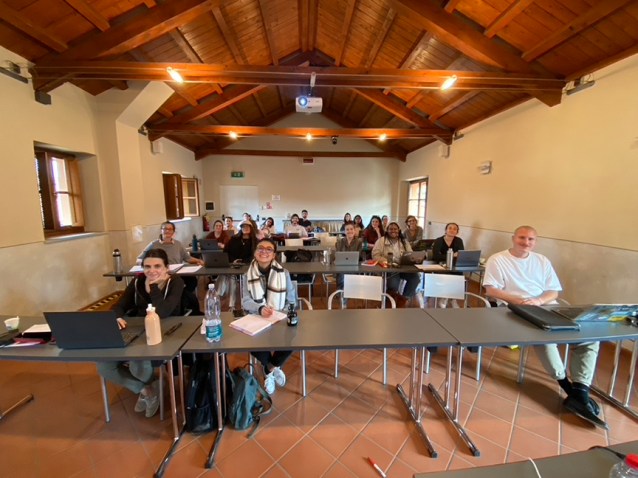
That’s my class above. A great and very motivated group of students.
I’m only halfway through my trip and it’s already been an unforgettable experience. Thanks for letting me share it with you. Now wish me luck, speed — and Nebbiolo!
 Happy birthday Tracie! The girls and I love you! Our doggies love you, too!
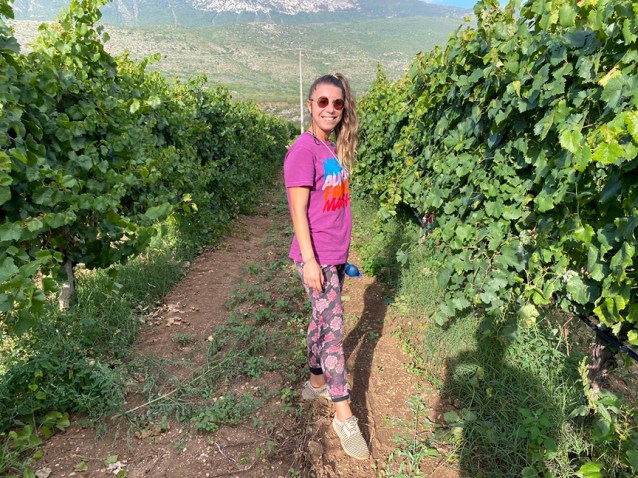 Above: brilliant, energetic, and super cool, Giulia Cataldi Madonna isn’t the winemaker that most people expect to find when they visit Abruzzo, one of Italy’s most undervalued wine regions. The work people like Giulia are doing there might just hold the key to the future of Italian viticulture.
 Above: Pecorino grapes at Cataldi Moadonna in Ofena commune were healthy and ready to pick despite the hot conditions. Ofena growers like Giulia have been dealing with extreme weather for generations. Their strategies offer clues into how Italian winemakers will need to face the challenges of climate change.
 Above: I’m going to get into trouble for saying this but Giulia told me that she agrees with me 100 percent when I say that Cerasuolo d’Abruzzo is not a rosé wine. It’s a red wine. More on that later.
 Next Thursday (10/13) in New York, I’ll be pouring and talking about “a wine for the worst kind of thieves”: Garganega (pictured in photo above, snapped a few weeks ago in Soave).
 It was the fall of 2007, nearly fifteen years ago this week, when I found myself on a park bench at the La Jolla Cove waiting to go to Yom Kippur services with my family at the same synagogue where I was a bar mitzvah some 27 years prior.
 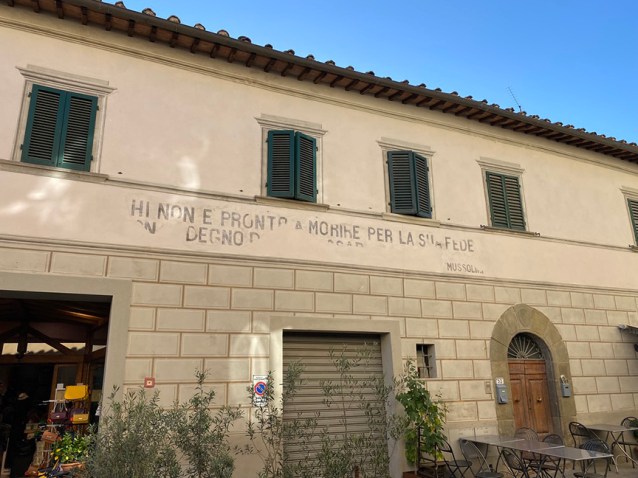 Above: “Chi non è pronto a morire per la sua fede non è degno di professarla — Mussolini” (“those not ready to die for their faith are not worthy of professing it”). No one has ever bothered to erase a Mussolinian aphorism from the main square in Gaiole in Chianti. Photo taken by me earlier this month.
 Shanah tovah (שנה טובה). Happy new year, everyone.
 Above:
  Above: Colline Teramane (Abruzzo) grower Bruno Nicodemi built an artificial pond on his family’s property in the 1970s. At the time, it was intended to foster biodiversity. Today, it’s a lifeline.
 Above: Lake Garda as seen from the vineyards of Ca’ dei Frati in Lugana.
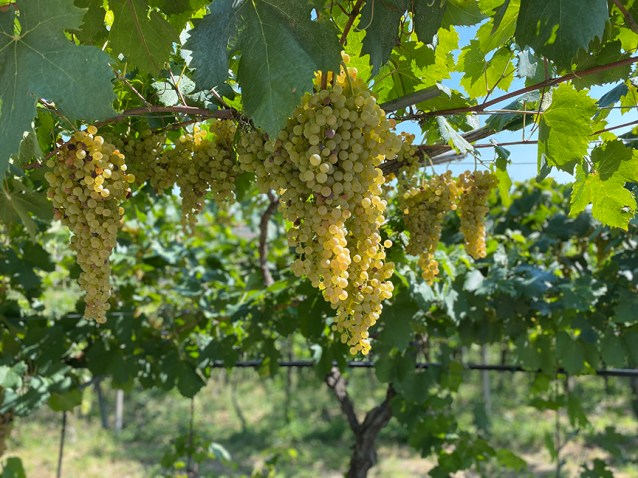 Above: Pergola-trained Garganega clusters in the heart of Soave. Note permanently mounted irrigation hose.
 The above figures come via vineyard consultant, publisher, and writer Maurizio Gily’s excellent online and print journal
  Do Bianchi