
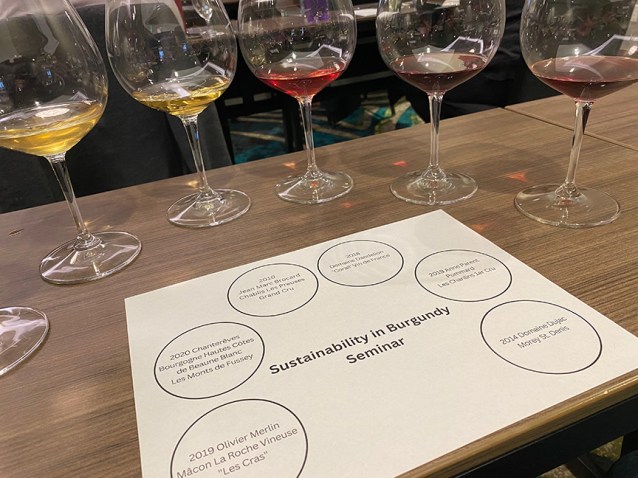
 Thanks to everyone who came out this year to make the Boulder Burgundy Festival 2022 such a great event!
And special thanks to the gathering’s featured educators this year, Elaine Brown and Esther Mobley, who led a fantastic seminar and tasting devoted to sustainability in Burgundy today.
Click here to see a Facebook album from the event (photos by me, the festival’s official blogger and media consultant, a gig I’ve been doing for more than a decade now).
This year’s Sunday seminar, which featured producers Simon Colin and Pierrick Bouley, was partly a continuation of the Friday morning talk that Esther and Elaine gave.
One of the most interesting elements that emerged was discussion of the constrained/shortened growing cycles that growers like Simon and Pierrick (both are the current generation of historic Burgundian families) have to face as climate change accelerates.
“These vineyards have been around for more than 1,000 years,” noted the 20-something Simon, whose family is one of Burgundy’s most famous. “We are only around for 30 or 40 years of that time. And like the generations before us, we have to face different problems,” like more frequent late spring frosts and warmer summer temperatures.
Pierrick made some of the most compelling comments when he discussed the issue of the contracted vegetative cycle.
As Elaine pointed out, warmer summer temperatures mean that ripening is accelerated in the final months of the grapes’ development. And that is reshaping the tasting profile for the wines. This is ultimately a worldwide phenomenon that is impacting grape growing across Europe.
But Pierrick’s insight, the fruit of timeless generational knowledge and experience, revealed something that might not be immediately apparent to the layperson.
When late season warm temperature shorten the cycle, making for, say, an 11-month as opposed to a 12-month cycle, that means that the next growing cycle is actually expanded.
When his family would start picking in September each year, said Pierrick, the cycle would more or less follow the 12-month calendar. But when they pick as early as mid-August, like they often have had to do in recent vintages, that gives the vines an extra month of dormancy. His family has begun to address the issue by experimenting with early winter pruning. But the new normal, as it were, is radically changing the way growers like him approach their work in the vineyard.
In other words, yes, the earlier picking times — something most are aware of — are changing the way the wines taste. But the accelerated start to the vegetative cycle is having a profound effect as well. Especially when it comes to the more frequent arrival of spring frost, the now syncopated timing becomes more and more delicate.
From an educational standpoint, it was one of the best festivals to date. And the wines by Simon (Chassagne) and Pierrick (Volnay) were exceptional. And of course, the brio — lubricated by great wines and food and wonderful people — was joyfully unbridled.
If you’ve never come up to experience the gathering, I hope we’ll get to see you next year! What a great ride! Same time, next year.
 Every year I have to pinch myself: the thrill of getting to be part of an event like this, with wines that clock in WAY above my pay grade, has never lost its sheen.
My heartfelt thanks goes out to my good friend Brett Zimmerman, owner of the Boulder Wine Merchant and founder of the festival, who invites me back each year. I’m truly blessed to have a friend and colleague like him.
Thanks also to the amazing Heather Dwight, owner of Calluna event planning in Boulder, for the seamless execution over the long weekend of eating, drinking, and education.
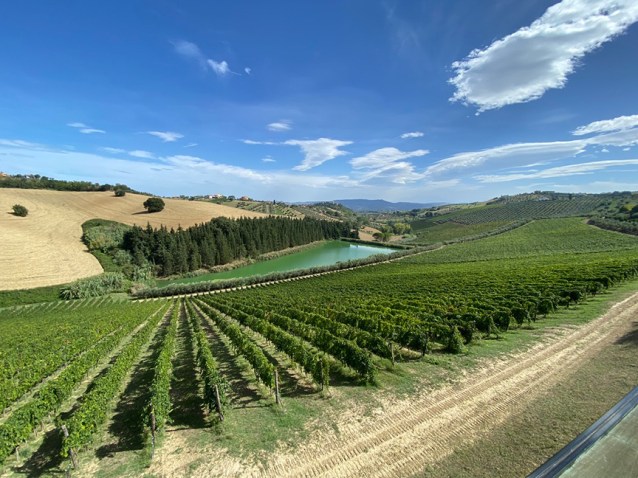 When I finally found my way to the Nicodemi winery in Colline Teramane in Abruzzo in September, I cautiously descended the steep driveway in my rented 500L to discover a paradise revealed behind the bushes that obscured the view from the road.
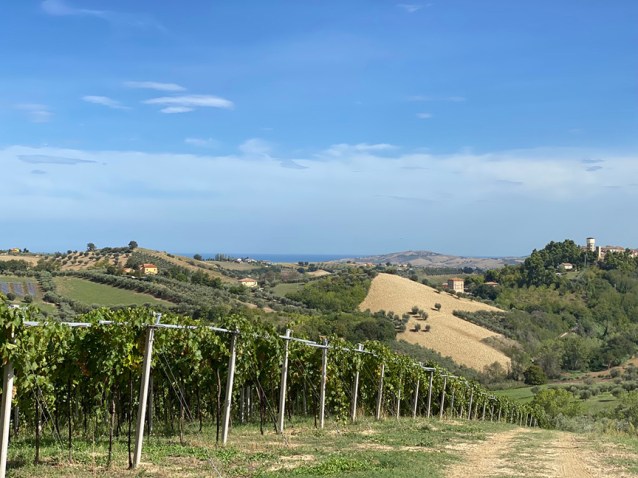 As you can see in the photo above, in the Colline Teramane, the vineyards are literally located a stone’s throw from the Adriatic. It’s where some of the region’s best wines are raised.
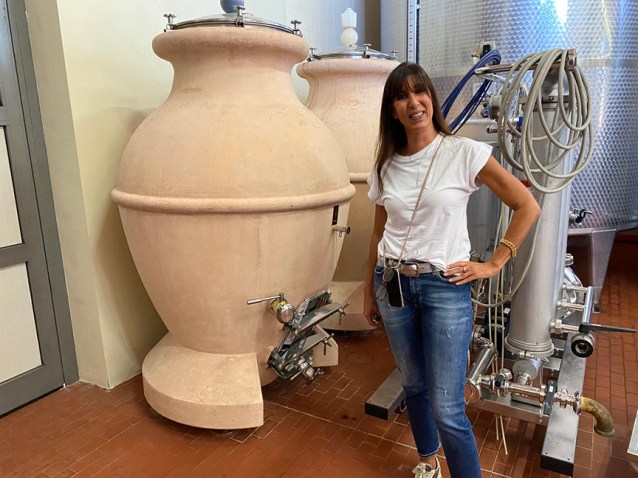 The beauty and viticultural significance of the Colline Teramane were no surprise to me, of course.
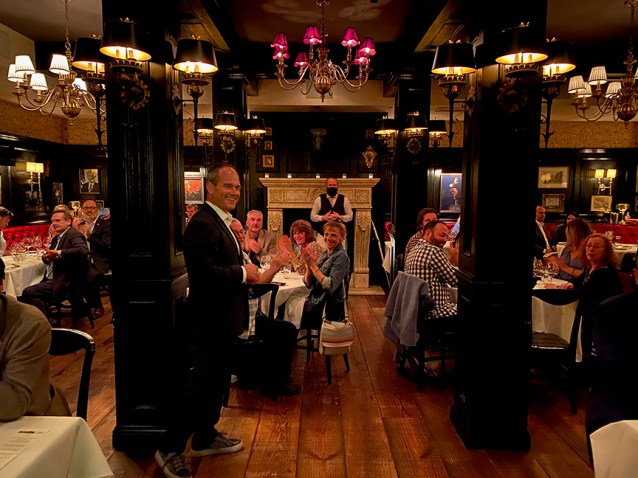 Festival founder Brett Zimmerman presents one of the marquee dinners at last year’s Boulder Burgundy Festival at Steakhouse Number 316 in Boulder. The wines, the food, and the people at all of the festival’s events are as compelling as they are welcoming and inspiring.
 The notion that tendone and pergola training systems could represent one of the grand solutions for winemakers facing the wrathful challenges of climate change was first suggested to me many years ago by the writer, publisher, and in-demand vineyard manager Maurizio Gily.
 Where pergola is a patchwork of small square structures that support the vines, tendone is a continuous and seamless series of pergolas, as it were. (To better get a sense of the system, keep in mind that a tendone in Italian means big tent.)
 The wines tasted at Caivolich were among the best during my early September harvest tour of central and northern Italy.
 It was such a treat for me to meet Chiara and Guerino. And it didn’t take long before my conversation with Chiara veered into 20th-century and contemporary literature (my kind of winemaker!). I highly recommend her wines and if you ever get the chance to taste and interact with her, take the opportunity. I really enjoyed visiting with her and came away inspired by our chat.
 According to the
  Above: a sunset in La Jolla, California where I grew up. Before my family moved there, realtors redlined Jews until it became apparent that community wouldn’t thrive without them.
 Some folks will remember that I used to run a wine club in California where I would sell mixed six-packs from my warehouse in San Diego.
  Above: my graduate student class at the Slow Food University of Gastronomic Sciences in Piedmont, Italy, on the last day of our seminars earlier this month.
 Just over the course of the last month, I’ve had the great fortune to interact with a half dozen wine professionals with whom I worked (and/or drank) during the late 1990s and early aughts in New York City.
 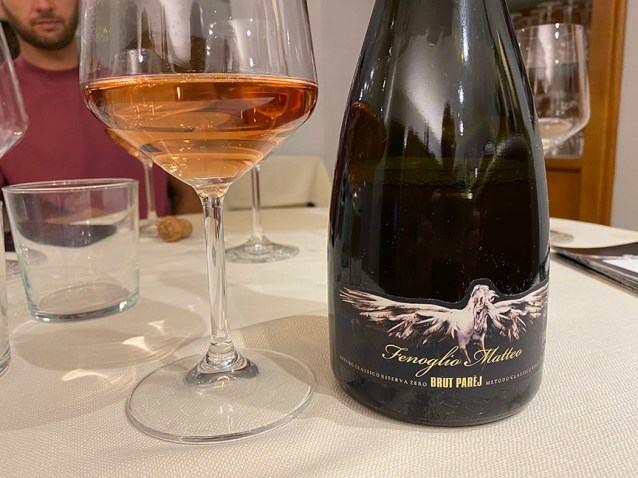 It’s not every day that you get an Instagram message from someone named Fenoglio.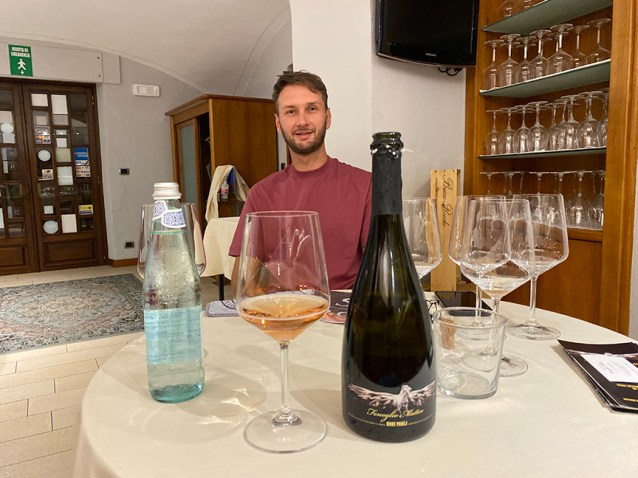
 Do Bianchi