That ol’ Nebbiolo sure cures those subterranean homesick blues

From the department of “you don’t need a weather man to know which way the wind blows”…

price conterno wine monfortinoMan, it’s been a crazy week here in New York. The weather tried to keep me from getting here but I made it just the same through sheer determination. And all week, I’ve been slugging through the snow and the slush trying to keep up with my appointments and meetings.

Yesterday, the snow fell over Manhattan from dawn to dusk (literally). Today, thank goodness, it looks like my flight back to Texas is going to get out on schedule.

I managed to catch up with a lot of great folks and met some new ones, too.

I have lots of tales to share but right now I’ve got to get my butt out to Newark and on a plane.

The one thing I can tell you is that ol’ Nebbiolo sure cures those subterranean homesick blues: next week, I’ll post my notes from an extraordinary dinner hosted by Chambers Street Wines last night at Maialino.

paula rester new york wineIn the meantime, I wanted to give a shout out to fellow Texan and Austinite Paula Rester (above) who moved to the city last year to take a job at Maialino as one of the restaurant’s sommeliers.

There’s a lot to be said about hard-nosed studying and maniacal tasting at a desk. But there’s also a lot to admire about someone who leaves the provinces, heads to the big city, and dives right into what is arguably the world’s best wine scene.

It was great to catch up with her, however briefly, last night at Maialino and taste the wonderful Charlot Tanneux Champagne that she’s pouring by-the-glass these days at the restaurant — the first time the wine’s been available in the states, she said.

Heartfelt thanks to the many gracious and generous people who hosted and poured for me this week. It’s been an amazing visit to my old city, despite the extreme weather.

I’m looking forward to posting my notes next week. But right now I just want to squeeze my babies, give my wife a big juicy kiss, and put on some dry socks.

Thanks for being here. See you on the other side…

A fantastic wine shop in Brooklyn and a first kiss with a great Lugana

best wine store brooklynNew Yorkers are pretty grumpy these days and it’s not hard to understand why: for four weeks, they’ve been schlepping through snow, bitter cold, and the grimy slush that follows snowfall in the city that never slips on the black ice.

Yesterday, I spent the afternoon “working the market” (as they say in the trade) with my client from Chianti Classico, La Porta di Vertine.

It had already begun to snow (again) around 3 p.m. when winemaker Giacomo Mastretta, my old friend Kevin Russell (who sells the wine), and I emerged from the mythical G train in Williamsburg.

But my spirits were bolstered when we stepped out of the weather and into the lovely Vine Wine shop on Lorimer (above).

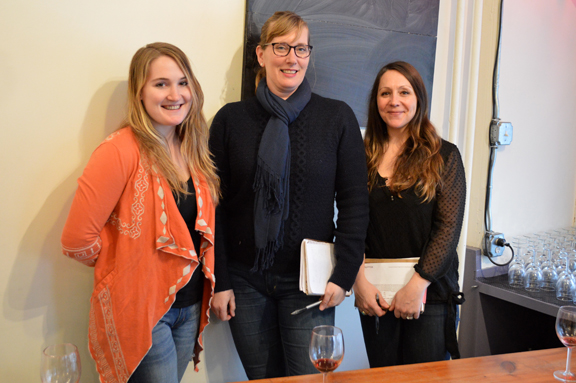
Talitha WhidbeeThat’s owner Talitha Whidbee (center) with a couple of her team members. Her shop is as bright and smart as she is and nearly every wine has a handwritten label with thoughtfully composed notes on the wine.

I was really impressed by the breadth of the selection in her tidy store, which is about to celebrate ten years in business.

But I was even more impressed by her savvy use of social media to create awareness and visibility for her brand.

Her blog is updated regularly and her Instagram is a true phenomenon among Brooklynite wine lovers.

Nearly every day, a staff member (whoever opens the shop, I was told) scribbles parodic news bites on a chalkboard outside the store and then posts it. It’s a brilliant way to host and exploit content. Chapeau bas, Talitha!

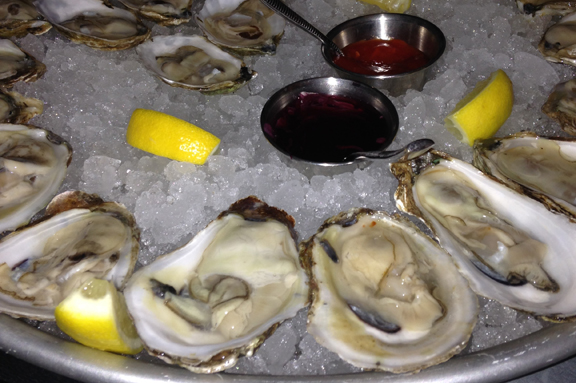
best oysters new jerseyAfter meeting and tasting with Talitha and her team, our rush-hour “no talking on the train allowed” schlepp out to Morristown, New Jersey was rewarded by a delicious spread of oysters, courtesy of New York restaurateur Chris Cannon, who’s opened a wonderful new Italianate restaurant there called Jockey Hollow.

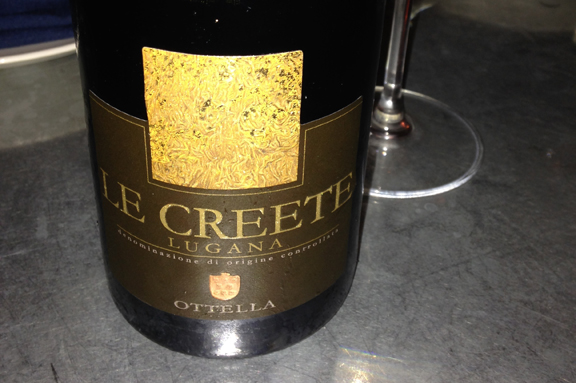
Chris is a passionate Italocentric enophile. And I loved the pairing he served us: the Ottella Lugana Le Creete (below).

le creete lugana otellaIts intense aromatic character was unusual for Lugana and its flavors were equally rich and focused. Great wine and a great discovery for me.

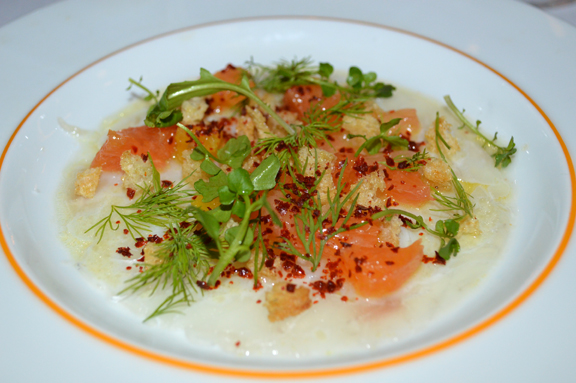
snapper carpaccio recipeThat’s the snapper carpaccio that Chef Kevin Sippel served as an antipasto to a delicious meal set against the ornate Vail mansion that Chris has transformed into an elegant fine dining experience.

I’m about to head out for another day of media appointments and market work with Giacomo and that’s all I have time for today.

It’s currently 37° outside and there’s a 50 percent chance of rain. Snow and a high of 28° are predicted for tomorrow.

But hey, someone has got to keep the world safe for Italian wine… Thanks for tagging along for the schlepp.

Italians say it better: publicist/journalist Annamaria Testa asks Italians to speak “a little bit more, please, in Italian.”

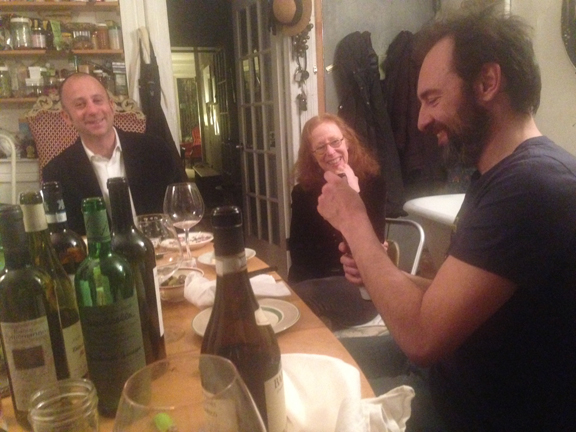
alice feiring wine writerAbove: last night, Alice hosted Giovanni, his crew, and me in Soho for salad and cheese after we pigged out at Katz’s Delicatessen on the Lower East Side of Manhattan. It’s so important for me to eat leafy greens when I’m the road. Alice always hooks me up. Photo by Ben who was also in attendance.

Last night, as the Italians and I sat around Alice’s table, tasting wines and bantering about, I couldn’t help but think of how many English words Italians use in wine trade parlance. Even the word winemaker has found its way into the language of Dante: it’s used loosely and frequently in Italian to describe someone who may or may not have a degree or experience in formal enology yet who makes wine nonetheless. In Italian, an enologist can be a winemaker but a winemaker doesn’t necessarily have to be an enologist.

Giovanni (above) is a winemaker, for example, even though his winemaking partners Andrea and Nico are the formally trained enologists who arguably do more of the heavy lifting when it comes to the technical aspects of vinification. Giovanni carries his weight when it comes to pruning, racking, tasting, blending, etc. But no one would call him an enologo.

I was thinking about the use of English words in Italian after a new petition to encourage Italian leaders and marketers to eliminate Anglicisms from Italian was brought to my attention by my ex-college roommate — an American who has lived and worked in Italy for more than twenty-five years and who is perfectly bilingual.

It’s called Dillo in italiano (say it in Italian) and according to its online petition, it calls on “the Italian government, public administrators, members of the media, and businesses to speak a little bit more, please, in Italian.”

One of its pillars is based on an old Italian saying.

“In Italglish,” writes the author of the petition, “it’s easy to use terms clumsily, incorrectly, or inappropriately. Those who speak in the same manner that they eat speak better [Italian].”

The project has been spearheaded by Italian publicist/journalist Annamaria Testa and the topic began trending in English as well as Italian in late February after Italian humorist and essayist Beppe Severgnini published a New York Times op-ed entitled “Italy’s New Lingua Franca.”

“Beautiful though our language may be,” he wrote, “it is not the medium of choice for engineers when they’re building a beltway in Norway or designing a dam in Vietnam.”

The thorny question of Italian linguistic purism dates back to the Fascist era and beyond.

In 1977, in The Italian Language Today, the great Italian linguists Anna and Giulio Lepschy wrote the following account.

“During the Fascist period there were severe puristic relapses. As early as 1923, a tax as levied on foreign words used in shop signs, and at the beginning of the second world war, a law banned such words altogether; a poster appeared with ‘Italiani, bicottate le parole straniere’ ‘boycott foreign words’ (not untypically using the verb boicottare, which etymological dictionaries trace back to circa 1880, deriving it, through French, from the English ‘to boycott,’ from the name of Captain James Boycott, first victim of this treatment in Ireland). A Fascist law which prohibited the giving of foreign Christian names [i.e., first names] to Italian children was abolished as late as 1966.”

Listening to Nico, Andrea, and Giovanni speak (as I translated for Alice and Ben), I wondered how stilted our conversation would be if they eliminated all English words from their banter.

Thankfully, the three of them are progressivists and they embrace foreignisms with gusto (hey, was that just an Italian word I used?).

I am an unabashed lover of Italian and find great joy in my knowledge of Italian language and literature. But I also believe that — historically — one of the Italian language’s greatest strengths has been its ability to absorb words from other languages.

Winemaker is such a powerful word in Italian in part because it is borrowed. It represents a new generation of people who make wine in Italy as they break away from past paradigms and forge new ground. It doesn’t threaten Italian. It enriches it with its foreignness.

But, hey, what do I know? Io sono solo un semplice blogger. I’m just a humble blogger.

Speaking of Italians who say it better, check out this post today for the Franciacorta, the Real Story blog. It features Chef Vittorio Fusari and his wonderful and wonderfully concise description of Franciacorta.

Daddy, will you take me on the plane with you? You can’t go to Nork City!

polaroid camera filmEast coast weather is so bad today… It’s a miracle that I’m getting on a flight at all.

I had to switch up my travel plans and so the girls drove me to the airport (because I’ll be returning to a different airport).

Before we got in the van, Georgia P said, “you can’t go to Nork City, daddy!” (“Nork” is her word for New York).

And when they dropped me off, she said, “daddy, will you take me on the plane with you?”

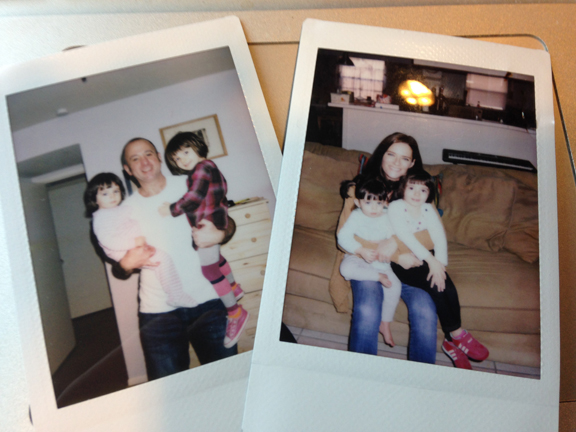
Man, it is so hard to say goodbye. Tracie P gave me some polaroids to take with me.

I love them so much and miss them so much already.

See you on the other side… wish me speed!

Scenes from Franciacorta in Austin and Chianti Classico tasting at Chris Cannon’s new restaurant next week in NJ

Click here to check out my notes from the super fun Franciacorta tasting I led this week in Austin.

It was great to catch up with River City wine folks and it was exciting to meet lifestyle writer and fragrance expert Alyssa Harad. She’s super cool.

Thanks again to Vino Vino owners Jeff Courington and Kelly Bell, Jr. for letting me hold the tasting at their swell joint.

And thanks to Buckley Wineholt for the swell photo above.

It’s been a busy week over here at Do Bianchi Editorial but I’m looking forward to the weekend with my girls and my trip next week to the east coast.

I’ll be speaking on Tuesday night at Chris Cannon’s new restaurant, Jockey Hollow, in Morristown NJ (among other events I’ll be attending).

Giacomo Mastretta (above) from La Porta di Vertine, my client, and one of the grooviest growers and winemakers in Chianti Classico will be pouring and speaking about the wines.

Click here for event details.

Should be a good time. The wines are awesome and Giacomo is amazing.

Thanks for being here this week!

Buon weekend, yall!

Is Luc Morlet the future of high-end California?

From the department of “nice work if you can get it”…

best foie gras recipeAbove: my friend and client Tony Vallone’s foie gras torchon with “pear cracklings,” crispy pear skins.

Last night found me a guest of my friend and client Tony Vallone at his flagship Tony’s for a wine dinner featuring the wines of Morlet Family Vineyards.

After reading up his California estate, I was impressed by the glowing praise and the across-the-board astronomic scores the wines have received from all sides of the wine writing establishment.

Robert Parker, Jr. has called him a “genius.” Honestly, that doesn’t really score a lot of points with me personally. But then when I saw that Antonio Galloni also wrote about Luc’s wines with superlatives like “off the charts” and scores to match, I began to inuit that Morlet has resonated broadly with the California wine intelligentsia.

I’d tasted a few of Luc Morlet’s wines previously at Tony’s but I had never tasted his top wines and I was very curious meet Luc and taste with him.

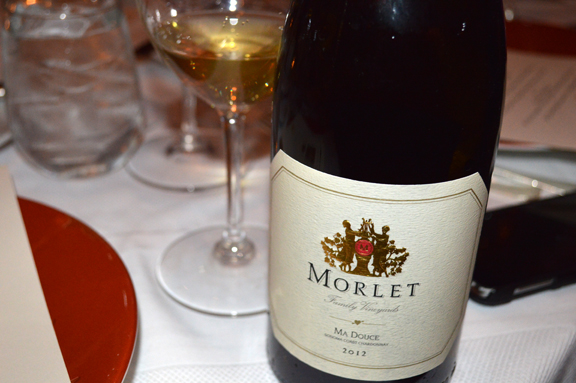
ma douceAbove: Luc’s Sonoma Coast Chardonnay Ma Douce illustrated his deft hand at barrel fermentation and barrel aging. He talked at length about the importance of not filtering. This isn’t a wine that I can afford but I thought it was gorgeous and enjoyed it immensely. Parker called a previous vintage “staggering.”

Luc, who was born and raised in Champagne, where his family continues to produce barrel-fermented wines, didn’t seem keen to talk about the fact that he is one of the premier cooperage brokers in California today. Understandably, he wanted to keep the focus on his wines and he wanted to connect with the well-heeled crowd that gathers at Tony’s for dinners like this.

But it’s abundantly clear that his experience in Europe and his expertise in cooperage has set a high new bar for the use of barriques in California, where, historically, winemakers have often favored oakiness in their wines.

Luc’s Sonoma Chardonnay Ma Douce and his Sonoma Coast Pinot Noir Côteaux Nobles were both fantastic. And they perfectly illustrated how restrained, thoughtful use of oak can deliver wonderful balance and extreme elegance. I liked the wines a lot.

(Luc will be speaking about cooperage and pouring barrel samples today at the Houston Sommelier Association, btw. It should be a fascinating tasting and he’s a great speaker.)

crescent island duckAbove: Tony and his chef Kate McLean are geeked about the Crescent Island duck they’ve been serving at the restaurant. I loved its balance of gentle fattiness and earthy flavor. It was a great pairing for Luc’s Knights Valley Cabernet Sauvignon Mon Chevalier.

In the short time I got to speak with Luc intimately, he was eager to talk to me about the Knights Valley AVA where he is growing Cabernet Sauvignon.

It lies in between Napa and Sonoma and the community there has resisted heavy investment in viticulture.

But there are a few growers who have planted to vine there and Luc is one of them.

It’s on the west side of Mt. Saint Helena, he explained, the highest peak in the area, and so it has the ideal elevation and temperature variation for the cultivation of Bordeaux grapes.

I liked the Knights Valley Cabernet Sauvignon Mon Chevalier a lot but I think the wine will benefit from more bottle aging. Here the oak was evident and not yet entirely integrated into the wine, which is from Luc’s 2011 harvest. I hope I’ll have a chance to revisit it in a few years: with great acidity and earnest, classic Cabernet Sauvignon flavors, there’s no doubt this wine will represent yet another great effort from Luc’s cellar.

As he talked to me about Knights Valley, I became more and more convinced that Luc and his approach to winemaking could very well be the future of high-end wine in California.

Whether he’s raising wine in a little known appellation tucked between Napa and Sonoma or whether he’s illustrating the expert application of cask fermentation and aging, he seems always to be one step ahead of his contemporaries.

As the “new California” has begun to reshape the viticultural landscape there, Luc and his “old world” sensibilities align nearly seamlessly with the tastes of current-generation collectors and winemakers.

Very interesting wines. I just wish I could afford them!

You’re a better man than I am, Master Sommelier candidate! Houstonians head to Dallas for theory exam

david keck houston sommelierI admire but do not envy them: the three dudes to the right, Travis Hinkle, David Keck, and James Watkins are heading next Monday from Houston to Dallas where they will be seated for the Court of Master Sommeliers theory exam, which, according to the court’s website has a 10 percent pass rate (holy smokes!).

I had the chance to taste Austrian wines with them last week when my friend Master Sommelier Jesse Becker came to town to lead a guided tasting from Winebow’s portfolio. That’s Ben Roberts to Jesse’s left. He’s also a Master Sommelier candidate but has already passed the theory exam.

As I was reading up on the grueling exam for my Houston Press post today, I was reminded of my years as a grad student prepping for my orals. It was a great experience and I’m glad I did it. But, man, I’m glad I don’t have go through that again!

Check out my post here.

Master Sommelier candidates: you are better men than I am!

In bocca al lupo! That’s what you say in Italian in this situation: may you go into the wolf’s mouth.

Is biodynamic farming the new religion of Italian winemaking? Tasting Alois Lageder in Houston

urs vetterWhenever possible, I always try to meet up and taste with Italian winemakers when they come to Houston.

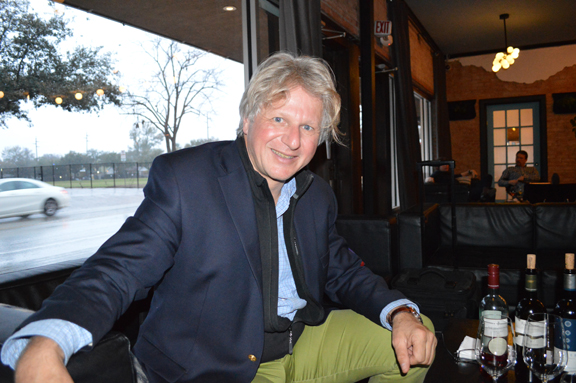
And so yesterday early evening found me with Urs Vetter (above) who’s worked for more than two decades as the sales and marketing director for legacy Alto Adige grower and winemaker Alois Lageder.

In my experience, Lageder’s entry-tier wines are always clean, focused, and very approachable and they represent great value. But it’s when you get into the higher tiers that the wines really start to take on character and depth imho.

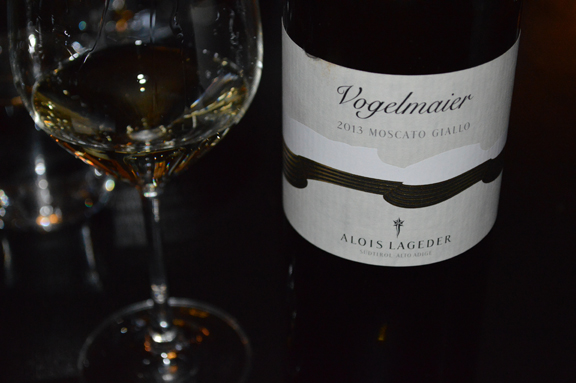
alois lageder moscato gialloI loved the 2013 Moscato Giallo Vogelmaier, with its show-stopping aromatics, balanced alcohol (12.5% according to the winery’s website), and elegant white fruit. Urs said this wine should retail for around $25 in our market. Great wine…

It was fascinating to hear Urs describe Lageder’s evolution as a biodynamic grower and the “snowball” effect that it’s had in the appellation.

Magrè, the village where the Lageder is located, he told me, has been transformed by the ongoing process of conversion of both estate-owned growing sites as well as vineyards owned by other growers who sell to Lageder.

Currently, he said, roughly fifty percent of Lageder’s wines are Demeter biodynamic certified and the winery is moving toward 100 percent certification.

He also mentioned that Lageder’s popular Summa wine fair, now in its seventeenth year, is leaning more and more toward biodynamic farming as its focus.

The fair includes roughly fifty producers, he said, and while “old friends” will never be excluded, the organizers are making biodynamic farming a priority in selecting new wineries to be included.

One of the things that always impresses me about Italians winemakers’ attitudes toward organic and biodynamic farming is that they often embrace it not only as a means to achieve greater quality but also as civic and even moral responsibility.

Hearing Urs describe the many grape farmers who have “converted” in recent years and Lageder’s own conversion made me think about how biodynamics has become the new “religion” of Italian winemaking. And I mean that in both figuratively and literally.

Most young and middle-aged Italians that I know are agnostic. And I can only think of three Italian winemakers (in my personal orbit) who are practicing Catholics.

But when I hear Italian growers — young and old — talk about biodynamic farming, I often get a sense that they perceive it as a higher mission that fills a spiritual gap and fulfills a basic human need to give meaning to things that lie beyond our comprehension (even though I believe that some are more self-aware in this perception than others).

When I asked Urs about this, he said that yes, most definitely, there is a “spirituality of the land” that has emerged in the village of Magrè where Lageder grows grapes and vinifies its wines.

Blessed are the meek: for they shall inherit the earth.

That verse from Matthew often pops into my mind when I think about what life will be like for our daughters after we are gone.

Will it be the earth as G-d created it? It would seem that more and more Italian winemakers are working to make it so. And no matter where you stand, that’s a good thing.

On dinosaurs and astronauts: Houston’s wonderful cultural resources

hello kitty astronautAbove: yesterday’s outing was to NASA’s Johnson Space Center, where I couldn’t resist buying Georgia P a Hello Kitty astronaut. Georgia, who’s now 3, calls the space center “the real astronauts.”

It still happens all the time.

When I’m on the road and people learn that I live and am raising a family in Houston, many respond with a knee-jerk reaction like o, I’m so sorry or Houston? How’s that going? or even — and this came from a relative — how can you live around all those awful people?

There’s no getting around it: Houston, like Texas in general, has a horrible reputation beyond its city limits.

Sadly, the hard-line republicans from Texas have given their state a bad name in the American consciousness. And it’s a real tragedy for the rest of us because Houston is actually a very liberal and ethnically and culturally diverse city.
Continue reading

Can a sommelier be trusted? If you need to ask, then you have no business dining out.

From the department of “I know I already wished everyone a good weekend but I just couldn’t help posting one more time this week… This really pissed me off!”

best cork screw boulder coloradoI’m just going to cut to the chase here.

Paul Sullivan’s ridiculous “Wealth Matters” column (“Reading Restaurant Wine Lists, for Blockbusters and Values”) for the New York Times this week really pissed me off.

In it he observes and asks: “At the end of the day, though, the sommelier is a salesman. Can he be trusted?”

Let’s disregard the inherent chauvinism of his rhetoric. Yes, it’s true that for many generations, men dominated cellar management in restaurants in the U.S. and Europe. That’s all changed now and many of the country’s leading sommeliers are women.

Would Sullivan have asked such an offensive question if he’d visited enough U.S. restaurants to discover that the patriarchal world that he cherishes, covets, and champions is rapidly disappearing? Probably not.

Beyond Sullivan’s latent misogyny, his misplaced and misinformed attitudes about sommeliers are a reflection of his manifest misanthropy.

It reminds me of my great uncle Ted, who was so convinced that every waiter was trying to rip him off that he often contested bills that were perfectly correct. If he didn’t make a fuss, he believed, he wasn’t getting his money’s worth. He’d get so worked up every time he took me out to dinner when I was in college at U.C.L.A. (he was a successful Beverly Hills commercial realtor), I wondered if he enjoyed going to restaurants at all…

Please click here to continue reading my post today for the Boulder Wine Merchant.