
In other Sangiovese news, please have a look at the new video by Fattoria dei Barbi owner Stefano Cinelli Colombini on the (short) history of Montalcino. Italian wine trade observers will note a few lacunae and the self-promotion is front and center. But the historic and contextual insight will surely surprise even the most jaded among Italian wine insiders and the production value is excellent (the film was produced by Cricket Productions in the UK).
 Wine Folly is one of my favorite wine blogs.
It’s well written and beautifully composed. Its posts are informed and informative. And its entertaining entries always seem to hit the right balance of neophyte accessibility and street cred.
It’s in my Feedly and I often recommend it to newly minted wine lovers who ask me which wine blogs they should follow as they dive into the world of fine wine.
When I saw “A Poster Shows What’s Inside Famous Wine Blends” in my Feedly, I was eager to check it out.
But you can imagine my disappointment and dismay when I read the entry for the primary grapes in Chianti: “Sangiovese, Cabernet Sauvignon, Cabernet Franc, others.”
(For the record, the traditional grape varieties in Chianti are Sangiovese, Canaiolo, and Colorino. A wide range of “authorized” international grape varieties are also allowed. Cabernet Sauvignon and Merlot are the most commonly used, especially in American-geared, international-style expressions of the appellation.)
I remain a loyal fan of Wine Folly and will continue to recommend the site. And I don’t blame the editors for this (sadly egregious) oversight.
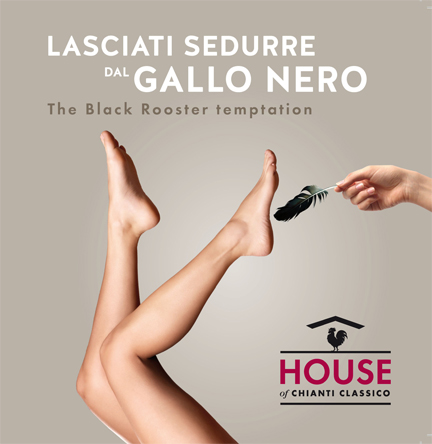 In my view, the blame lies with a bottlers consortium that creates marketing campaigns like the one above.
Translated, the Italian copy above reads: “let yourself be seduced by the black rooster.”
The recently launched campaign hinges on a new tasting room in Radda in Chianti, “The House of Chianti Classico.”
Awkward English aside, this new “Chianti Classico center” is to be host to events, tastings, and seminars. (The English- and Italian-language calendars don’t seem to align and the site loads in different ways depending on whether or not the host sees your browser as English-speaking or not. It’s all very confusing and clumsy.)
If the ludicrous nature of this campaign isn’t immediately apparent, here’s what a Tuscan wine trade veteran wrote about it on the Italian-language blog Accademia degli Alterati (translation mine).
“We have a sense of humor,” noted Raffaella Guidi Federzoni. “We’re still applying ourselves to that end and every once in a while we make a great leap forward, as in this case.”
“Let’s hope that it doesn’t happen again. Let’s hope that for a wine and appellation like Chianti Classico, future campaigns are modern, yes, but not laughable.”
The powers-that-be at the Chianti Classico consortium really need to step up their game and take their marketing seriously.
Otherwise, who can blame the editors of a well-intentioned and otherwise well-informed site for such a grave misrepresentation of one of the world’s greatest wines?
See also Alfonso’s post on the misogynist tone of the Chianti campaign, “Sex and the Cittadella.”




 Do Bianchi