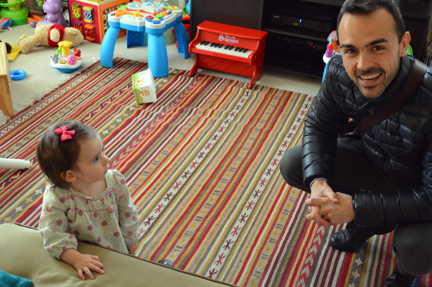
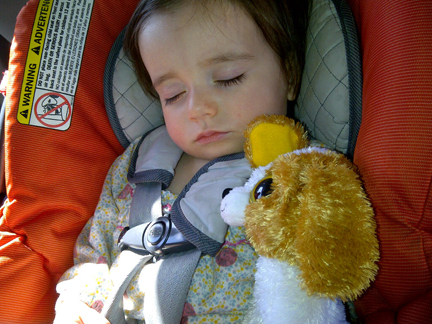
Above: One of my favorite Italian winemakers, Giampaolo Venica, visited us last week in Austin, Texas. He met Georgia P for the first time.
Familial vicissitudes quieted things down here on the blog last week. And today, I feel compelled to return to recent events in Italy that — I believe — have had and will have a profound effect on Italian wines and the people who grow and produce them.
Here’s the NY Times thread of coverage on last week’s elections in Italy, which resulted in a rebuke of the German-backed austerity measures set forth by technocrat (and now politically ruined) Monti and a political gridlock, a sort of Mexican standoff, between center-left Bersani (a relic from Italy’s communist era), center-right Berlusconi (charlatan in chief), and self-defined revolutionary Grillo (a comedian turned political activist although not a candidate himself).
If you follow current events, you know — and don’t need me to tell you — that Italy is on a precipice. And as its third-largest economy, it’s carrying the Eurozone on its back.
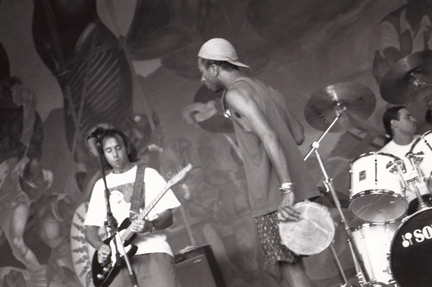
On Tuesday of last week, after the election results had been filed, I spoke to an old friend of mine in Padua, a few years older than me and a professional musician who supports his family on his concert income and production fees.
“I’m thinking about moving to Eastern Europe,” he told me when we spoke (for reasons that had nothing to do with wine), noting that emerging markets like Poland offer considerably lower taxes and greater employment opportunities.
The thought of a middle-aged jazz musician from Italy moving to Poland! It would have been hard to imagine such a thing even five years ago (let alone last week).
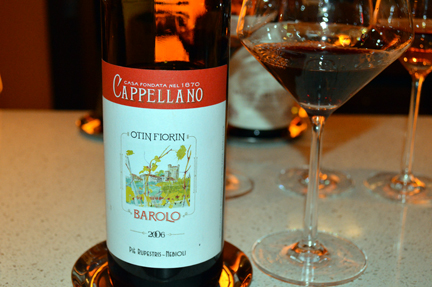
Above: Giampaolo and I shared a bottle of 2006 Cappellano Barolo Otin Fiorin from Mark Sayre’s list. The wine was remarkably bright and very fresh. Although very youthful, it was going through a moment of grace and shared its fruit and its soul with us.
Tuesday evening, when we were visited here in Austin by our good friend Giampaolo Venica (whom I respect as much for his winemaking as I do for his personal ethos), our conversation was dominated by the dire situation faced by young Italians, who have very few prospects in terms of employment or economic mobility.
“What good is a university degree,” asked Giampaolo who is in his mid-thirties, “when there are no jobs to be had?” (Italy hit record unemployment rates in January according to news reports; that figure will only climb as uncertainty and gridlock fears persist.)
Italian wine is not made in a vacuum. It’s not a shiny, straw-flasked package intended to evoke the dolce far niente, Coppola-fueled stereotype that most Americans love to embrace.
All too often, wine bloggers in the U.S. — Italophile and otherwise — focus purely on the false romance of Italian wine. Few speak Italian and an even smaller number follow the news from Italy and/or Italian wine blogs.
In my view, there is a generational tragedy unfolding in Italy, affecting Italians young and old, including those who make the wines that we — at least I — love so very much.
Wine, like all things we eat and drink, is a product of agriculture and human culture. And like the people that produce it, wine is intrinsically and unavoidably ideological and ethical in nature. It is after all, to borrow a phrase, human, all too human.
No, I have no tasting note for you today, no star anise or gooseberry.
Just an invitation to remember that there are people behind every wine that we drink. And today, I think it’s worthwhile to take time out to remember that our fellows in Italy are facing some really tough choices to come before elections are held again (probably in a year’s time).
Thanks for reading…







 Do Bianchi