

For my last 2012 meal in Italy, I was the guest of one of my best friends from my university days there, Stefano (you may remember him from my post on his Milanese “urban botanical” project which he has now aggregated on Pinterest).
Stefano is a member of Milan’s intelligentsia and is well connected in the city’s design, fashion, and publishing cliques. He had invited interior designer Gavino Falchi to join us. Gavino graciously offered to bring dinner with him for our Sunday evening repast.
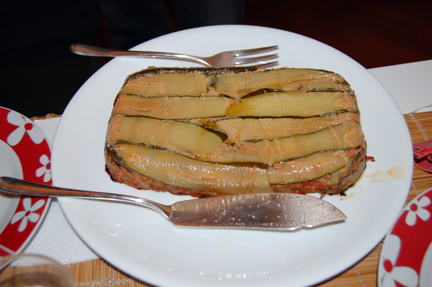
The pièce de résistance of Gavino’s menu was this sformato, accompanied by vintage Luigi Caccia Dominioni silver serving utensils (when he arrived, Gavino was wearing an overcoat from Ugo Mulas’ personal wardrobe, given to him by Ugo’s widow).
A sformato is an Italian casserole, generally made with grated Parmigiano Reggiano, beaten eggs, and various ingredients that have been cooked in a bain-marie and then turned out from the casserole pan or mold (hence the term sformato, meaning literally “turned out from a mold,” a designation which only began to appear in Italian gastronomic literature in the first decades of the twentieth-century, even though such casseroles were already popular in Italian cooking by the second half of the nineteenth century; the timpani in Cavalcanti’s 1837 Cucina teorica-pratica are a precursor to the twentieth-century sformato).
I imagine that the term sformato didn’t become popular until cooking molds were widely produced and available in Italy in the country’s era of industrialization.
Gavino had made his with the classic base, using zucchine as the “pasta” and adding finely ground pork to the batter. It was as delicious as it was beautiful.
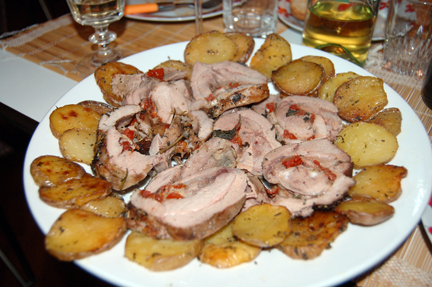
He also made this excellent rolled and stuffed wild turkey breast with roast potatoes, a dish that you often find in northern Italian homes on Sundays (Gavino is Sardinian by birth, Milanese by osmosis).
 My good friend Michele Scicolone doesn’t include any recipes for sformati in her just released recipe book, The Mediterranean Slow Cooker, although many of the entries resemble or evoke the sformato model (the book is the lastest in a series that she has published with Houghton Mifflin Harcourt; her Italian Slow Cooker does include a number of sformato recipes).
Tracie P and I just received our copy of the book (which came out last week) and we’re geeked to dive in (we’re big slow cookers here in the Parzen household).
If you’re not familiar with Michele’s work, she’s one of the top Italian cookery book authors working in the field today and she’s one of the best cooks I’ve ever met. The thing I love about her recipes is their precision: Michele grew up in an era of food publishing when recipes were tested over and over and over again. As an editor for Ladies Home Journal, she told me, every recipe had to be executed no fewer than three times before it made it into the magazine.
She also happens to be married to one of my Italian wine mentors, the inimitable Charles Scicolone, an Obi-Wan Kenobi of an Italian wine universe that has been dominated, sadly, by the “dark side” of the force in recent decades.
They’re some of my best friends in New York and I’m looking forward to seeing them when I travel there later this month.
Stay tuned!
 Do Bianchi
This is timely, as I am just delving into the world of the slow cooker myself! I’ll have to check the book out — sounds interesting.
Sounds like the perfect book to add to my collection!