What is Prosecco Col Fondo (Colfòndo) @biondivino?

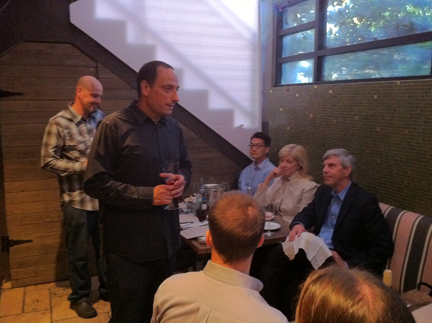
We’ll be tasting Riccardo Zanotto’s Prosecco Colfondo in San Francisco on Friday, August 17 at the amazing Ceri Smith’s Biondivino from 6-8 p.m.

The following post was originally published in March 2011 and provides some background on what exactly Prosecco Col Fondo is…

I’ll be at Sotto in Los Angeles tomorrow and Wednesday nights (August 14-15). Hope to see you in SF or LA! Thanks for reading…
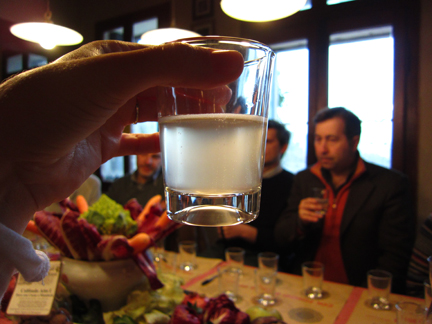
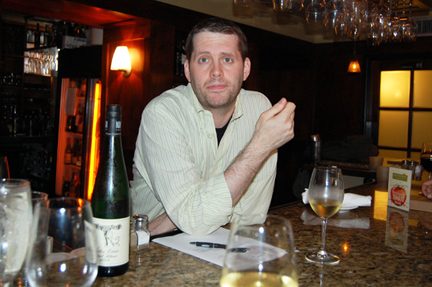
Above: Until the 1970s, before pressurized “autoclave” tanks were introduced into the appellation, most Prosecco was double-fermented in bottle “on its lees.” The resulting wine was gently sparkling, cloudy, and still had the “fondo” (sediment) in the bottom of the bottle. Even when I lived and worked in the Veneto in the 1990s, it was a lot easier to find Prosecco “col fondo” (with sediment) than it is today. The traditional glass for Prosecco is the one pictured above.

Tracie P and I got to experience so many great tastings on our recent trip to Italy but none was more thrilling than our appointment with the Colfondisti, a loosely gathered group of Prosecco producers who have returned to the fondo (i.e., the bottom, pun intended) of their tradition, producing bottle-fermented, lees-aged Prosecco — the way their grandfathers did it and the salty, crunchy, utterly delicious way that Tracie P and I like it. The event was organized by an old friend of mine and colfondo bottler, Riccardo Zanotto (who knows me from my coverband days, when I spent three summers playing 6 nights a week in a zone that some call the “Sinistra Piave,” the left bank of the Piave river).
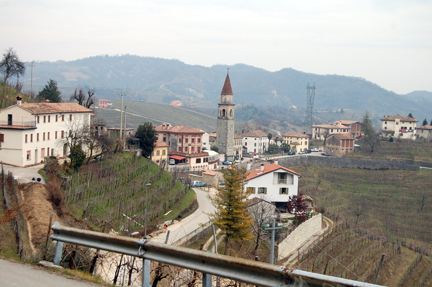
Above: The village of Rolle (not Passo Rolle, the mountain pass, btw) lies at the epicenter of the Prosecco appellation. Nearly equidistant from Conegliano and Valdobbiadene. Most locals would argue that Conegliano is where Prosecco was born as an appellation, even though Valdobbiadene has eclipsed its sister village. Our tasting was held in a home in the center of the village.

We tasted five bottlings of sparkling Prosecco, from different vintages. And then we tasted the new Prosecco (still), by one of the producers, from the 2010 vintage — in other words, wine that had yet to be double-fermented.

Bele Casel 2009 Prosecco

Luca Ferraro’s wine is made in Asolo (a more recently authorized Prosecco appellation, not far from the Conegliano-Valdobbiadene series of valleys). Among the colfondisti, some serve their wines torbido (literally, turbid or cloudy), while others serve theirs limpido (limpid or clear). Luca is a torbidista, who prefers the sediment in the wine. Very fresh nose, clean, and with some savory notes. Some yeasty notes in the mouth, dominated by good white fruit. Balanced acidity. (Luca is extremely active in social media, he speaks English well, and his wines are present in the U.S. market.)

Cantina Gatti 2009 Prosecco

Carolina Gatti’s wine was the one that reminded me the most of the Prosecco I used to drink in the late 80s and early 90s: it was super salty and crunchy. Some citrus notes and lots of savory on the rich nose. Lighter in the mouth with salty and strong citrus notes. Bright, bright acidity the way I like it! Carolina is also very active in social media and she authors a wonderful blog called Rabosando.
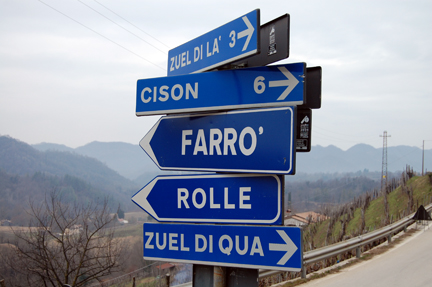
Above: “Zuel” denotes “sella” or “saddle” in local dialectal inflection and it is a topographic designation that applies to the many “saddles” or gentle hills that shape the appellation. In case you were confused, there’s a saddle “di qua” (over here) and another saddle “di là” (over there).

Costadilà 2008 Prosecco

Ernesto Cattel is perhaps the most savvy marketer of the colfondisti and his wine has good representation in some of the bigger U.S. markets. He is of the limpido persuasion (although we always mix up his wines when we drink them at home). If you follow along here, you’ve seen his wine on my blog before. His wine was perhaps the most balanced, very clean on the nose and the mouth, good acidity and good saltiness balanced by honest fruit. He’s done a lot to document the origins of Prosecco Colfòndo but unfortunately his work is not available online. According to Ernesto, it was the legendary Venetian oste (tavern-keeper) Mauro Lorenzon who popularized the term colfòndo (with sediment), giving producers their battle cry in the face of the industrial and commercial autoclave production that now dominates the appellation and brand. Ernesto will be releasing an orange-wine, skin-contact Prosecco from the 2009 vintage.
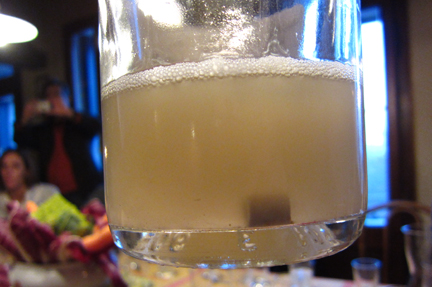
La Basseta Casa Belfi 2009 Prosecco

Maurizio Donadi is a locally based enologist who makes Prosecco Colfòndo as a labor amoris. He currently experimenting with Effective Microorganism ceramic chips (above) as a means of controlling unwanted aromas and flavors in unsulfured wines. I liked his wine a lot but it may not be for everyone (you have to be careful not to ingest the chip!). Very nice citrus and white fruit nose and mouth. Very clean and with good acidity. Very interesting to talk to Maurizio and taste his wines with him. As you can see above, he is of the torbido persuasion.

Zanotto 2009 Prosecco

I’m so glad to have reconnected with Riccardo and I love his wines. A highly successful businessman (in the furniture business), he makes this wine out of passion and he’s just one of those folks whose generosity of heart and happy spirit can’t help but rub off on you. He bottles wine that his uncle grows in family-owned vineyards and his wine — served limpido — was probably the most elegant of all the wines we tasted. Beautiful nose, very fresh and very clean, fantastic balance of white fruit and savory notes. I could drink this wine every day.

And the still 2010 Prosecco, you ask?
You’ll just have to be like Tracie P and me and go to Rolle to taste it!

Special thanks to Enrico who hosted the tasting in his home in Rolle.
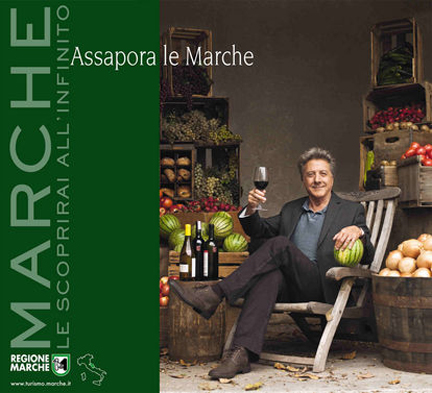
Is Rosso Conero the Dustin Hoffman of Montepulciano? @SeanForLBW got me thinking @EatingOurWords

Click here for my profile of one of my favorite people in the Houston Wine scene, Sean Beck… today for the Houston Press.

Sean’s assertion that Chablis is the Steve Buscemi of Chardonnay got me thinking: is Rosso Conero the Dustin Hoffman of Montepulciano?

Update on the Cantele heist

Above: I took this photo of Paolo Cantele when we first met in Austin, Texas, back in 2009.

Tracie P and I are still reeling from the news that the winery of our friends (and my client), the Cantele family, was robbed of 30,000 bottles of wine.

“It’s very strange,” said Paolo Cantele, when he and I spoke by phone yesterday. “I’ve never seen anything like this. There have been cases where thieves steal bulk wine: it’s easy to bottle and sell without being traceable. But I’d never heard of anyone stealing bottled wine” at a winery like Cantele.

I asked Paolo why the wine wasn’t insured, as his brother Umberto wrote in a letter published on their English-language blog (translated by me).

“Wineries that sell high-end wines regularly insure their wines in storage,” he told me. “But at wineries like ours, where the wines are relatively inexpensive, it doesn’t make sense since no one would ever steal [our] bottled wine.”

The 30,000 bottles were worth Euro 160,000, he said.

Where are they destined?

“They could be heading to the Balkans,” he speculated. Remember: on a clear day in Lecce, you can see Albania across the Adriatic.

“But the thieves could also sell them to an unscrupulous distributor here in Europe.”

Cantele’s wines earmarked for the U.S. market are stored in a warehouse in Genoa, he told me. Thus, it’s unlikely that the wines could make it to the U.S. “They were all labeled for sale in Europe and so you wouldn’t be able to bring them to the U.S. anyway.”

Will the Cantele winery be alright?

“We make 2 million bottles of wine every year. This was a huge setback for us but we won’t have any problems fulfilling orders. We’re about to bottle our red wines and they will ship in September.”

On his English-language blog, Paolo posted a message (translated by me): “I’m happy to inform you,” he wrote, “that Cantele’s soul is intact and perfectly healthy. The thieves gave us something that money can’t buy: the will to work harder and better.”

Thieves steal Cantele’s current vintage

Not only is the Cantele family a client of mine, they are also my close friends. It is with great sadness that I share the following message (which I translated for them this morning). Tracie P and I are keeping their families in our hearts, thoughts, and prayers. We’ll be visiting them early next month and will report back on this tragic story. That’s Cantele Chardonnay, from a past vintage, in the image above.

Dear Friends,

I’m writing you to let you know that on August 2, 2012, our winery was the victim of a robbery. An enormous quantity of bottled wine was stolen by a large and very well organized group of thieves (numbering at least 12-15 persons).

A detailed list of the stolen wines follows:

2,052 bottles Chardonnay Igt Salento 2011
174 bottles Verdeca Igt Puglia 2011
4,242 bottles Negroamaro Rosso Igt Salento 2010
4,746 bottles Primitivo Igt Salento 2009
2,640 bottles Salice Salentino Doc Rosso Riserva 2008
3,576 bottles Varius Syrah Igt Puglia 2010
3,972 bottles Varius Merlot Igt Puglia 2010
66 bottles Alticelli Aglianico Igt Puglia 2008
168 bottles Alticelli Fiano Igt Salento 2011
78 bottles Teresa Manara Chardonnay Igt Salento 2011
2,028 bottles Teresa Manara Negroamaro Igt Salento 2009
5,082 bottles Amativo Igt Salento 2009
12 bottles Le Passanti Fiano Passito Igt Salento 2007

Needless to say, we reported the crime the next day, August 3, 2012, to the Carabinieri stationed at Gaugnano.

In order to avoid any misinformation and/or to preclude idle gossip, I would like to confirm the following:

1) The stolen property was not covered by insurance.

2) Our storage of market-ready products was not protected by an alarm system; it was monitored solely by a video camera system.

In the wake of the theft, our initial sense of powerless disappointment was quickly overcome by our shared resolve, making us even stronger and more determined than before.

The only way to react to incidents like this is to get back to work. And in this spirit, I can confirm the following:

1) Tomorrow we will begin to harvest our 2012 crop, starting, as usual, with our Chardonnay.

2) The new 2010 vintage of Primitivo, Teresa Manara Negroamaro, and Amativo has been aging in bottle for a number of months and in the next few days, we will proceed to label the bottles so that the wines can be released onto the market by early September.

3) None of our winery’s projects has been or will be hindered by this deplorable event.

Lastly, I’m hoping that you will take note of any anomalies that might occur in the market in coming months.

It’s vital that we maintain and protect the supply chain, positioning, and correct pricing of each of our wines.

Thank you in advance for your much appreciated help in this matter.

Sincerely,

Umberto Cantele

Life before Pinot Grigio @EatingOurWords

Santa Margherita Pinot Grigio changed everything…

Click here for my post today for the Houston Press.

@EvanDawson on corkage @PalatePress @SottoLA (& note on Ah So)

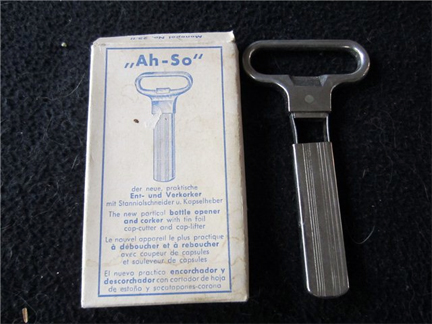
Above: We may never know the true etymon of the brand name “Ah So” but I’m working on it! See below (image via Bonanza).

My good friend and super cool dude Evan Dawson gave me and Sotto (the Los Angeles restaurant where I curate the wine list) a shout out today in his excellent post on corkage for Palate Press.

Corkage is such a delicate and often emotionally charged issue in our country. That may sound like an overstatement but it’s really true. As Evan notes in his piece, when someone brings in a bottle of Valdicava Brunello di Montalcino to Sotto, shows it to me or Rory, and asks us (with an air of condescension, of course) if we are “familiar” with this wine, it’s like a punch to the gut. Does it not occur to them that our heart and soul has gone into the selection of wines to pair best with the chefs’ food? Of course, we just smile and open their shitty, overpriced barriqued wine for them. They might as well be drinking KJ (and they often do). But it doesn’t mean that it doesn’t hurt. It just means that we’re professionals.

Check out Evan’s piece here.

In other news…

Image via kooky kitsch.

I’ve been working on a magazine piece on Italian wine basics, including a note on corkscrews. The gig led me back to an etymological conundrum that I have yet to resolve: the origin of the name “Ah So.”

In my research over the weekend, I discovered that the reason why we call pronged corkscrews Ah So in this country is that the “butler’s friend” (as it is often called) was first marketed in the U.S. by a German company, Monopol, who called it the Ah So. The Ah So was one of many names used by Monopol, who had also called it the “Ah-Ha.” Another German company in the 1930s had called it the “So So.” And the Atelier Saint-Germain had marketed another version around the same time as “A.S.”

It just so happens (sorry for the paronomasia) that the Monopol was the one that became so popular in the U.S. The earliest mention I’ve discovered is in a November 1970 issue of The New Yorker, where it is referred to as a new product in the U.S., used by European sommeliers.

My philological hunch tells me that Monopol was trying to imitate the proprietary name of another successful marketer of the device.

My dissertation advisor didn’t call me the bloodhound for nothing!

Notes on the Texas 2012 Harvest @EatingOurWords

When I consider that European winemakers, even in Puglia, are still weeks away from harvest, I find it all the more remarkable that here in Texas growers began picking their fruit as early as two weeks ago.

Click here for my notes on the 2012 Texas Harvest for the Houston Press.

Oblong Table & Bible Study w/ @LouAmdur @SottoLA Tues. Aug. 14

The “Oblong Table” series that we’ve been doing with Lou at Sotto has been so popular and so much fun that we’ve decided to do one more before fall.

Tuesday, August 14, Lou and I will be leading a guided tasting of some of our favorite Natural wines from Southern Italy (including the Fatalone, white and red, from Puglia).

At the July event, it was fascinating to hear Lou compare the current debate over Natural wine (and whether or not the category really exists) to the dietary laws in Leviticus.

It was such a brilliant analogy: the current dichotomy between the Natural wine purists, on the one hand, and their abjuration of the industrial complex, and the conventional winemakers, on the other, and their disdain for a category they believe doesn’t even exist, is nothing less than biblical in the breadth of acrimony it has generated.

In essence, the laws of kashrut divide the animal world into “clean” that you can consume and “unclean” that you cannot. During the conversation (and btw, it’s an informal setting where wine professionals and lovers chime in with observations and questions), it occurred to me that both parties in this logomachy (a fight over words more than wines) apply the terms clean and unclean. The Natural purists say the conventional winemakers’ wines are unclean because they’ve been manipulated with additives while the conventional winemakers say the Natural wines are unclean because they have unwanted bacteria and “off” aromas and flavors.

At one point, I brought up Eric the Red’s recent The New York Times article “Wines Worth a Taste, but Not the Vitriol” and the Italian authorities’ recent crackdown on the use of the term Natural in advertising.

“Is this a line in the sand?” I asked Lou. “Is this the end of the beginning or the beginning of the end?” I queried in chiasmus.

Lou’s answered simply that he didn’t care. Enjoying the aroma of the Cornelissen (arguably the most extreme expression of Natural wine today), he talked about how much he enjoyed the way was changing in the glass and how he would continue to call it Natural because it’s a term that captures the spirit of these wines (“like obscenity, I can’t tell you exactly what it is but I know it when I see it”). And he said that he agreed with our mutual friend Ceri Smith who recently proposed that the category be defined by “those winemakers who tell you what they put in the wine and those who don’t.”

The conversation at our Oblong Tables is always fascinating and you’ll always find some of the top wine professionals in LA there with us. I hope you can join us!

Here are event and reservation details.