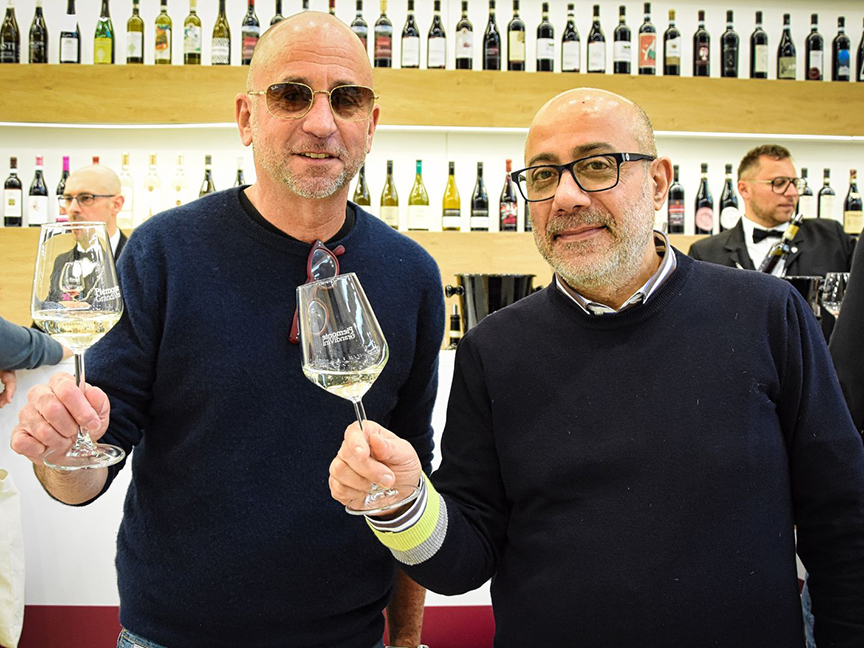
VIDEO: my tariffs interview with Sapori del Piemonte (in Italian).

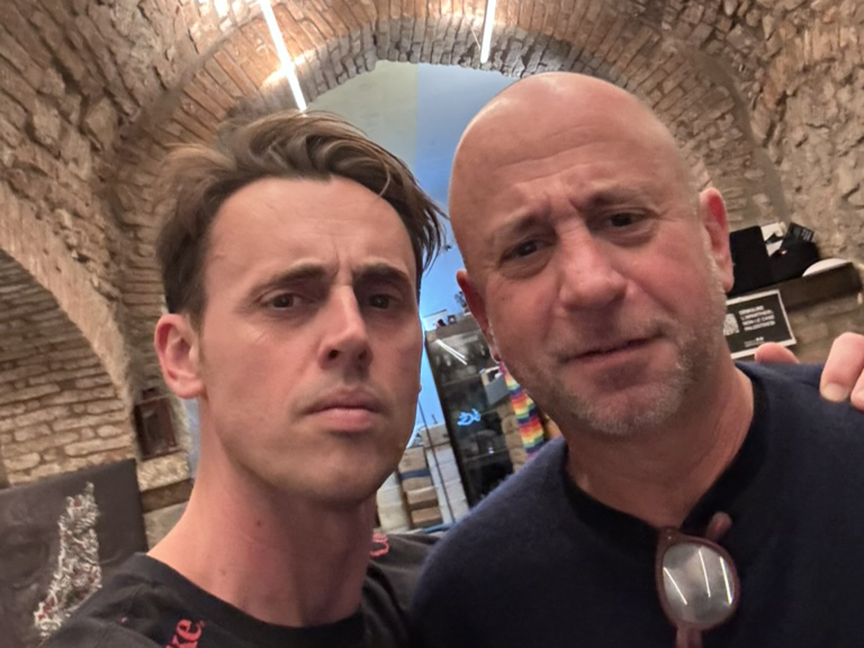
“It was an emotional interview,” wrote my longtime friend and colleague Filippo Larganà (above), editor of the widely read Sapori del Piemonte blog.

My heartfelt thanks goes out to him for letting me appear on his vlog series about Vinitaly, our industry’s biggest annual fair, which closes today in Verona.

At nearly every meeting during the fair, the first question from my Italian colleagues was “what’s going to happen with the tariffs???!!!”

I’m no expert on economics but I was happy to share my reading of the moment. Please see the video below (in Italian).

Thank you, Filippo!

I have lots to tell about my time on the ground in Italy this week. I’m on my way back stateside right now but I hope to get a solid post up tomorrow. Thanks for being here and thanks for supporting Italian wine. #ItalianWineStrong

Tariffs send shock waves through Italian wine community on both sides of the Atlantic.

Above: a rack of Italian wine in a retail shop in Tulsa, Oklahoma.

First the good news:

The new across-the-board 20 percent tariffs aimed at the E.U. are lower than once expected and nowhere near the 200 percent the U.S. had initially threatened. As one high-profile Italian wine grower said yesterday evening in an interview with a national daily, “it could have been worse.”

More good news:

The new tariffs allow exceptions for products “on the water,” in other words, on a U.S.-bound container ship. Importers of E.U. products have up until midnight the evening before the deadlines to get their products out of the block. Many importers were fearful that they would be slapped with the tax for products already en route.

Not great news:

The big story in the Italian papers this morning isn’t about wine (although last night, the initial freakout focus was wine). It’s about Parmigiano Reggiano exports to the U.S. which were already being taxed at 15 percent. Parmigiano Reggiano producers are now facing a 35 percent tariff on their wheels. I guess we better get used to grating “Parmesan” from Wisconsin.

The hard truth:

Italy exports more wine, worth roughly $2 billion, to the U.S. than any other E.U. country.

The opening paragraph of the lead story in the Times, “A Stunned World Reckons with Economic Fallout from Trump’s Tariffs,” really put it into perspective:

“Laptop computers from Taiwan, wine from Italy, frozen shrimp from India, Nike sneakers from Vietnam, and Irish butter. These products are found in homes across the United States.”

The above quote gives you a sense of how much Italian wine relies on the U.S. market for sales. By most accounts, roughly a quarter of all Italian wine production heads to our shores. Of all the major E.U. producers of wine, Italy is without question the most vulnerable and exposed in the trade war.

Vinitaly, our industry’s annual four-day trade fair, begins on Sunday. I’m heading to Italy tonight to attend. And I’ll be reporting on my conversations with Italian wine producers and U.S. wine importers. There’s going to be a lot of pain, a lot of sacrifice. But we will get through this. #ItalianWineStrong!

A great evening in Tulsa helped me forget wine trade troubles.

Giving a warm shout-out this morning to Vintage Wine Bar in Tulsa and the 30 wine professionals who came out to taste with Emma Baudry from the Union des Vins Doux de Bordeaux (part of the Charming Taste of Europe Campaign).

Tulsa and its wine community have enchanted me since I first came to Oklahoma for wine in 2020 (just two weeks before the closures began). Before Houston took that title in the 1970s, the city was the world’s oil capital. The pre-Reagan era brought wealth and people to this midwest outpost, once a major hub along Route 66.

Today, Tulsa’s restaurant scene is hopping and the wine culture is cosmopolitan. It reminds me of Austin when I first moved there in 2008 to be with Tracie. Like the Texans back then, people here know great wine and they are thirsty to expand the city’s wine cred.

Thank you to the wonderful staff at Vintage Wine Bar (man, the 2015 Turley Zinfandel Mead Ranch was outstanding!). And thank you to all the great folks in Tulsa who came out for the event. It was wonderful to see every seat taken! Thank you!

And, wow, as we tasted through sweet wines from Bordeaux, for a fleeting moment, I could forget about the looming news that tomorrow will bring for our industry.

Today, on the eve of Vinitaly, the Italian wine world’s main event in Verona, we are all holding our collective breath waiting for an update.

Importers with “wine on the water” are praying that their wines will be exempt from the taxes. For some, it could be ruinous if they are not excluded from the tariffs.

All are quietly hoping that their home or focus countries might be spared.

The entire supply chain is bracing for rough waters ahead, regardless of the final figure.

The one thing we all know for certain is that the uncertainty has been unbearable for our industry.

Tomorrow will tell. And as the saying goes, “tonight, there’s nothing left to do but dance.”

USWTA: “While we have no guarantee, we are hopeful.” Tariffs update.

Published by the U.S. Wine Trade Alliance on Saturday:

On April 2nd, President Trump will make an announcement regarding reciprocal tariffs. Previously, the thinking in Washington had been that this date would see a set of instructions or other actions initiated, as the time necessary to determine truly reciprocal tariffs (including non-tariff trade barriers) would be many months.

Now, it seems the administration may not be looking to enact truly reciprocal tariffs between products or sectors, which would take time to determine, but will instead use a single rate for each country or trading block. There has been reporting that Commerce Secretary Lutnick indicated to the EU that reciprocal tariffs somewhere between 10% and 25% could now be imposed as soon as April 2.

We have spent the last several days in Washington D.C., asking members of Congress, and staff at USTR and Commerce, to keep tariffs off wine. Likewise, we have stated clearly how catastrophic April 2 would be for American businesses if they imposed tariffs without a notice period or goods-on-the-water exception. While we have no guarantee, we are hopeful any tariffs imposed would allow for businesses to receive the goods that were already in transit without a damaging surprise tariff.

Uncertainty is a frustrating yet defining element of this process, and we understand how truly damaging this is to your businesses. We know that many of you have halted all shipments of wine from the EU, as we are still in purgatory, waiting for the forthcoming announcements from the EU and the U.S. regarding steel tariffs and any potential retaliations that could impact our industry. American businesses are suffering right now, and the administration will need to work hard to right the ship. Policies that prevent American businesses from generating the revenue they need to survive are incredibly harmful.

We will keep you updated with details as we have them. The next few weeks will be incredibly stressful for our industry, but we are all in this together.

Tariffs update with Erlinda Doherty, D.C.-based wine and spirits industry lobbyist and advocate.

After I posted my recent chat with D.C.-based wine and spirits industry lobbyist Erlinda Doherty about the ongoing tariff war, I received scores of messages asking us to do more vlog posts.

As she recounts in the video below, she has been interacting this week with congress members and sharing the pain caused by the uncertainty of the looming import/export taxes.

She also confirmed that according to the word on the street, the wine tariffs won’t be as high as expected and they will probably be based on a country-by-country basis.

She and I are also planning on covering urgent topics in future posts: new organic labeling regulations, new dietary labeling regulations, and the neo-prohibition movement.

I know she shares my desire to help people in the wine industry navigate these challenging seas. I can’t thank her enough for making time for it. Stay tuned! Stay strong!

“20% reciprocal tariffs” is the word on the street in D.C.

According to my source in D.C., the E.U. and U.S. trade negotiators agreed earlier this week that 20 percent reciprocal tariffs will be enacted in April.

That’s the word on the street, although I haven’t been able to confirm this figure. But it would seem to align with what Trump’s press secretary told reporters earlier today (following Trump’s middle-of-the-night tweet announcing automobile tariffs): the E.U. reciprocal tariffs, she said, will “be more conservative than many people are expecting.”

I have been talking to importers of Italian wine, large and small, all week. Some are working as fast as they can to get wine to the U.S. Others have cancelled all orders until there is more clarity. At least one major Italian importer is reassuring clients said that there will be no disruption while another top player announced that all orders are on hold until the tariff storm passes.

The lucky ones are those who front-loaded their inventory at the beginning of the year.

“America is a great country. I love Americans,” said Pietro Oddero (below, left), scion of the legacy Barolo grower Oddero. We met at a tasting organized by his importer in Houston, Ian McCaffery (below right), owner of the Austin-based Rootstock. Pietro shared the sign he created above.

He also reminded me that his family’s winery survived both 20th-century world wars. “We’ll get through this,” he told me cautiously but confidently.

Angelo Gaja sees a ray of light in the tariff war.

In a rare interview with a major mainstream media outlet this week, Angelo Gaja shares a ray of light that he sees in the fog of tariff war.

(The interview came to my attention via a post by the excellent Italian wine-focused journalist Filippo Larganà and his blog Sapori del Piemonte.)

He reminds his interlocutor, the high-profile editor and journalist Salvatore Merlo, that Italy was spared from tariffs in the first Trump administration while other European nations like France were targeted.

This created new “space” for Italian wines in the U.S. market, resulting in sales growth. It’s possible that the Trump trade team will exclude Italian wine on April 2 when they release their final list of tariffed products. Let’s wait and see what happens, he tells his interviewer. It might be good for Italian wine, he notes.

Gaja also expresses his optimism about the end of the war in Ukraine. There will be a lot to celebrate when hostilities cease, he points out. The Russian market will be thirsty for Italian wine, he speculates, once the country opens up again to the world.

Merlo also asks Gaja to share his thoughts on the Italian political class. In his answers, he likens pols to wines. Meloni? A “Lambrusca.”

Screenshot via Il Folio.

A D.C. lobbyist/sommelier shares her insights into tariffs and new organic and labeling requirements.

A few weeks ago, while pouring and speaking for Abruzzo wines at the Slow Wine Guide tasting in Washington D.C., I had the opportunity to taste with Erlinda Doherty, above.

She’s a D.C.-based lobbyist and sommelier whose consulting business is focused on helping wineries and importers navigate the changing landscape of FDA requirements for imported wines.

Let’s just say that I had a million and one questions for her!

In the meantime, the threat of business-crushing tariffs arrived via tweet.

So, I reached out to Erlinda to see if she’d be willing to do a video chat with me to share here. I quickly realized that there are so many questions and so much to discuss that we would need to do a series of videos to cover the issues. If all goes well, we will! In the meantime, I asked her to share her insider knowledge of how the tariffs work and we began to tackle the new FDA requirements.

I hope you find our conversation as useful as I did. Let me know if you’d like us to continue the series! And thanks for being here.

In other news, the only news about tariffs is that they have been delayed until mid-April. We are all holding our breath and praying that the U.S. and E.U. negotiators can work it out without fiscal violence.

Just this week, one of the largest importers of Italian wine in the U.S. announced that it was placing a hold on all orders. The mere menace of tariffs in a tweet has upended our work. Will this be a temporary disruption or an epochal shift in our industry? Only time will tell at this point.

Stay strong, everyone! Coraggio a tutti noi!

BREAKING: EU and US tariffs delayed.

A new message from the U.S. Wine Trade Alliance:

Important Update for USWTA Members:

EU / US DELAY IN TARIFFS ON BOURBON, WINE, ETC.
 
Dear Friends and Colleagues,
This morning, the EU announced a delay to their retaliatory tariffs on bourbon, whiskey and other products from the U.S. until April 13. We have just confirmed that the U.S. response – including retaliatory tariffs on wine and other alcohol from the EU – will now be delayed until April 14. 

This is a good first step in lowering the temperature, and hopefully giving the U.S. and EU time to come to a negotiated settlement on the underlying issue. While we certainly welcome the news, the current state of purgatory in the industry is still tremendously damaging to businesses all over the United States. 

Currently, the EU appears to be underestimating the U.S. willingness to forcefully respond to any EU attempt to retaliate against the steel and aluminum tariffs. We fully expect the U.S. to tariff the EU at double the value of any retaliation to the steel tariffs, but we are of course urging the administration to ensure those tariffs are thoughtfully determined to keep the harm away from U.S. businesses and limit the damage to the EU. As we know, tariffs on wine do significantly more harm to U.S. businesses, making them needlessly harmful to American interests and a poor lever to influence policy change.

The wine industry can be a model for the fair trade the U.S. desires, benefitting businesses on both sides of the Atlantic, and supporting hundreds of thousands of American jobs. While we hope the U.S. and the EU are able to resolve the underlying issues, in the event of a dispute, retaliatory tariffs should be limited to products that primarily benefit EU companies. Tariffs on wine are bad for America. 

I know this has been a stressful week, for all of us. We hope to have more news soon, and continue to work each day to tell the story of our amazing industry to the policy makers in Washington. Thank you for your help and support.

Sincerely,

Ben Aneff

Taste Sweet Bordeaux with me in Tulsa, Monday, 3/31. Open to trade and media. Thanks for your support!

I’ve always said that Italian wine is my signora and French wine is my mistress. I’m a huge Francophile and even played in a French band!

So it was all the more thrilling to me that the Union des Vins Doux de Bordeaux asked me to give them a hand this year organizing trade and media tastings across the U.S. We have some fun cities lined up, including dates for Austin and Houston in April.

But our launch city this year is Tulsa, a town that I’ve been enchanted by on recent visits.

Please help me spread the word and I’ll look forward to a great tasting at one of my favorite wine bars in the country week after next! I hope you can join me. Thanks for the support.

Sweet Bordeaux
wine tasting and seminar

with Bordeaux expert
Emma Baudry
Sweet Wines of Bordeaux Association

Monday, March 31
5-7pm
Vintage Wine Bar
324 E. 1st St.
Tulsa OK 74120

Open to trade and media.

RSVP to Jeremy Parzen at jparzen at gmail.com.

Please join us for a tasting of 15+ sweet wines from Bordeaux, including sparkling wines, with Bordeaux expert Emma Baudry from the Sweet Wines of Bordeaux Association.

The event includes a walk-around tasting from 5-7pm and a guided tasting and seminar, with pairings, from 5:45-6:30pm.

This event is sponsored by the Union des Vines Doux de Bordeaux and the Charming Taste of Europe campaign to promote EU food and wine in North America.

Wine writer and educator Jeremy Parzen, the organizer, will also be pouring and speaking at tasting.

Image via the McGill Library Flickr (Creative Commons).