The Italian baked potato has arrived. And other memorable dishes from my first kiss Italy 2024.

A seven-day trip to Italy began last week with spaghetti alla chitarra in Ortona, Abruzzo. The seafood there is ridiculously good.

Case in point: cuttlefish crudo. So simple, so perfect.
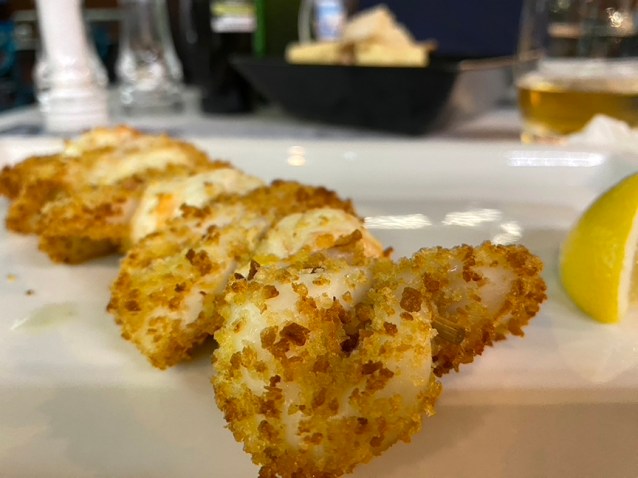
The first night I was in Pescara, I saw all these Carabinieri (Italian paramilitary police) filing into this forgettable seafood takeaway shop. The joint had a few tables where I enjoyed lightly breaded and delicately grilled cuttlefish and shrimp. The cuttlefish were wonderfully tender, the shrimp so sweet they tasted like candy.

Oven-fired sea bass with roast potatoes. May I have another glass of Cerasuolo di Abruzzo, please? So good. Continue reading
Italians, we need your partnership more than ever. Time to STEP it up. BIG TIME.

Now is the season when I make the round of my clients in Italy and we sit down and look at our market and media strategies for the year ahead.

And this time around, I have an urgent message for all my clients: Americans need your partnership more than ever and now is the time to step it up. BIG TIME!

The news from across the Italian wine spectrum is bad.

Western governments are publishing more and more warnings and guidelines about the dangers of alcohol consumption; the new generation of would-be wine drinkers is focused on cocktails and is avoiding alcohol in general; the American restaurateurs and retailers who made it through the pandemic and ensuing financial crisis are barely hanging on.

Anecdotally, distributors reps have been telling me that 2023 was their toughest year ever since the historic financial crisis of the aughts.

As boring it is to read a bunch of blowhards complaining about the good old days, I highly recommend that everyone in our industry read this interview published Tuesday by WineBusiness.com, “Wholesalers Discuss Biggest Changes in the Industry.” Weak title but worth the read.

Italians, we are facing a now-or-never moment in our industry when those who have the right attitude will thrive; those who don’t will flounder.

The Italian wineries who are going to make it through to the other side of American wine sales are going to be those who: 1) invest wisely in marketing; and 2) spend time working, physically present, in the market.

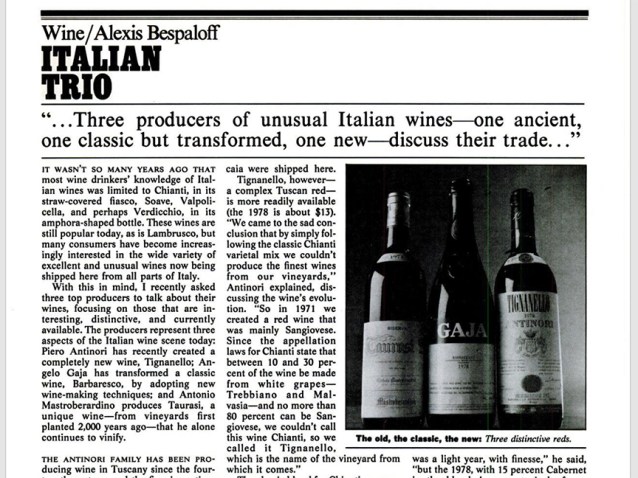
Please keep in mind that the challenges are not insurmountable. Think of Angelo Gaia, Piero Antinori, and Piero Mastroberardino who came to the U.S. in the early 1980s when Italian wine was considered a benchwarmer. Those dudes rolled up their sleeves, heard “no” for an answer more than once, and they turned the world on to the magic of great Italian fine wine. Think of their legacy today. Think of Michele Chiarlo sending his importer a container of Moscato d’Asti on spec!

Let those visionaries and risk takers be our Virgil! In the case of each, they physically came and they invested heavily — with time and money.

That’s what we’re going to need moving forward.

Thank you to Hue Society for a great event! Italian wine crisis comes into starker focus. Heading to Abruzzo today despite German transportation strike.

membership atlanta houstonSuper shout out today to @thehuesociety for hosting me on one of their virtual tastings last night. That was a blast.
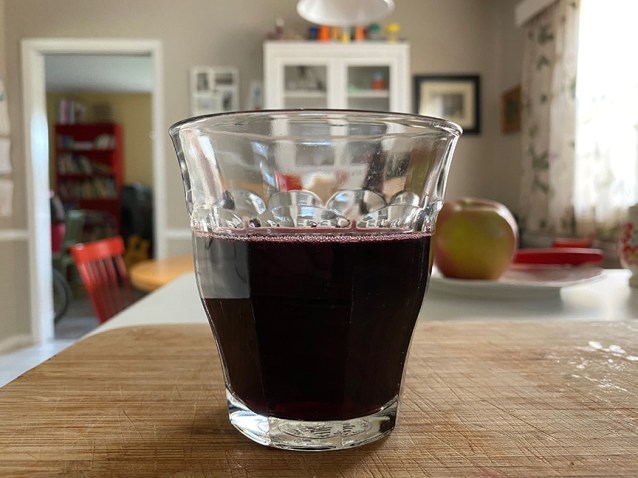
And heartfelt thanks to @marcofantinel for hooking up super wines. The Pinot Grigio RocciaPonca was a standout for me. And perfect for showing the range of #Friuli wines.

My week got turned upside down when German transportation workers negotiations sent everyone scrambling to find alternate routes for destinations in Europe.

Lufthansa strike aside, I’m on a flight eastbound still hoping to make my first appointment in Abruzzo early on Thursday morning.

Travel to and from that part of Italy can have its challenges. It just takes a little bit of time to get there. Maybe that’s part of what makes it so cool. I’m really looking forward to getting back.

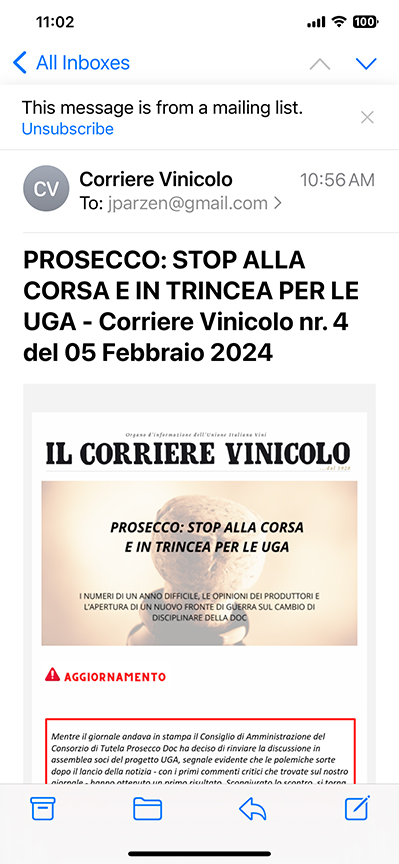
In other and more important news… I felt compelled to share this screenshot today from the Corriere Vinicolo, one of the institutional voices of the Italian wine industry.

“The Prosecco rush comes to a stop,” reads the headline. Allusion is to the “Corsa all’Oro,” the “Gold Rush” in Italian.

“For cru-designated wines,” it continues, “it will be a trench war,” with the implication that only the strongest will survive the mano-a-mano fight for market share.

When Prosecco is in trouble, people of the Italian wine trade, we all need to take time out and have some serious conversations.

I’ll be traveling across central and northern Italy for the next seven days and I’ll be talking to a wide variety of people, trade and lay. I’m looking forward to sharing our chats and their notes here. I’m optimistic for a clear path forward in Italian wine. But I’m also realistic in recognizing the immense obstacles that lay ahead.

Thanks for being here and please wish me speed!

volume italian wine

Taste Friuli and talk Italian wine with Hue Society and me online Monday evening February 5.

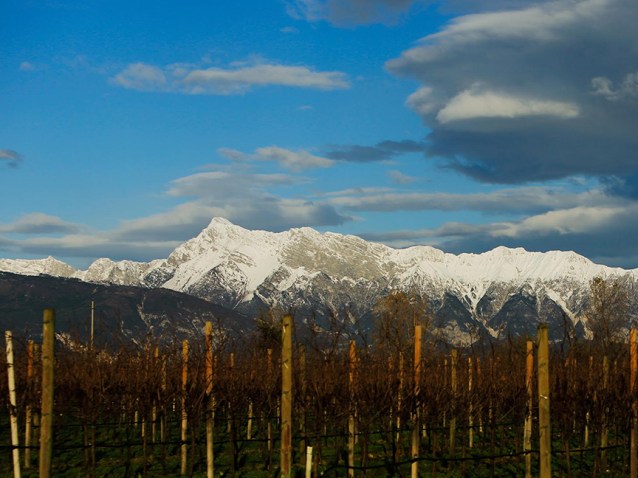
The picture above says it all, doesn’t it?
Diluvial and limestone soils at the foot of the Carnic Alps in Italy’s far northeast. Mountains protecting the growing area from the cold winds from the north but marittime influence from the Adriatic arrives from coast (in the form of clouds in the image).

There’s so much to decipher in this photo sent to the Hue Society by my longtime friend, Friulian grower Marco Fantinel.

On Monday, February 5, at 8 p.m. EST, members of the Hue Society and I will be joining a Zoom where we’ll discuss Friuli and other appellations that should be on wine professionals’ radars these days.

Only Hue Society members will receive the wines, but anyone is welcome to join.

This is a group of seasoned pros. So I’m not going to do Italian wine 101 or anything like that. Throughout conversation, we’ll keep the focus on what’s new and exciting in Italian viticulture.

My partnership with Hue Society is part of the group’s campaign to build up their chapter in Houston. And founder and president Tahiirah Habibi and her crew will be joining Tracie and me for a party we’re hosting for them at our house in mid-March (stay tuned for details). We’re also planning a happy hour that week.

In the meantime, please join us on Monday for our Zoom call. If you don’t have wines from Marco, open some Friuli… or open whatever you have handy… and let’s talk Italian wine!

Here’s the link. Call starts at 8 p.m. EST on Monday. Hope to see you then! Buon weekend a tutti!

Could Lambrusco save Italian wine from its looming demise?

Across the world of Italian wine and beyond, industry observers are decrying the looming demise of our trade.

Young people are drinking less and less wine, they note. People are consuming fewer alcoholic beverages in general as they focus on health and wellness. Climate change is reshaping and perhaps demystifying our notion of terroir. Italy alone has an abundance of unsellable surplus wine destined to be distilled — despite diminished production levels owed to global warming.

I spent last week in New York with my longtime friend and client Alicia Lini, producer of Lini 910 Lambrusco. We were there to meet with media. At each of our appointments, our interlocutors spoke of our mission and duty — as producers of wine and chroniclers of wine — to share the values and joy of our work with the public.

It was at one of our highest profile meetings that a young colleague, an assistant to one of the most well known wine writers in the U.S., suggested that Lambrusco could be the category to save Italian wine.

They had just returned from a trip to Emilia and had been thrilled to taste Lambrusco in its natural habitat.

Lambrusco is a great wine for young people who are just getting into wine, they said. It’s easy to understand; it’s fun and unusual for people not accustomed to red sparkling wines, a conversation piece; it’s food-friendly and low in alcohol; and — most significantly — it’s not prohibitively expensive.

All of my friends love Lambrusco, they told us.

It reminded me of what another Lambrusco producer once told me, using a ¢75 but on-point word: Lambrusco is propaedeutic, they said. As per the young professional’s notes above, it could the perfect wine “to get people into wine.”

Some believe that Lambrusco is the world’s oldest grape variety to be continuously vinified since antiquity. And some of a certain age will remember a time when Emilians served nothing but Lambrusco with the culinary treasures of their region.

Maybe our quest to “save” Italian wine would be well served by getting back to the basics.

Texas BBQ & Italian Wine, February 26, Houston.

Please join me and Houston sports and wine writing legend Dale Robertson as we present the annual Texas BBQ & Italian Wine seminar at the Italy-America Chamber of Commerce Taste of Italy trade fair, Monday, February 26.

Click here to reserve your spot.

Click here to see the complete list of events, including the Prosecco seminar I’ll be leading (filling up fast btw) and the grand tasting.

The smoked meat component of our tasting will be led by the inimitable pitmaster Ara Malekian (above), owner of Harlem Rd. Texas BBQ just outside of Houston proper.

It’s hard to imagine now but when I first moved to Texas there wasn’t a lot of hipster bbq available in the urban centers. Yes, there were a few legacy places that still served lackluster smoked meats. But you had too drive out to the country to find the really great stuff (does anyone remember the mania created by Snow’s back in the late 2000s?).

Today, that’s all changed and there more smokers in Austin and Houston than I can count.

And as cliché and passé as it may sound to pair Texas BBQ with Italian wine (been there, done that?), it just works really well and the foodies seem to come back gladly. It’s a special event and I love doing it.

This seminar sells out every year so please reserve asap to ensure availability. We have some great wines lined up, including some Aglianico, Sangiovese, and a couple of surprises.

Thanks for the support and I hope to see you there!

In other news…

I’m just wrapping up a crazy week of media meetings in NYC. It’s been great to be back in the city, my first visit this year. The energy is coming back. It’s not quite all there but it’s getting there. I’m looking forward to visting later this year (in March I’ll be doing an Abruzzo seminar there at the Slow Wine tasting).

No big discoveries on this round (too many meetings and client visits) but I did find an amazing dive bar in the subway! That end-of-the-night beer made it really feel like home again.

Italian wine dictionary updated with Piedmontese translations.

My colleague Maurizio Gily and I are pleased to present the most recent update to our Italian-English wine glossary.

The exciting news about this update is that Maurizio has begun to populate Piedmontese dialect translations of terms.

The reason behind this latest revision was prompted by necessity. As he wrote me recently in an email, migrant workers are often flummoxed by dialectal terms for grape farming practices. He was inspired to add the “Piedmontese” column as a guide for the perplexed.

As with all works of lexicography, this small trésor is a work in progress and is surely in need of improvement. Maurizio and I are always happy to crowdsource more finely tuned entries. Please share your notes with me. And we are also eager to entertain new entries. Please suggest them.
Continue reading

Allora, an extraordinary meal in Sacramento. Highly recommended list and menu.

It seems like just yesterday that the Times was singing the praises of the Sacramento restaurant scene.

But in the editors’ roundup of top destinations, they omitted two Sacramento standbys: Waterboy, the all-time classic and leader, where the capital’s food cognoscenti have dined for decades; and Allora, a relatively new fine-dining concept where the husband-and-wife team have set a new bar for Italian cookery in the city.

During my trip there last week, I ate at both and both were nothing short of spectacular.

Waterboy doesn’t need any help from me in getting the word out. It’s been on gastronomes’ radar for a generation, one of the early interpreters of the California farm-to-fork movement.

Over at my new favorite Californian Italian, Allora, the brilliant co-owner Elizabeth-Rose Mandalou has put together a compact and precise progressive list, like the Colombo Pelaverga above. (It’s important to note that not all of the small- and mid-sized hipster distributors deliver to Sacramento. So, Elizabeth’s work is even more impressive given the challenges of limited deliveries and added costs.)

She also has what may be the deepest selection of Franciacorta in the U.S. Who can say no to a glass of Franciacorta and caviar and freshly shucked oyster service?

I loved how the cheese course masqueraded as dessert.

Everything about this place was warm, welcoming, entertaining, surprising and familiar at the same time. And the service, including the cork presented on a tray (yes!), was impeccable.

Thank you again, Elizabeth and team! I cannot wait to get back.

And for the record, here’s the chicken pot pie I had for lunch at Waterboy, below. Enough said!

Taste with me in at Taste of Italy in Houston and more events in Miami, New York, Austin, Denver, and more…

From the department of “festina lente”….

The 2024 vintage is shaping up to be a good one over here at Do Bianchi Editorial… poo poo poo!

Here are some upcoming events where we can taste together and trade notes.

February 5: online “What’s Happening with Italian Wines” tasting with Hue Society (wines available exclusively to Hue Society members but Zoom call open to all; stay tuned for link).

February 26: Taste of Italy Houston, the city’s 10th annual Italian food and wine trade fair. I’ll be leading a number of tastings including the “Texas BBQ and Italian Wine” seminar (sells out every year; reserve now to secure your spot).

February 29: I’ll be pouring Amistà at the James Suckling tasting in Miami.

March 13-14: Tracie and I will be hosting a reception for Tahiirah Habibi at our house in Houston (March 13) and then a Hue Society Happy Hour, also in Houston where she is recruiting new members for Hue Society (March 14, venue TBD). Stay tuned for details.

March 18 (week): I’ll be leading Abruzzo seminars at three stops along the Slow Wine Tour in New York, Austin, and Denver. If you attend in Austin, hit me up for info about our annual Slow Wine honky tonk crawl (no joke, just ask Giancarlo!).

April 14-17: I’ll be doing a ton of stuff at Vinitaly this year and will be attending all four days. Hit me up if you want to taste with Amistà or Abruzzo or if you just want to connect. Hopefully I’ll be doing a Hue Society event as well.

Looking forward to connecting with you in 2024! Thanks for the support!

“Victims of terroir.” The year’s most interesting prediction for Italian wine.

The 2023 vintage will be remembered as a turning point for the mainstreaming of hybrid grape varieties in Italian viticulture.

It will also be evoked when tradesfolk recall the downturn in sales and volumes as prolonged inflation, saturated markets, rising competition, and declining interest in fine wine impacted the Italian wine industry.

But this year’s most interest prediction for Italian wine was published on Christmas Day 2023 by the excellent wine-focused news and media portal WineNews.it.

The post is an interview with and paraphrasis of the great Italian ampelographer and viticultural philosopher Attilio Scienza.

In the piece, Professor Scienza illustrates how the rising alcohol levels and sustainability crises caused by increasing climate change have made us “victims of terroir.” Or to put it more precisely and slavishly, quoting the professor (translation mine): “we are still victims of the ambiguity of terroir.”

He rightly points out that until the contemporary era, wine was not considered a luxury product but rather a human necessity — like food or potable water. For that reason, wine appellations sprung up primarily around transport corridors and hubs and were closely aligned with other products of consumption. Where trade routes existed for other and undoubtedly more important products, wine growers planted their roots where they knew the customers were.

Today, that model is entirely inverted.

Fine wine is grown in places where people wanted to grow it, not where it would grow with the greatest results.

Yes, there are counter examples, places like Burgundy where wine has been grown for centuries. But why did people plant grapes there in the first place? Because there was limestone in the slopes? Or because Dijon and Avignon were nearby?

If you trace the Montalcino DOCG back to its origins, you will find that Biondi Santi set up their cooperative because a new train station had been built nearby (Sant’Angelo Scalo).

In Napa, people planted Cabernet Sauvignon on the valley floor where apples should have been planted, not because it was the best place for the grape variety but because the people who lived there wanted to drink it.

Climate change, says Scienza, should prompt us to rethink where, what, and how winemakers grow grapes. And maybe that’s how we unchain ourselves from the historically false notion of terroir and make better wines and bolster more sustainability.