No tariff relief in sight for EU wine growers. Hard times expected ahead.

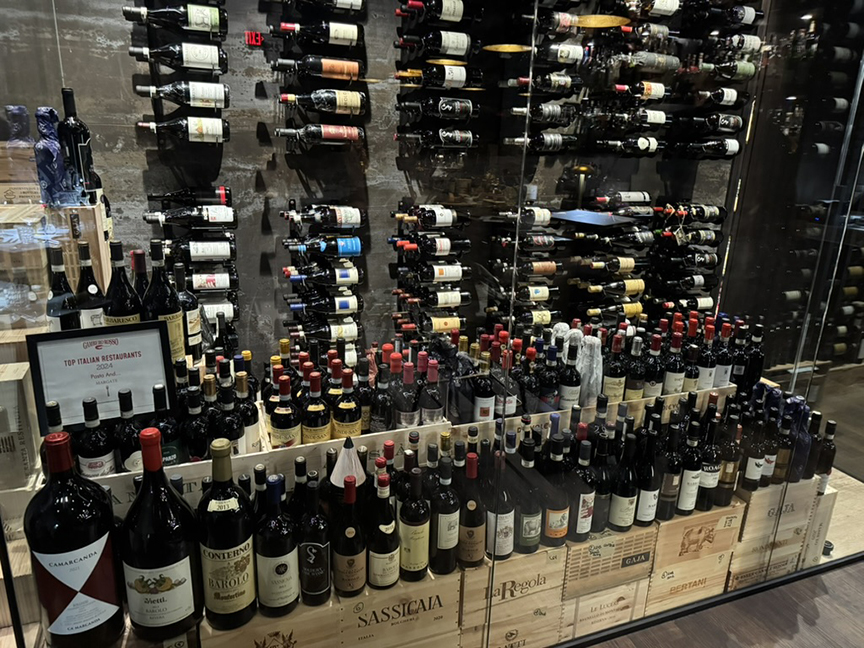
Above: a cellar-full of high-end Italian wine at a leading Italian restaurant in Florida. All Italian wines are now being taxed with a 15 percent tariff. There are no indicators that the Trump administration will lift those levies in the near or even distant future.

UPDATE: Times reporting confirms that wine and spirits will not be exempt from tariffs as final details of negotiations emerge. See article here.

In case you missed it, the Times reported this week that current tariff negotiations between the E.U. and U.S. will not make an exemption for wines and spirits shipped from Europe: “alcohol is still not part of the agreed-upon deal, and it increasingly appears that European negotiators are giving up on getting an exemption into this round of negotiations.”

The news has been greeted with gloom: “European producers have warned that the consequences of leaving alcohol tariffs at 15 percent could be grave. The Federation of French Wine and Spirits Exporters had previously said a failure to secure an exemption would create an ‘extremely violent shock.'”

Click here to read the Times reporting.

It’s certainly too early to determine whether or not the tariffs will prompt Americans to buy more U.S.-grown wine.

Gauging from everything I read and the conversations I’ve had with wine growers in California, the U.S. wine industry is definitely in need of help. Wine sales are declining overall, labor costs for the fall harvest are expected to rise (because of lack of workers due to immigration raids), and tariffs are inflating the prices of materials (corks and bottles, for example) and tools domestic winemakers buy from Europe (quite a bit from Italy where things like top-of-the-line bottling machines are produced among other instruments).

I’m heading to Dallas tonight to lead a few talks at TexSom and I’ll be back again next week to pour at a few walk-arounds. I’m really looking forward to connecting with wine professionals from across the country and the world. I’ll report back on what I learn.

Thanks for the support and solidarity. Drink some Italian wine tonight, folks! Help support the growers who have been sending such great wines since the Italian wine renaissance took shape in this country two decades ago.

How do Americans perceive Italian wines today?

One of my best friends in the Italian wine business — a Tuscanophile Paduan a few years older than me, a veteran of the industry and one of the wisest wine professionals I know — sent me the following query: “when it comes to the average American customer, which Italian wines are the most popular?”

His inquiry led to copious notes about my own thoughts on how Americans perceive Italian wines today. Of course, my reflections are based mostly on my experiences on the ground and anecdotal reporting from what I read online and hear from the street. I plan to share our dialog at some point here.

But I thought I would preface that by taking my Italian readers on a tour of the wine shop at my local HEB supermarket, where I shop on a nearly daily basis.

I believe that the Italian wine industry needs to be recast. And I strongly feel industry actors need to rethink their approach not by reading Eric Asimov (no offense, Eric!) and blogger/influencers (much to say about that down the road). Instead, they need to look at the way the majority of Americans shop for wine.

My go-to HEB has a high-end wine department, including high-priced wines from France, California, and Oregon. I buy a lot of wine there (mostly Jadot and California whites). Although I also buy a lot of wine from Houston Wine Merchant (my favorite shop), HEB is the kind of place where a lot of my (non-wine industry) peers will shop for wine.

Let’s start with the image above: France has its own wall while Italy and South America share a wall. That says a lot.

If they aren’t aware already, Italians should now that Americans still cognitively classify their wines as grape varieties. My European counterparts might be surprised to learn that Pinot Grigio (here listed as “Pinot Grigio/Pinot Gris”) has its own section.

Note the magnums of Italian Pinot Grigio above. But “Pinot Grigio” in America isn’t limited (in terms consumer awareness) to Italy. Feast your eyes on the Sutter Home Magnum of Californian Pinot Grigio (labeled as such) for less than $10.

I have much more to report and opine. But I hope this point will serve as a starting point for useful dialog. Please stay tuned.

Check out my Instagram today for more photos from my visit to my HEB yesterday.

You can take the boy out of the wine but you can’t take the wine out of the boy: upcoming tastings and events.

The Roman writer Horace reminds us that you can chase nature away with a pitchfork, but it will always return (naturam expellas furca, tamen usque recurretet).

He wasn’t referring to Nature with a capital “n” but rather the “nature of things.” In other words, a leopard can’t change their spots.

As Tracie’s career has been evolving and expanding (poo, poo, poo!) and the girls need more support with their music and studies, I’ve taken a step back from the insane amount of traveling I’ve been doing over the last four years.

But the world of wine still calls. Here are some great tastings and dinners I’m leading or working on in coming weeks.

On Friday, I’ll be giving two talks about Abruzzo at TexSom in Dallas. On Monday and Tuesday, I’ll be pouring Abruzzo at walk-around tastings at the conference. I’m really looking forward to reconnecting with some many colleagues and friends I know I’ll see. Please stop by and taste with me!

Then, in a just a few weeks, on September 3 and 4, I’ll be leading two public-facing Abruzzo wine dinners at Milton’s in Houston with my good friend and super sommelier Mark Sayre (I need to share the wonderful story of how he and I met in an upcoming post; he became one of my first friends in Austin when I moved to Texas to be with Tracie). These sell out quickly, Mark told me, and I will share the registration info as soon as I get it.

In October, dates to be determined, I will be leading an Abruzzo tour through Texas, with stops most likely in Houston, Austin, and possibly Dallas. These will be trade-focused events. I’m hoping I can convince them to do Tulsa as well (but we’ll see). Our event earlier this year in NOLA was so amazing. I know these dates will be great, too.

And then, dulcis in fundo (brush up your Latin, people!), I’ll be heading to Boulder in late October for Boulder Burgundy Festival where I’ve been a festival media consultant for 15 years (!!!).

See? You can take the wine out of the boy, but you can’t take the boy out of the wine. Hope to see you at one or all of these events. Thanks for the support and solidarity! The wine world needs you now more than ever.

When Barolo met Sex and the City.

It was probably inevitable that our family would be drawn into the hype about the “And Just Like That…” revival finale last week.

Some of the themes are arguably too mature for our girls, 12 and 13. But how could we refuse to let them watch it when they knew their mother had been following the once one-off mini-series and was excited for the last episode?

I missed all the shows except the last when our family gathered for dinner to watch.

As Tracie filled me in on all that had happened in my three-year absence, I couldn’t help but fixate on an episode of the original series, which aired when I was living and working in New York.

My first real job in the city was as an editor and writer in print media. My office was in the “toy building,” literally across the street from Madison Square Park where my co-workers and I would see them filming.

During those years, I was tasked with interviewing one of the earliest celebrity mixologists, Dale DeGroff, who was erroneously credited with inventing the Cosmopolitan — a cocktail recipe, he claimed, he poached from an Absolut vodka campaign. For anyone living (and dating) in the city at that time, Cosmopolitans, as seen in “Sex and the City,” were the cocktail of choice.

I had so many indirect connections to the show, including the fact that a boss at another job had a brother who worked on the show and the cast would party at the restaurant where I often worked the floor.

But the thing I remember more than anything else about the show was the 2004 episode (season six) where Mikhail Baryshnikov served Carrie a Barolo and would subsequently prepare a risotto while complaining that she didn’t have a proper “risotto” pan (whatever that is!).

Back then Barolo was hardly a household word. Burgundy, Bordeaux, and Napa (and maybe Brunello) were the go-to wines for entitled New Yorkers. It was the first time I heard the then esoteric (to most Americans) appellation mentioned on TV.

To me it was an unforgettable zeitgeist moment that made me think to myself, maybe Italian wine is going to become big in the U.S.

Some 20 years later, it’s incredible to think back on how Americans’ perceptions of Italian wine changed during those years. Thank you, Carrie!

Italian wineries, partners scramble to avoid new tariff rate.

Late on Thursday last week, the wire came in: the new tariff rate for all goods from the EU rose to 15 percent, a five-point increase from the 10 percent that had been imposed since April (before the current administration, the rate was 2.5).

For those inclined to read the fine print (read the entire White House statement here), there was also a vital piece of info: for European wines to avoid the new tax rate, they would need to be “on the water” by end of day on Wednesday, August 6.

As a result, Italian wineries and the partners are scrambling to get their wines to Livorno (where most wine is shipped from Italy) no later than 12:01 a.m. on August 7 (EDT).

The wine must arrive in the U.S. on or before October 5. In the case of a mishap or delay (caused by, say, rejected paper work), importers will be on the hook for the new tax. It’s risky.

And the danger is compounded by the fact that the dollar is growing weaker against the Euro.

I’m seeing numerous reports of importers asking their suppliers to lower costs to assuage the tariff pain. Today, they are counting on even more support from bottlers. On both sides of the Atlantic, actors are hanging in there. But there is a growing sense that the situation is not sustainable, especially now that the 15 percent tax will likely stay in place for a while as the dollar continues to decline.

In recent weeks, I’ve been asked by clients to join marketing/sales calls with Asia and northern European countries. Italians are increasingly looking to markets beyond the U.S. to rebalance their businesses.

Remember when Trump 1.0 essentially decimated the Burgundy market in the U.S. as growers pivoted to Asia? As supply dwindled, prices skyrocketed. In many cases (excuse the pun), only the ultrarich can afford the wines today. As Italians look beyond Trump’s America (which they increasingly disdain), similar patterns might emerge for italo-centric oenophiles.

There is so much uncertainty facing European winemakers and their U.S. partners today. The only thing they know for sure is that the European wine industry will be radically and indelibly reshaped by current U.S. policy and its wishy-washy execution.